
A 4-1/2 inch angle grinder will handle most jobs around a fab shop. You can cut rebar, bevel plate edges, clean up welds, and strip rust without breaking a sweat.
But try to surface grind a 20-foot I-beam with one, and you’ll be there all day. That’s where large angle grinders come in.
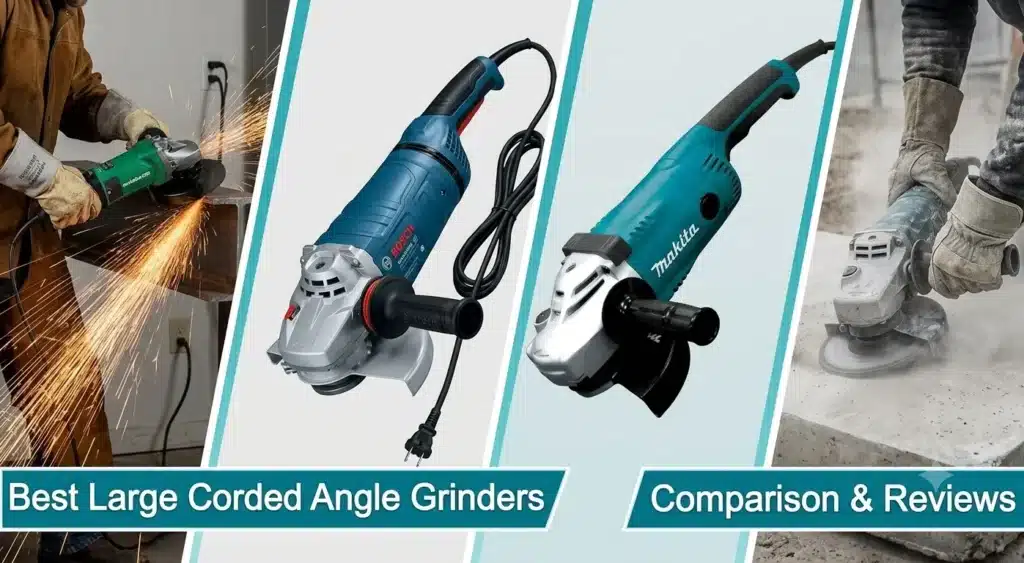
The step up to a 7-inch or 9-inch grinder isn’t just about a bigger disc. It’s about horsepower, torque, and the kind of sustained material removal that small grinders physically cannot deliver no matter how long you lean on them. A 15-amp 9-inch grinder running a hard wheel will remove steel at a rate that makes a 4-1/2 inch grinder look like a toy. If you’re doing structural fabrication, pipeline work, shipbuilding, or heavy equipment repair, you already know this. You’ve probably burned out a small grinder or two trying to make it do a large grinder’s job.
So, let’s get started.
Best Corded Large Angle Grinders — Comparison Table
| Image | Name | Disc Size | Power | Speed (RPM) | Variable Speed | Switch Type | Check Price |
|---|---|---|---|---|---|---|---|

| Hilti 2075615 AG 700-14D 7" Angle Grinder | 7" | 14A / 1,400W | 3,450 RPM | No | Slide | Check Price |

| Bosch GWS25-180JR 7" Large Angle Grinder | 7" | 15A | 8,500 RPM | No (Soft Start) | Lock-On Trigger | Check Price |

| Bosch GWS25-230JR 9" Large Angle Grinder | 9" | 15A | 6,500 RPM | No (Soft Start) | Lock-On Trigger | Check Price |

| Metabo HPT W 24-230 MVT 9" Angle Grinder | 9" | 15A / 2,400W | 6,600 RPM | Yes (MVT) | Lock-On Slide | Check Price |

| DEWALT D28499X 7"/9" Angle Grinder | 7" / 9" | 15A / 5.3 HP | 6,000 RPM | No | Trigger w/ Lock | Check Price |

| Makita GA7021 7" Angle Grinder | 7" | 15A | 6,600 RPM | No | AC/DC Slide Lock-On | Check Price |
Best Corded Large Angle Grinders — Reviews & Features
1. Hilti 2075615 AG 700-14D 7″ Angle Grinder – Best Professional-Grade Large Grinder
Best Professional-Grade Large Grinder
Hilti 2075615 AG 700-14D
The Hilti AG 700-14D is the kind of tool that makes you understand why professional contractors pay Hilti prices. This 7-inch angle grinder runs on a 14-amp motor that delivers 1,400 watts of continuous power — not peak, not burst, but actual sustained output you can count on when you’re three floors up on a jobsite with a deadline breathing down your neck.
| Disc Size: | 7″ | Power: | 14A / 1,400W |
| Speed: | 3,450 RPM | Variable Speed: | No |
| Switch Type: | Slide Switch | Weight: | 12.1 lbs |
| Input Voltage: | 120V AC | Country of Origin: | Germany |
| Warranty: | 2-Year Limited | Spindle Thread: | 5/8″-11 UNC |
Where this grinder separates itself from the Bosch and DEWALT competition is in vibration control. The AG 700-14D uses Hilti’s Active Vibration Reduction (AVR) system, which decouples the handle from the motor housing. After two hours of grinding overhead on a structural beam, your hands will actually still feel like hands — not numb stumps. For anyone doing industrial grinding, that alone justifies the premium.
The 3,450 RPM speed is deliberately lower than the 6,000-8,500 RPM you see on other large grinders, and there’s a reason for that. Lower RPM with higher torque means you can lean into the workpiece without bogging the motor. The 14-amp rating isn’t just a number on paper — this grinder maintains consistent speed under load in a way that cheaper 15-amp grinders simply don’t.
Build quality is where Hilti pulls ahead of everyone else. The sealed bearing system keeps concrete dust and metal shavings out of the motor — the number one killer of angle grinders on construction sites. The spindle lock mechanism is machined from solid steel, not stamped sheet metal like you’ll find on most competitors. At 12.1 pounds, it’s balanced well enough that the weight feels like stability rather than fatigue.
Let’s be honest about the downsides. At 3,450 RPM, this isn’t your grinder for thin cutting discs that need high surface speed. You’re trading speed for torque, and for heavy grinding wheels, cup wheels, and wire brushes, that’s a worthwhile trade. But if most of your work is cutting rebar and angle iron with thin wheels, look at the Bosch or Makita instead.
For the professional welder or steel erector who needs a grinder that shows up every single day without complaint, the AG 700-14D is the benchmark. The upfront cost stings compared to the Bosch or DEWALT alternatives, but the first time you finish a job without a mid-shift tool failure, you’ll understand why Hilti owners rarely go back to anything else.
Pros
- Active Vibration Reduction system — genuine all-day comfort
- Sealed bearings protect motor from jobsite debris
- Consistent torque under heavy load — no bogging
- Machined steel spindle lock, not stamped sheet metal
- 14-amp continuous-duty rating is honest, not inflated
- Excellent balance at 12.1 lbs for a 7-inch grinder
Cons
- 3,450 RPM is slow for thin cutting discs
- Hilti replacement parts are significantly more expensive
- The upfront price tag — you’re paying the Hilti premium
2. Bosch GWS25-180JR 7″ Large Angle Grinder – Best All-Around 7-Inch Large Grinder
Best All-Around 7-Inch Large Grinder
Bosch GWS25-180JR
The Bosch GWS25-180JR is the grinder you buy when you’re tired of replacing budget tools every six months but you’re not quite ready to drop Hilti money. At 15 amps and 8,500 RPM, this 7-inch beast sits in the sweet spot between raw power and user-friendly features that actually matter on a jobsite.
| Disc Size: | 7″ | Power: | 15A |
| Speed: | 8,500 RPM | Variable Speed: | No (Soft Start) |
| Switch Type: | Lock-On Trigger | Weight: | 12.8 lbs |
| Input Voltage: | 120V AC | Country of Origin: | Germany |
| Warranty: | 1-Year Limited | Spindle Thread: | 5/8″-11 UNC |
The soft start feature sounds like marketing fluff until you’ve had a grinder kick in your hands on a cold morning. The GWS25-180JR ramps up smoothly, and the restart protection means if your extension cord gets yanked out and plugged back in, the grinder stays off until you intentionally squeeze the trigger again. That’s the kind of safety feature that prevents Monday-morning ER visits.
Under load, the 15-amp motor holds its own. Grinding a 3/8-inch bevel on plate steel, the grinder maintains speed without that telltale RPM drop you feel with underpowered tools. The rotating main handle lets you position your grip for vertical cutting, horizontal grinding, or overhead work — and you’ll use all three positions because this grinder is versatile enough to be your only large angle grinder.
Bosch paid attention to vibration with the anti-vibration auxiliary handle. It’s not quite Hilti’s AVR system, but the rubber-damped handle absorbs enough of the high-frequency buzz that you can run a full battery of cutoff wheels without your fingers tingling for the next hour. The lock-on trigger switch is positioned so you can engage it with your thumb without shifting your grip.
At 12.8 pounds, you feel the weight after a full shift, but that mass translates directly to stability. A lighter grinder would bounce and skip on uneven surfaces — the GWS25-180JR plants itself and lets the disc do the work. The cooling system with rear air inlets is clever — it pulls air across the motor from back to front instead of sucking debris through the gear housing.
For the price, you’re getting German engineering that’ll outlast any import-brand grinder twice over. The GWS25-180JR hits the value sweet spot that Bosch has owned for decades — not the cheapest, not the most premium, but the one that professional welders actually buy with their own money.
Pros
- 15-amp motor with genuine 8,500 RPM no-load speed
- Soft start and restart protection — real safety features
- Rotating main handle for cutting/grinding versatility
- Anti-vibration side handle noticeably reduces fatigue
- Lock-on trigger positioned for easy thumb engagement
- German build quality at a reasonable price point
Cons
- 12.8 lbs gets heavy after extended overhead work
- No variable speed — you get 8,500 RPM or nothing
- Plastic gear housing feels less premium than all-metal rivals
3. Bosch GWS25-230JR 9″ Large Angle Grinder – Best 9-Inch Grinder for Heavy Fabrication
Best 9-Inch Grinder for Heavy Fabrication
Bosch GWS25-230JR
When a 7-inch grinder isn’t enough — and in heavy fabrication, it often isn’t — the Bosch GWS25-230JR steps up with a 9-inch disc and 6,500 RPM of sustained grinding power. This is the tool you reach for when you’re prepping 40 feet of I-beam for welding or surfacing a steel deck plate that covers half a trailer bed.
| Disc Size: | 9″ | Power: | 15A |
| Speed: | 6,500 RPM | Variable Speed: | No (Soft Start) |
| Switch Type: | Lock-On Trigger | Weight: | 13.7 lbs |
| Input Voltage: | 120V AC | Country of Origin: | Germany |
| Warranty: | 1-Year Limited | Spindle Thread: | 5/8″-11 UNC |
The 9-inch wheel capacity changes the math on big jobs. Where a 7-inch grinder covers roughly 38 square inches per pass, the 9-inch covers about 64 — that’s nearly 70 percent more surface area with every sweep. Over the course of an eight-hour shift, that difference compounds into hours saved. The 15-amp motor pushes 6,500 RPM specifically tuned for large-diameter wheels.
Like its 7-inch sibling, the GWS25-230JR comes with soft start and restart protection. But on a 9-inch grinder, these features matter even more — the rotating mass of a 9-inch wheel at speed carries serious kinetic energy. A sudden startup without soft start can literally twist the tool out of your hands. Bosch got this right.
The rotatable main handle is essential on a grinder this size. For horizontal surface grinding, you rotate the handle to the top for a natural downward grip. For vertical edge beveling, swing it 90 degrees. The anti-vibration side handle absorbs enough chatter that you can surface grind for an hour without your forearms feeling like they’ve been through a paint shaker.
The Achilles heel of large grinders is heat buildup — you’re spinning a heavy wheel under constant load, and that generates serious thermal stress. The GWS25-230JR’s cooling system routes air through the motor from the rear inlets, pulling heat away from the armature instead of pushing it toward the gear housing. It’s a small design choice that pays off in motor longevity.
If your work involves structural steel, shipbuilding, heavy equipment repair, or pipeline welding — anywhere you’re removing material by the pound rather than the ounce — the GWS25-230JR is the right tool. For the fabricator who already owns smaller grinders, this fills the role those tools can’t touch: raw material removal at scale.
Pros
- 9-inch wheel covers 70% more area per pass than 7-inch
- 6,500 RPM optimized for large-diameter grinding wheels
- Soft start essential for 9-inch wheel safety
- Rotatable handle adapts to horizontal and vertical work
- Anti-vibration side handle for sustained surface grinding
- Rear-inlet cooling protects motor on long continuous runs
Cons
- 13.7 lbs — strictly a two-handed tool, no exceptions
- 6,500 RPM limits compatibility with smaller accessories
- Bulkier than 7-inch grinders for tight-space work
4. Metabo HPT W 24-230 MVT 9″ Angle Grinder – Best Vibration-Controlled Large Grinder
Best Vibration-Controlled Large Grinder
Metabo HPT W 24-230 MVT
The Metabo HPT W 24-230 MVT makes one claim that matters more than any other spec on the sheet: you can run this 9-inch grinder all day and still feel your fingers at quitting time. The MVT in the name stands for Metabo VibraTech, and unlike the marketing fluff that usually accompanies vibration claims, this system actually delivers.
| Disc Size: | 9″ | Power: | 15A / 2,400W |
| Speed: | 6,600 RPM | Variable Speed: | Yes (MVT) |
| Switch Type: | Lock-On Slide | Weight: | 14.3 lbs |
| Input Voltage: | 120V AC | Country of Origin: | Japan |
| Warranty: | 1-Year Limited | Spindle Thread: | 5/8″-11 UNC |
The MVT system uses an integrated damping mechanism inside the gear housing combined with a decoupled side handle. The result is measured vibration reduction of up to 50 percent compared to a rigid-handle 9-inch grinder — and you feel every percentage point of that reduction when you’re surface grinding for the third hour straight. For anyone with a history of hand-arm vibration issues, this is a career-extender, not a luxury.
Power-wise, the 15-amp motor pushes 2,400 watts and 6,600 RPM through a 9-inch wheel. The rat-tail body design — a love-it-or-hate-it ergonomic choice — puts your rear hand in line with the motor axis rather than perpendicular to it. This grip style gives you better control on horizontal surfaces because your push force aligns directly with the disc rotation.
The three-position side handle and rotating main handle give you genuine adjustability. You can set up for vertical edge beveling, overhead grinding, or flat surface work without fighting the tool’s natural balance point. The tool-free guard adjustment is a small thing that saves minutes every time you switch between cutting and grinding — no wrench, no searching for the right size hex key.
Metabo HPT’s dust protection system deserves a mention because it’s the kind of detail that separates a three-year tool from a ten-year tool. The patented labyrinth seal design around the armature bearings keeps the fine metal dust that kills most grinders out of the motor housing. Combined with the oversized carbon brushes, this grinder is engineered to outlast its warranty by a wide margin.
At 14.3 pounds, this is the heaviest grinder in its class, but the vibration damping means the weight feels more manageable than the numbers suggest — fatigue from vibration hits faster than fatigue from pure mass. For heavy fabrication shops, bridge work, and shipyard applications, the W 24-230 MVT earns its place on the tool rack.
Pros
- MVT vibration damping — genuine 50% reduction vs rigid-handle grinders
- 2,400-watt motor with sustained 6,600 RPM under load
- Rat-tail body design gives superior control on horizontal surfaces
- Three-position side handle plus rotating main handle
- Tool-free guard adjustment for fast cutting/grinding swaps
- Patented labyrinth dust seals protect armature bearings
Cons
- 14.3 lbs — heaviest in its class
- Rat-tail grip is polarizing — not everyone likes the in-line stance
- Higher price than comparable Bosch and DEWALT 9-inch models
5. DEWALT D28499X 7″/9″ Angle Grinder – Most Versatile Large Angle Grinder
Most Versatile Large Angle Grinder
DEWALT D28499X
The DEWALT D28499X solves a problem that every fabrication shop faces: do you buy a 7-inch grinder AND a 9-inch, or can one tool do both? DEWALT’s answer is this dual-capacity grinder that accepts both 7-inch and 9-inch wheels, running a 5.3-horsepower motor that translates to roughly 15 amps of real-world draw at 6,000 RPM.
| Disc Size: | 7″ / 9″ | Power: | 15A / 5.3 HP |
| Speed: | 6,000 RPM | Variable Speed: | No |
| Switch Type: | Trigger w/ Lock | Weight: | 13.0 lbs |
| Input Voltage: | 120V AC | Country of Origin: | USA |
| Warranty: | 3-Year Limited | Spindle Thread: | 5/8″-11 UNC |
The rotating rear handle is the standout ergonomic feature. Unlike most large grinders where the rear grip is fixed, the D28499X lets you rotate the entire back end of the tool. For horizontal surface grinding, you position the handle vertically. For vertical edge work, swing it 90 degrees. The five-position side handle adds another dimension of adjustability — you can dial in the exact grip configuration for whatever awkward position the job demands.
That 5.3 HP rating isn’t marketing inflation. The epoxy-coated field and armature windings are protected against the abrasive dust that shorts out unprotected motors, and the overload protection circuit shuts the tool down before you can cook the windings. The automatic turn-off brushes are a smart inclusion — when the brushes wear to the replacement point, the tool stops rather than continuing to run and arcing the commutator.
The keyless adjustable guard is genuinely tool-free — twist the collar, rotate the guard, release, and it locks. No tools required, no set screws to lose, no excuses for running without a guard because you couldn’t find the right hex key. The low-profile gear case lets you get into tighter spots than most 7/9-inch grinders, which is useful when you’re cleaning up welds in corners or between gussets.
At 13 pounds, the weight is right in the middle of the large-grinder class. The balance feels more front-heavy than the Metabo HPT because the motor sits forward of the grip, which gives you better leverage for downward pressure on horizontal surfaces but makes overhead work more taxing. The trigger switch with lock-on is intuitive — squeeze and slide forward to lock, tap the back of the trigger to release.
For a shop that handles both structural fabrication and occasional detail work, the D28499X’s dual-disc compatibility means one tool covers two roles. It’s a pragmatic choice — not the best at either size, but good enough at both that the versatility outweighs the compromises for most shops.
Pros
- Accepts both 7-inch and 9-inch wheels — two grinders in one
- 5.3 HP motor with genuine overload protection
- Rotating rear handle plus 5-position side handle
- Epoxy-coated windings resist abrasive dust damage
- Automatic brush shutoff prevents commutator damage
- DEWALT 3-year warranty and nationwide service network
Cons
- Front-heavy balance makes overhead work taxing
- No soft start — 6,000 RPM hits immediately on trigger pull
- No variable speed — single RPM for all wheel sizes
6. Makita GA7021 7″ Angle Grinder – Best Value 7-Inch Large Grinder
Best Value 7-Inch Large Grinder
Makita GA7021
The Makita GA7021 has been in production for over two decades, and there’s a reason it hasn’t changed much — Makita got it right the first time. This 7-inch, 15-amp grinder delivers 6,600 RPM in a package that weighs just 12.3 pounds, making it one of the lightest large angle grinders you can buy without sacrificing build quality.
| Disc Size: | 7″ | Power: | 15A |
| Speed: | 6,600 RPM | Variable Speed: | No |
| Switch Type: | AC/DC Slide Lock-On | Weight: | 12.3 lbs |
| Input Voltage: | 120V AC / DC | Country of Origin: | Japan |
| Warranty: | 1-Year Limited | Spindle Thread: | 5/8″-11 UNC |
The AC/DC switch is the feature that sets the GA7021 apart from every other grinder on this list. Flip it to DC, and you can run this grinder off a welder-generator or a DC power supply — no inverter needed. On pipeline jobs, bridge construction, and remote sites where AC power isn’t always available, this capability turns the GA7021 from a shop tool into a field tool.
The 6,600 RPM speed hits a practical sweet spot for 7-inch wheels. It’s fast enough for efficient material removal with grinding discs but not so fast that you burn through cutting wheels in half the time. The rear trigger switch with lock-on sits naturally under your index finger — squeeze to run, slide forward to lock for extended grinding. The rubberized soft grip on the main handle matters after hour three of continuous use.
Makita’s labyrinth construction seals the motor and bearings against dust and debris using a multi-stage channel design rather than a single seal. The result is the same: the fine metal dust and concrete particles that kill cheaper grinders don’t reach the armature. The large rubber tool rest on top of the gear housing protects your workpiece when you set the grinder down between passes.
At 12.3 pounds, the GA7021 is noticeably lighter than the Bosch and Metabo competitors. You trade some of the vibration damping and premium features for that weight savings — the GA7021 has a more basic anti-vibration side handle compared to Bosch’s damped system or Metabo HPT’s MVT. But for fabricators who move between stations all day, the weight difference is meaningful.
For the price, the GA7021 is probably the best value in large angle grinders. It’s not the most feature-rich, not the most powerful, and certainly not the most premium-feeling. But thousands of professional welders have been buying it for 20-plus years because it simply works, every time, without excuses. In a world of disposable tools, the GA7021 is refreshingly honest.
Pros
- AC/DC switch — runs on generator and DC power supplies
- 12.3 lbs — lightest in the large-grinder class
- Labyrinth dust protection extends motor and bearing life
- 6,600 RPM optimized for 7-inch wheel efficiency
- Rubberized soft grip reduces fatigue on long runs
- Proven design with 20+ year production track record
Cons
- Basic vibration damping compared to Bosch and Metabo HPT
- No soft start — 6,600 RPM hits immediately on trigger pull
- Plastic tool rest feels less premium than all-metal competitors
SAFETY — Handling Large Angle Grinders
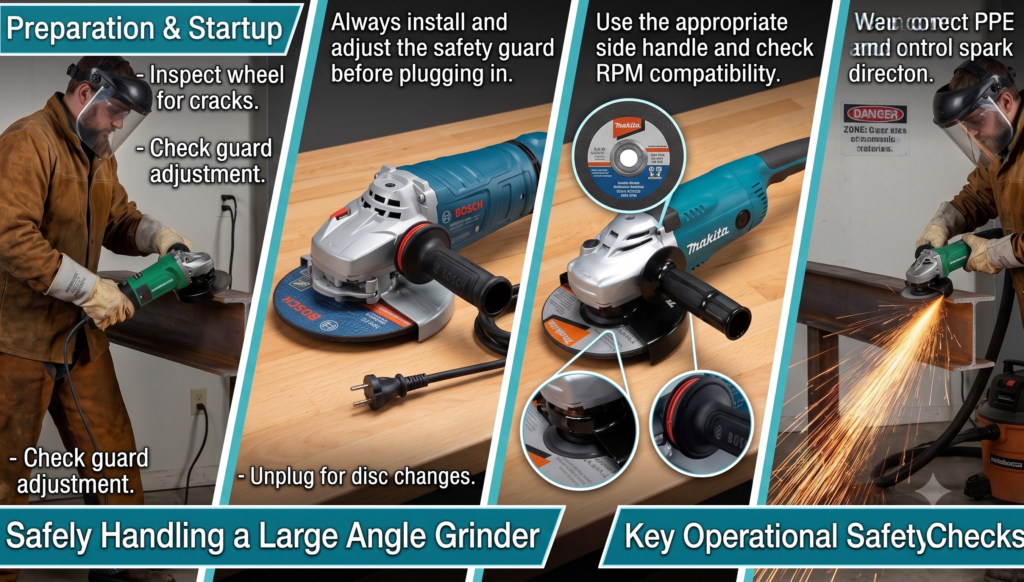
Large angle grinders are not just bigger versions of your 4-1/2 inch grinder. The forces involved scale up fast, and the consequences of a mistake scale up even faster. I’ve seen what happens when a 9-inch wheel binds at full speed. It’s not something you want to experience firsthand.
Always use the guard, and use the right guard. Type A guards are for cutting wheels. Type B guards are for grinding wheels. They’re shaped differently for a reason. A cutting guard won’t protect you from a grinding wheel that shatters, and vice versa. Position the guard between you and the wheel at all times. If you’re grinding overhead, that means the guard goes on top, not on the side.
Two hands, no exceptions. A large grinder is never a one-handed tool. The side handle isn’t optional, and you need a solid grip on both handles before you pull the trigger. The rotating mass of a 9-inch wheel carries enough kinetic energy at 6,500 RPM to twist the tool out of one hand without much effort. A broken wrist is the best-case scenario if that happens.
Inspect every wheel before you mount it. Look for chips along the rim, cracks in the body, and signs of water damage. A grinding wheel that’s been dropped or stored in a damp environment can fail catastrophically under load. Do the ring test: hang the wheel from a finger, tap it gently with a screwdriver handle, and listen for a clear ring. A dull thud means the wheel is cracked internally. Throw it out. Wheels are cheap compared to what happens when one explodes at speed.
Clamp your workpiece. On a small grinder, you can sometimes get away with holding a piece with one hand and grinding with the other. Do not try this with a large grinder. The tool will grab if the disc binds, and a clamped workpiece means the tool flies instead of the part. Either way, you want the part stationary and both hands on the grinder.
Wear a full face shield over your safety glasses. Grinding wheels throw sparks, grit, and occasionally chunks of themselves at high velocity. Standard safety glasses protect your eyes but not your face. A face shield rated for impact is cheap insurance. Add hearing protection too. Large grinders run loud enough to cause permanent hearing damage over a shift, and the frequency is particularly punishing.
Let the tool do the work. The instinct is to lean into a large grinder to speed up material removal. Don’t. The weight of the tool provides enough pressure for effective grinding. Adding your body weight behind it overheats the motor, glazes the wheel, and increases the chance of binding. If the grinder is bogging down under its own weight, you’re using the wrong wheel or the wrong grit, not the wrong amount of pressure.
Disconnect power when changing wheels or making adjustments. Unplug the cord. Don’t just rely on the switch lock. I don’t care if it’s a slide switch or a paddle switch. Unplug it. The five seconds it takes is nothing compared to what happens if the trigger gets bumped while your fingers are on the wheel.
MAIN PARTS — Anatomy of a Large Angle Grinder
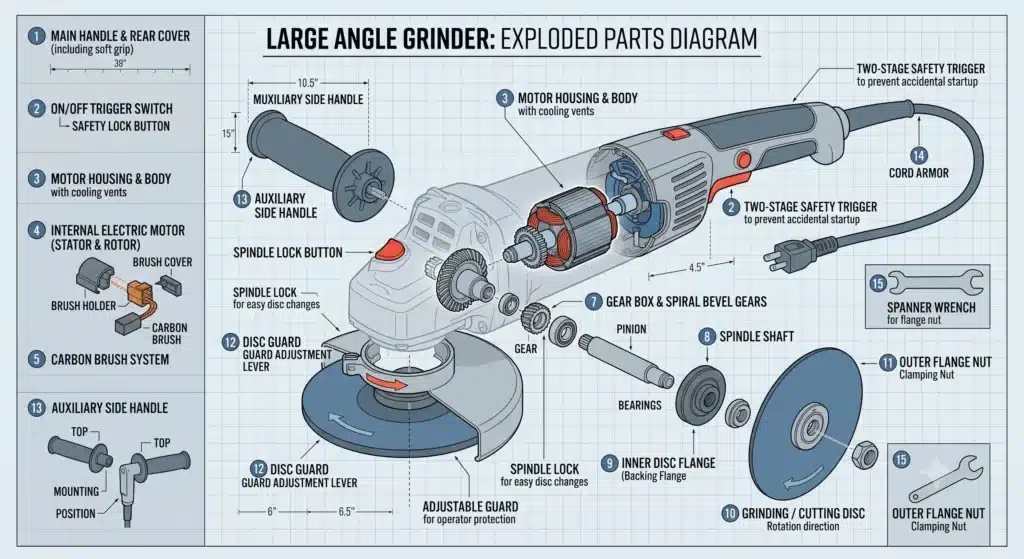
If you’ve used small angle grinders, most of the parts will look familiar. But large grinders have a few design differences worth understanding before you buy.
Motor. This is the heart of the tool, and in large grinders, you’re looking at 14 to 15 amps with output ranging from roughly 2 to 5.3 horsepower. More important than the peak rating is whether the motor holds speed under load. A grinder that claims 8,500 RPM but drops to half that when you lean on it is less useful than a grinder rated at 6,500 RPM that barely slows down in the cut. Look for epoxy-coated windings if you work in dusty environments. Concrete dust and metal shavings are electrically conductive. They’ll short an unprotected motor eventually.
Gear housing and spindle. The gear housing transfers motor power to the spindle through a set of bevel gears, typically with a 90-degree angle change. On large grinders, the gear housing is bigger and heavier than what you’d find on a 4-1/2 inch model because it has to handle more torque. The spindle thread is almost always 5/8 inch by 11 UNC on US-market grinders. The spindle lock button lets you change wheels with one wrench instead of two. On quality grinders, the spindle lock is machined steel. On budget tools, it’s stamped and will round off eventually.
Handles. Large grinders come with two handle configurations. The D-handle style puts a trigger grip at the rear with the motor body between your hands. The rat-tail style extends the rear grip in line with the motor axis. Neither is objectively better. D-handle users tend to prefer the perpendicular grip for horizontal surface grinding. Rat-tail users like the in-line stance for cutting and edge work. The side handle is always present, usually with two or three mounting positions so you can set it up for left-handed or right-handed use. Some models let you rotate the main handle as well.
Guards. The guard does two things: it protects you from the wheel, and it directs sparks and debris away from your body. Type A guards are open on one side for cutting wheels. Type B guards wrap further around the circumference for grinding wheels. Most large grinders come with both, or at minimum a Type B guard. Tool-free guard adjustment is becoming standard on professional models. A collar that you twist to reposition the guard without a wrench saves real time when you switch between cutting and grinding throughout a shift.
Switch. Three types dominate the market. Slide switches lock in the on position and stay there until you slide them back. They’re good for extended grinding where you don’t want to hold a trigger, but they’re less safe if the tool gets away from you. Paddle switches require constant pressure and stop when released. They’re safer but tiring on long jobs. Trigger switches with lock-on give you both options: squeeze for momentary use, or squeeze and slide forward to lock for continuous running. Your preference probably depends on what you learned on.
Brushes. Every brushed motor has carbon brushes that wear down over time. The difference between a good grinder and a great one often comes down to how it handles brush wear. Automatic shutoff brushes stop the tool when the brushes reach their replacement limit instead of letting the worn brushes arc against the commutator and destroy it. A 15-dollar brush replacement becomes a 150-dollar armature replacement when there’s no shutoff. If you use your grinder daily, tool-free brush access caps that save you from opening the housing are worth paying for.
Dust protection. This is the feature that separates grinders that last three years from grinders that last ten. A labyrinth seal uses a series of channels and chambers to trap dust before it reaches the bearings. Some manufacturers use a single seal. Others, like Makita, use a multi-stage labyrinth. Either way, the goal is the same: keep conductive abrasive dust out of the motor housing. If the manufacturer doesn’t mention dust protection in the specs, assume there isn’t any.





