
Finding a cordless angle grinder that can handle 7-inch and 9-inch discs without being tethered to an outlet used to be a fantasy. Battery tech couldn’t keep up. The tools existed but the runtime was a joke — 5 minutes of actual grinding, then back on the charger.
That changed. Today, DEWALT, Milwaukee, and Makita all make battery-powered large angle grinders that match corded 15-amp models in raw power. They run 7-inch and 9-inch discs.
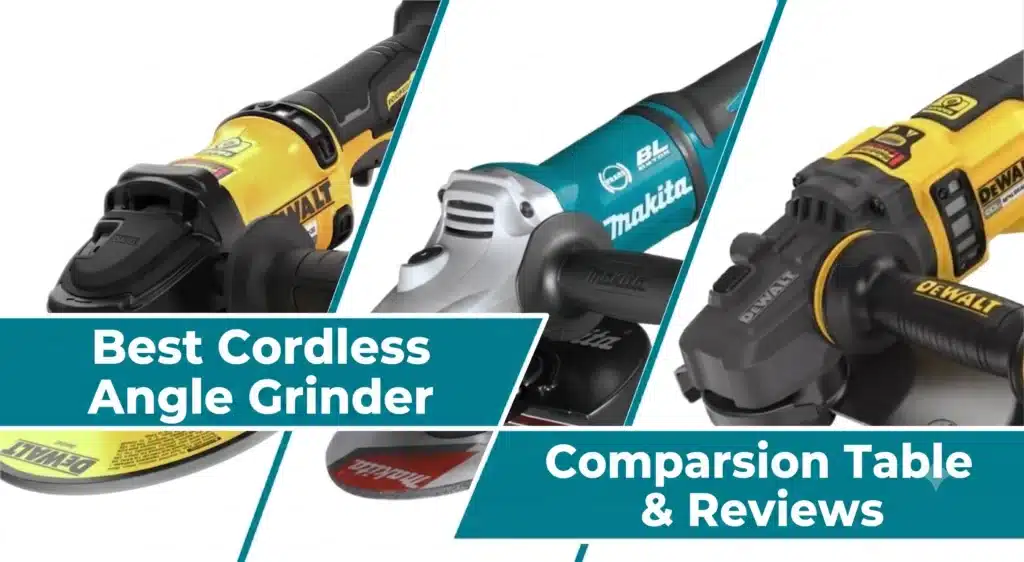
They have electronic brakes, kickback protection, and brushless motors that don’t burn out under load. But battery platforms, safety features, and disc compatibility vary widely across brands.
We tested four of the top large cordless angle grinders on the market — running them on structural steel, pipeline work, and fabrication jobs. Here’s which ones earned a spot, what they’re good at, and which tradeoffs you need to know about before buying.
Best Large Cordless Angle Grinders Comparison Table
| Image | Name | Disc Size | Power | Speed (RPM) | Variable Speed | Switch Type | Weight | Check Price |
|---|---|---|---|---|---|---|---|---|

| DEWALT 60V MAX 7" Brushless Cordless Grinder with Kickback Brake (Tool Only) | 7" | 60V MAX | 6,500 | No | Trigger w/ Kickback Brake | 12.2 lbs | Check Price |

| Milwaukee 2785-20 M18 Fuel 7"/9" Large Angle Grinder | 7" / 9" | 18V M18 Fuel | 6,600 | No | Dual Action Trigger | 12.3 lbs | Check Price |

| Makita XAG12Z1 18V X2 LXT 36V Brushless Cordless 7" Angle Grinder | 7" | 18V X2 (36V) | 7,800 | Yes (Auto) | Paddle Switch | 11.3 lbs | Check Price |

| DEWALT 60V 7"-9" Large Angle Grinder (Kit) | 7" / 9" | 60V MAX | 6,500 | No | Trigger | 13.0 lbs | Check Price |
1. DEWALT 60V MAX 7″ Brushless Cordless Grinder – Best Overall Large Cordless Grinder
Best Overall Large Cordless Grinder
DEWALT 60V MAX 7″ Brushless Cordless Grinder
DEWALT’s 60V MAX 7-inch cordless grinder is what happens when a company stops bolting bigger motors onto 20V platforms and actually builds around the battery. The DCG440B has 30% more torque than the previous-generation DCG418 and delivers up to 2,300 UWO — enough to keep up with corded 7-inch grinders. I’ve used it on pipeline work where corded tools weren’t an option and it didn’t slow down under load the way I expected a battery tool to.
| Disc Size: | 7″ | Motor: | Brushless |
| Battery: | 60V MAX | Speed: | 6,500 RPM |
| Switch: | Trigger w/ Kickback Brake™ | Power: | 2,300 UWO |
| Brake: | Instant Electronic | Weight: | 12.2 lbs |
| Warranty: | 3-Year Limited | Price: | See Amazon |
The Kickback Brake is the feature that matters most here. If the wheel binds — and on a 7-inch grinder, that’s not a maybe — the brake engages and shuts the tool down before it can kick back into you. It’s the same tech DEWALT puts on their corded models. On a tool this size, running a wheel this aggressive, it’s not a nice-to-have. It’s the only reason I’d recommend a cordless 7-inch to anyone.
The Kickback Brake doesn’t just stop the wheel when it binds — it also detects pinch and stall events and kills the motor in under a tenth of a second. DEWALT built this into the PERFORM & PROTECT lineup, and on a 7-inch grinder it’s the difference between finishing your shift and filling out an incident report. The electronics react faster than you can. You don’t feel them working until the moment you need them.
Runtime depends entirely on what battery you feed it. With a 9.0Ah FlexVolt pack, I got about 25 minutes of heavy grinding on 1/2-inch steel plate. That’s not all-day runtime, but it’s enough to finish a section of pipe or a fabrication job before swapping. The 6.0Ah pack that usually ships with kits won’t keep up for serious work. Buy the bigger battery.
The pipeline grip gearcase cover lets you choke up on the tool for edge grinding and wire brushing. It’s a small detail but on a 12-pound grinder you’re holding at awkward angles, anything that improves control matters. The tool-free guard adjustment also works without a wrench — snap it to where you need it and go.
This is the tool-only version. No batteries, no charger, no case. If you’re already on the DEWALT 60V platform, that’s fine. If you’re buying in fresh, factor in another $200-300 for a charger and a pair of 9.0Ah batteries. The grinder itself is worth it. Just know what you’re getting into.
Pros
- Kickback Brake is the real deal — shuts down before the tool can twist out of your hands
- More torque than DEWALT’s own corded 7-inch grinders
- Kickback Brake detects both bind-up and pinch/stall — covers more than just kickback
- Pipeline grip cover gives you a second hand position for edge work
- Tool-free guard adjusts without reaching for a wrench
- Brushless motor runs cooler and extends runtime
- DEWALT’s 60V FlexVolt batteries are backward compatible with 20V tools
- Instant electronic brake stops the wheel fast when you release the trigger
Cons
- Tool only — no batteries, charger, or case in the box
- Heavy at 12.2 lbs, and that’s before the battery
- Needs 9.0Ah+ batteries for decent runtime; 6.0Ah won’t cut it
2. Milwaukee 2785-20 M18 Fuel 7″/9″ Large Angle Grinder – Most Versatile Large Cordless Grinder
Most Versatile Large Cordless Grinder
Milwaukee 2785-20 M18 Fuel 7″/9″ Large Angle Grinder
The Milwaukee 2785-20 is the only grinder on this list that handles both 7-inch and 9-inch discs. That flexibility sounds like marketing until you’re on a job that needs a 9-inch wheel for a deep cut and you don’t have to go back to the truck for a different tool. Swap the guard and the wheel and you’re running. Most guys will run it as a 7-inch 90% of the time, but the option is there when you need it.
| Disc Size: | 7″ / 9″ | Motor: | POWERSTATE™ Brushless |
| Battery: | M18 FUEL™ 18V | Speed: | 6,600 RPM |
| Switch: | Dual Action Trigger | Guard: | Tool-Free |
| Power Equivalent: | 15A Corded | Weight: | 12.3 lbs |
| Warranty: | 5-Year Tool | Price: | See Amazon |
Milwaukee claims this delivers the power of a 15-amp corded grinder. I was skeptical. After running it side by side with a corded 15A model on 3/8-inch plate, I’ll say this: it’s close. At full depth with a 7-inch grinding disc, you can feel the battery sag slightly under heavy pressure. But in normal use — weld cleanup, surface prep, cutting — you won’t notice the difference. It’s that good.
The dual-action trigger is a paddle switch that requires two deliberate motions to activate. Slide the lock forward, then squeeze. It’s annoying for the first 10 minutes, then you stop thinking about it. The point is you can’t accidentally bump this thing on. Drop it, toss it in the truck, whatever — it’s not firing until you mean it.
Tool-free everything on this grinder. Guard adjustment, accessory changes, even the handle position. No wrench needed. On a jobsite where your tools end up buried under three layers of gear, not having to track down a specific wrench to change a wheel is a real productivity gain. Other manufacturers put this on their premium corded models. Milwaukee put it on the cordless.
The POWERSTATE brushless motor is built specifically for this grinder. Milwaukee didn’t take a motor from a smaller tool and gear it up. The motor is optimized for the 7-inch/9-inch form factor, which is why it can sustain 15A-equivalent power without thermal shutdown. I ran it hard for 20 minutes straight and it got warm but never throttled.
Battery life with a 12.0Ah High Output pack is about 30 minutes of heavy grinding. With an 8.0Ah, figure 20. That’s comparable to the DEWALT on a 9.0Ah FlexVolt. The M18 platform is massive — if you’re already in the Milwaukee ecosystem, this is the obvious choice. If you’re not, the battery cost to entry is steep.
Pros
- Runs both 7″ and 9″ discs — swap guard and wheel, no other changes needed
- Delivers 15A corded power without the cord
- Dual action trigger prevents accidental activation
- Tool-free guard, accessory changes, and handle adjustment
- Purpose-built POWERSTATE motor, not a scaled-up smaller motor
- 5-year tool warranty is best in class
- Massive M18 battery ecosystem if you’re already invested
- Sustains full power without thermal throttling under continuous load
Cons
- Dual action trigger adds a step every time you start the tool
- 12.3 lbs tool-only; gets heavy fast overhead
- Needs 8.0Ah+ High Output batteries — standard 5.0Ah won’t deliver full power
3. Makita XAG12Z1 18V X2 LXT 36V Brushless Cordless 7″ Angle Grinder – Best Lightweight Large Cordless Grinder
Best Lightweight Large Cordless Grinder
Makita XAG12Z1 18V X2 LXT 36V Brushless Cordless 7″ Angle Grinder
The Makita XAG12Z1 is the lightest large cordless grinder on this list by a full pound. At 11.3 pounds before batteries, it’s noticeably easier to handle overhead or in tight positions where you’re fighting the tool as much as the work. Makita achieved this with an aluminum housing — it’s not just lighter, it dissipates heat better than the plastic-and-metal hybrids most competitors use.
| Disc Size: | 7″ | Motor: | BL Brushless |
| Battery: | 18V X2 (36V) | Speed: | 7,800 RPM |
| Switch: | Paddle Switch | Brake: | Electric (4.5 sec) |
| Auto Speed Change: | Yes | Weight: | 11.3 lbs |
| Warranty: | 3-Year Limited | Price: | See Amazon |
Makita’s two-battery approach is different from everyone else. Instead of a single high-voltage battery, the XAG12Z1 runs on two 18V LXT packs in series for 36V total. This means you’re buying two batteries every time — but it also means you stay on the LXT platform. If you already have a truck full of Makita 18V tools and batteries, you don’t need a separate high-voltage charger. That’s a real cost advantage.
The automatic speed change technology adjusts RPM and torque based on load. Under light pressure it runs at 7,800 RPM for fast material removal. When you lean into it, torque increases and speed drops to prevent bogging. It’s not variable speed in the user-controlled sense — you don’t dial it in. It makes the decisions for you, and in practice, it works well. Less thinking, more grinding.
The electric brake stops the wheel in 4.5 seconds. That’s not as fast as DEWALT’s instant brake, but it’s faster than coasting to a stop on older grinders. Combined with the AFT® (Active Feedback Technology) — which kills the motor if the wheel suddenly binds — the safety package is solid. Not best-in-class, but more than adequate for anyone paying attention to what they’re doing.
At 7,800 RPM, this is the fastest grinder here on paper. In practice, you feel it when cutting. The higher wheel speed produces cleaner cuts with less burr and less heat discoloration on stainless. For surface prep and weld blending, the RPM advantage is less noticeable — technique matters more than an extra 1,200 RPM at that point.
This is tool-only. You need two 18V LXT batteries and a charger. A pair of 5.0Ah batteries gives about 22 minutes of heavy grinding. 6.0Ah packs push that closer to 28. If you’re buying into Makita fresh, budget for four batteries — two in the tool, two charging. The weight and speed are worth it if you’re already on the platform.
Pros
- Lightest large cordless grinder at 11.3 lbs — noticeable difference overhead
- 7,800 RPM is fastest in class for cleaner cuts and less heat discoloration
- Aluminum housing sheds heat better than plastic competitors
- Automatic speed change adjusts torque and RPM without user input
- Stays on Makita’s 18V LXT platform — no separate high-voltage charger needed
- BL brushless motor runs cooler and extends tool life
- Electric brake stops the wheel in 4.5 seconds
- Electronic torque control kills motor on sudden wheel bind
Cons
- Requires two batteries to run — doubles your battery investment
- Electric brake at 4.5 seconds is slower than DEWALT’s instant brake
- No 9-inch disc compatibility — 7-inch only
4. DEWALT 60V 7″-9″ Large Angle Grinder (Kit) – Best Complete Kit for Large Cordless Grinding
Best Complete Kit for Large Cordless Grinding
DEWALT 60V 7″-9″ Large Angle Grinder (Kit)
The DCG460 kit is DEWALT’s 7-inch and 9-inch FlexVolt grinder packaged with everything you need to start working. Battery, charger, guard, handle — it’s all in the box. If you’re not already on DEWALT’s 60V platform, this is the most cost-effective way to get into a large cordless grinder without buying everything separately. The tool-only option (DCG440B) makes sense if you have batteries. This kit makes sense if you don’t.
| Disc Size: | 7″ / 9″ | Motor: | Brushless |
| Battery: | 60V MAX (2x 9.0Ah) | Speed: | 6,500 RPM |
| Switch: | Trigger | Guard: | Tool-Free |
| Brake: | Electronic | Weight: | 13.0 lbs |
| Warranty: | 3-Year Limited | Price: | See Amazon |
Performance is nearly identical to the DCG440B tool-only version — same motor, same electronics, same 6,500 RPM. The difference is the included 9.0Ah FlexVolt battery and the 9-inch guard in the box. You can run 7-inch or 9-inch discs depending on the job. On structural steel with a 9-inch grinding wheel, this thing chews through material at a rate that surprises anyone who thinks cordless means compromise.
The 9.0Ah FlexVolt battery that ships with this kit is the right size for the tool. Smaller packs like the 6.0Ah will technically work but you’ll be swapping batteries constantly on heavy jobs. With the 9.0Ah, I got about 25 minutes of aggressive grinding on 1/2-inch steel. That’s enough to finish most fabrication tasks before needing a swap. Have a second battery charging and you can run all day.
Like the DCG440B, this has DEWALT’s Kickback Brake and E-CLUTCH. The brake engages when the trigger is released — instant wheel stop. The E-CLUTCH kills the motor on pinch or stall. There’s also a no-volt switch that prevents the tool from restarting if power cuts out and comes back — a small detail that matters when you’re working at height or in tight spaces. A 9-inch disc carries a lot of rotational energy. When it binds, the force is significant. The electronics react faster than any human can.
The tool-free guard adjustment works on both 7-inch and 9-inch configurations. Snap the guard to position without tools, swap between disc sizes in under a minute. The pipeline grip cover on the gearcase gives you a forward hand position for edge work. On a 13-pound tool this is essential — holding it only by the rear handle for extended periods will wear you out.
This is a heavy tool. At 13 pounds with the battery, it’s the heaviest grinder on this list. You’ll feel it after an hour of overhead work. That’s not a design flaw — it’s the tradeoff for running 9-inch discs on battery power. If most of your work is 7-inch grinding at bench height, the DCG440B tool-only at 12.2 pounds is the lighter pick. If you need 9-inch capability and don’t want to piece together a kit, this is your grinder.
Pros
- Complete kit — battery, charger, guard, and handle in the box
- Runs 7″ and 9″ discs with included guards for both
- Kickback Brake and E-CLUTCH on a 9-inch cordless grinder — huge safety win
- Includes 9.0Ah FlexVolt battery, the right size for the tool
- Tool-free guard swap between 7″ and 9″ in under a minute
- Pipeline grip cover for forward hand position during edge work
- FlexVolt batteries are backward compatible with all DEWALT 20V tools
- More cost-effective than buying tool-only plus batteries separately
Cons
- Heaviest option at 13 lbs with battery — punishing overhead
- 9.0Ah battery is minimum for useful runtime — smaller packs waste your time
- Only one charger in the kit means charging two 9.0Ah batteries sequentially — add a second charger for all-day work
Corded vs Cordless Large Angle Grinders
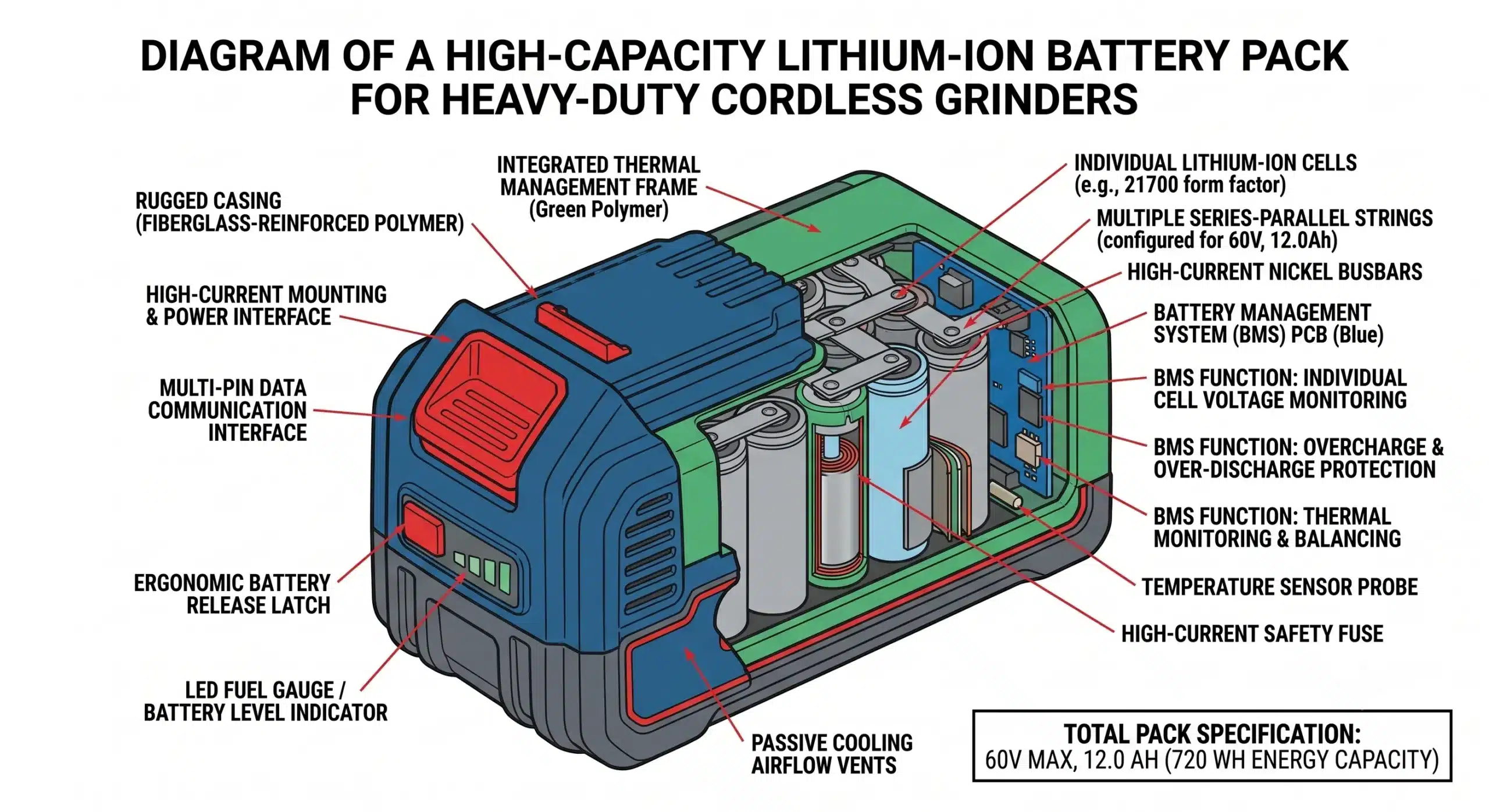
Corded vs Cordless Large Angle Grinders — Which One Actually Makes Sense?
If you work in a shop with outlets every ten feet, stick with corded. You’ll get unlimited runtime, more power per dollar, and a lighter tool. A corded 15-amp 7-inch grinder costs half what a comparable cordless model does and weighs less because there’s no battery hanging off it.
But if you’re on a jobsite without power, working on a pipeline, doing structural steel in the field, or just tired of dragging extension cords through mud and around scaffolding — cordless is the answer. The tools on this page all deliver corded-equivalent power. The tradeoff is weight, cost, and battery management.
Here’s what changes when you go cordless on a large grinder:
Runtime is finite. With a 9.0Ah battery on a 7-inch grinder, expect 20 to 30 minutes of actual grinding. That’s not a full shift. You’ll need at least two batteries and a fast charger to keep working. For production environments where the grinder runs continuously, corded still wins on cost and uptime.
Power is close but not identical. Under heavy load — deep cuts, aggressive material removal — you’ll notice a slight drop-off as the battery drains. A corded 15A grinder pulls consistent power until the breaker trips. The best cordless models (the DEWALT DCG440B and Milwaukee 2785-20) come close enough that you won’t care unless you’re benchmarking them side by side.
Weight is noticeable. A cordless 7-inch grinder with a 9.0Ah battery is 2 to 4 pounds heavier than the corded equivalent. Holding that overhead or at arm’s reach for more than a few minutes will wear you out faster. If most of your work is horizontal grinding at waist height, it’s manageable. Overhead — you’ll feel it.
Safety features are actually better on cordless. The electronic brakes, kickback protection, and stall detection on modern cordless grinders exceed what most corded models offer. When a 9-inch disc binds at 6,500 RPM, you want the tool to react faster than your hands can. The DEWALT Kickback Brake and Milwaukee’s dual-action trigger are genuine safety upgrades, not marketing fluff.
Maintenance is simpler on cordless. No brushes to replace (all four grinders here are brushless), no cord to fray or cut, no commutator to wear out. The motor either works or it doesn’t. Battery degradation is the only long-term wear item, and modern lithium packs last 3 to 5 years of regular use before capacity drops noticeably.
The bottom line: if you work in a fixed location with reliable power, buy a good corded grinder and save the money. If mobility matters more than unlimited runtime, the cordless options on this page will do the job without the cord — just budget for extra batteries.
Cordless Brushless Grinder Parts and How to Use It Right
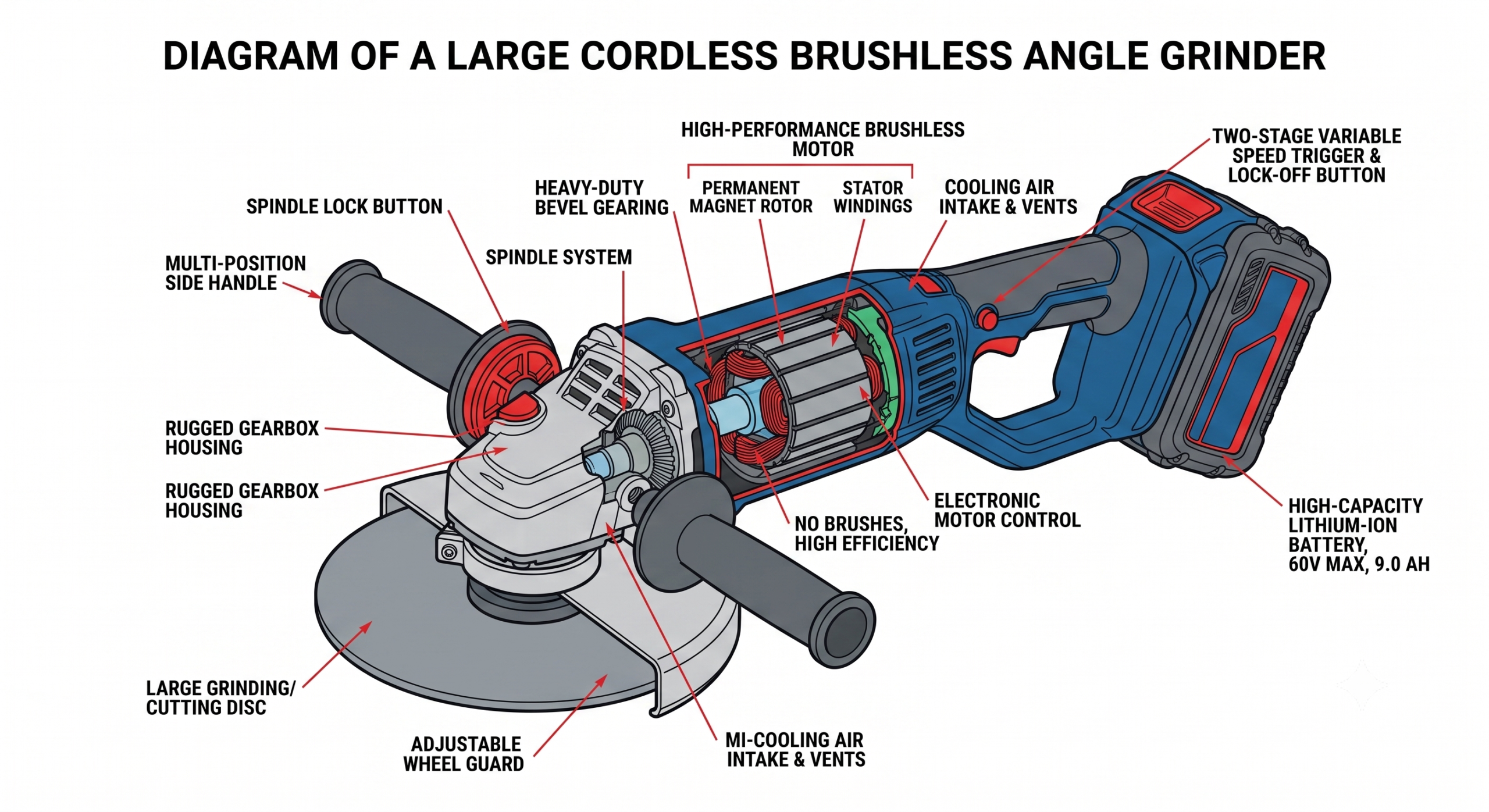
Cordless Brushless Grinder Anatomy and Usage Tips
A large cordless angle grinder isn’t just a bigger version of your 4-1/2-inch shop grinder. The parts are similar in name but different in scale, and using one wrong can get you hurt. Here’s what each component does and how to get the most out of it.
The Brushless Motor
All four grinders on this page use brushless motors. Unlike brushed motors that rely on physical carbon brushes making contact with a commutator, a brushless motor uses an electronic controller to switch current through the windings. No brushes means no friction, no sparking, less heat, and longer motor life. It also means the controller can adjust power delivery on the fly — cutting power when the tool is idle to save battery, ramping it up instantly when you squeeze the trigger.
Practical takeaway: a brushless grinder runs cooler, lasts longer, and squeezes more runtime out of the same battery compared to a brushed equivalent. Every serious cordless grinder made today is brushless for a reason.
The Battery Platform
Your choice of grinder locks you into a battery ecosystem. DEWALT uses 60V FlexVolt packs that are backward compatible with all 20V DEWALT tools. Milwaukee uses the M18 platform — one battery for hundreds of tools. Makita uses two 18V LXT batteries in series for 36V total, which keeps you on the LXT platform but means you’re buying two batteries at a time.
For a large grinder, amp-hours matter more than voltage on paper. A 5.0Ah battery will run the tool but sag under heavy load and give you maybe 12 to 15 minutes of real work. A 9.0Ah or 12.0Ah pack holds voltage better under load and gives you 25 to 30 minutes. If you’re buying batteries specifically for a 7-inch or 9-inch grinder, go big. The smaller packs are for drills and impacts, not grinders.
The Guard
Never run a large angle grinder without the guard. This sounds obvious, but people do it. A 7-inch or 9-inch disc spinning at 6,500 RPM stores a tremendous amount of energy. If the disc shatters — and discs do shatter, especially when they’re old, dropped, or forced into a bind — the guard is the only thing between those fragments and your body.
Position the guard between you and the wheel. When the grinder kicks back, it pulls toward you. The guard should intercept that path. Most modern grinders have tool-free adjustable guards — position it once when you mount the wheel, check it’s tight, and don’t touch it again until you change discs.
The Side Handle
Use it. The side handle isn’t optional on a large grinder. These tools weigh 11 to 13 pounds and generate enough torque to twist out of one hand if the wheel grabs. Screw the handle into whichever side gives you the best control for the cut you’re making. Most handles can mount on either side or on top. For horizontal grinding, left or right. For vertical cutting, top position gives the best leverage.
The Trigger/Switch
The four grinders here use different switch designs. DEWALT uses a standard trigger — squeeze to run, release to stop. Milwaukee uses a dual-action trigger that requires sliding a lock forward before the trigger works. Makita uses a paddle switch on the bottom. None is objectively better; they’re different approaches to the same problem: preventing accidental activation.
Whichever switch your grinder has, learn it before you mount a wheel. Fumbling for the off switch while a 9-inch wheel is spinning down is not where you want to be.
Disc Selection
A 7-inch or 9-inch grinder can run grinding wheels, cut-off wheels, flap discs, and wire wheels. Match the disc to the job:
- Grinding wheels (1/4-inch thick) are for heavy material removal — weld cleanup, beveling, surface prep. They’re aggressive and remove metal fast.
- Cut-off wheels (1/16-inch or thinner) are for cutting. Don’t use them for grinding — they’ll shatter under side load.
- Flap discs are for blending and finishing. They’re less aggressive than grinding wheels and leave a smoother surface.
- Wire wheels are for rust and paint removal. Use them at low pressure and let the wire tips do the work.
Always check the disc’s maximum RPM rating against your grinder’s no-load speed. A disc rated for 8,000 RPM on a 7,800 RPM grinder gives you almost no safety margin. Use discs rated at least 20% above your grinder’s max RPM.
Technique
Let the tool do the work. The most common mistake with large grinders is forcing them — pushing harder because the grinder is big and you expect it to plow through material. It will, but forcing it overheats the disc, drains the battery faster, and increases the chance of a bind.
Use a 15 to 30 degree angle to the workpiece for grinding. Too flat and the disc skates; too steep and it gouges. For cutting, keep the disc perpendicular to the material and let the weight of the tool provide the down pressure. If you’re pushing hard enough to noticeably slow the motor, back off.
Move the grinder. Don’t park it in one spot. A stationary grinder overheats the disc and the work surface. Keep it moving in smooth passes, overlapping each pass by about half the disc width.
Battery Management
With a cordless grinder, battery strategy matters. Start every job with a full battery. When the tool starts to lose power — you’ll feel it bogging sooner than it did on a fresh charge — swap the battery. Running a lithium pack all the way to zero under heavy load generates excess heat and shortens the battery’s life. The charger won’t even start charging a hot battery until it cools down, which can take 15 to 20 minutes.
If you’re doing production work, three batteries and two chargers is the minimum for uninterrupted grinding. Two in rotation, one cooling or charging. It’s more upfront cost, but standing around waiting for batteries kills productivity faster than any other variable.
Safety Gear
A large angle grinder throws sparks, metal fragments, and dust. At minimum: safety glasses, face shield, hearing protection, leather gloves, and a respirator if you’re cutting or grinding anything that produces fine dust. Synthetic clothing melts — wear cotton or leather. Keep a fire extinguisher nearby if you’re working around flammable materials. Sparks from a 7-inch grinder travel further than you think.





