
If you are a professional welder, or you spend long hours fabricating under a welding hood, the helmet matters almost as much as the machine. Basic auto darkening hoods get the job done, but eye strain and neck fatigue catch up with you by Friday. The helmet is the one tool you wear for eight or ten hours straight, so small differences between models compound over a week into the difference between a normal Friday and a miserable one.
The Lincoln Electric VIKING 3350 sits at the top of the welding helmet range, and the matte black K3034-4 is the plain version most welders end up buying. You can check the full lineup on Lincoln’s product page. Lincoln also sells the same Viking helmet platform in more than a dozen licensed graphic shells, from Steampunk to Motorhead; the matte black K3034-4 is the plain version that skips the artwork, not the features.
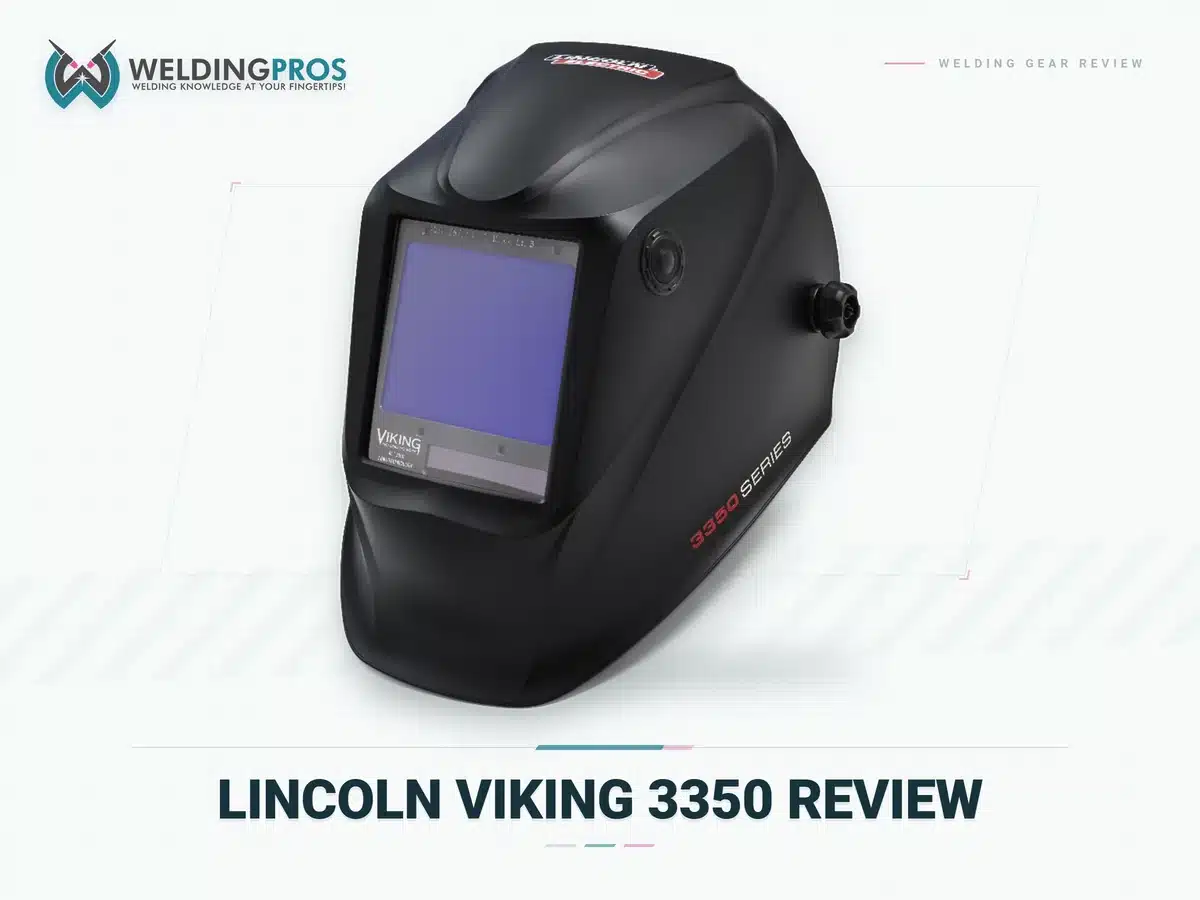
The Viking 3350 is a premium auto darkening welding helmet built around a 12.5 sq. in. 4C lens with a 1/1/1/1 optical clarity rating, four arc sensors, and an X6 headgear that takes real weight off your neck over a full shift. Amazon titles it an extra-large helmet, and the window is the first thing you notice coming from a basic hood: you see the whole puddle and the joint ahead of it instead of a keyhole view, and the large field of view helps depth perception when you are stacking bead on bead.
In this Lincoln Viking 3350 review, I cover what ships in the box, how the welding helmet performs in daily shop work, where it falls short, and who would be better off saving the money and buying one of the cheaper Vikings instead.
Lincoln Viking 3350 Package Content & Technical Specifications
The K3034-4 ships as a complete kit, so besides the helmet itself you also get a set of spare lenses and a few extras Lincoln includes. The spares matter more than they first appear: five outside cover lenses and two inside ones is enough to keep the view clean for months of daily welding, because a pitted cover lens will degrade a 1/1/1/1 optic faster than any difference between filters. The rest of the box is a Sport-Pak helmet bag that actually fits the hood with the headgear extended, a Foose series bandana, and a sticker sheet.
Lincoln’s Top-Tier Auto-Darkening Welding Helmet

- VIKING 3350 welding helmet, matte black shell
- X6 Headgear (pre-installed)
- 5 outside cover lenses
- 2 inside cover lenses
- Sport-Pak helmet bag
- Foose bandana
- Helmet stickers
Technical Specifications
| Model: | Lincoln Viking 3350 (K3034-4), matte black |
| Viewing Area: | 3.74 x 3.34 in. (95 x 85 mm) – 12.5 sq. in. |
| Optical Clarity: | 1/1/1/1 (EN 379) |
| Lens Technology: | 4C® lens technology |
| Shade Range: | DIN 5–13, internal control |
| Grind Mode: | Shade 3.5, external grind button |
| Switching Speed: | 1/25,000 s |
| Arc Sensors: | 4, fully adjustable |
| Power Supply: | 1 CR2450 battery with solar assist |
| TIG Rating: | AC and DC: 2 amps and above |
| Helmet Weight: | 21 oz (595 g) |
| Compliance / Warranty: | ANSI Z87.1, CSA Z94.3 / 5-year warranty |
Pros
- 1/1/1/1 optical clarity with 4C lens technology
- Extra-large 12.5 sq. in. viewing area
- Light 21 oz shell plus X6 headgear for all-day comfort
- External grind button – no helmet flips to switch modes
- Hard hat and cheater lens capable
Cons
- Premium price near the top of the helmet market
- Shade, sensitivity, and delay controls are internal
- Cheater lenses and hard hat adapter sold separately
- Viewing area is large but not the biggest available
- Matte black shell shows spatter marks over time
How the Lincoln Viking 3350 Welding Helmet Performs
Reading the spec sheet tells you what the Lincoln Viking 3350 promises on paper; the rest of this review covers how it delivers. The two numbers that decide how a helmet behaves over a full shift are the 1/1/1/1 optical rating and the 21 oz weight, so those are the ones to watch. Lincoln Electric rates the helmet across every welding process it builds machines for: stick, TIG, pulsed TIG, MIG, pulsed MIG, flux-cored, gouging, and grinding. A rating list that wide usually hides a compromise at the extremes, normally at low amperage, so that is where I looked hardest.
After the package content and technical specifications, here is the hands-on part of the review: how the welding helmet holds up in real shop use. I have split my experience into three parts: the view through the lens, all-day comfort, and the controls. For context on where this welding helmet sits, Lincoln Electric’s own line runs from the basic 1740 up through the 1840 and 2450 to the 3350, and the lens size chart in the brochure climbs with the range: every step down trades away viewing area.
Optics: the 4C Lens and 1/1/1/1 Clarity
The 3350’s strongest selling point is the clarity of the view through its large viewing area. As a Lincoln Electric VIKING welding helmet, it carries Lincoln’s exclusive 4C lens technology, which broadens the color spectrum you see in both the light and the dark, which removes the lime-green tint common on cheaper filters. Colors look close to natural, the puddle is easy to read, and my eyes were noticeably less tired after long TIG welding sessions. The 4C panel is a proprietary liquid crystal display, and the point of it is simple: a filter that shows you actual hues instead of one saturated color. That is what creates the clearest view of the base material, the puddle, and the slag, and it is why small defects in the weld read clearly before they become repairs. Spare parts are easy to source too: cover lenses are stocked by every Lincoln dealer, so keeping the view clean costs a few dollars and a minute, not a new helmet.
The 1/1/1/1 optical clarity rating means top marks in all four EN 379 categories: optical class, diffusion of light, luminous transmittance variation, and angle dependence. In practice, day-to-day performance shows up as shade consistency across the whole 3.74 x 3.34 in. window, with no blur toward the edges and no shade shift when you look at the arc from an angle. Optical class is the sharpness of the image, diffusion of light is measuring blurriness, luminous variation is how evenly the dark tone holds across the glass, and angle uniformity is whether it drifts with your head off-center; fail one of the four and your eyes quietly do the compensating all shift. The other half of the optics story is the auto darkening welding lens itself. Its shade ranges are flexible enough for different processes, and the even color rendering keeps the puddle and work piece easy to separate while reducing eye strain. The lens flips from light to dark in 1/25,000 of a second, fast enough that you never catch a flash on arc strike, and four sensors feed it, so a tight corner or a fixture that hides one sensor does not leave you unprotected.
Comfort: X6 Headgear and 21 oz Weight
At 21 oz (595 g), the Viking 3350 is not the lightest welding helmet on the market, but the X6 headgear makes the weight feel smaller than the number. The X6 distributes weight, reduces pressure, and optimizes balance through six separate adjustments: form-fitting top supports, a rotatable front headband, a rear support band, and a flexible backpad that removes the usual pressure point at the back of the skull. Compare that with the two or three fixed bands on a budget hood, which concentrate the whole weight on one strip across the crown, and it is clear the improved headgear is doing as much work as the shell. Five hundred ninety-five grams sounds harmless until hour nine of a ten-hour shift. Multiplied by every nod and every flip-up, raw weight is not what wrecks your neck, poor balance is, and spreading pressure across six contact points is the whole argument for the X6 during long welding sessions. The adjustment most welders skip is the forward and backward rack: sliding the hood closer narrows the gap where sparks spit in from underneath, and sliding it back gives your face clearance.
The ratchet adjusts with one hand even in gloves, the six-way range covers different head sizes, and the orientation pin lets you adjust the resting angle so the hood sits where you want it when flipped up. That setup is user friendly in practice: you see the work piece clearly when tracking the puddle and joint, across shade ranges from #5 to #13. None of this is exciting on day one. On day five of a production week, it is the difference between ending the shift with a sore neck and ending it without one. Lincoln numbers the six X6 adjustments in its documentation, and the order is worth following when you first set the hood up: top supports first to carry the weight, then the front headband rotation, then the rear band for balance, and the backpad last. Set them in that order once and the Viking 3350 stops being something you think about. The lens keeps a slight green blue tint that is still far more natural than the harsh lime-green cast of cheaper filters, so your eyes do less compensating after a long TIG day. That even, readable view across the large window is a strength in heavy fabrication and structural welding.
Controls: Grind Button and Internal Settings
Of all the controls, the one I use most is the external grind button on the left side. Press and hold for three seconds and the lens switches between weld and grind mode, so you can switch to grinding without flashing yourself and without taking the helmet off. The button is low profile, so it never catches on anything mid-shift. Lincoln builds it as an industrial button rather than a touch strip for a reason: it works with gloves on, it does not fire when a sleeve brushes across it, and it locks the lens at a fixed shade 3.5 instead of trusting sensors to guess what a spark is. Fewer helmet flips per shift is a real productivity gain, not a slogan. It also increases versatility: the same hood covers grinding and gouging without reaching for a second face shield.
The shade, sensitivity, and delay controls live inside the helmet, which is my one ergonomic gripe: every adjustment except grind needs the helmet off your head. On the plus side, internal dials cannot get bumped out of setting when you tuck the hood under your arm or carry it by the shell. The dials matter more than they look like they would, because the helmet is rated for consistent indoor and outdoor performance, from a dark garage to direct sun. Bright sunlight fools a poorly tuned filter into flickering or locking dark; here you back the sensitivity off until the lens answers the arc and nothing else, then set the delay to hold the dark shade a beat after you break the arc so the puddle stays visible. The dark shade itself runs from 5 to 13 on the internal dial, which covers everything from light-gauge work at shade 9 or 10 up to heavy amperage where 12 or 13 is the right call. A short delay suits production MIG, where you are striking again within a second; a long delay is better for TIG, where you want to watch the puddle freeze.
Frequently Asked Questions [F.A.Q]
Is the Lincoln Viking 3350 good for low-amperage TIG welding?
Yes. The welding helmet carries a TIG rating of 2 amps and above for both AC and DC, and the sensitivity control is continuous, so you can tune it until low-current arcs stop causing false darkening. With four sensors and adjustable delay, 20-amp TIG work is not a problem. The 2-amp floor is the number that matters, because plenty of budget filters will not hold a stable dark state below 10 amps, which is exactly where thin-material TIG lives. Lincoln’s process list for the helmet explicitly includes pulsed TIG alongside standard TIG, so the sensitivity range is built with low-energy arcs in mind, not just adjusted to tolerate them.
What battery does the Lincoln Viking 3350 use?
One replaceable CR2450 coin cell with solar assist. The solar cells stretch battery life, and the battery is an inexpensive part you can swap in about a minute, with no charging cable and no proprietary pack. Any hardware store or electronics shop stocks CR2450 cells, so a dead battery never ends a welding shift.
Can I use it with a hard hat or a magnifying lens?
Both. The Viking 3350 is hard hat capable with an adapter, and it accepts magnifying cheater lenses from 1.00 to 2.50 diopter. The adapter and the lenses are sold separately. The diopter range covers the common 1.00 to 2.50 magnifications, so most welders who use reading glasses can drop a cheater in and leave the prescription glasses in the locker.
How does grind mode work?
Press and hold the external button on the left side of the helmet for three seconds. The lens locks at shade 3.5 for grinding, and another three-second hold switches it back to welding mode. Because grind mode bypasses the arc sensors entirely and holds the fixed shade, the lens cannot flash you when a grinder throws sparks near the hood.
Conclusion
The Lincoln Viking 3350 welding helmet is not cheap, and it does not pretend to be. What you pay for is the best optics Lincoln sells: the 4C lens, the extra large viewing area, a headgear system that actually distributes weight, and the small quality-of-life features like the external grind button, the five-year warranty, and the spare lenses in the box. If you weld every day, those earn their keep. At the time of writing, the K3034-4 sits around $490 on Amazon with a 4.8 out of 5 rating, and the warranty runs a full 60 months from purchase. Replacement outside cover lenses are the only real consumable, and they sell as the KP2898-1 five-pack, the same part the box is stocked with. For occasional welding, hobby welders can get by with the Viking 1840 or 2450 for less money, and you can see how the Viking 3350 stacks up against the best helmets and other hoods in our best welding helmet roundup. One last practical note on the matte black shell: it looks sharp new, but spatter marks and scuffs show on it faster than on a gloss finish, so wipe it down rather than chipping slag off. If you wear the welding helmet for a living, the Viking 3350 is worth it.






