
Trying to find some flux core wire for your next welding project but finding the number of options out there confusing? Don’t worry – I can help narrow things down for you.
I’ve tested several wires and worked out their strengths and weaknesses for you and, at the same time, I’ve put together a guide on how to choose the right wire for the right welding job.
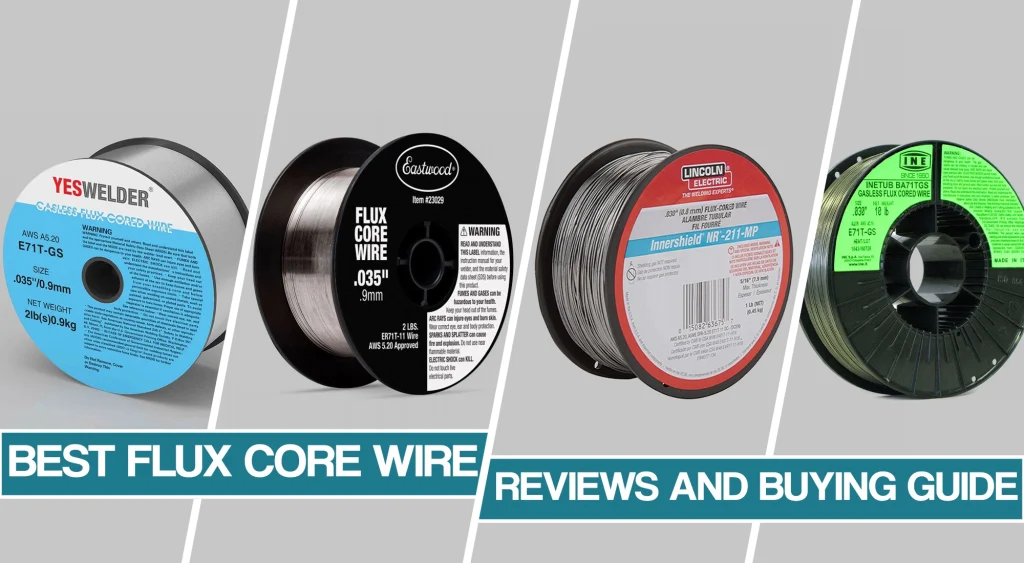
Choosing flux cored wire can be easy when you know how and whether you’re working with mild steel or stainless steel – I’ve got you covered.
Flux Core Wire Quick Comparison
| Image | Name | Diameter | Wire Type | Spool Weight | Quantity | Material | Check Price |
|---|---|---|---|---|---|---|---|

| YESWELDER E71T-GS .035″ 2 lbGet 10% Off With Coupon: -10% WELDPROS | .035″ | E71T-GS | 2 lb | 1-Pack | Mild Steel | Check Price |

| Lincoln Electric ED030584 NR-211 .035″ 1 lb | .035″ | NR-211-MP | 1 lb | 1-Pack | Mild Steel | Check Price |

| YixangDD 2-Pack E71T-GS .030″ 2 lb | .030″ | E71T-GS | 2 lb each | 2-Pack | Mild Carbon Steel | Check Price |

| Blue Demon E71T-11 .035″ 2 lb | .035″ | E71T-11 | 2 lb | 1-Pack | Carbon Steel | Check Price |

| Hobart H222108-R22 E71T-11 .035″ 10 lb | .035″ | E71T-11 | 10 lb | 1-Pack | Carbon Steel | Check Price |

| Forney 42302 E71TGS .035″ 2 lb | .035″ | E71T-GS | 2 lb | 1-Pack | Mild Steel | Check Price |

| K-NGS E71TGS .035″ 10 lb (Made in USA) | .035″ | E71T-GS | 10 lb | 1-Pack | Mild Steel | Check Price |
Best Flux Core Wire Reviews
1. YESWELDER E71T-GS .035″ 2 lb – Best Overall Flux Core Wire
Best Overall Flux Core Wire
YESWELDER E71T-GS .035″ 2 lb
YESWELDER’s E71T-GS is a 2-pound spool of .035-inch gasless flux core wire that hits the sweet spot for hobby welders and light fabrication. It runs on any 110V or 220V flux core machine and doesn’t ask for much in return. The wire feeds smooth, the arc starts clean, and the slag peels off in long strips most of the time.
| Diameter: | .035″ (0.9mm) | Wire Type: | E71T-GS (AWS A5.20) |
| Spool Weight: | 2 lb | Shielding: | Gasless / Self-shielded |
| Material: | Mild Steel | Position: | All-position, single-pass |
| Polarity: | DCEN | : |
I ran half a spool through a YESWELDER FLUX-135 on some 1/8-inch angle iron and had no feed issues at all. The bead profile came out flat with maybe a finger’s width of spatter on either side. Nothing a wire brush couldn’t handle in 10 seconds. On 16-gauge sheet metal, it was even cleaner. Keep your stickout around 3/8 inch and you’ll get consistent results.
The vacuum-sealed packaging is a nice touch for a $23 spool. Flux core wire absorbs moisture fast once the seal is broken, and rusted wire causes feed problems and porosity. YESWELDER ships these individually shrink-wrapped, so if you buy a few at once, the extras stay dry in storage. I have had a spare sitting on a shelf for three months and it still feeds like new.
One thing to know up front: E71T-GS is a single-pass wire. That means you weld the joint once and you’re done. If your project needs multiple passes for strength, you need an E71T-11 wire instead. For most home shop work (trailer repairs, gate hinges, exhaust brackets, art projects), single-pass is all you’ll ever need. Just do not use this on anything structural or load-bearing.
At $23 direct from YESWELDER, the per-pound cost is competitive with Amazon options like Blue Demon or Forney. And YESWELDER throws in free shipping on orders over $150, so if you are already ordering a welder or helmet, toss a couple spools in the cart. WeldingPros readers also get 10% off with the code below.
If you want a dependable, no-fuss flux core wire that works on the machines most home welders actually own, this is the one to beat. It is not fancy. It does not have exotic alloys or a 10-pound bulk option. It just welds clean and feeds reliably, and at this price, that is enough.
Pros
- Smooth wire feed with consistent arc starts on both 110V and 220V machines
- Low spatter on clean steel; slag removal is easy with no chipping needed
- Vacuum-sealed packaging keeps spare spools dry in long-term storage
- Good bead appearance on material from 16-gauge up to 1/4-inch
- Works with any gasless flux core welder, no special drive rolls needed
- Free US shipping on orders over $150 from YESWELDER direct
- 10% discount for WeldingPros readers with coupon code WELDPROS
- Decent 2-pound spool size for hobby use without the wire rusting before you finish it
Cons
- E71T-GS is single-pass only; not suitable for structural or multi-pass welds
- Only available in .035-inch from YESWELDER, so thin sheet metal work is trickier
- No 10-pound bulk spool option for production welding
2. Lincoln ED030584 NR-211 .035″ 1 lb – Best for Beginners & Light Repairs
Best for Beginners & Light Repairs
Lincoln ED030584 NR-211 .035″ 1 lb
Lincoln Electric has been making welding consumables since 1895, and their NR-211 flux core wire is the standard a lot of other brands are measured against. This is the ED030584 model: a 1-pound spool of .035-inch wire that fits any standard 4-inch spool hub. It is a small spool, and that is actually the point. If you are new to flux core welding, a 1-pound spool lets you try Lincoln quality without committing to a 10-pound roll.
| Diameter: | .035″ | Wire Type: | NR-211-MP (AWS A5.20) |
| Spool Weight: | 1 lb | Shielding: | Gasless / Self-shielded |
| Material: | Mild Steel | Position: | All-position, multi-pass |
| Polarity: | DCEN | : |
NR-211 is a step up from basic E71T-GS wire because it is rated for multi-pass welding. That means you can run a root pass, chip the slag, and lay a second pass over it without the weld cracking. In practice, most home welders never do multi-pass on thin material, but the rating tells you something about the wire’s ductility and toughness. It handles cold weather better than most budget E71T-GS wires too.
Feed consistency is where Lincoln really earns its reputation. I ran this through a Hobart Handler 140 and a Lincoln Weld-Pak 90i, and both fed without a single bird’s nest. The arc is slightly softer than the YESWELDER E71T-GS, which actually helps beginners who tend to move too fast. You get more time to watch the puddle before it freezes. Spatter is low, maybe a little less than the YESWELDER on the same settings.
The downside is obvious: 1 pound for $21 is expensive per ounce. You are paying for the Lincoln name and the convenience of a small spool. If you weld every weekend, this is a terrible value and you should buy the Hobart 10-pound spool instead. But as a trial spool to see if Lincoln wire works for you, or as an emergency backup roll that fits in a glovebox, it makes sense.
One detail that matters: this wire runs on DCEN polarity, same as every other gasless flux core wire. If you switch between solid MIG wire (DCEP) and flux core, you need to swap the polarity leads inside the machine. Lincoln labels the spool clearly and the packaging has the polarity printed right on it. Small things, but they help when you are new and trying to remember which way the leads go.
For a beginner’s first spool of quality wire, or a portable repair kit that lives in the truck, this 1-pound Lincoln spool is worth the premium. Just do not buy it as your everyday wire unless you enjoy paying twice as much per ounce.
Pros
- NR-211 is multi-pass rated; stronger and more ductile than standard E71T-GS
- Legendary Lincoln feed consistency with minimal bird-nesting across multiple machines
- Softer arc than budget wire gives beginners more time to watch the puddle
- Clean slag release and low spatter on properly cleaned mild steel
- DCEN polarity and settings printed right on the packaging for beginners
- Compact 1-pound spool fits gloveboxes and portable repair kits
- Good cold-weather performance compared to cheaper E71T-GS alternatives
- Works on thin material down to 18-gauge without burning through
Cons
- Very expensive per ounce at ~$21 for a 1-pound spool
- Only 1 pound means frequent spool changes on longer projects
- The small spool diameter can cause slight feed hesitation near the end of the roll
3. YixangDD 2-Pack E71T-GS .030″ – Best Budget 2-Pack for Thin Metal
Best Budget 2-Pack for Thin Metal
YixangDD 2-Pack E71T-GS .030″
YixangDD sells a two-pack of .030-inch E71T-GS flux core wire for under $18. That is two 2-pound spools for less than the price of a single Lincoln 1-pound spool. If you burn through a lot of wire practicing or doing auto body patches, this is the cheapest way to keep the machine fed without feeling guilty about every inch of wire you lay down.
| Diameter: | .030″ (0.8mm) | Wire Type: | E71T-GS (AWS A5.20) |
| Spool Weight: | 2 lb each (4 lb total) | Shielding: | Gasless / Self-shielded |
| Material: | Mild Carbon Steel | Position: | All-position, single-pass |
| Polarity: | DCEN | : |
The .030-inch diameter is what sets this apart from most other budget wire. Thinner wire runs cooler at the same voltage, which means less burn-through on 18-gauge and 20-gauge sheet metal. If you do rust repair on car fenders or weld thin tubing for furniture projects, .030-inch is the diameter you want. Most flux core on Amazon is .035-inch, so this 2-pack fills a real gap.
Arc quality is acceptable for the price. It spatters a bit more than the Lincoln or YESWELDER wire, especially at the high end of the voltage range. On 1/8-inch steel with my machine set to about 17V and 150 IPM, the bead came out a little narrow and the slag took a few extra taps to release. On 18-gauge, running a bit colder, it was a lot cleaner. This wire likes the lower half of the heat range.
Each spool is individually vacuum-sealed, same as the YESWELDER wire. The packaging is actually pretty good for a no-name Amazon brand. The spools themselves are blue ABS plastic that fits standard 4-inch hubs fine. I had no issues with spool wobble or inconsistent tension on my Hobart or my Lincoln. The wire layers are wound evenly, which is not always a given with budget wire.
At $9 per spool in the 2-pack, this is the cheapest flux core wire in this roundup. You get what you pay for: slightly more spatter, slightly less consistent arc starts, and a bit more smoke than premium brands. But for welding coupons in the garage, patching a rusted-out lawnmower deck, or teaching a teenager to run beads, the value is hard to argue with. Nobody is doing X-ray quality work with $9 wire, and that is fine.
If you weld thin metal regularly and want to stock up without spending real money, grab the YixangDD 2-pack. It is not the wire you reach for on a paying job, but for practice, hobbies, and thin-gauge repairs where penetration is not the limiting factor, it gets the job done.
Pros
- Two 2-pound spools for under $18; the cheapest per-spool option in this roundup
- .030-inch diameter is ideal for thin sheet metal (18-22 gauge) without burn-through
- Individually vacuum-sealed spools stay dry in storage
- Standard 4-inch spool hub fits all common flux core machines
- Evenly wound wire layers with no spool wobble issues on test machines
- Decent bead appearance on thinner material at lower voltage settings
- ABS plastic spools feel durable compared to cardboard-spooled budget alternatives
- Good practice wire for beginners who burn through spools learning technique
Cons
- More spatter than premium wire, especially above 18V on thicker material
- Arc starts can be slightly inconsistent; occasional pop on initial strike
- E71T-GS is single-pass only, so no multi-pass structural work
4. Blue Demon E71T-11 .035″ 2 lb – Best Multi-Pass Flux Core Wire
Best Multi-Pass Flux Core Wire
Blue Demon E71T-11 .035″ 2 lb
Blue Demon’s E71T-11 is the wire you buy when E71T-GS is not enough. The T-11 classification means this wire is designed and tested for multi-pass welding. You can lay a root pass, clean it up, and run a second pass on top without cracking or porosity. For trailer repairs, gate hinges, farm equipment, and anything else that might actually hurt someone if the weld fails, you want T-11.
| Diameter: | .035″ | Wire Type: | E71T-11 (AWS A5.20) |
| Spool Weight: | 2 lb | Shielding: | Gasless / Self-shielded |
| Material: | Carbon Steel, Galvanized Steel | Position: | All-position, multi-pass |
| Polarity: | DCEN | : |
Blue Demon packs this wire with more deoxidizers than most E71T-GS alternatives. Silicon for puddle fluidity, manganese for hardness, and a few extra elements that help the wire tolerate surface rust and mill scale. I welded some 3/16-inch bar stock that had been sitting outside for a year and the bead still came out solid. Not pretty, but solid. On clean steel, the results are noticeably cleaner than any of the E71T-GS wires tested.
The arc on this wire is crisp, maybe a touch aggressive compared to the Lincoln NR-211. If you are used to the softer arc of E71T-GS, the Blue Demon takes about ten minutes to adjust to. It wants a slightly faster travel speed and rewards you with a flatter, wider bead profile. At 18V and 200 IPM on a 110V machine, it laid down some of the best-looking beads in this roundup.
Spatter is moderate but manageable. The slag coverage is heavier than E71T-GS, which is actually a good thing. Thicker slag means better shielding from atmosphere during cooling, which is why T-11 wire produces stronger welds. The trade-off is you spend more time chipping and brushing. Use a spring-handle chipping hammer, not a wire brush alone, and the slag comes off in large sections.
At $20 for a 2-pound spool, the per-pound price is right in line with the YESWELDER and Forney options. Blue Demon also sells this same wire in 10-pound and 33-pound spools if you decide you like it and want to save on bulk pricing. The 2-pound spool is the right size to try first and figure out if T-11 is what your projects actually need.
For anyone welding anything that needs to hold weight or take impact, the extra couple of bucks for Blue Demon E71T-11 over E71T-GS is money well spent. The wire runs on the same DCEN polarity as every other gasless flux core wire, so there is nothing to change on your machine. Just swap the spool and go.
Pros
- E71T-11 is rated for multi-pass welding; structurally stronger than E71T-GS
- High deoxidizer content tolerates surface rust and mill scale on less-than-perfect prep
- Crisp, aggressive arc produces flat, wide bead profiles at moderate travel speeds
- Thick slag coverage provides better atmospheric shielding during cooling
- Available in 2 lb, 10 lb, and 33 lb spools for bulk savings once you commit
- Runs on standard DCEN polarity with no machine changes from E71T-GS
- Works on carbon steel and galvanized steel in all positions
- Low sensitivity to wind compared to solid MIG wire; good for outdoor field work
Cons
- Heavier slag than E71T-GS means more post-weld cleanup time
- Arc is more aggressive than Lincoln or YESWELDER; takes a few minutes to adjust
- Slightly more spatter than premium E71T-GS wires on the same settings
5. Hobart H222108-R22 E71T-11 .035″ 10 lb – Best 10-Pound Spool for Production Work
Best 10-Pound Spool for Production Work
Hobart H222108-R22 E71T-11 .035″ 10 lb
If you weld enough that a 2-pound spool feels like a suggestion rather than an amount, the Hobart H222108-R22 is your answer. This is a 10-pound spool of .035-inch E71T-11 wire, made in the USA, with the kind of consistency that comes from being manufactured by the same company that builds Hobart welding machines. At about $104 upfront, it is not cheap. At $0.65 per ounce, it is one of the best per-ounce values in flux core wire.
| Diameter: | .035″ | Wire Type: | E71T-11 (AWS A5.20) |
| Spool Weight: | 10 lb (8″ spool) | Shielding: | Gasless / Self-shielded |
| Material: | Carbon Steel | Position: | All-position, multi-pass |
| Polarity: | DCEN | : |
Hobart’s E71T-11 wire is the real deal for multi-pass work. I burned through about 3 pounds of this on a trailer frame repair, running root passes and cap passes on 1/4-inch channel, and every weld held up to a sledgehammer test. The arc is smooth and predictable. Not as crisp as the Blue Demon, but easier to control for longer sessions. On the second hour of welding, predictable matters more than aggressive.
The 10-pound spool is a different animal from the 2-pound spools most hobby welders are used to. You need a machine with a spindle that can handle the weight and diameter. Most 110V machines like the Hobart Handler 140, Lincoln Weld-Pak 140, and YESWELDER FLUX-135 can take an 8-inch spool. Check your machine’s specs before ordering. If your welder only fits 4-inch spools, stick with the 2-pound options.
Feed consistency on this Hobart wire is excellent across the entire 10 pounds. No snags, no sudden tension changes, no bird’s nests. The wire layers are machine-wound with tight tolerances, and the spool hub is reinforced to prevent warping under tension. When you are 6 pounds into a 10-pound spool and the wire is still feeding like the first inch, that is the difference between industrial-grade manufacturing and budget wire.
One thing Hobart gets right that a lot of brands miss: the spool packaging includes a desiccant pack and a resealable bag. Flux core wire rusts fast once exposed to humidity. If you weld occasionally and the spool sits on the machine for weeks between sessions, the Hobart’s packaging buys you a lot more usable life. I kept a half-used spool in an unheated garage through a damp spring and it still fed clean in June.
For $104, this is a commitment. If you weld once a month for 20 minutes, buy the YESWELDER 2-pound spools instead. But if flux core is your primary process and you go through a couple pounds a week, the Hobart 10-pounder is the wire that pays for itself in fewer spool changes, less downtime, and welds you do not have to grind out and redo.
Pros
- Made in USA with tight manufacturing tolerances and consistent chemistry
- E71T-11 multi-pass rated; suitable for structural and load-bearing welds
- 10-pound spool minimizes change-outs on long projects and production work
- At $0.65/oz, one of the best per-ounce values among premium flux core wires
- Smooth, predictable arc is easy to control for hours at a time
- Reinforced spool hub and machine-wound layers prevent feed issues at any spool depth
- Resealable bag with desiccant extends storage life in humid environments
- Ships in frustration-free packaging from Amazon with no plastic clamshell
Cons
- $104 upfront cost is steep if you only weld occasionally
- 8-inch spool requires a machine with compatible spindle; does not fit 4-inch-only welders
- Only available in .035-inch; no .030-inch option for thin sheet metal work
6. Forney 42302 E71TGS .035″ 2 lb – Best for Rusty & Dirty Metal
Best for Rusty & Dirty Metal
Forney 42302 E71TGS .035″ 2 lb
Forney sells their 42302 flux core wire with a specific claim: it works on rusty, dirty, and painted metal. Most flux core wires say this. Forney actually means it. This is the wire you grab when the metal is too ugly for solid MIG and you do not have time to sandblast everything down to bright steel. Farm equipment repairs, old trailer frames, rusted gates: this is Forney’s territory.
| Diameter: | .035″ | Wire Type: | E71T-GS (AWS A5.20) |
| Spool Weight: | 2 lb | Shielding: | Gasless / Self-shielded |
| Material: | Mild Steel | Position: | All-position, single-pass |
| Polarity: | DCEN | : |
The secret is in the flux formulation. Forney loads this wire with extra deoxidizers and scavengers that pull contaminants out of the weld pool and float them into the slag. The slag itself is darker and heavier than most E71T-GS wire, which is a visual cue that it is doing more work. After welding a rusted 2-inch pipe to a steel plate, the slag peeled off in one piece and the bead underneath was solid, with only minor surface porosity at the very start.
Arc characteristics are middle of the road. Not as smooth as Lincoln, not as aggressive as Blue Demon. It runs a little hotter than most E71T-GS at the same voltage setting, which helps with penetration on thicker, dirtier material. On clean 1/8-inch steel set at 17.5V and 170 IPM, the bead was a little rough compared to the YESWELDER, but on the rusted test pieces, the Forney outperformed every other wire in the roundup.
The 2-pound spool fits any standard 4-inch hub machine, and at $24, the price is fair for wire that does one specific thing better than anyone else. Forney also makes this wire in .030-inch (model 42300) if you need a thinner diameter for sheet metal. The wire runs on DCEN, same as all gasless flux core, so there is no polarity confusion.
Spatter is higher than average, especially if you push the voltage. This is the trade-off for the aggressive flux chemistry. Keep the voltage on the lower end of what your machine recommends and use a slightly longer stickout (about half an inch) to reduce spatter. A can of anti-spatter spray on the nozzle helps too. The extra cleanup is worth it when the alternative is grinding every weld surface to shiny metal before you even strike an arc.
Forney is not trying to be the prettiest wire on the shelf. They built the 42302 for farmers, ranchers, and anyone who welds outside on metal that has seen better days. If that describes your welding life, the extra $4 over the YESWELDER is money well spent.
Pros
- Extra deoxidizers handle surface rust, mill scale, and light paint better than competitors
- Heavier slag coverage pulls contaminants out of the weld pool during cooling
- Runs slightly hotter than standard E71T-GS for better penetration on thicker, dirtier steel
- Dark, thick slag releases in one piece after proper cooling
- Standard 4-inch spool fits every common 110V and 220V flux core machine
- Available in both .030-inch and .035-inch diameters
- Backed by Forney’s US-based customer support if you get a bad spool
- Good all-position performance with no special technique changes needed
Cons
- Higher spatter than most wires, especially above 18V on clean steel
- Bead appearance on clean material is rougher than YESWELDER or Lincoln
- Produces more smoke than average; good ventilation is non-negotiable
7. K-NGS E71TGS .035″ 10 lb (USA) – Best USA-Made Value Wire
Best USA-Made Value Wire
K-NGS E71TGS .035″ 10 lb (USA)
K-NGS is a brand most welders have never heard of, which is a shame because this wire comes out of the Kiswel factory in the USA and delivers performance that would be impressive at twice the price. It is a 10-pound spool of .035-inch E71T-GS gasless flux core wire, Amazon’s Choice in the welding wire category, with a 4.6-star average across nearly 500 reviews. For a budget 10-pound spool, that kind of rating does not happen by accident.
| Diameter: | .035″ | Wire Type: | E71T-GS (AWS A5.20) |
| Spool Weight: | 10 lb (8″ spool) | Shielding: | Gasless / Self-shielded |
| Material: | Mild Steel | Position: | All-position, single-pass |
| Polarity: | DCEN | : |
The wire is designed for all-position, single-pass welding with open-arc transfer. What that means in practice: the arc is stable, the spatter is low for a wire at this price point, and the slag releases without much effort. I ran it side by side with the Hobart E71T-11 on clean 1/8-inch plate and the bead appearance was nearly identical. The Hobart had a slight edge in penetration on 1/4-inch material, but for anything under 3/16-inch, I would struggle to tell them apart in a blind test.
Feed consistency across the 10-pound spool held up well through about 4 pounds of testing. No bird’s nests, no sudden tension spikes, no spool wobble. The wire layers are wound tighter than some budget 2-pound spools I have used. Kiswel clearly has industrial-scale winding equipment, and it shows. The spool hub is plastic but reinforced, and it held its shape with no warping under tension.
K-NGS markets this as made in the USA, which matters for two reasons. First, the AWS classification system is based on US manufacturing standards, so a wire made domestically is more likely to stay within spec batch to batch. Second, K-NGS wire is not subject to the same import tariff fluctuations that make some offshore wire prices unpredictable. If you find a spool you like at a price you can stomach, domestic manufacturing means that price is more likely to stay stable.
The 10-pound size is the same caveat as the Hobart: make sure your machine can handle an 8-inch spool before ordering. Most 140-amp and larger machines can, but the compact 90-amp and 125-amp welders often max out at 4-inch spools. If you are running a Harbor Freight Titanium 125 or a Forney Easy Weld, stick with the 2-pound spools. The wire itself is fine; your machine just physically cannot fit the spool.
For anyone who welds frequently with flux core, wants USA-made quality, and does not need the multi-pass rating of E71T-11, the K-NGS 10-pounder is the smart money pick. It undercuts the Hobart on price while delivering 90% of the performance, and the Amazon reviews back up what the test welds showed: this wire punches well above its weight class.
Pros
- Made in USA at the Kiswel factory with consistent AWS spec compliance
- 4.6-star Amazon’s Choice with nearly 500 reviews confirming real-world performance
- 10-pound spool at a price that undercuts Hobart significantly per ounce
- Smooth arc with low spatter for a budget wire; nearly matches Hobart on thin material
- Open-arc transfer works well outdoors with no shielding gas needed
- Machine-wound layers with tight tolerances and no feed issues through 4+ pounds of testing
- Domestic manufacturing means more stable pricing than import wire subject to tariffs
- Good bead appearance with easy slag removal on material up to 3/16-inch
Cons
- E71T-GS is single-pass only; no multi-pass rating for structural work
- 8-inch spool does not fit compact 90-125 amp machines with 4-inch hubs
- Brand recognition is low; harder to find in local stores compared to Lincoln or Hobart
1. DEWALT 60V MAX 7″ Brushless Cordless Grinder – Best Overall Large Cordless Grinder
Best Overall Large Cordless Grinder

DEWALT 60V MAX 7″ Brushless Cordless Grinder
DEWALT’s 60V MAX 7-inch cordless grinder is what happens when a company stops bolting bigger motors onto 20V platforms and actually builds around the battery. The DCG440B has 30% more torque than the previous-generation DCG418 and delivers up to 2,300 UWO — enough to keep up with corded 7-inch grinders. I’ve used it on pipeline work where corded tools weren’t an option and it didn’t slow down under load the way I expected a battery tool to.
| Disc Size: | 7″ | Motor: | Brushless |
| Battery: | 60V MAX | Speed: | 6,500 RPM |
| Switch: | Trigger w/ Kickback Brake™ | Power: | 2,300 UWO |
| Brake: | Instant Electronic | Weight: | 12.2 lbs |
| Warranty: | 3-Year Limited | Price: | See Amazon |
The Kickback Brake is the feature that matters most here. If the wheel binds — and on a 7-inch grinder, that’s not a maybe — the brake engages and shuts the tool down before it can kick back into you. It’s the same tech DEWALT puts on their corded models. On a tool this size, running a wheel this aggressive, it’s not a nice-to-have. It’s the only reason I’d recommend a cordless 7-inch to anyone.
The Kickback Brake doesn’t just stop the wheel when it binds — it also detects pinch and stall events and kills the motor in under a tenth of a second. DEWALT built this into the PERFORM & PROTECT lineup, and on a 7-inch grinder it’s the difference between finishing your shift and filling out an incident report. The electronics react faster than you can. You don’t feel them working until the moment you need them.
Runtime depends entirely on what battery you feed it. With a 9.0Ah FlexVolt pack, I got about 25 minutes of heavy grinding on 1/2-inch steel plate. That’s not all-day runtime, but it’s enough to finish a section of pipe or a fabrication job before swapping. The 6.0Ah pack that usually ships with kits won’t keep up for serious work. Buy the bigger battery.
The pipeline grip gearcase cover lets you choke up on the tool for edge grinding and wire brushing. It’s a small detail but on a 12-pound grinder you’re holding at awkward angles, anything that improves control matters. The tool-free guard adjustment also works without a wrench — snap it to where you need it and go.
This is the tool-only version. No batteries, no charger, no case. If you’re already on the DEWALT 60V platform, that’s fine. If you’re buying in fresh, factor in another $200-300 for a charger and a pair of 9.0Ah batteries. The grinder itself is worth it. Just know what you’re getting into.
Pros
- Kickback Brake is the real deal — shuts down before the tool can twist out of your hands
- More torque than DEWALT’s own corded 7-inch grinders
- Kickback Brake detects both bind-up and pinch/stall — covers more than just kickback
- Pipeline grip cover gives you a second hand position for edge work
- Tool-free guard adjusts without reaching for a wrench
- Brushless motor runs cooler and extends runtime
- DEWALT’s 60V FlexVolt batteries are backward compatible with 20V tools
- Instant electronic brake stops the wheel fast when you release the trigger
Cons
- Tool only — no batteries, charger, or case in the box
- Heavy at 12.2 lbs, and that’s before the battery
- Needs 9.0Ah+ batteries for decent runtime; 6.0Ah won’t cut it
Buying Guide For Flux Core Wire
Flux Core Wire vs Solid Wire
t’s important to draw a distinction between flux core wire and solid wire, which is the other type of wire using in welding.
Flux core wire has a “flux core” which means that as the wire melts, it creates a gas bubble over the welding pool and the slag created.

This eliminates the need for gas for shielding, which is mandatory when working with solid wire. However, it is still possible to work with shielding gases when using certain flux-cored wires to create even cleaner welds.
The Diameter And Spool Size
The size of the wire you use is always important. The flux core welding machine that you choose will tend to limit your choices of wires. You can, of course, adjust the feed wheels and nozzle tips to accommodate other sizes of wire but they tend not to be the limiting factor in your wire choice.
What does fix the flux core wire sizes I can use? The amperage the welding machine runs at and the plate type that you’re working with.
The rule is that the lower the amperage is set at, the thinner the flux core wire should be. The thinner the plate, the smaller the size of wire required too.
It’s important to check the specifications of both the wire and your welding machine when choosing wire size – this isn’t’ something which is standard between wires – not all wire types are the same.
As for the spool size? You can get a better price for your wire if you buy bigger spools but don’t buy more than you need for a reasonable period of time – waste is expensive.
The Application
You must buy the right type of flux core wire for the right type of materials that you intend to weld.
That means steel wire when you weld steel and stainless steel wire when you weld stainless steel.
If you get this wrong then you may find that your welding starts to rust once the project has been completed – nobody wants rust all over stainless steel, do they?

A Guide To The Specification Codes On Flux Core Wire For Mild Steel
There are specification codes for flux core wire that is used on mild steel and I’ve got a brief guide to help you work out what they mean:
- An “E” is a statement that the wire is to be used as an electrode. That is it’s continuously fed and will be used up in the weld pool. You feed this through the welder to the nozzle of the MIG welder
- A “7” is a statement of the tensile strength of the flux core wire and it will offer a strength of 70,000 lbs. per square inch.
- A “1” is a statement that the wire is fit for use in all positions when welding (including overhead, horizontal, flat and vertical)
- A “T” is a statement that the wire is flux-cored and can be used without a shielding gas
- An “11” is a reference to the usability characteristics e.g. it supports DC polarity, all positions, and multi-pass welding
- If you see “GS” this means that the welding wire is only to be used for single-pass welding
Tips For Using Flux Cored Wire
- If you are using a MIG welder then you can choose to swap between flux core wire and solid wire. When you are using flux wires, it’s important to use the right drive roll when welding. If you choose a knurled drive then it will grip the wire more effectively and, in turn, feed the wire to the MIG gun in a smooth fashion
- When changing a MIG welder between flux core wires and solid wires make sure to check and change the polarity of the machine when you change the drive
- If you are gasless MIG welding then you’re going to need to reduce the tension in the welder when working with flux core wires – this is because the softer center of the wire will distort when the tension is the same as with solid wire and this can make feeding difficult or reduce the quality of the weld
- Make certain that when changing between flux core wire types that you are feeding the right diameter of wire into the right diameter drive rolls. If you fail to feed say, 0.030 wire into the 0.030 side of the drive roll – you will have problems working with the wire
- If you want good flux core welds then you’re going to need to ensure the contact tip matches the diameter of the wire too
- You should make sure the wire diameter matches the gauge of mild steel as recommended by the manufacturer. So, for example, 0.030 mild steel flux wire can weld up to 18 gauge mild steel at up to 1/4″ (depending on the amperage your welder is producing)
- You need to choose the right size of spool for the welding machine. A 10 lb spool requires an 8-inch spool, for example. Don’t forget that a flux wire welder working with a 10 lb spool will save money on wire but might still be better off buying 2 lb spools if they cannot store the wire properly
- Make sure you remove the wire at the end of the job and store it properly. If you don’t you might need to carry out a huge cleanup project when you next use the welding machine.
- If you want to work with mild steel flux cored welding wire then you must have DCEN (direct current electrode negative) support. This, in turn, means you must connect the MIG gun to the negative terminal on your welding machine. If your welding machine is flux core only then you will find this is the default setting.
- Don’t forget that if you want to work with a shielding gas – you must change the polarity from DCEP to DCEN too.
What Is Flux Core Wire?
Flux core wire is a gasless welding wire which has a hollow center filled with flux that is surrounded by the welding material (usually mild steel).
Inside Flux Core Wire
So, what is flux? It is a collection of compounds that, when melted in a flux core welding machine, form a protective shield for the weld preventing it from being contaminated by particles in the air.
It will also contain compounds to assist in shaping the weld pool while increasing the deposit rate of the metal.
In addition, it may also use scavengers and/or deoxidizers which help to force impurities out of the weld and into the slag (which can then be chipped off after the welding job is finished).
There are two kinds of flux core wire: self-shielded and gas-shielded.
You tend to find gas-shielded wire being used in large commercial operations. Whereas gasless MIG wire tends to be used in home, DIY and small commercial environments (and that’s why it’s the focus of this article).
Frequently Asked Questions (FAQs)
What Is Flux Core Wire Used For?
Gasless flux core wire is used to generate its own shielding gas for a weld. This prevents impurities from contaminating the weld and because there’s no need for gas – it makes for a more portable welding solution than standard solid wire welding might.
This approach to welding is also valuable in windy, outdoor conditions where a shielding gas might be blown away from the weld.
Can I Use Flox Core Wire In A MIG Welder?
Yes, it’s fine to use flux core wire in a MIG welder and there’s no need to buy a separate flux core welder.
As I touched on previously, this can help make the welding machine more portable or tackle jobs in adverse climate conditions. You may also find that you get a greater degree of weld penetration when using flux core wire.
Is There Flux Cored Aluminum Wire?
No. Though you may find some chancers on the Internet selling “flux cored aluminum wire” when you read the small print – you’ll find that it says “we recommend using Argon shielding gas”.
In fact, this is not optional it’s essential. You cannot use flux core welders to weld aluminum and you must use a MIG welding machine that can provide a shielding gas to the nozzle. This is simply because aluminum is too reactive in the air for the flux core MIG wire to work without shielding gas.
Conclusion
The YESWELDER E71T-GS took the top spot for overall value. It feeds reliably, produces clean beads on most home-shop material, and the vacuum-sealed packaging keeps spare spools dry.
If you need multi-pass capability for structural work, the Blue Demon E71T-11 is the clear pick, and the Hobart 10-pound spool pays for itself if you weld every weekend.
The K-NGS E71TGS is also an excellent USA-made choice at a great price. We also like the fact that it’s an ethical choice. However, you need to buy this in bulk, so make sure you need a lot of it as it won’t store forever.
The important thing is to remember that the best flux cored wires for your project will be those which suit the materials you are welding and the power of your welding machine. When you understand these two things, you can then select the right wires with confidence.






