
Flux core wire is the consumable where cheap turns expensive. A bad spool birds-nests in the liner, clogs the contact tip, and leaves slag you fight with a chipping hammer. This Forney 42302 review covers the .035 inch, 2 pound spool of E71T-GS wire from a company that has been putting welding products in farm shops and hardware stores for generations, and it currently sits at #142 in Amazon’s Welding Wire category with a 4.7 star average across 937 ratings.
The classification does most of the talking here. E71T-GS is a self-shielded, gasless flux core wire for mild steel, rated for all-position, single-pass welding at high travel speed.
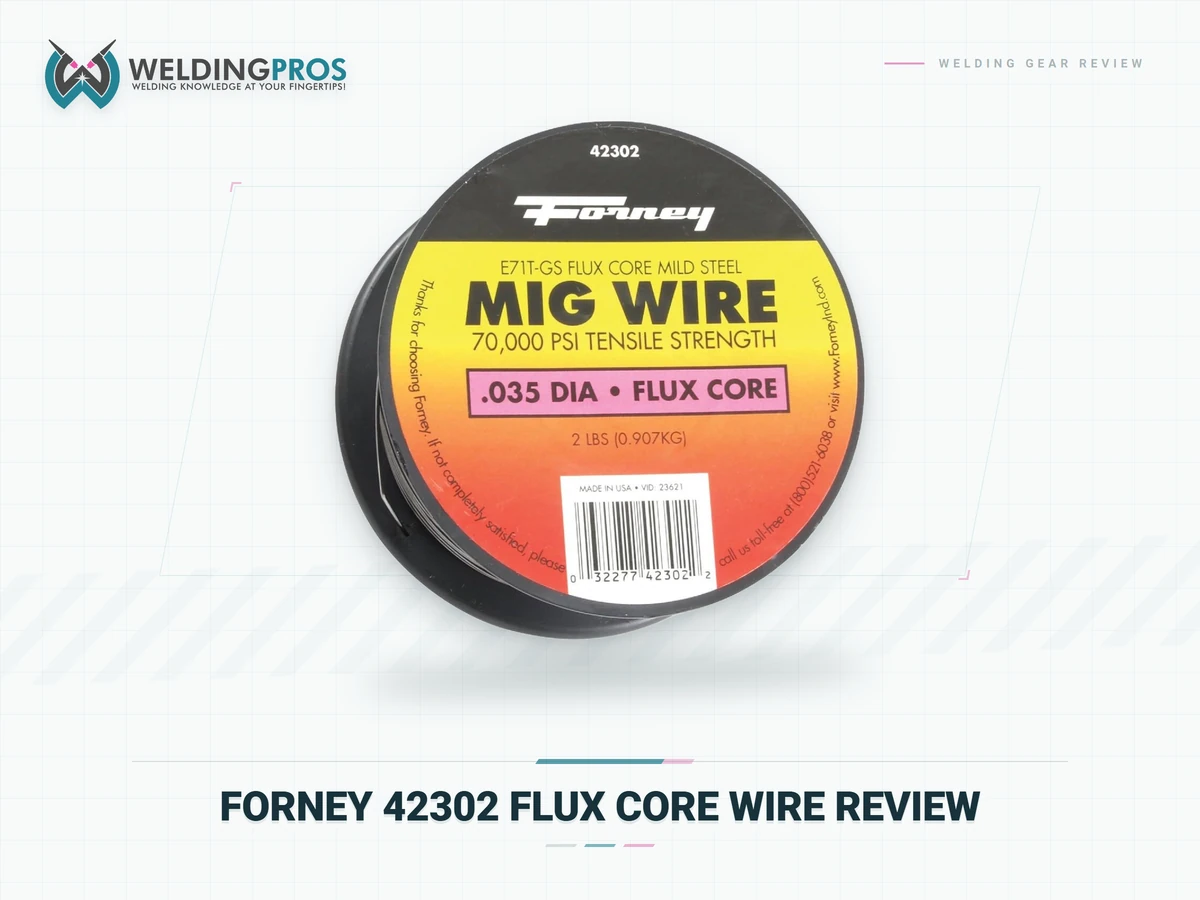
Forney sells the same wire in a .030 inch version under model 42300; the 42302 reviewed here is the .035 diameter that most 140-amp-class hobby machines feed well. The Self in the product name is the gasless part; the pink band on the label is how you confirm you grabbed the right spool.
Forney Industries operates out of Fort Collins, Colorado; the 42302 ships sold by Forney, fulfilled by Amazon, with the standard 30-day return window. The catalog runs from wire and rods to abrasives and helmets, but the spools are what you see stocked in every farm supply aisle.
In this Forney 42302 review, I will cover setup and polarity, bead quality on dirty metal, the single-pass question, and who should buy this spool instead of the alternatives.
Forney 42302 Package Content & Technical Specifications
The package is one 2 lb spool in a sealed bag, nothing else. Normal for wire. Keep the bag, because flux core wire left open in a humid garage picks up moisture and feeds badly regardless of brand. The package includes:
Gasless Single-Pass Wire For Mild Steel
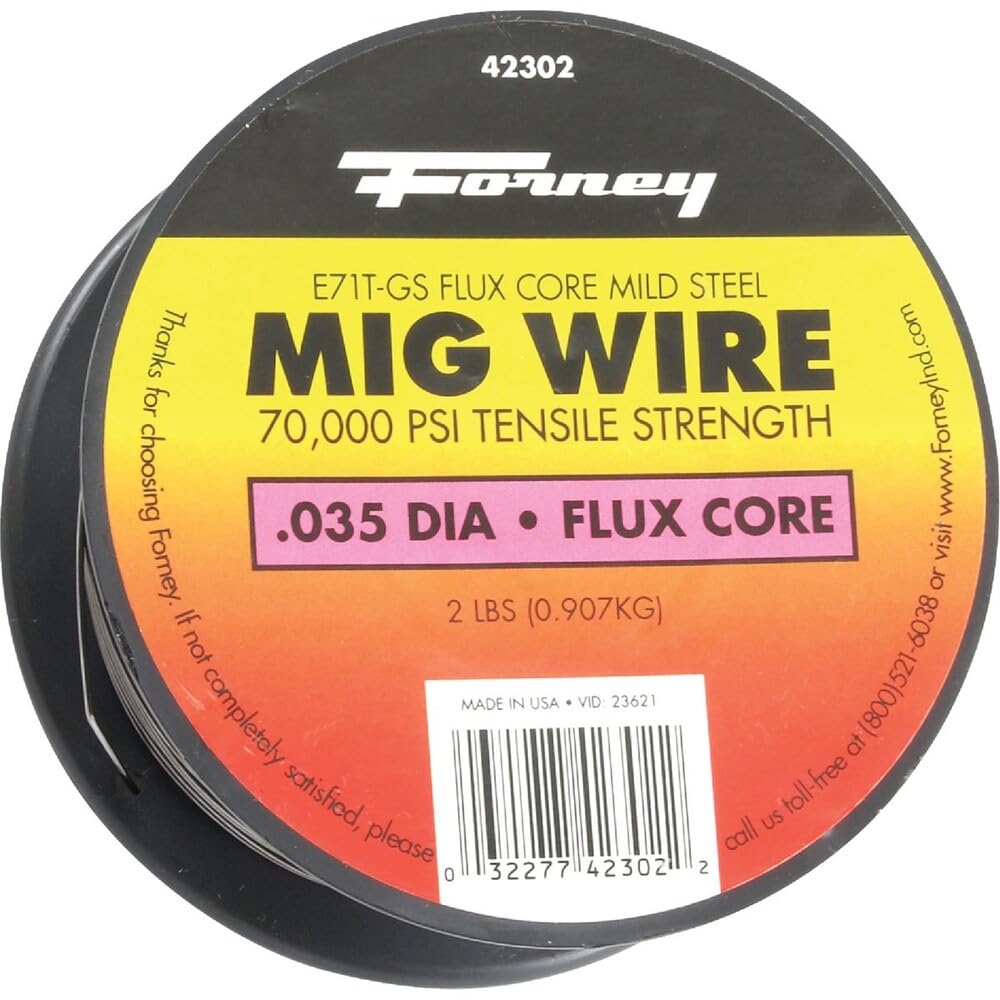
- 2 lb spool of Forney 42302 E71T-GS .035″ (0.889 mm) gasless flux core welding wire
- Spool label with pink color code, specification, and safety notes
Technical Specifications
| Brand: | Forney Industries (Fort Collins, Colorado) |
| Model: | 42302 |
| Classification: | E71T-GS self-shielded flux core (AWS A5.20) |
| Wire diameter: | .035″ (0.889 mm) |
| Spool weight: | 2 lb (0.907 kg) |
| Tensile strength: | 79,000 PSI |
| Shielding gas: | None required (self-shielded) |
| Polarity: | DCEN straight (electrode negative) |
| Welding positions: | All positions |
| Passes: | Single pass |
| Base metal: | Mild steel, including rusty, dirty, painted |
| Best use: | Thin gauge, high travel speed, outdoor work |
| Line variants: | .030″ sibling, model 42300 |
| Amazon rating: | 4.7/5 (937 ratings) |
Pros
- No shielding gas needed, so no bottle, regulator, or hose to drag outside
- Feeds and welds on rusty, dirty, and painted steel without grinding to bright metal
- All-position capability including vertical and overhead
- 79,000 PSI tensile rating with a 4.7 star average across 937 ratings
- Pink label color code makes the right spool easy to grab
Cons
- Single pass only; stacking passes is outside the classification
- Runs hotter than solid wire, which limits it on very thin sheet
- Moderate to low spatter, still more cleanup than solid wire under gas
- DCEN required, so leads need swapping from a solid-wire setup
- 2 lb spool costs more per pound than the 10 lb spools in the category
How the Forney 42302 .035 Wire Performs
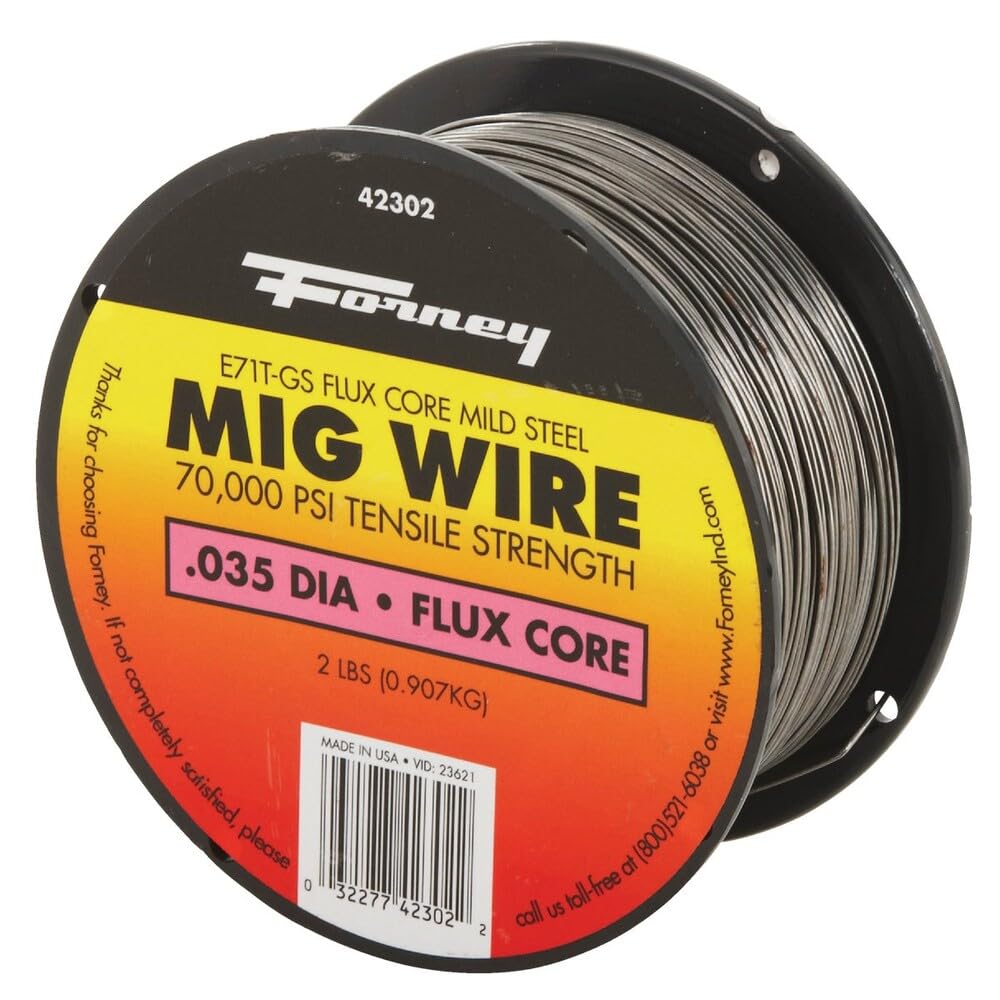
No gas bottle changes where you can work. The flux inside the wire forms its own shielding as it burns, so wind that would blow away a shielding gas stream and leave porosity in the bead barely matters here. Forney’s own listing pitches the 42302 at outdoor use and high wind conditions, which is exactly the niche gasless wire was built for: fence repair, farm equipment, trailer fixes, anything done in a driveway or a field instead of a shop. The AWS A5.20 spec defines what E71T-GS means, worth reading if you want the full usability designators.
On paper, the 42302 is ordinary GS wire done properly. What separates it from the anonymous no-name spools beside it on the shelf is quality control, spatter behavior, and a label that tells the truth about polarity. Those three threads run through everything below.
Setup: Polarity, Contact Tip, and Drive Rolls
The wire runs on DCEN, direct current electrode negative, what Forney’s spec sheet calls straight polarity. Most small MIG machines ship configured for solid wire, the opposite polarity, so the leads move to different terminals before the first pass. Skip that step and the arc sounds wrong and spatters ugly, the most common way a new spool gets blamed for a setup error.
Two details finish the changeover: a .035 contact tip, not the .030 still in the torch from a thinner spool, and flux core drive rolls, since a solid-wire roll can squash the tubular wire and bird-nest it at the liner. The 42302 label prints the polarity right on the spool, which cheaper wire often omits. If you are new to the process, our MIG welding guide walks through the full setup.
Bead Quality, Spatter, and Dirty Metal
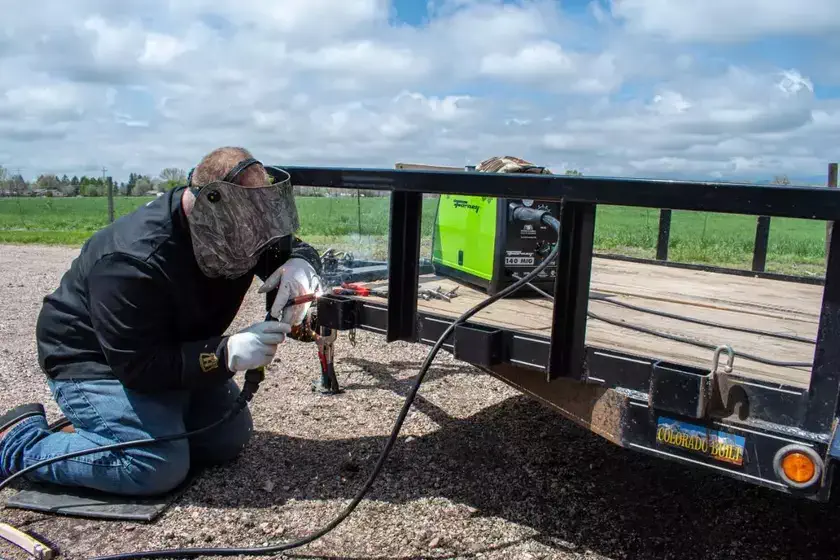
Forney describes the spatter as moderate to low, and adds that running an Argon/CO2 mix will reduce it further, an odd option on a wire that needs no gas but useful if you already own a bottle. The honest expectation for any GS wire: more cleanup than solid wire under gas, slag to chip after every pass, and smoke. Within that reality, 4.7 stars across 937 ratings says this spool behaves: consistent feeding, a controllable puddle on thin material, and the same mess every flux core wire earns.
The stronger selling point is what it tolerates before welding: Forney rates the wire for rusty, dirty, and painted material, with deoxidizers in the flux handling base metal you did not grind to shine. Farm and field repair is the whole point, because cleaning a gate or a loader arm to bright metal in a pasture is not happening. On thin gauge the .035 sits at the upper end of comfortable, and Forney notes the wire runs hotter than solid wire, so voltage comes down a step from ER70S-6 settings.
Single Pass, Sibling Sizes, and Who Should Buy
The GS classification is a single-pass wire. E71T-GS is built for one pass at high travel speed; if the joint needs stacked passes, the wire you want is E71T-11, which carries a limited multi-pass rating and costs a bit more per pound. For thin stock, tube, sheet, and most repair work, single pass is all a joint ever sees, which is why GS dominates the hobby end of the category. The decision only bites on thicker material, roughly quarter inch and up, where a second pass is the difference between a fillet and a fusion failure.
Diameter and spool size are the other two calls. The .030 sibling, model 42300, lays flatter beads on auto body gauge and feeds on even the smallest 90-amp machines, while the .035 reviewed here penetrates better on thicker stock and runs happily on 140-class machines. The 2 lb spool is the try-it size; if the wire earns a permanent spot on the shelf, buying a 10-pound spool from any brand cuts the per-pound cost noticeably.
Frequently Asked Questions [F.A.Q]
Does the Forney 42302 need shielding gas?
No. It is a self-shielded E71T-GS flux core wire; the flux core generates the shielding as it burns. That makes it suitable for outdoor and windy work where gas-shielded welding would suffer porosity. Forney notes an optional Argon/CO2 mix will reduce spatter, but it is not required.
What polarity does the Forney 42302 use?
DCEN, direct current electrode negative, called straight polarity on the Forney spec sheet. Machines set up for solid MIG wire run the opposite polarity, so swap the leads before welding, and fit a .035 contact tip with flux core drive rolls.
Can I weld rusty or painted metal with it?
Yes. Forney rates the wire for rusty, dirty, and painted mild steel, since the flux formulation includes deoxidizers that handle imperfect surfaces. Heavily scaled steel still welds better with the worst loose scale knocked off, and anything galvanized needs ventilation for the zinc fumes.
What is the difference between the Forney 42302 and 42300?
Diameter only. The 42302 is .035 inch wire and the 42300 is .030 inch, both 2 lb spools of the same E71T-GS formulation. The .030 suits thin auto body work and small machines, the .035 penetrates better on thicker stock.
Conclusion
The Forney 42302 is the spool I would hand someone welding mild steel outside with no gas setup: an honest, well-labeled E71T-GS wire from a Colorado company that has been in the welding aisle for decades, with a 4.7 star average across 937 ratings and a #142 rank in a very large category. Set the polarity right, chip the slag, keep your expectations aligned with what single-pass GS wire is, and it earns its shelf space. See how it stacks up against Lincoln, Hobart, and YesWelder in our best flux core guide.






