
Most home welders burning gasless wire know the disappointment of a no-name spool: spatter everywhere, a bird-nested liner, and slag that fights back. The YESWELDER E71T-GS review below covers the .035″ version on the 2 lb spool, the one most people load for weekend repairs.
I have run enough of this flux core wire now, on clean mild steel and on some ugly farm-stock repairs, to know where it earns its spot as our best flux core wire overall and where its single-pass limit bites. Wind, driveway, no gas bottle: none of that matters to a self-shielded wire.
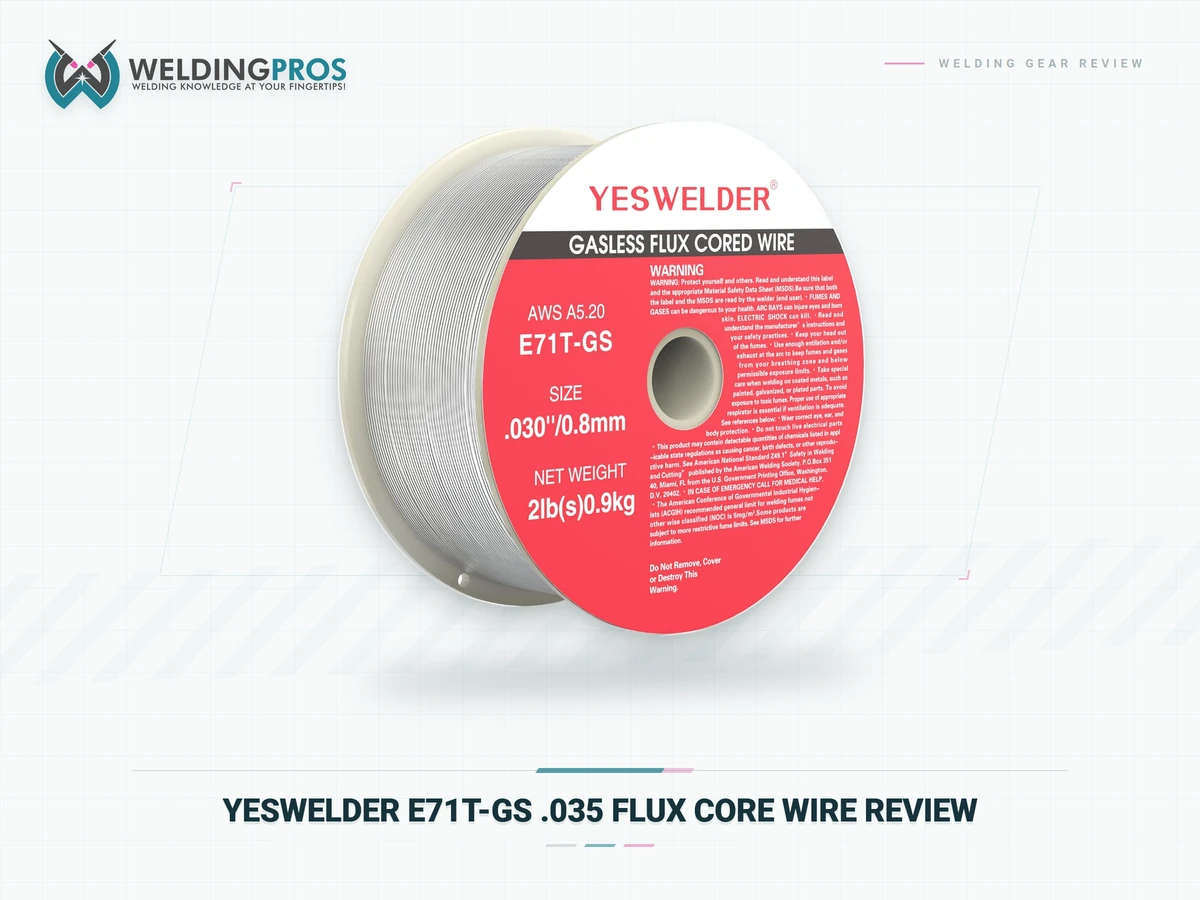
The short version: this wire feeds smooth, starts arcs without fuss, and the slag lifts off in one piece. YesWelder rates it 4.8 out of 5 across 99 reviews on its own store, and that number matches what happened at my bench. It is ordinary E71T-GS done properly, sealed packaging included.
In this YESWELDER E71T-GS review, I will cover feed behavior, spatter and slag, machine fit, and who should buy a different classification instead.
YESWELDER E71T-GS Package Content & Technical Specifications
This is a consumable, not a machine, so the box is short and honest. The spool arrives sealed in a plastic bag inside the shipping box, which several buyers called out by name in their reviews. The package includes:
Clean-Feeding Gasless Wire For Mild Steel

- 2 lb (0.9 kg) spool of .035″ (0.9 mm) E71T-GS flux core wire, sealed in a plastic bag
- Specification and safety notes on the spool labeling
10% Discount Code: “WELDPROS”
Technical Specifications
| Classification: | E71T-GS (AWS A5.20) |
| Wire diameter: | .035″ (0.9 mm) |
| Process: | Flux-cored, self-shielded (gasless) |
| Shielding gas: | Not required |
| Tensile strength: | 70,000 psi |
| Welding positions: | All positions |
| Passes: | Single-pass only |
| Polarity: | DCEN (electrode negative) |
| Base material: | Mild steel, carbon steel |
| Spool weight: | 2 lb (0.9 kg) |
| Other variants: | .030″, 10 lb spool, 3-pack and 5-pack |
| Store rating: | 4.8/5 (99 reviews) |
Pros
- Feeds smooth with consistent arc starts on 110V and 220V machines
- Low spatter on clean steel, and slag removal is a brush job, not a chisel job
- Sealed-bag packaging keeps spare spools dry in storage
- Flat, consistent beads on mild steel from 16 gauge up to 1/4 inch
- Works with any gasless flux core welder, no special drive rolls needed
- 4.8 out of 5 across 99 buyer reviews on the YesWelder store
- 2 lb spool size suits hobby use without the wire rusting before you finish it
- Free US shipping on orders over $150 from YesWelder direct
- 10% discount for WeldingPros readers with coupon code WELDPROS
Cons
- E71T-GS is single-pass only, so structural multi-pass welds need E71T-11 wire
- Cheaper per ounce in 10 lb spools, but those need an 8 inch spool compartment
- .035″ is too thick for thin sheet below 16 gauge, where the .030″ variant fits better
YESWELDER E71T-GS Review: Feed and Arc Behavior
Feed behavior is the reason this wire keeps the top spot. Through several spools I had zero bird-nesting, and the arc re-struck cleanly on both a 110V compact machine and a 220V MIG. Cheap flux core usually announces itself with an angry, spitting start. This one does not.
One owner on the YesWelder store put it better than I can: his feeder “seems to like this wire better than all the others I’ve used.” Another switched back from a Harbor Freight roll mid-repair and immediately got less spatter and a controllable arc again. Nothing about the drive setup needs to change either: standard .035″ drive rolls and a matching contact tip, and the MIG welding basics carry over.
Wire Feed and Arc Starts
The feed story holds up across machine types. YesWelder lists the 2 lb spool for its DP200, MCT520-A, MIG-205DS-PRO, MIG-250PRO-A, MP200-PRO, and YWM-160, and the FLUX-135PRO-A takes the 2 lb spool only. On any other brand of gasless machine the small-hub spool drops onto a standard spindle without adapters.
Arc starts were repeatable across cold starts and restarts, which is where budget wire usually falls apart. A spatter-heavy, unstable arc in the first second is the classic sign of inconsistent wire chemistry or bad winding, and neither showed up here. The wire responded predictably to small voltage changes, which one buyer noted it does better than the cheaper rolls he ran before.

Spatter and Slag on Mild Steel

On clean steel from 16 gauge up to 1/4 inch, spatter stayed modest and slag removal was a brush job, not a chisel job: the coating peeled in flakes. That is the practical difference between this and the no-name rolls. Beads came out flat and consistent at mid-range voltage, and a wire brush was usually the whole post-weld routine.
On scaly or painted stock I still prep first, because E71T-GS is not the deoxidizer-heavy formula for filthy metal. That job belongs to something like Forney 42302, which trades feed manners for rust tolerance. Respect the classification limit too: the GS suffix means single-pass welding, so root-and-cap work on thicker joints wants an E71T-11 wire such as Blue Demon or Hobart H222108-R22.
Spool Fit, Diameters, and Storage
Spool fit is the main check before ordering. The 2 lb spool uses the common small-hub format and fits the compact machines most home welders own. The 10 lb roll is an 8 inch spool, so measure your compartment before sizing up. Thin sheet work below 16 gauge is the one place I would point you at the .030″ variant of this same wire rather than the .035″ reviewed here.
Storage is where the sealed bag earns its keep. Flux core wire pulls moisture out of the air, and a damp spool runs porosity no settings will fix. Buyers consistently mention the sealed packaging in their reviews, one calling it packaged like it is hermetically sealed. A spare spool stored in its bag, in a dry cabinet, stays weldable for seasons, which is exactly what the 2 lb format is for.
Frequently Asked Questions [F.A.Q]
Is the YESWELDER E71T-GS wire good for beginners?
Yes. Gasless operation removes the bottle and regulator from the setup, the arc is forgiving, and a 2 lb spool costs little to learn on. Just accept that slag chipping is part of flux core, and set the machine to DCEN before the first weld.
Can I run multiple passes with E71T-GS wire?
No. The GS classification restricts it to single-pass welds. Multi-pass cracks and trapped slag are the documented failure mode. For root-and-cap work on thicker material, choose an E71T-11 wire such as Blue Demon or Hobart H222108-R22 instead.
What polarity does YESWELDER E71T-GS need?
DCEN, direct current electrode negative, which is the standard requirement for self-shielded flux core. Running DCEP by mistake gives you a harsh arc and heavy spatter. Swap the leads at the machine, not the wire.
Will the 2 lb spool fit my welder?
Almost certainly. The 2 lb spool uses the common small-hub format, and on YesWelder machines it fits everything the company currently sells, including the FLUX-135PRO-A (2 lb only). The 10 lb spool is an 8 inch roll and needs a spool compartment that size.
Conclusion
The YESWELDER E71T-GS .035″ is the wire I hand to anyone asking what to load first in a gasless machine. It feeds without drama, welds clean on mild steel, stores well thanks to the sealed bag, and the 4.8-star track record across 99 buyer reviews says my bench results are typical. Respect the single-pass limit, match your polarity, and it will outperform its price every spool. Use code WELDPROS at checkout for 10% off, and free US shipping kicks in over $150 if you stock up on 3-packs. See how it stacks against the alternatives in our best flux core wire comparison.





