
The Hobart Handler 190 is the welder I recommend when someone has outgrown a 140-amp machine but does not want a shop-sized unit. It runs on 230V power, puts out 25 to 190 amps, and welds mild steel from 24 gauge to 5/16 inch in a single pass. Hobart positions it for farm repair, trailer work, and heavy DIY jobs, and after real time on one I think that positioning is honest rather than marketing.
It holds a spot on our best beginner welders list for one specific buyer: the person who has 230V power in the shop and wants a machine that survives being used hard.
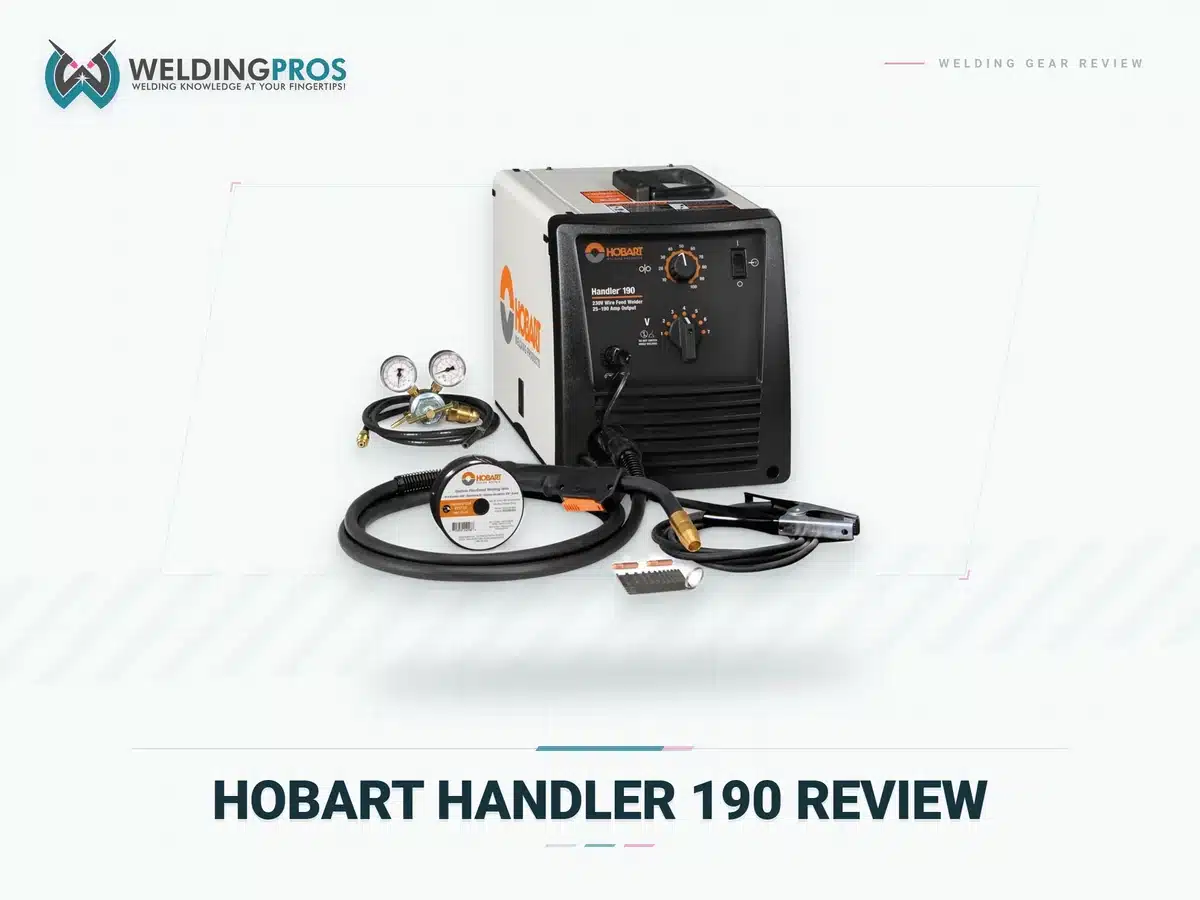
The Handler 140 below it in the range runs on 120V household power; the 190 gives up that convenience and pays you back in output. The transformer power source is old-school on purpose, and that single design choice shapes everything this machine does well.
The short version of the trade: you give up dual voltage, synergic menus, and low weight. You get a durable arc, seven well-spaced voltage taps, self-resetting protections, a spool-gun-ready feeder, and Hobart’s 5/3/1 industrial warranty. If any of those give-ups are dealbreakers, a dual-voltage inverter will serve you better. If none of them are, this machine stays bought for a long time.
In this Hobart Handler 190 review, we cover what ships in the box, the specifications that matter, and how the machine behaves in real welding time. I will flag the trade-offs as we go, because there are a few worth knowing before you spend the money.
Hobart Handler 190 Package Content & Technical Specifications
Hobart ships the Handler 190 (part 500554) as a ready-to-weld package rather than a bare power supply. The HR-100 MIG gun is the piece you touch most, and its rubber-padded ergonomic handle is a small thing that matters on long welds. Here is the full list, matched against the official spec sheet.
Industrial-Grade 230V MIG Welder for Farm and Heavy DIY Work

- Hobart Handler 190 MIG welder (part 500554)
- HR-100 MIG gun with 10 ft. lead
- Work cable with clamp (10 ft.)
- Dual-gauge gas regulator with hose, built-in gas solenoid valve
- Quick Select drive roll for .024 in. or .030/.035 in. solid wire and .030/.035 in. flux-cored wire
- Sample spool of .030 in. flux-cored wire with spare .030 contact tips
- Power cord with plug, spool hub (4 or 8 in.), material thickness gauge, owner’s manual
Technical Specifications
| Welding Process: | MIG (GMAW) / Flux-Cored (FCAW) |
| Input Voltage: | 230V (220/230/240 V), 1-phase, 60 Hz |
| Output Range: | 25-190 A DC |
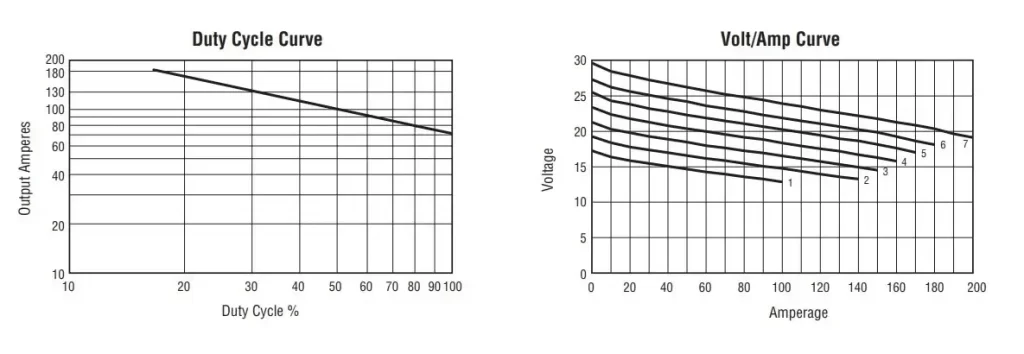
| Rated Output: | 130 A at 21.5 V, 30% duty cycle |
| Open Circuit Voltage: | 31 VDC max |
| Wire Feed Speed: | 40-700 IPM |
| Wire Sizes: | .023-.035 in. solid / .030-.045 in. flux-cored |
| Material Thickness: | 24 ga. to 5/16 in. mild steel |
| Spool Sizes: | 4 and 8 in. |
| Machine Weight: | 68 lb (31 kg) |
| Machine Size: | 12.375 x 10.625 x 19.5 in. (H x W x D) |
| Warranty: | Hobart 5/3/1 industrial warranty |
Pros
- Welds 24-gauge to 5/16-inch mild steel in a single pass
- Quick Select drive roll handles solid and flux-cored wire without swaps
- Built-in contactor keeps wire electrically cold until the trigger is pulled
- Self-resetting thermal and motor protection, no fuses to replace
- Hobart 5/3/1 industrial warranty covers transformer, boards, and gun
Cons
- 230V-only input, no 120V option
- 30% duty cycle at 130 amps rules out long production runs
- Tap-controlled voltage, no synergic or fine adjustment
- 68-pound transformer case, a cart is recommended
- Spool gun for aluminum welding is sold separately
Hobart Handler 190 Welding Performance and Daily Use
Spec sheets tell you what a machine can do on paper. I ran the Handler 190 the way its buyers actually use it: fence gates, trailer hitches, bracket repair, and the occasional sheet-metal patch. Three things define this welder in practice. The arc you get from seven voltage taps, the 30% duty cycle at 130 amps, and the fact that it only ever asks for a 230V outlet. Everything else is detail, but the detail is where Hobart earns the price.
One note before the details. This is a transformer machine, not an inverter, and that choice drives most of what follows: the 68-pound case, the simple control panel, and the kind of arc that has not changed much in decades because it did not need to.
Welding Power, Arc Quality, and Duty Cycle
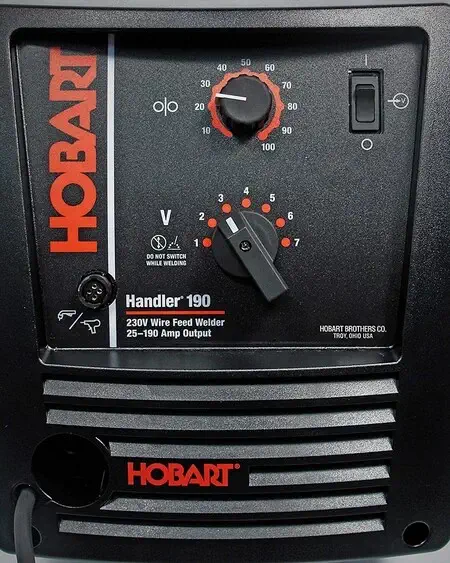
Output runs from 25 to 190 amps DC. In practice that means 24-gauge sheet on the low taps and 5/16-inch mild steel in a single pass at the top, with thick stock reachable in multiple passes. The 7-position voltage control plus infinite wire speed give a stable arc across the whole range, and the steps between taps are spaced well enough that I never felt stuck between two settings.
The door chart inside the wire compartment lists starting points for every wire, gas, and thickness combination, which does most of the setup thinking for you and helps you dial in the right settings, though the wire speed number is a starting value rather than a law: stickout, travel speed, and how clean the metal is all move the right setting once the arc is lit.
Gas choice follows the chart: a 75/25 argon-CO2 mix for clean beads, good arc stability, and low spatter on steel, or straight CO2 when cost matters or the work is outdoors in wind, and a helium tri-mix for stainless, all fed at 20 to 30 CFH. If you are still getting the hang of the process itself, our how to MIG weld guide covers the fundamentals this review assumes.
The rated duty cycle is 30% at 130 amps and 21.5 volts, so figure three minutes of arc-on time out of every ten at rated output. That covers farm repair and structural DIY work without forced cooldowns. Push toward the full 190 amps and the usable duty cycle drops fast, which tells you this machine is built for serious repair work rather than production welding. When you do overwork it, the thermal protection trips, the arc stops, and the machine resets itself once it cools; there is no breaker to find on a dark fence line.
The spec sheet is blunt about one habit worth building early: do not flip the voltage switch mid-weld. Change taps between beads, not during one. On the electrical side, it draws about 20.5 amps input at rated output, which is why Hobart specifies a 230V circuit with a 30-amp breaker. Open-circuit voltage is 31 VDC, and the unit is CSA certified to both Canadian and US standards.
Drive System, Setup, and Consumables
The Quick Select drive roll carries three grooves: one for .024 (0.6 mm) solid wire, one for .030/.035 solid, and a knurled groove for .030/.035 flux-cored. Overall the machine runs .023 to .035 solid wire and .030 to .045 flux-cored, with wire feed speed ranging from 40 to 700 IPM. Wire changes take minutes, and the quick-release lever means you are not fighting the feeder when you re-thread.
The spool hub accepts both 4 and 8-inch spools, so a large flux-cored spool lasts a season of weekend repair work.
Tension setup is printed on the machine for a reason: set the drive tension knob to 3 at start, then adjust per the manual until the wire feeds without slipping, because most bird-nesting complaints trace back to tension that was never set right in the first place. Dialed in correctly, the wire feed is smooth and reliable.
Consumables stay easy to find: contact tips from .023 to .045, spare Quick Select rolls, and a dual-groove V-knurled roll (part 202926) if you burn .045 flux-cored regularly. The HR-100 replacement gun (part 284546) is stocked wherever Hobart gear is sold.
The small setup details are handled well. Setup is straightforward, and the control panel keeps things simple: a wire-speed knob, a voltage selector, and an on-off switch. Polarity changeover between solid and flux-cored wire takes a minute inside the door, the built-in contactor keeps the wire electrically cold until you pull the trigger, which helps protect the operator from touching a hot wire accidentally, and both the drive motor and the transformer have self-resetting protection.
Nothing here needs a fuse replaced after a stall; you let the machine cool down or clear the fault and go back to work. Short-circuit protection covers the input side as well. The door latch and hinges feel designed by people who expect that door to be opened often, because it is: that is where the settings chart and the spool gun switch both live.
Input Power, Portability, and Aluminum
The Handler 190 is 230V only, single phase, 60 Hz. It requires a dedicated 230V outlet on a proper 30-amp circuit, which is the same kind of outlet most large shop tools use, but it rules out the household 120V receptacle, and that is the single most common reason buyers pass on this machine.
Generator power works when you are away from the shop. Expect around 5,000 watts continuous to hold a 130-amp output, and roughly 7,000 watts to run the machine near full capacity.
In my experience the transformer power source is also more forgiving of generator power than most inverter boards, which matters on automotive, farm service, and light fabrication work.
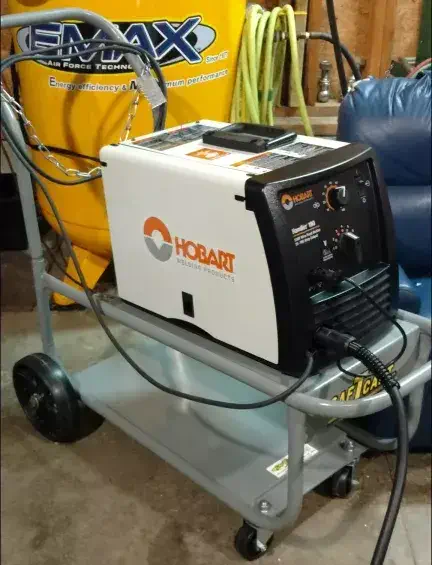
At 68 pounds (31 kg), this is portable but not light, and most owners mount it on a cart quickly; Hobart sells a small cylinder rack (part 194776) for exactly that.
The case measures 12.375 by 10.625 by 19.5 inches, so it fits on the same shelf a Handler 140 does, just heavier. If the weight matters more than output, dual-voltage inverters like the Eastwood MIG 180i trade some amperage ceiling for a much lighter case. Aluminum is on the menu too, but only with the optional SpoolRunner 100 spool gun.
Installation is close to plug-and-play: the power pin goes into the feedhead, the trigger lead clips on, and one switch inside the door flips the machine into spool gun mode. That gun is rated at 150 amps at a 60% duty cycle, welds 16-gauge to 3/16-inch aluminum with .030 or .035 wire from 4-inch spools, and ships in its own carrying case with spare tips.
The door chart covers aluminum too, with 4043 and 5356 filler under 100% argon, and you need the right regulator for your shielding gas setup. Hobart also sells the 190 bundled with the SpoolRunner 100 (part 500554001), and multiple retailers often run sales that make that package deal more attractive than buying the two separately. Without a spool gun, soft aluminum wire bird-nests in the standard lead, the same as on any MIG machine in this class.
Frequently Asked Questions [F.A.Q]
Is the Hobart Handler 190 good for beginners?
Yes, the Handler 190 is a good choice for beginners, with one condition. The tap-style controls and the settings chart inside the door make setup simple, the machine is user-friendly, and the controls are straightforward; the arc is forgiving, and the protections reset themselves when a beginner overdoes it instead of leaving you hunting for a fuse. It is still a MIG-only machine, not a multi-process unit for TIG or stick. The condition is power: you need a 230V outlet, which not every home shop has. If the outlet exists, this Hobart machine is one of the friendliest first welders to grow into rather than out of.
What is the duty cycle of the Hobart Handler 190?
30% at 130 amps and 21.5 volts. That works out to three minutes of welding out of every ten at rated output, which suits repair and fabrication work rather than continuous production welding. At outputs above 130 amps the duty cycle falls further, so plan around the rated numbers for anything sustained, and let the self-resetting thermal protection do its job when you push past them.
Can the Hobart Handler 190 weld aluminum?
Yes, the Handler 190 is spool gun ready for aluminum welding with the optional SpoolRunner 100 spool gun, which plugs directly into the machine without an adapter or control box. It handles 16-gauge to 3/16-inch aluminum using .030 or .035 wire on 4-inch spools, with 4043 or 5356 filler under 100% argon. Hobart also sells a bundle (part 500554001) that may help buyers pay less than they would for separate purchases, though you’ll still need ongoing consumables for MIG welding. Feeding soft aluminum wire through the standard gun and liner invites bird-nesting, so the spool gun is not optional in practice if aluminum is regular work.
Will the Hobart Handler 190 run on 120V household power?
No. This is a 230V-only machine (220/230/240V single-phase) and needs a circuit protected at 30 amps. If your workshop only has 120V outlets, the Handler 140 or a dual-voltage inverter is the better fit. Paying an electrician to wire a 230V circuit for one welder can make sense if more tools will follow, but it belongs in the purchase decision, not in a surprise after the box arrives.
Conclusion
The Handler 190 is not trying to be modern, and that is the point. It is a transformer MIG welder with tap controls, a 68-pound case, and a 30% duty cycle at 130 amps. In exchange for giving up dual voltage and synergic menus, you get a durable arc, drive and thermal protection that reset themselves, a spool-gun-ready feeder, and Hobart’s 5/3/1 industrial warranty: five years on the transformer, stabilizers, and main rectifier, three on boards and drive system parts, one on the MIG gun, serviced through Hobart and Miller authorized repair shops. For farm repair, trailer work, and heavy DIY projects where 230V power is available, it earns its asking price. If your outlets are 120V only or you need to carry the welder up a ladder, lighter inverter machines serve those jobs better. This one is a plug-in shop tool that stays bought.






