
Auto-darkening welding helmets live or die by three things: how well you can see the puddle, how reliably the lens switches, and how the helmet feels after a full shift. The 3M Speedglas 9100XXi is 3M’s answer for professional welders who want a large view, low-amperage TIG reliability, and external controls they can reach without lifting the hood.
3M sells the 9100 platform in several filter versions, and the XXi sits at the top of the standard range: improved optics for more natural colors, two memory modes, and a silver front panel that puts grind and memory buttons on the outside of the helmet.
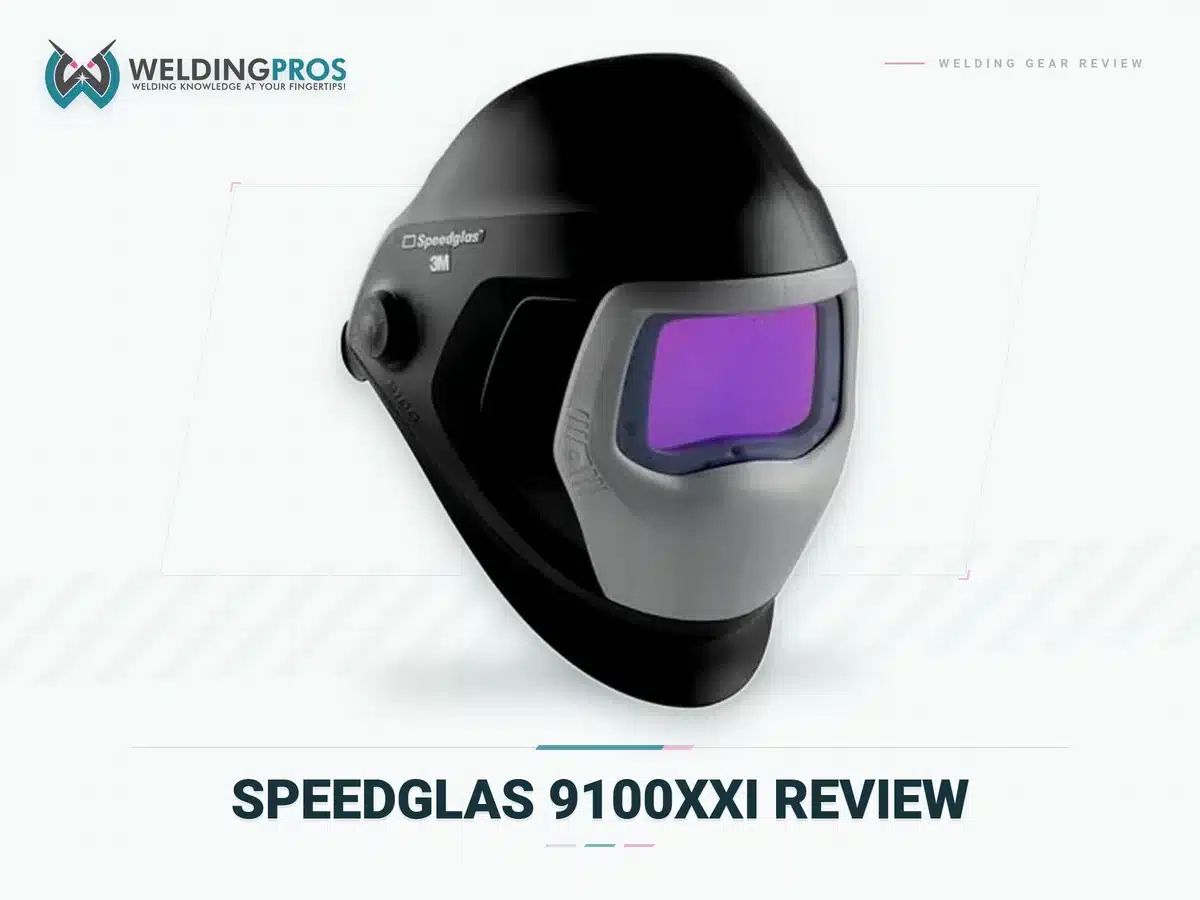
The 3M Speedglas 9100XXi is a professional auto-darkening welding helmet built around the 9100 shield with side windows and the 9100XXi auto-darkening filter. It offers a 2.8 x 4.2 in (73 x 107 mm) viewing area, shades 5 and 8-13 plus a shade 3 light state, three arc sensors, and roughly 1800 hours of battery life from two CR2032 cells. It carries ANSI Z87.1-2010 certification and, with the hard hat adapter, also meets ANSI Z89.1.
The 9100 platform is 3M’s long-running professional shield, sold with four filters: the 9100V, the 9100X, the 9100XX, and the 9100XXi reviewed here. Above it sits the 9100-Air variant with an integrated supplied-air connection, and the hard hat adapter (part 06-0014-00NR) converts any 9100 for sites that require Z89.1 head protection. The 06-0100-30iSW package currently holds a 4.5-star average from 269 ratings on Amazon and carries an Amazon’s Choice badge, a reasonable sanity check that the model still sells well years after launch. The XXi filter also appears across the wider 9100 family, from the plain helmet kit to the 9100-Air supplied-air and Adflo PAPR assemblies.
In this 3M Speedglas 9100XXi review, we will walk through what the helmet does, what you get in the box, and where it beats or trails the competition. We also spend time on the settings system, because the seven-level sensitivity and the five-position delay are what keep a lens switching reliably on difficult arcs.
3M Speedglas 9100XXi Auto Darkening Welding Helmet Package Content & Technical Specifications
Here is what 3M ships inside the box of the 06-0100-30iSW package, followed by the full technical specifications of the helmet. Alongside the helmet itself, the welding cap and carry bag handle storage and daily transport, and the starter kit covers the first set of consumables. Over the life of the helmet, the parts you actually replace are the protection plates and the batteries.
Professional Auto-Darkening Welding Helmet With External Controls

- Speedglas 9100 welding helmet with side windows
- 9100XXi auto-darkening filter pre-mounted
- Silver front panel 9100XXi
- Welding cap
- Carry bag
- Starter kit (outer and inner protection plates)
- User instructions
Technical Specifications
| Helmet Series: | 3M Speedglas 9100 with side windows |
| Auto-Darkening Filter: | Speedglas 9100XXi with silver front panel |
| Viewing Area: | 2.8 x 4.2 in (73 x 107 mm) |
| Light State / Dark State: | Shade 3 / shades 5, 8-13 |
| Arc Sensors: | 3 independent sensors |
| Switching Time (light-dark): | 0.1 ms (+23 °C) |
| Sensitivity / Delay: | 7 levels / 5 positions, 0.04-0.8 s |
| TIG Rating: | Down to about 1 A |
| Battery: | 2 x CR2032 lithium, about 1800 h |
| Helmet Weight: | About 1.35 lb (610 g) |
| Standards: | ANSI Z87.1-2010; ANSI Z89.1 with adapter |
| Model Number: | 06-0100-30iSW |
Pros
- Large 2.8 x 4.2 in view plus side windows
- Reliable low-amp TIG detection (about 1 A)
- External grind and memory controls work with gloves
- Two memory modes for repeated settings
- 1800 h battery life with easy CR2032 swaps
Cons
- XXi battery life is the shortest in the 9100 range
- Premium price vs budget auto-darkening hoods
- No solar assist on the XXi filter
- Grind and memory modes require the silver front panel
- Consumables limited to original 3M spare parts
View Area, Optics, and Everyday Use
After the box contents and the spec table, the real question is how the helmet performs across a working day. The 9100XXi separates itself from the cheaper 9100 filters in three areas that matter in practice: view and optics, control layout, and long-shift comfort.
None of this is exotic technology on its own; the value is how it works together under a welding schedule. The rest of this review looks at each area in detail.
3M positions the 9100XXi across assembly work, facility maintenance, grinding, machine operation, sanding, and welding, with construction, heavy infrastructure, and industrial maintenance listed as its recommended industries. That breadth matters for a shop helmet: the same hood gets used for tack welds, for plasma or gas cutting with the lens locked in a dark shade, and for grinding between passes, which is exactly the workload the grind mode and the memory modes are built around.
View Area and Optics
The filter itself switches from light to dark in about 0.1 ms at 23 °C, and three independent arc sensors watch the arc, so a briefly obscured arc does not leave you flashed. 3M’s improved optics on the XXi filter show the puddle with more natural colors and better contrast than the older 9100XX, which helps on TIG work where you read the pool more than the arc. The three sensors react independently, so a sensor blocked by a fixture does not blind the other two, though a fully shielded arc can still delay switching.
The numbers behind that view: the XXi window measures 2.8 x 4.2 in (73 x 107 mm), and the shade-rated side windows widen your awareness of obstacles and coworkers without letting in stray arc flash. In the light state the filter sits at shade 3, bright enough for joint setup and post-weld inspection.
Protection is permanent where it counts: the auto-darkening lens blocks harmful UV and IR radiation at a shade 13 equivalent in every state, light or dark, whether or not the auto-darkening function is working, and a failed lens rests at shade 5 rather than clearing. For choosing dark shades, 3M guidance adapted from ANSI Z49.1 puts stick welding at 60 to 160 amps around shade 10 and TIG at 50 to 150 amps around shade 12, and the 8-13 range of the XXi covers both without straining. Switching between the two shade groups, 5 and 8 versus 9 to 13, is a two-second hold of the shade button, and a separate cut mode locks the selected dark shade for plasma or gas cutting work.

Silver Front Panel: Grind and Memory Controls

On controls, the silver front panel is the functional difference between the XXi and a plain 9100XX: the external controls, grind mode, and two memory modes sit behind an external button you can press with gloves on. The delay function is five-position adjustable from roughly 0.04 to 0.8 seconds, and sensitivity offers seven levels, so low-current TIG down to about 1 A stays reliable.
The details are well thought out. Grind mode locks the welding filter at shade 3 and flashes its LED about every five seconds so you do not forget it is active; one press on the front panel returns you to welding, which is handy when you flip between welding and grinding tasks. Holding the external button for two seconds toggles between two stored combinations of shade, sensitivity, and delay, which suits welders who jump between welding processes. Delay and sensitivity share one LED but adjust separately, and auto-on returns the filter to your last used settings the moment you pick the helmet up.
The seven sensitivity levels are what keep the filter switching on awkward jobs, so they deserve a slow read. Position 1 is the least sensitive, meant for shops where other welders arcs keep triggering your lens. Position 2 is the default for most indoor and outdoor welding. Position 3 suits stable arcs such as regular TIG, position 4 targets low-current TIG and inverter machines, and position 5 handles TIG work where part of the arc is hidden from the sensors. The practical rule from 3M is simple: if the lens does not darken, raise the sensitivity, and if it stays dark after the arc stops because of ambient light, lower it.
Headgear, Weight, and All-Day Comfort
Comfort comes from the 9100 head suspension: multiple adjustment points, a pivot knob to set the distance of the helmet from your face, and a head size range of 50-64 cm. The headgear is comfortable, and the design is lightweight and ergonomic. The shell ships at roughly 1.35 lb (610 g) complete with filter, and the three-channel exhaust vent across the chin directs breath down and out, which keeps the lens from fogging on humid days. That low weight also helps minimize neck strain when you wear the helmet through a full shift. 3M also rates the helmet for hard hat use with the adapter and for use with a respirator. For full supplied-air setups, the separate 9100-Air helmet adds a breathing-tube connection, a real comfort gain in hot or fume-heavy work. A comfort sweatband is available as an accessory in 3-packs and 12-packs, which matters more than it sounds once the original has absorbed a summer of sweat.
The battery story is simple: two CR2032 lithium cells deliver about 1800 hours of welding, and a low-battery indicator tells you when to swap them. The XXi has no solar assist (unlike the 9100V and 9100X), which is why its rated life sits below the 2500-2800 hours of its siblings. On the upside, the cells are cheap, sold in pairs, and replaceable in seconds without tools. Replacement cells ship as a two-pack under part 04-0320-00, and the battery holder (06-0400-55) is a listed spare as well.
Materials and spare parts round the helmet out. The shell is PPA, the silver front frame is PA, the side windows are polycarbonate, and the face seal is a 50/50 polyester-cotton mix. Component weights stay low, about 265 g for the shield with side windows and silver front, 120 g for the headband, and 200 g for the XXi filter itself, and the filter is rated from -5 to +55 °C. The 3M spare-parts catalog keeps each unit alive for years: scratch-resistant and heat-resistant outer plates, inner plates, sweatbands, battery holders, and 1.5x to 2.5x magnification lenses can be replaced individually, though replacement parts can cost more than entry-level helmet consumables. The one restriction is that 3M specifies original spare parts only, since substitute parts can compromise the protection classification and affect warranty claims; check the instruction manual for approved parts, maintenance, and replacement guidance.

Frequently Asked Questions [F.A.Q]
Is the Speedglas 9100XXi compatible with a cheater lens?
Yes. 3M offers magnification (cheater) lenses for the 9100 series in 1.5, 2.0, and 2.5 diopter strengths (part numbers 06-0500-56, -57, -58, -59), and they fit behind the inner protection plate of the XXi filter.
Can you TIG weld at low amperage with the 9100XXi?
Yes. Sensitivity is adjustable across seven levels, and 3M rates the filter for TIG above roughly 1 A, so low-current TIG and inverter machines are within its design range. Positions 3 to 5 of the sensitivity settings exist specifically for stable or low-current TIG arcs. The switch itself takes about 0.1 ms from light to dark, quick enough that even tack welds are covered.
Is the Speedglas 9100XXi compatible with respirators?
Yes. The standard 9100 shield (the non-Air version) can be used with many reusable and maintenance-free welding respirators, though the exact compatibility depends on the 3M respirator model. 3M also sells the 9100-Air version with an integrated supplied-air connection, aimed at professional welders who need a full respiratory setup.
What is the difference between 9100XX and 9100XXi?
The optics and the controls. The XXi improves color rendering over the XX, and its grind and memory modes work through an external silver front panel button instead of controls you have to open the helmet to reach. Battery life is the trade-off: the XXi is rated at about 1800 hours versus 2000 on the XX, because the XXi has no solar assist. Both filters share the same 2.8 x 4.2 in window and the same 9100 shell, so the choice comes down to whether the external controls and the better color rendering are worth the shorter battery life to you.
Conclusion
The 3M Speedglas 9100XXi earns its place as a professional pick: the 2.8 x 4.2 in view with side windows, reliable sub-2-amp TIG detection, and glove-friendly external grind and memory controls add up to a helmet you stop thinking about mid-shift. The costs are real too: XXi battery life is the shortest in the 9100 filter range, and the helmet is priced well above budget hoods, and replacement parts can cost more than entry-level consumables. If you weld for a living and divide your time between TIG, MIG, and grinding, the 9100XXi is one of the strongest packages in this price class; if you weld occasionally, a cheaper 9100V or G5-variant will do the same safety job for less money. The package holds a 4.5-star average across 269 Amazon ratings at the time of writing, and the official documentation behind it, from the spec sheets to the spare-parts catalog, is deeper than most helmet brands ever publish. You can compare it against the other helmets we tested in our best welding helmet guide for a direct comparison of the welding helmet market.






