
A boot can pass every safety rating on paper and still fall apart in a welding shop. Ratings get tested in labs. Shops drop plate on your instep, spray slag across your laces, and cook cheap glue until the sole peels off. This Timberland PRO Met Guard review covers the 8-inch steel toe 53530, the boot I ranked first in my best welding boots guide, and why it earned that spot.
Quick orientation on what this boot is. The 53530 is a black 8-inch steel toe work boot, a lace-up in an Ever-Guard leather upper with a steel safety toe, an external hinged metatarsal guard, and an electrical hazard rating.
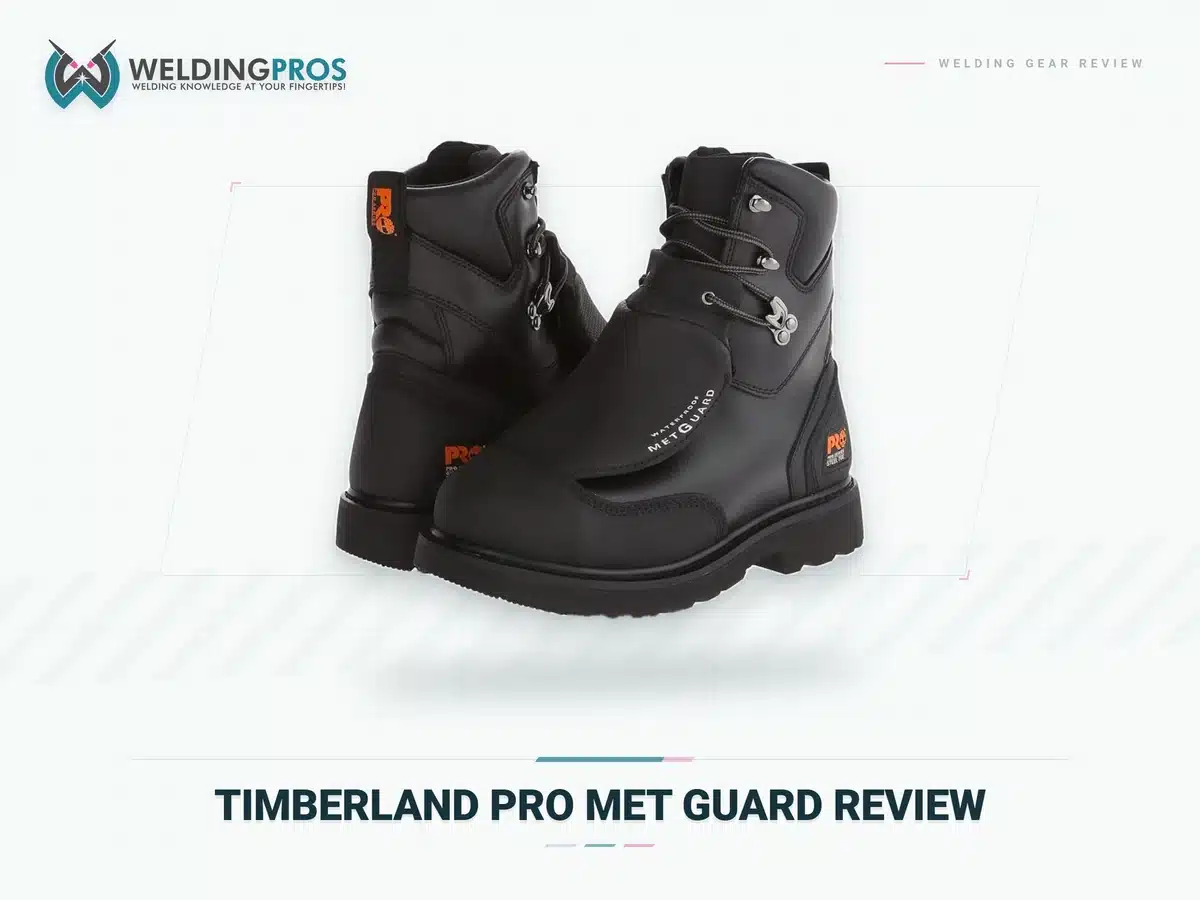
Amazon customer reviews rate it 4.5 out of 5 across more than 1,400 ratings, which for a boot that gets abused daily says something. The listing has been on Amazon since 2008, so this is a proven design for tough work, not a new one.
Timberland PRO Met Guard Package Content & Technical Specifications
Boots in this class ship with the pair and whatever Timberland PRO includes as standard. Here is what comes fitted and in the box on the 53530.
External met guard boot for heavy fabrication.

- 1 pair Timberland PRO Met Guard 8″ Steel Toe boots (style 53530)
- Kevlar-stitched lace set
- External met-guard flap (pre-fitted)
- Closed-cell PU footbeds (pre-fitted)
- Steel shanks (pre-fitted)
- Waterproof membrane lining (pre-fitted)
- Care/warranty info from Timberland PRO
Technical Specifications
| Material: | Ever-Guard full-grain leather, waterproof membrane |
| Safety Rating: | Steel toe + external met guard, ASTM F2413-24 (I/75 impact, SR slip, EH) |
| Height: | 8″ shaft |
| Waterproof: | Yes |
| Sole: | Heat/oil/slip-resistant rubber, non-marking, Goodyear welt |
| Footbed: | Closed-cell polyurethane (PU), 24/7 Comfort Platform |
| Shank: | Steel |
| Met Guard: | External, hinged, asymmetrical ABS |
| Style Number: | 53530 (MGUARD8IN) |
| Lining: | Breathable, moisture-wicking, at least 50% recycled plastic |
Pros
- Ever-Guard leather shrugs off sparks and slag better than standard leather
- External metatarsal guard protects the instep from dropped stock
- Goodyear welt construction is resoleable
- Closed-cell PU footbed holds its shape through long shifts
- Electrical hazard rating for work boots near live circuits
Cons
- The met guard flap wears through faster if you spend long stretches on your knees
- Heavier than plain steel-toe boots
- Premium price
- One colorway only (black)
- Runs warm in summer (waterproof membrane)
What makes the Timberland PRO Met Guard work for welding
The leather matters more than you would think
Standard chrome-tan leather takes sparks fine for a while. Slag is the killer. It lands hot enough to burn through and leave a hole that grows. Ever-Guard is Timberland’s heat-treated, abrasion-resistant leather, and the company claims it is ten times stronger than regular leather and heat resistant. Treat the number as marketing, but the practical result stands: slag bounces off instead of melting in.
Then there is the thread. Most boots are stitched with polyester thread that melts at spark contact, and every melted stitch is a hole that grows. Timberland uses Kevlar sewing thread on the welt and the upper of this boot, so the seams take the same abuse the leather does.

The upper is backed by a waterproof membrane, and the lining carries an antimicrobial treatment for odor control. Neither shows up on a spec sheet you would cross-shop, but both matter in a boot worn ten hours a day. Wet feet in winter and stink in summer are the two complaints that push welders out of otherwise fine boots, and the 53530 addresses both.
The met guard is the whole point

A steel toe protects the front quarter of your foot. Nothing about a standard boot protects the top, which is exactly where a dropped piece of plate or a chipping hammer lands.
The 53530 puts an asymmetrical ABS guard over the laces and instep, wrapped in leather so it does not look like a hockey pad.
The detail that makes it wearable is the hinge. Solid guards stop your foot flexing, which matters when you squat to tack a joint. This one is hinged, so it moves with your arch and only goes rigid when something hits it.
Plenty of boots hide an internal metatarsal guard under the leather instead; the external kind takes the hit directly and is easier to inspect for damage.
Foot protection that lets you actually work beats foot protection that fights you, and it is one of the few pieces of welding safety equipment where the comfortable option is also the safer one.
The honest cost is kneeling. If your work keeps you on your knees, the flap is the first part to scuff through.
Fabricators who kneel all day wear through guards faster than soles.
That is the trade for metatarsal protection in any external met-guard work boot.
Welt, sole, and the cost per year
The sole is stitched on with a Goodyear welt instead of glued. Two things follow. First, the mechanical bond survives heat that would soften cement in a cheap boot. Second, when the tread dies, a cobbler can resole the boot for far less than a new pair costs. On a work boot at this price, that changes the real cost per year. Daily welders in the parent review’s comments report two-plus years of service; add one resole and you spread the purchase over three or four years.

Underfoot, the non-marking rubber outsole is rated heat, oil, and slip resistant, for shops that care about floor scuffs. A steel shank sits between footbed and sole, keeping the boot stable on ladder rungs and grating.
The contoured footbed is closed-cell polyurethane on Timberland’s 24/7 Comfort Platform, built for breathable lightweight comfort over long hours. It does not soak up sweat and pack flat the way cheap open-cell foam does. The lining wicks moisture, at least half of it recycled plastic, and an antimicrobial treatment handles odor control. Nice, but not why you buy.
Frequently Asked Questions [F.A.Q]
Are Met Guard boots comfortable?
Comfortable enough to wear all day, which is not a given for met guard footwear. The hinge is the reason: the guard flexes when you walk or squat instead of holding your foot flat. The closed-cell footbed keeps its cushion past the point where cheap foam packs out. Expect a break-in period on any 8-inch leather boot; after that, owners report comfy full shifts over long hours without wanting to take them off.
What is the difference between Timberland and Timberland PRO?
Timberland is the outdoor lifestyle brand; Timberland PRO is its work line, built around ASTM-rated safety footwear. PRO safety features range from steel safety toes to alloy and composite toe options, met guards, and electrical hazard protection. The Met Guard 53530 sits in the PRO line. If a boot carries the PRO badge, it is aimed at job sites, not hikes.
Is a met guard the same as a steel toe?
No, they protect different zones. The steel toe caps the front of the foot against impact resistance and compression. The met-guard covers the metatarsal bones along the top of the foot, behind the toes. Dropped plate tends to hit that zone more often than the toe cap itself, which is why heavy fabrication work calls for both.
Is the Timberland PRO Met Guard good for welding?
Yes, and it is my top pick among welding boots. The combination that matters: heat-resistant Ever-Guard leather, Kevlar-stitched seams, a guarded instep for dropped stock, and a resoleable Goodyear welt, so the shoe outlives its first outsole. Very few boots put all four in one package
Conclusion
The Timberland PRO Met Guard is not the lightest boot I have worn, not the cheapest, and not what I would hand a welder who spends all day kneeling. For daily fabrication work it is the one I would buy with my own money. The leather survives slag, the seams are stitched with thread that does not melt, the instep is guarded, and the durability story ends with a resole instead of a replacement. Protection you can rebuild is worth paying a premium for.
If kneeling work or a tighter budget describes you better, the pull-on Wellington options in my roundup of the best welding boots trade the met guard for simpler maintenance and a lower price.






