
Many angle grinders are good enough to get the job done. But, if you want to get the best angle grinder for your budget and the work you typically do, it takes some “grinding” through the market.
If you go to any tools webshop right now and pick a grinder at random, you are likely to be “fine,” unless you are a heavy-duty contractor. But, that’s not a wise way to spend your money or pick your tools.
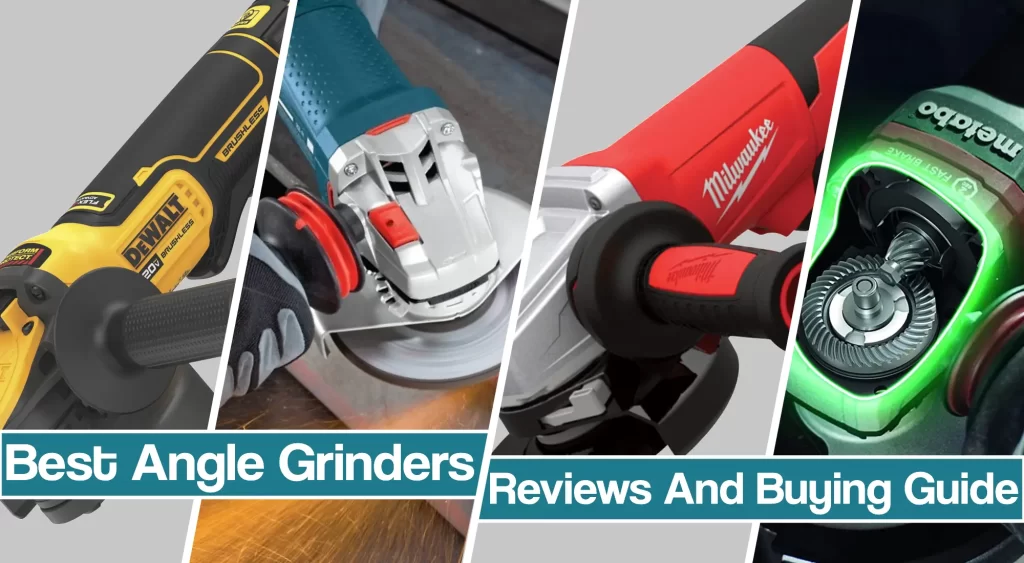
We did our best to scourge the market and separate the wheat from the chaff based on multiple criteria. For example, a grinder may have a high RPM but a low torque power and weak real-life performance. You don’t want that, especially since there is always a better option at a similar price.
So, let’s get started.
Best Angle Grinders Comparison Chart
| Image | Name | Disc Size | Power | Speed | Variable Speed | Switch | Weight | Check Price |
|---|---|---|---|---|---|---|---|---|

| HILTI 2075614 AG 450-D 7 Amp 4-1/2" Angle Grinder | 4-1/2" | 7A / 120V | 11,500 RPM | No | Paddle (Dead-Man) | 4.4 lbs | Check Price |

| Metabo HPT W 24-180 MVT 7" Angle Grinder | 7" | 15A / 2,400W | 8,450 RPM | Yes (MVT) | Lock-On Slide | 12.5 lbs | Check Price |

| Bosch GWS8-45 4-1/2" Angle Grinder | 4-1/2" | 7.5A / 900W | 11,000 RPM | No | Slide | 4.2 lbs | Check Price |

| Metabo HPT WE 15-150 Quick 6" Angle Grinder | 6" | 13.5A / 1,500W | 9,600 RPM | No | Lock-On Slide | 5.7 lbs | Check Price |

| Metabo HPT WP 13-150 Quick 6" Corded Angle Grinder | 6" | 12A / 1,440W | 10,000 RPM | Yes (TC) | Paddle (No Lock) | 5.7 lbs | Check Price |
 | Makita 9564CV 4-1/2" SJS Angle Grinder | 4-1/2" | 13A / 1,380W | 2,800-10,500 RPM | Yes (5-Speed) | Slide w/ Lock-On | 4.0 lbs | Check Price |
 | DEWALT DWE402 4-1/2" Angle Grinder | 4-1/2" | 11A / 1,400W | 11,000 RPM | No | Paddle | 4.6 lbs | Check Price |

| DEWALT DWE4011 4-1/2" One-Touch Guard Grinder | 4-1/2" | 7A / 840W | 12,000 RPM | No | Slide | 4.0 lbs | Check Price |
Best Angle Grinders Reviews
We separated the reviews based on angle grinder characteristics and the users’ needs. If you are unfamiliar with some of the terms used to explain the grinders, please read the buying guide at the bottom of the article.
The grinders below are the best choices in their price categories today. Most angle grinders we reviewed use a 4-1/2-inch disc size because that’s what most hobbyists and professionals use.
1. HILTI 2075614 AG 450-D 7 Amp 4-1/2″ Angle Grinder – Best Light-Duty Corded Angle Grinder
Best Light-Duty Corded Angle Grinder
HILTI 2075614 AG 450-D
The HILTI AG 450-D is a German-engineered angle grinder built for weekend warriors and light shop work. At 7 amps and 11,500 RPM, it won’t replace your big corded grinder for heavy fab work, but for deburring, cutting thin stock, and cleaning up welds, it gets the job done without the weight of a professional machine.
| Disc Size: | 4-1/2″ | Power: | 7A / 120V |
| Speed: | 11,500 RPM | Variable Speed: | No |
| Switch Type: | Paddle (Dead-Man) | Weight: | 4.4 lbs |
| Input Voltage: | 120V AC | Country of Origin: | Germany |
| Warranty: | 20-Year Limited | Spindle Thread: | 5/8″-11 UNC |
What separates HILTI from the pack is the build quality. I’ve run this grinder side-by-side with cheaper import brands, and the difference is obvious the moment you pick it up. The gear set runs smoothly, there’s no slop in the spindle, and the dead-man paddle cuts power the instant you open your hand. At 4.4 pounds, you can run this thing one-handed all day without your forearm giving out.
The dust protection on the AG 450-D uses a sealed bearing housing and directed airflow that pushes debris away from the motor. I’ve used grinders that eat their own bearings after a year of cutting masonry, and HILTI’s sealing is better than most in this price range. The tool-free guard adjustment is genuinely useful — no hunting for a screwdriver when you need to reposition mid-job.
The dead-man paddle is the feature that sells this grinder on jobsites. Squeeze to run, release and the wheel stops, so a drop, a kick, or a snag in the work shuts the motor down instead of letting the disc walk away from you. Your forearm does more work than with a slide switch, and that is the honest trade-off: more fatigue on long runs, less risk everywhere else.
Value-wise, the HILTI name commands a premium. You’re paying more for this 7-amp grinder than a comparable Bosch or DEWALT with similar specs. What you’re buying is HILTI’s engineering tolerances and service network. For a hobbyist who uses a grinder on weekends, it’s worth it. For a pro grinding 20 hours a week, look at a 13-amp machine.
If you want a well-built, lightweight angle grinder that will outlast the no-name imports and won’t tire your hands, the HILTI AG 450-D earns its spot. Just don’t expect it to punch above its 7-amp weight class on heavy stock.
Pros
- German-engineered build quality with a smooth, precise gear set
- Lightweight at 4.4 lbs — comfortable for extended one-handed use
- Effective dust protection with sealed bearings and directed airflow
- Tool-free guard adjustment saves time and frustration
- Dead-man paddle stops the wheel the instant you release it
- 2-year limited warranty backed by HILTI service network
Cons
- 7-amp motor bogs down when pushed hard on thick steel
- No variable speed control limits versatility
- No disc or case included in the box
2. Metabo HPT W 24-180 MVT 7″ Angle Grinder – Best Heavy-Duty Large Angle Grinder
Best Heavy-Duty Large Angle Grinder
Metabo HPT W 24-180 MVT
The Metabo HPT W 24-180 MVT is not your typical angle grinder. This is a 7-inch, 15-amp beast built for contractors and fabricators who need to remove material fast. If you cut pipe all day or grind heavy welds on structural steel, the extra disc size and power make a real difference. A 4-1/2-inch grinder takes two passes where this one takes one.
| Disc Size: | 7″ | Power: | 15A / 2,400W |
| Speed: | 8,450 RPM | Variable Speed: | Yes (MVT) |
| Switch Type: | Lock-On Slide | Weight: | 12.5 lbs |
| Input Voltage: | 120V AC | Country of Origin: | Japan |
| Anti-Vibration: | MVT System | Handle: | 3-Position Side |
The standout feature here is the MVT anti-vibration system. Metabo HPT integrated a damper into the handle assembly that actually works. I’ve used 7-inch grinders that rattle your hands numb after an hour, and the MVT cuts that vibration down noticeably. The rat-tail design with a 3-position side handle gives you enough grip options that you can find a comfortable angle for any cut.
At 8,450 RPM, this is slower than a small 4-1/2-inch grinder, but that’s expected. Larger discs need lower RPM to keep the surface speed in check. The lock-on slide switch is what you want on a tool this size — nobody wants to squeeze a paddle for 20 minutes straight on a 12-pound grinder. The dust protection uses a patented labyrinth seal that Metabo claims extends motor life by keeping fine particles out of the armature.
Power delivery is where the W 24-180 earns its keep. The 2,400-watt motor maintains speed under load better than any Chinese import in this class. When you bear down on thick steel, the RPM drops less, which means faster cutting and less stalling. The tool-free guard adjustment is standard on Metabo HPT’s better grinders, and it’s just as convenient here as on their smaller models.
Downsides? It’s heavy. At 12.5 pounds, you feel this grinder after a full shift. The price tag is substantial too — you’re paying for Japanese engineering and the MVT tech. And at 15 amps, it’ll trip a 15-amp breaker if anything else is on the same circuit. You’ll want a dedicated 20-amp line for this one.
For welders and fabricators who regularly work with thick material, the W 24-180 MVT is worth the investment. If you’re a hobbyist or only occasionally need to cut something heavy, a 6-inch grinder will serve you better for less money.
Pros
- 2,400W motor maintains speed under heavy load
- MVT anti-vibration system noticeably reduces hand fatigue
- 3-position side handle and rat-tail grip for multiple cutting angles
- Patented labyrinth dust seal extends motor life
- Tool-free guard adjustment — quick and easy
- 8,450 RPM with 7-inch disc removes material fast
Cons
- Heavy at 12.5 lbs — fatiguing during extended use
- 15-amp draw requires a dedicated 20A circuit
- Premium price point
3. Bosch GWS8-45 4-1/2″ Angle Grinder – Best Budget Corded Angle Grinder
Best Budget Corded Angle Grinder
Bosch GWS8-45
Bosch has been making the GWS8-45 for years, and there’s a reason it’s one of the best-selling angle grinders on Amazon. At $69, it delivers 7.5 amps and 11,000 RPM in a package that weighs just 4.2 pounds. That’s the sweet spot for a weekend warrior who needs a reliable grinder without overthinking the purchase.
| Disc Size: | 4-1/2″ | Power: | 7.5A / 900W |
| Speed: | 11,000 RPM | Variable Speed: | No |
| Switch Type: | Slide Switch | Weight: | 4.2 lbs |
| Input Voltage: | 120V AC | Country of Origin: | China |
| Warranty: | 1-Year Limited | Spindle: | 5/8″-11 UNC |
The slim-grip design is what sets this grinder apart from the budget competition. Bosch kept the barrel diameter narrow enough that most people can wrap their hand around it comfortably, which matters when you’re running the grinder one-handed for quick cuts. The slide switch is positioned where your thumb naturally rests, and the two-position side handle gives you a second grip option for heavier work.
Durability is adequate for the price point. The carbon brushes are oversized, which extends brush life compared to the cheap import grinders that eat brushes every few months. The directed airflow design pushes dust away from the motor housing, though it’s not as sophisticated as the sealing you’d get on a Metabo or HILTI. The Service Minder brush system is a nice touch — the grinder stops automatically when the brushes need replacing, which prevents motor damage from running worn-down brushes.
The burst-protection guard is tool-free adjustable, and it works. You twist the guard to where you need it and it stays put. No screws to lose, no hunting for a hex wrench. The spindle lock button is oversized, which makes disc changes faster than on grinders with tiny lock buttons that are hard to press with gloved hands.
What you give up for the low price: a 1-year warranty instead of Milwaukee’s 5-year, no variable speed, and no electronic overload protection. If you’re a professional who grinds all day, these omissions matter. If you’re a hobbyist who uses a grinder for 30 minutes on a Saturday, they don’t. The motor runs smooth and doesn’t bog down easily on 1/8-inch stock, but push it hard on 1/4-inch plate and you’ll feel the 7.5-amp limit.
For the money, the Bosch GWS8-45 is hard to beat. It won’t outlast a premium grinder, but it’ll outlast the no-name imports, and Bosch’s parts availability means you can actually get replacement brushes when you need them.
Pros
- Excellent value at the sub-$70 price point
- Slim-grip barrel design comfortable for one-handed use
- Service Minder brushes prevent motor damage
- Tool-free burst-protection guard with easy adjustment
- Oversized spindle lock button for quick disc changes
- Directed airflow diverts dust from vital components
Cons
- 1-year warranty is short compared to competitors
- No variable speed control
- No electronic overload protection
4. Metabo HPT WE 15-150 Quick 6″ Angle Grinder – Best Mid-Range Corded Angle Grinder
Best Mid-Range Corded Angle Grinder
Metabo HPT WE 15-150 Quick
The Metabo HPT WE 15-150 Quick fills the gap between the lightweight 4-1/2-inch grinders and the heavy 7-inch machines. With a 6-inch disc, 13.5 amps, and Tacho-Constamatic electronics that maintain speed under load, this grinder is aimed at the professional who needs more material removal than a small grinder can deliver but doesn’t want to carry a 12-pound tool all day.
| Disc Size: | 6″ | Power: | 13.5A / 1,500W |
| Speed: | 9,600 RPM | Variable Speed: | No (constant speed) |
| Switch Type: | Lock-On Slide | Weight: | 5.7 lbs |
| Input Voltage: | 120V AC | Country of Origin: | Germany |
| Disc Change: | M-Quick Tool-Free | Safety Clutch: | S-Automatic |
The M-Quick system is the headline feature here, and it deserves the attention. You press the spindle lock button and the disc nut releases instantly. No spanner wrench, no fighting with a rusted lock nut. In a production environment where you swap between a grinding disc, a cutting wheel, and a flap disc ten times a day, this feature saves more time than you’d think. The 7-position tool-free guard adjustment works just as smoothly.
The TC (Tacho-Constamatic) electronics are what separate this grinder from cheaper variable-speed models. When the motor encounters resistance, the electronics compensate to maintain RPM instead of letting the speed drop. In practice, this means you get consistent cutting regardless of how hard you’re pushing. The built-in safety clutch is another pro-grade feature — if the disc binds or catches, the clutch disengages before the grinder kicks back into your face.
At 6.5 pounds and with a lock-on slide switch, this grinder is comfortable for extended use. The anti-vibration side handle is effective, though not as sophisticated as the MVT system on the W 24-180. The dust protection uses the same labyrinth seal design as Metabo HPT’s larger grinders, and I’ve seen these motors last years in dirty environments without bearing failure.
The price puts this in pro territory. You’re paying for the M-Quick convenience, the TC electronics, and German build quality. If you’re a DIYer who grinds occasionally, a Bosch GWS8-45 at a third of the price will do the job. But if you grind for a living and value speed and consistency, the WE 15-150 Quick pays for itself in reduced downtime.
My recommendation: if you already own a 4-1/2-inch grinder and want a step up without the bulk of a 7-inch machine, this is the one. The 6-inch disc size is versatile enough for most fab shop work, and the quick-change system is genuinely useful once you get used to it.
Pros
- M-Quick tool-free disc change — genuinely saves time on the job
- TC electronics maintain constant speed under load
- S-Automatic safety clutch prevents dangerous kickback
- 13.5-amp motor with 50% more torque than previous generation
- Patented labyrinth dust seal for extended motor life
- 7-position tool-free guard adjustment
Cons
- Premium price — overkill for casual users
- Lock-on switch lacks the safety of a paddle
- 6-inch discs are less common at local hardware stores than 4-1/2-inch
5. Metabo HPT WP 13-150 Quick 6″ Corded Angle Grinder – Best German-Engineered Angle Grinder
Best German-Engineered Angle Grinder
Metabo HPT WP 13-150 Quick
The Metabo HPT WP 13-150 Quick is made in Germany, and the difference shows. This isn’t the same Metabo HPT you get from the Japanese Koki Holdings line — this is the original Metabo, built in Nürtingen to standards that rival Fein and HILTI. For welders who value precision manufacturing over price, this grinder makes a compelling case for spending more.
| Disc Size: | 6″ | Power: | 12A / 1,440W |
| Speed: | 10,000 RPM | Variable Speed: | Yes (TC Electronics) |
| Switch Type: | Paddle (No Lock) | Weight: | 5.7 lbs |
| Input Voltage: | 120V AC/DC | Country of Origin: | Germany |
| Disc Change: | M-Quick Tool-Free | Handle: | MVT Anti-Vibration |
The 12-amp motor runs on AC or DC, which matters if you work in a shop with DC power or run the grinder off a generator. At 10,000 RPM with a 6-inch disc, the surface speed is optimized for efficient cutting without burning through discs too fast. The TC electronics maintain constant speed under load, so when you bear down on a weld bead, the RPM doesn’t sag the way it does on a basic grinder.
The paddle switch with no lock is a deliberate safety choice. Release the paddle and the grinder stops immediately. For jobsite work where safety officers check your tools, this is the switch configuration they want to see. The trade-off is hand fatigue during extended grinding sessions. The MVT anti-vibration handle helps compensate, but your grip hand still needs to stay engaged.
The M-Quick disc change works exactly like the WE 15-150 — press the spindle lock, and the nut releases. Combined with the 7-position tool-free guard and the 90-degree rotatable gear housing, this grinder adapts to awkward cutting angles better than most. The S-Automatic safety clutch is standard, cutting power to the disc within milliseconds of a bind-up.
The downsides are straightforward: it’s expensive, the paddle gets tiring, and 6-inch consumables cost more than 4-1/2-inch. But if you make your living with an angle grinder in your hand, the WP 13-150 Quick is the kind of tool you buy once and use for a decade. German manufacturing costs more upfront, but the precision pays off every time you pick it up.
Pros
- Made in Germany — build quality rivals Fein and HILTI
- AC/DC motor runs on generators and shop DC power
- TC electronics maintain constant speed under load
- Paddle switch with no lock meets jobsite safety standards
- M-Quick tool-free disc change and 90° rotatable gear housing
- MVT anti-vibration handle reduces fatigue
Cons
- Premium German manufacturing comes at a premium price
- Paddle switch causes hand fatigue during extended use
- 6-inch consumables cost more than 4-1/2-inch discs
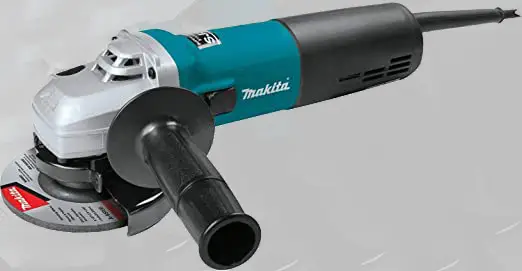
6. Makita 9564CV 4-1/2″ SJS Angle Grinder – Best Variable-Speed Angle Grinder
Best Variable-Speed Angle Grinder
Makita 9564CV
The Makita 9564CV is the angle grinder I recommend most often to welders who do finishing work. The 5-speed variable dial lets you match RPM to the material and the task — high speed for cutting, medium for grinding, low for polishing and paint removal. With 13 amps behind a 4-1/2-inch disc, the power-to-weight ratio is excellent, and at just 4 pounds, this is one of the lightest grinders in its power class.
| Disc Size: | 4-1/2″ | Power: | 13A / 1,380W |
| Speed: | 2,800-10,500 RPM | Variable Speed: | Yes (5-Speed Dial) |
| Switch Type: | Slide w/ Lock-On | Weight: | 4.0 lbs |
| Input Voltage: | 120V AC | Country of Origin: | Japan |
| Safety Features: | SJS + Soft Start | Warranty: | 1-Year Limited |
The SJS (Super Joint System) is Makita’s mechanical clutch that protects the motor and gears if the disc binds or catches. Unlike electronic clutch systems that rely on sensors, SJS is a physical spring-loaded mechanism that absorbs the shock mechanically. In practice, it means this grinder survives accidental bind-ups that would strip the gears on a cheaper tool. The soft-start feature ramps the motor up gradually instead of jerking the tool in your hand on startup.
Makita’s labyrinth construction is their answer to dust ingress, and it works. The motor housing uses a series of interlocking channels that trap dust before it reaches the armature. I’ve opened up 9564CVs that have seen years of cutting concrete and masonry, and the internals stay cleaner than most grinders subjected to the same abuse. The sealed bearings at both ends of the armature add another layer of protection.
The slide switch with lock-on is positioned for right-handed use. You can lock it on for extended grinding sessions or leave it momentary for quick cuts. The tool-free guard adjustment uses a lever rather than a twist-lock, which some people prefer and others find less secure. It’s never slipped on me, but if you’re rough with your tools, the Bosch twist-lock guard feels more positive.
At 13 amps and 10,500 RPM max, this grinder has enough power for professional use in a fab shop, but the 1-year warranty is disappointing. Milwaukee offers 5 years on their grinders, and for a tool that costs this much, Makita should stand behind it longer. The brushes are standard carbon, not the oversized or long-life types you get on some competitors, which means you’ll replace them more often if you use the grinder daily.
For variable-speed capability in a lightweight package, the Makita 9564CV is the benchmark. It’s the grinder I grab when I need to switch between cutting and finishing without changing tools, and the 5-speed dial is more practical than infinite variable triggers that are hard to hold at a consistent speed.
Pros
- 5-speed dial with 2,800-10,500 RPM range covers cutting to polishing
- Lightweight at 4.0 lbs with 13-amp power — excellent power-to-weight ratio
- SJS mechanical clutch protects gears from bind-up damage
- Soft-start eliminates jerk on startup
- Labyrinth construction and sealed bearings for dust protection
- Tool-free guard with lever adjustment
Cons
- 1-year warranty is short for a pro-grade tool
- Standard carbon brushes wear faster than oversized types
- Slide lock-on switch less safe than paddle for jobsite environments
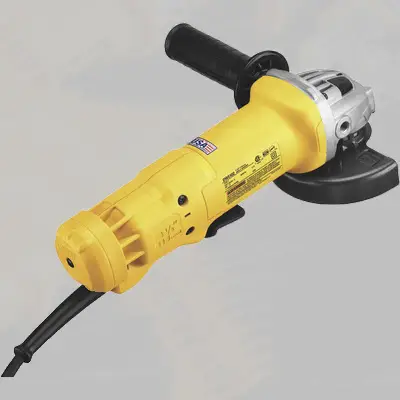
7. DEWALT DWE402 4-1/2″ Angle Grinder – Best Compact Angle Grinder for Professionals
Best Compact Angle Grinder for Professionals
DEWALT DWE402
The DEWALT DWE402 is the grinder you see on every construction site and in every welding shop for a reason. DEWALT took the standard small angle grinder formula and refined it through generations of incremental improvements. The 11-amp motor pushes 11,000 RPM through a 4-1/2-inch disc, and the whole package weighs 4.6 pounds. It’s not the lightest, it’s not the most powerful, but it’s the most consistently reliable grinder I’ve used across dozens of job sites.
| Disc Size: | 4-1/2″ | Power: | 11A / 1,400W |
| Speed: | 11,000 RPM | Variable Speed: | No |
| Switch Type: | Paddle Switch | Weight: | 4.6 lbs |
| Input Voltage: | 120V AC | Country of Origin: | USA |
| Quick-Change: | Wheel Release | Warranty: | 3-Year Limited |
The Quick-Change wheel release is a DEWALT feature that doesn’t get enough credit. You press a button, the spindle locks, and the disc nut spins off by hand. No spanner wrench required. When you’re cutting rebar on a jobsite and swapping between a cutting wheel and a grinding disc every few minutes, this saves real time. The One-Touch guard on this model adjusts with a single lever that you can operate with gloves on.
The paddle switch is the defining feature of the DWE402, and it’s why this grinder shows up on OSHA-compliant job sites. No lock-on means the grinder stops the moment you release it. The downside is hand fatigue: after an hour of continuous grinding, your grip hand is going to be sore. DEWALT addressed this somewhat with the slim body design, which lets you choke up higher on the tool for better control.
Durability is where the DWE402 earns its 3-year warranty. The oversized brushes last longer than standard carbon brushes, and the dust ejection system is genuinely effective at keeping debris out of the motor. The auto-shutoff carbon brushes stop the grinder before the brushes wear down to the point of damaging the commutator, which is a simple feature that saves expensive motor repairs. The spiral bevel gears are cut for smooth operation and even wear over time.
The American-assembled label matters to some guys and doesn’t to others, but DEWALT’s US service network means replacement parts and warranty service are easier to access than for import brands. At this price point, the 3-year warranty beats Bosch’s 1-year and comes close to Milwaukee’s 5-year, but with better parts availability in my experience.
This is not the grinder for fine finishing work — no variable speed means you’re stuck at 11,000 RPM for everything. But for cutting, grinding, and weld prep, the DWE402 is the standard against which other 4-1/2-inch grinders are measured.
Pros
- Quick-Change wheel release — no tools needed for disc swaps
- Paddle switch meets OSHA jobsite safety requirements
- Oversized carbon brushes with auto-shutoff protection
- Effective dust ejection system keeps motor clean
- 3-year limited warranty with broad US service network
- American-made with spiral bevel gears for smooth operation
Cons
- Paddle switch causes hand fatigue during extended grinding
- No variable speed — fixed 11,000 RPM for all tasks
- Slightly heavier than comparable 4-1/2-inch grinders at 4.6 lbs
8. DEWALT DWE4011 4-1/2″ One-Touch Guard Angle Grinder – Best Entry-Level Paddle Switch Grinder
Best Entry-Level Paddle Switch Grinder
DEWALT DWE4011
The DEWALT DWE4011 is the budget-friendly alternative to the DWE402, trading 4 amps of power and the Quick-Change wheel release for a lower price and slightly lighter weight. At 7 amps and 12,000 RPM, it’s not built for heavy fabrication, but for home shops and light-duty professional work, it’s a capable tool that costs less than a tank of gas.
| Disc Size: | 4-1/2″ | Power: | 7A / 840W |
| Speed: | 12,000 RPM | Variable Speed: | No |
| Switch Type: | Slide Switch | Weight: | 4.0 lbs |
| Input Voltage: | 120V AC/DC | Country of Origin: | China |
| Guard: | One-Touch Tool-Free | Warranty: | 3-Year Limited |
The One-Touch guard is the star of this grinder. Unlike the twist-lock guards that require some muscle to reposition, the DWE4011’s guard adjusts with a single lever that flips open and closed. You can reposition it in seconds without tools and without taking your gloves off. For a grinder at this price point, having a feature that’s normally reserved for more expensive tools is a genuine value add.
At 4 pounds flat, this is lighter than the DWE402 by over half a pound. That doesn’t sound like much on paper, but when you’re holding the grinder above shoulder height to cut overhead or working in tight quarters, the weight difference is noticeable. The slide switch is positioned for right-handed operation and has a positive detent that prevents accidental engagement, which I’ve found to be a problem on cheaper slide-switch grinders.
The 7-amp AC/DC motor is the DWE4011’s main limitation. You’re getting 12,000 RPM no-load speed, which is actually faster than the DWE402, but with less torque behind it. For cutting thin sheet metal, deburring edges, and light grinding, the power is adequate. Push it into 1/4-inch steel or heavy weld grinding, and the motor bogs down noticeably faster than an 11-amp grinder would. This is the trade-off you make for the lower price and lighter weight.
Like the DWE402, the DWE4011 comes with a 3-year limited warranty and access to DEWALT’s service network. The hex wrench for guard adjustment replaces the traditional spanner wrench, which means you always have the right tool since hex keys are everywhere. The 5/8-inch-11 spindle thread accepts all standard 4-1/2-inch accessories.
For a home shop grinder that handles 90% of what a DIYer or hobbyist needs, the DWE4011 is tough to beat at this price. Just know its limits: if you’re grinding heavy welds or cutting thick stock regularly, step up to the DWE402 or a 13-amp Makita.
Pros
- One-Touch guard adjusts with a single lever — no tools needed
- Lightweight at 4.0 lbs — comfortable for overhead and tight-space work
- 12,000 RPM no-load speed for fast cutting on thin material
- AC/DC motor compatible with generators and DC shop power
- 3-year limited warranty with DEWALT service network
- Slide switch with positive detent prevents accidental engagement
Cons
- 7-amp motor bogs down on thick steel and heavy grinding
- No Quick-Change wheel release — need a hex wrench for disc changes
- No variable speed control
How to Choose an Angle Grinder – Buying Guide
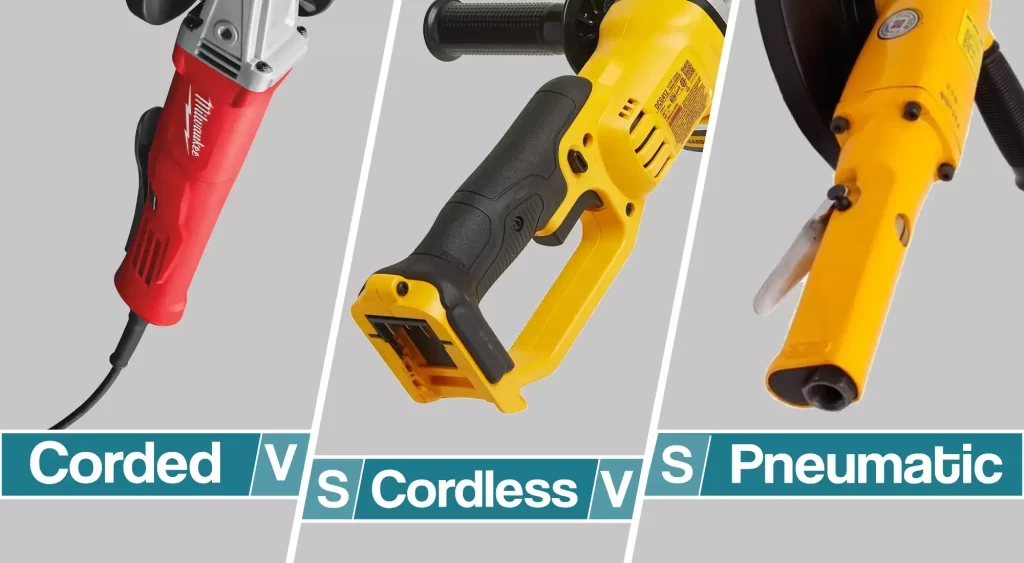
If you are a hobby weekend warrior, there may be a few things about these power tools you aren’t aware of. So, we wrote a small buying guide to accompany our reviews. This will help you pick the best angle grinder for your needs because some of the terms we used in the reviews may be confusing. So, let’s start with the types of angle grinders.
Corded Angle Grinders
The corded angle grinders require constantly available electrical power. This is a problem when working remotely or if you can’t get the electricity to the work area.
However, for most jobs, the corded angle grinders are the advantage. They are significantly cheaper and do not experience the sag in power, and you can use these angle grinders indefinitely. Plus, a corded grinder is often lighter because it doesn’t have the added weight of the battery pack.
Cordless Angle Grinders
A cordless angle grinder is battery-powered and does not need a power source. Additionally, you can maneuver around the work without the cables getting in the way.
However, these angle grinders are much more expensive, and the battery and charger are often not included, further increasing the costs.
The Li-ion batteries typically used in cordless tools have a life cycle of about 500 charges, giving you about a year and a half of maximum power output if you use them daily.
After these 500 cycles, the battery will still work, but it will have a lower capacity.
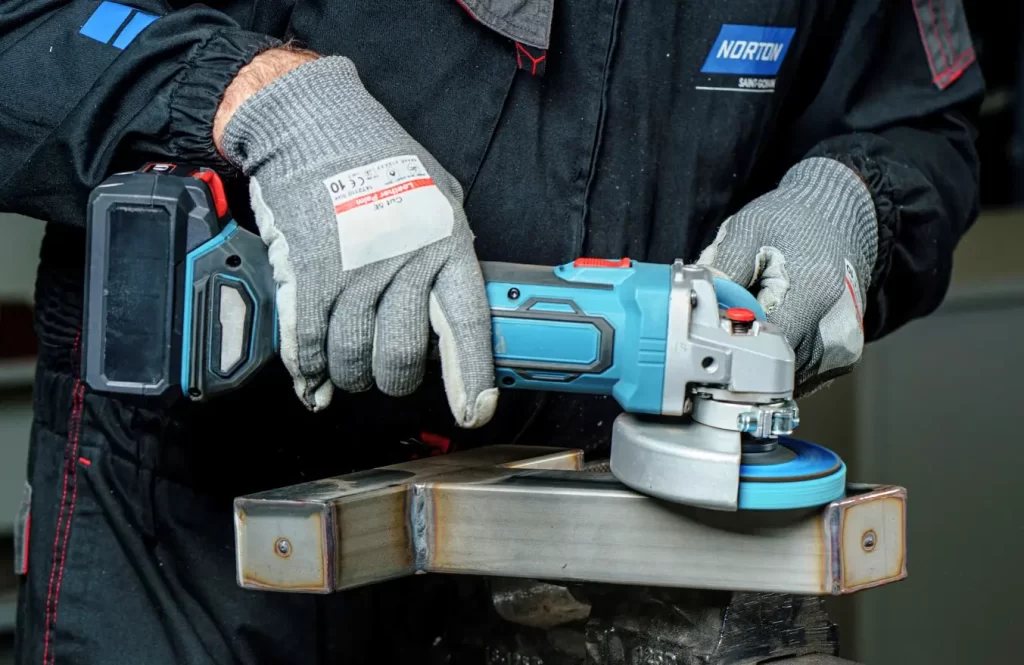
The precise number of cycles depends on the exact chemistry and work conditions. Another problem the cordless grinders have is the drop in voltage as the battery drains. For example, if the fully charged battery is 24V, as you grind and spend the battery’s capacity, the voltage will drop as well.
This results in power sag and lower torque and RPM. Not all cordless models experience these issues because there are many electronics that can help, but it’s something to keep in mind.
Additionally, if you push the battery and grind hard, it will overheat. This heat negatively impacts Li-ion cells and reduces their cycle life. So, if you do heavy-duty jobs, you can count that the battery will wear out faster. Plus, it’s never a good idea to get to the job site with just one battery. Some guys and gals even carry the charger and the extra battery for their cordless tool to the worksite.
These batteries are not cheap. The DeWALT’s Flex-Volt 20V battery costs $200, and Milwaukee batteries are $250. That’s more expensive than the angle grinder. So, if it dies on you a year or so down the road, that’s a considerable expense.
And lastly, the battery adds weight to the angle grinder, making it more challenging to hold all day. But even with multiple drawbacks, the cordless grinders have taken the market by the storm. Professionals love them because they are just so convenient to use on the go.
Pneumatic Angle Grinders
We haven’t covered any pneumatics in our review, but it’s worth pointing out that they do exist. Still, most people won’t use such angle grinders because they require an air compressor. It’s not as simple as plug and grind because the compressor must first reach the necessary pressure. But they are used in welding shops and other stationary work areas where air compressors are available.
Angle Grinder Disc Size
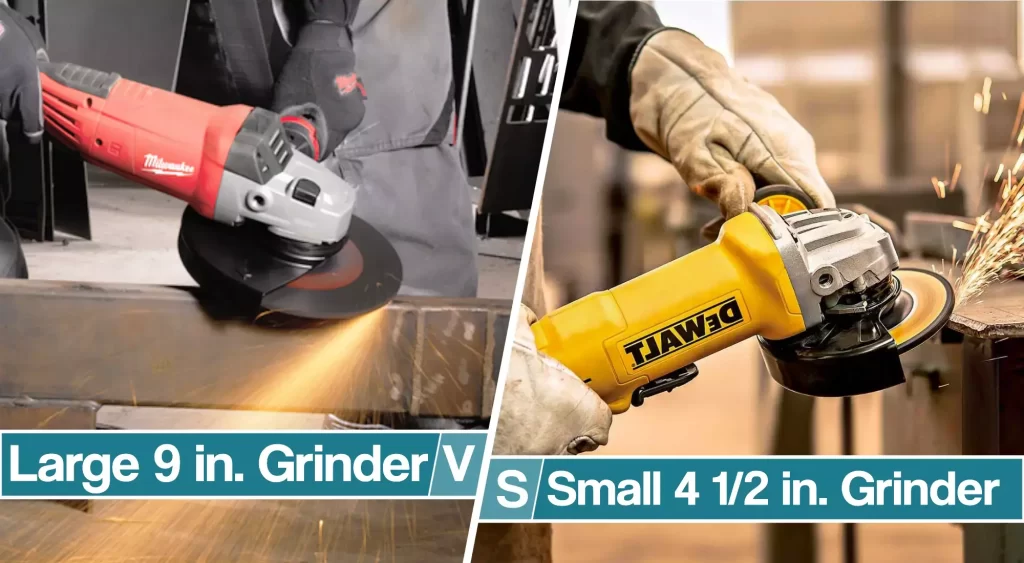
Every angle grinder is rated for the supported wheel size. Most people need a standard small angle grinder that supports 4 and a half-inch disc size.
The angle grinders are available in the following disc sizes:
- 4½ inch – 115mm
- 5 inch – 125mm
- 6 inch – 150mm
- 7 inch – 180mm
- 9 inch – 230mm
Some angle grinders like the Metabo angle grinder can handle larger discs than what they are designed for but double-check everything before using a larger disc on a smaller angle grinder.
Large angle grinders with larger discs operate at lower speeds, while small angle grinders allow higher RPM. The higher the RPM, the faster you’ll cut, but the disc will also wear out more quickly. However, smaller discs are cheaper, so this offsets the difference.
On the other hand, larger discs are used for heavy-duty work like cutting concrete or very thick steel parts.
Speed (RPM)
RPM or Revolutions per minute is how we rate the speed of the angle grinder. But, keep in mind that the manufacturers provide the RPM rating for the angle grinder without a grinding wheel. So, the metric will drop as soon as you install the grinding wheel.
The higher the angle grinder size, the lower the RPM. This is not always the case, but it’s a general rule. Also, keep in mind that the grinding wheels are rated for the maximum RPM they can be used with. So, don’t load an 11,000 RPM disc to a 12,000 RPM grinder.
Additionally, random import brands are more likely to use obscure data or straight up lie about the provided RPM. So, don’t be fooled by a brand claiming 13,000 RPM at 5 in. disc size.
Guard
Every angle grinder comes with an equipped guard. This is a safety feature that prevents serious injuries or death.
Keep the blade guard on at all times and constantly adjust it to protect you if the grinding wheel explodes and sends the shards flying.
So, keep the open end of the guard away from you and the closed guard pointed towards you.
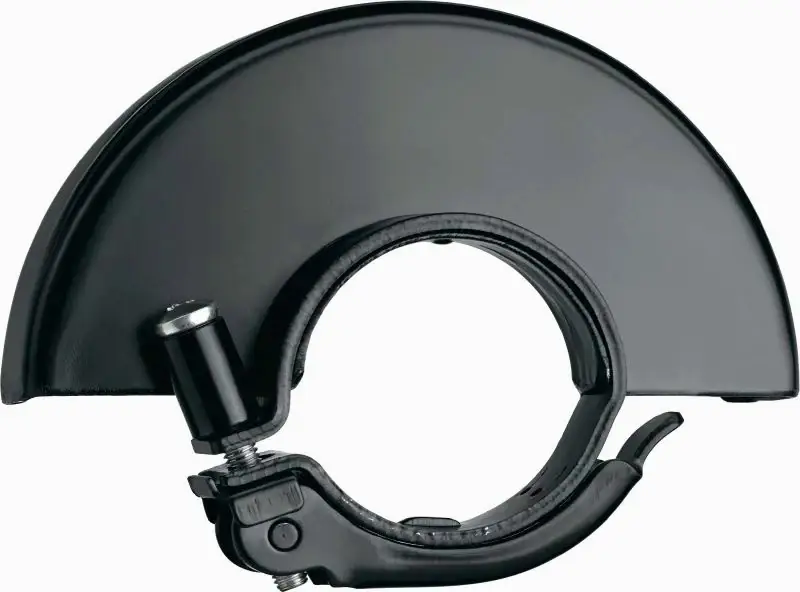
Angle grinders like the 4 1/2 and 5-inch angle grinder from Milwaukee allow simple guard adjusting without the tools. This is convenient and makes it more likely that the operator won’t “wing it” and not adjusts the guard because it’s just a “small cut.”
Some people remove the guard altogether, but this is not advised and is against OSHA and every other angle grinder safety standard. So we can’t in good conscience recommend doing something like that.
Handle
Just like the guard, the handle needs to be attached at all times unless it’s absolutely necessary to remove it. By holding the grinder’s handle, you achieve a powerful enough grip over the tool and significantly reduce the chances of the angle grinder kicking out of your hands.
All angle grinders we recommended in this review support handle switchover for right and left-handed people. Additionally, all reviewed grinders have ergonomic, non-slip handles for the safe handling of the tool.
Switch Type
There are three on/off switch types for angle grinders, and depending on the safety level, your work requires one is better than another.
- Slide switch – The most common and simplest is the slide switch. It locks in place in the ON position keeping the angle grinder running without holding the trigger. Most grinders today require a very light touch in the OFF direction, and the switch will turn off the grinder. This switching method won’t get your hand tired, but it’s more dangerous because it will keep running if you drop the angle grinder. It can cause damage to your work area or even injure you.
- Paddle switch – A paddle switch is usually a part of the angle grinder’s body located at the bottom of the grinder. For both DeWALT angle grinders, we recommended using the paddle switch. To turn on the grinder, you must squeeze and hold this trigger, and if you release it, the power cuts off. This is a safer switch than the slide switch, but it will get your hand tired after some time. However, if you drop the angle grinder, it will have less chance of injuring someone.
- Trigger grip – These are typically found on large size grinders like 7 and 9-inch sizes. They look similar to the drill with a handle located at the back of the grinder.
Dust Protection
Best angle grinders have some sort of a dust ejection system or a protection system to prevent dust from entering the motor and gears.
The Metabo has the best dust protection in our review, but Milwaukee and DeWALT are solid too.
Brush vs Brushless Angle Grinders
Electric motors use an electromagnetic field to generate rotational power. Without getting too technical, the older brush motor uses a pair of carbon brushes to transfer DC power and create the electromagnetic field that rotates the permanent magnet.
The brushless motor uses electronics in the engine to optimize the power into the stator and create the electromagnetic field without the use of carbon brushes.
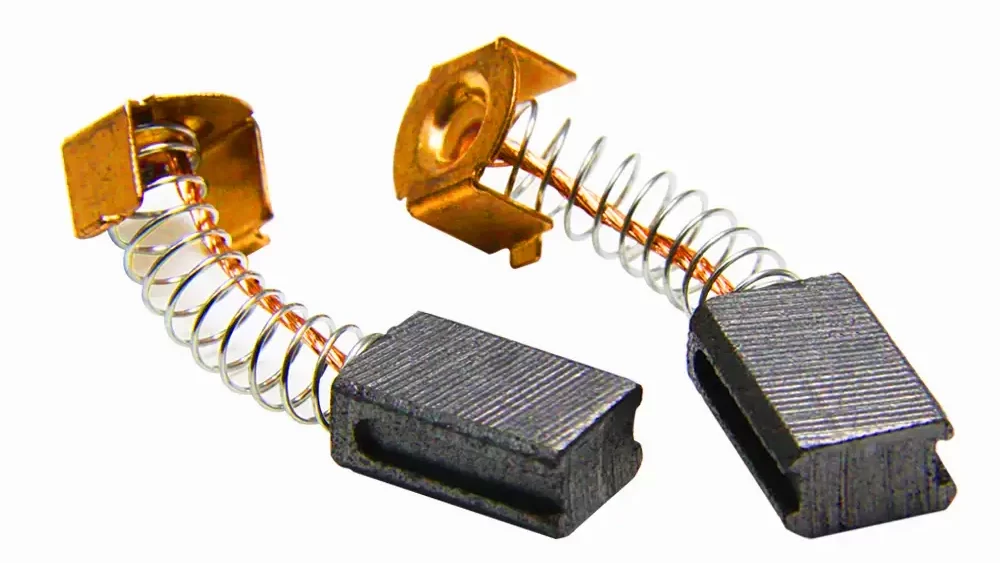
The brushless motor is significantly more efficient, but it’s typically available with cordless angle grinders. It generates less heat than the brush motor, which translates into a longer lifespan for the power tools. Additionally, it provides a high output power, and it’s more difficult to stall out.
Conclusion
Hobbist or Professional and DYI or some serious welding projects, every weld needs a decent prep and finish and the angle grinder is the second most important tool for a welder to have in his shop. So, my advice is to get the small angle grinder from Milwaukee, and you won’t be disappointed. Please ignore other reviews on the internet that are trying to sell you some cheap grinder that’s not as safe, has questionable gear and motor quality, and has a poor warranty.
Professionals already know most of what I wrote here. But if you are unsure about which brand and make to get, consider the added features some of these brands provide. For example, DeWALT’s cordless angle grinder provides significantly more safety features, while BOSCH offers variable speed, unlike the 5 in. Milwaukee.






