
Choosing the proper gas welding regulator is not only important for maintaining the proper flow of gases while you weld. It also improves safety and ensures the best welding results. You wouldn’t want a faulty regulator especially if you are dealing with combustible gases.
But which regulator is the best?
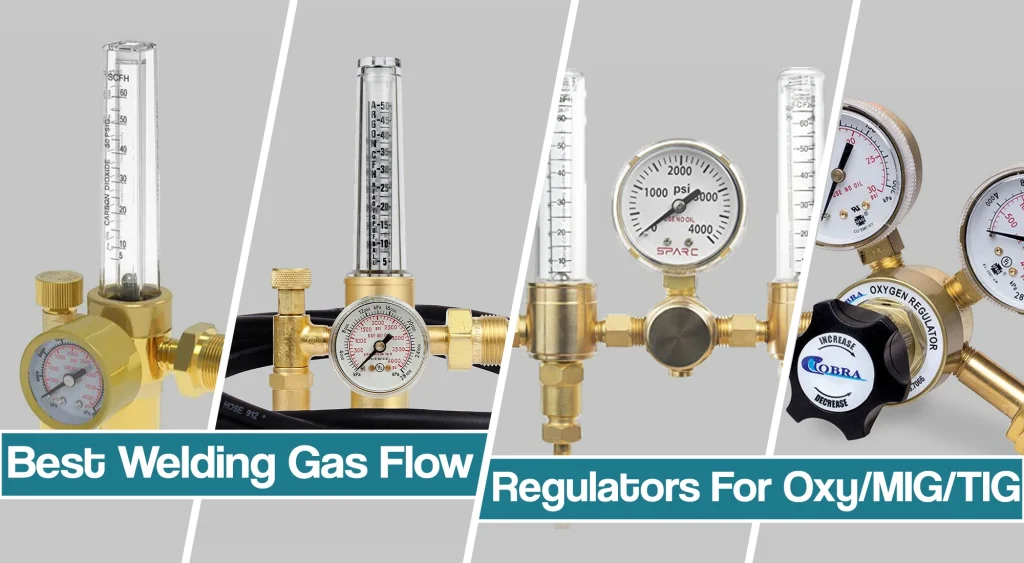
Although there are a few of them and each manufacturer ensures that theirs is the best, there are a few that are more reliable than others. Check out our picks that we have singled out after a detailed analysis of each and every one of them.
Welding Gas Regulators Comparison Table
| Image | Name | Gas Type | Flow Rate | Pressure Range | Inlet | Gauge Type | Check Price |
|---|---|---|---|---|---|---|---|
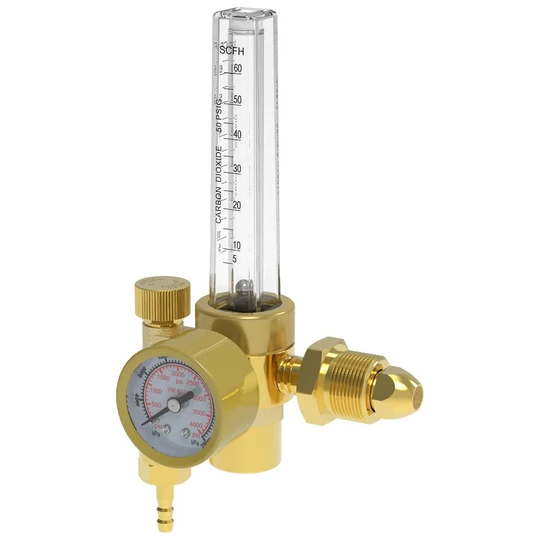 | QB01 Argon and CO₂ Flowmeter RegulatorGet 10% Off With Coupon: -10% WELDPROS | Argon, Argon/CO₂ | 0-60 CFH | 0-4000 PSI | CGA-580 | Flowmeter + Gauge | Check Price |
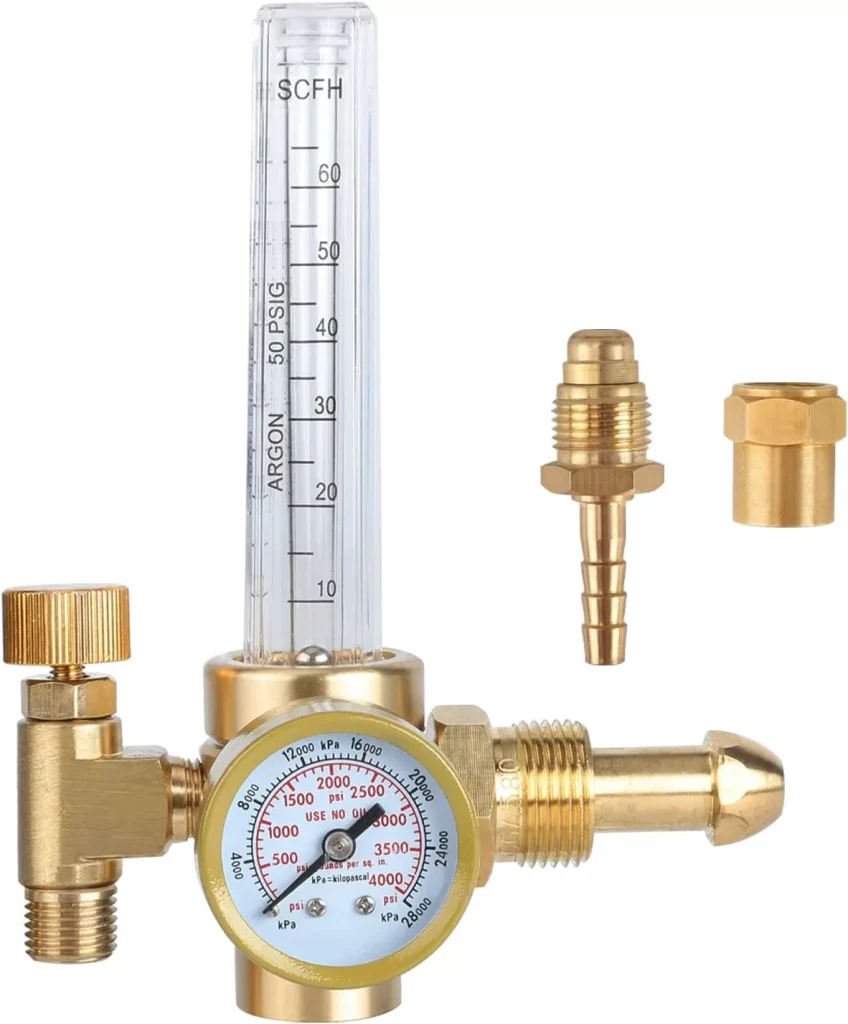 | BETOOLL Argon/CO2 Mig Tig Flow Meter Gas | Argon, Nitrogen, Argon/CO₂ | 10-60 CFH | 0-4000 PSI | CGA-580 | Diaphragm Flow Gauge | Check Price |
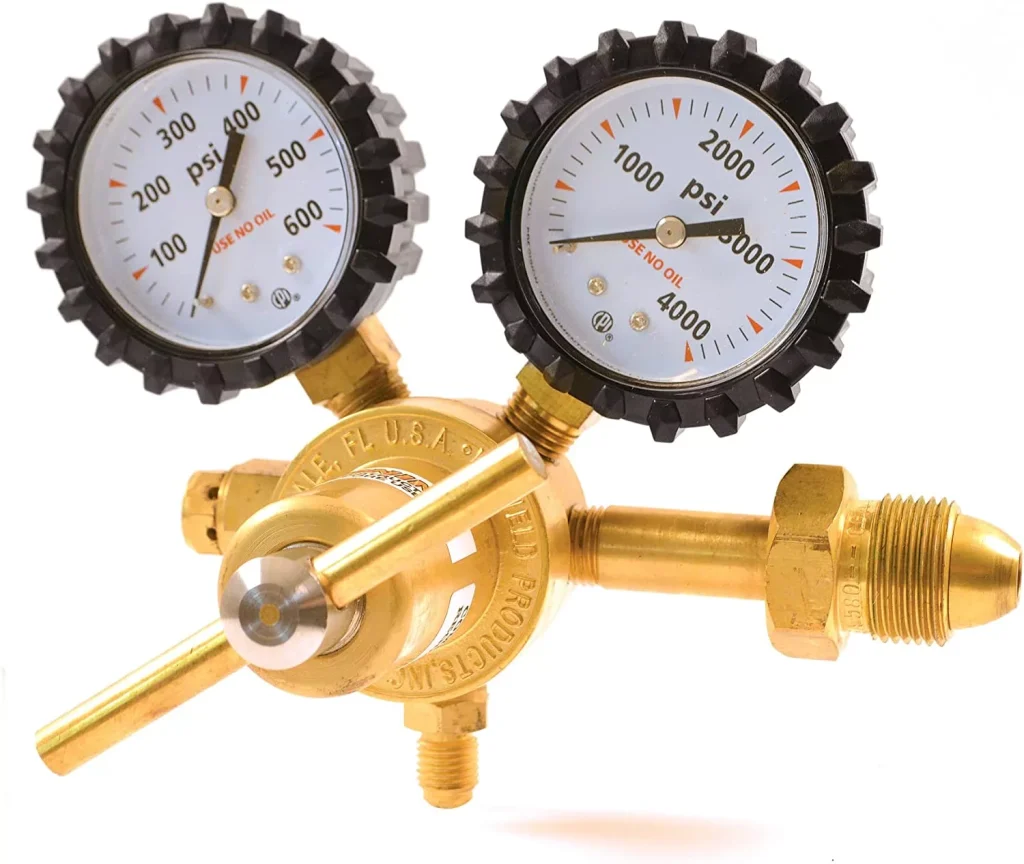 | Uniweld RHP400 Nitrogen Regulator with 0-400 PSI Delivery Pressure, CGA580 | Nitrogen | — | 0-400 PSI | CGA-580 | Double Gauge | Check Price |
 | T742HP Primary Double Gauge CO2 Regulator, Brass | CO₂ | — | Adjustable, 15 PSI Relief | CGA-320 | Double Gauge | Check Price |
 | Argon Regulator TIG Welder MIG Welding CO2 Flowmeter 10 to 60 CFH | Argon, CO₂, Helium | 10-60 CFH | 0-4000 PSI | CGA-580 | Flowmeter + Gauge | Check Price |
 | CO2 Argon Regulator Gas Flowmeter for Mig Tig Welding with 10FT Gas Hose | Argon, CO₂ | — | 0-4000 PSI | CGA-580 | Flowmeter + Gauge | Check Price |
 | Dual Argon Flow Meter High Flow 0-100CFH 1/4" Input 0-500PSI | Argon, Helium, N₂, Argon/CO₂ | 0-100 CFH | 0-500 PSI | CGA-580 | Dual Output Flowmeter | Check Price |
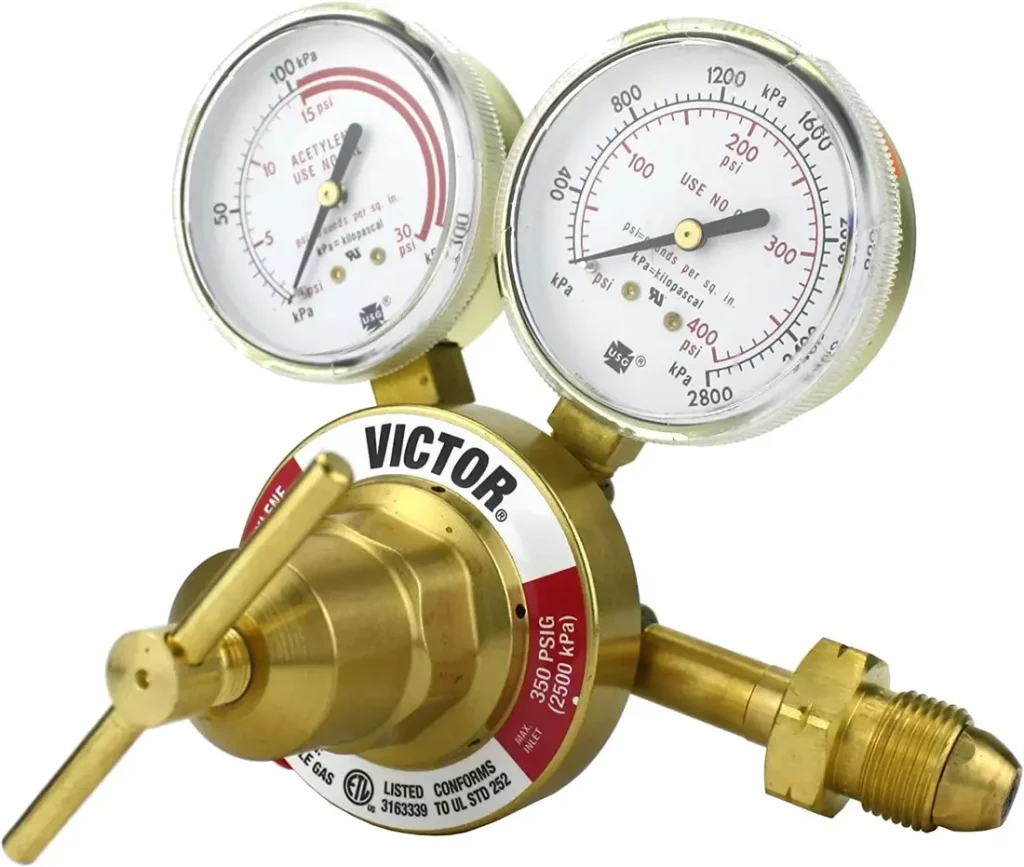 | VICTOR Heavy Duty Oxygen Regulator Model: 350-125-540 | Oxygen | — | 5-125 PSI | CGA-540 | Single Gauge (Brass) | Check Price |
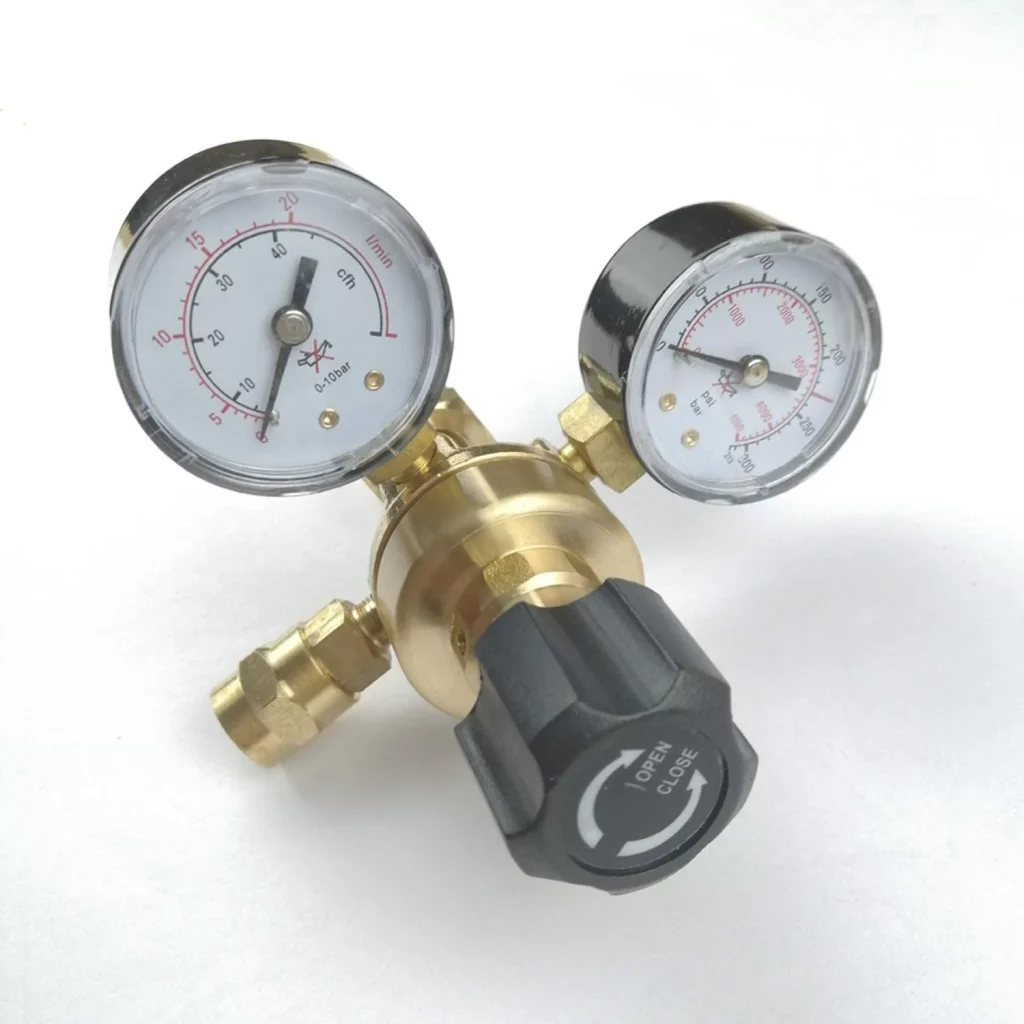 | Argon CO2 Regulators Gauges Gas Welding Regulator cutting Regulator CGA580 | Argon, CO₂ | — | 0-4500 PSI | CGA-580 | Double Gauge | Check Price |
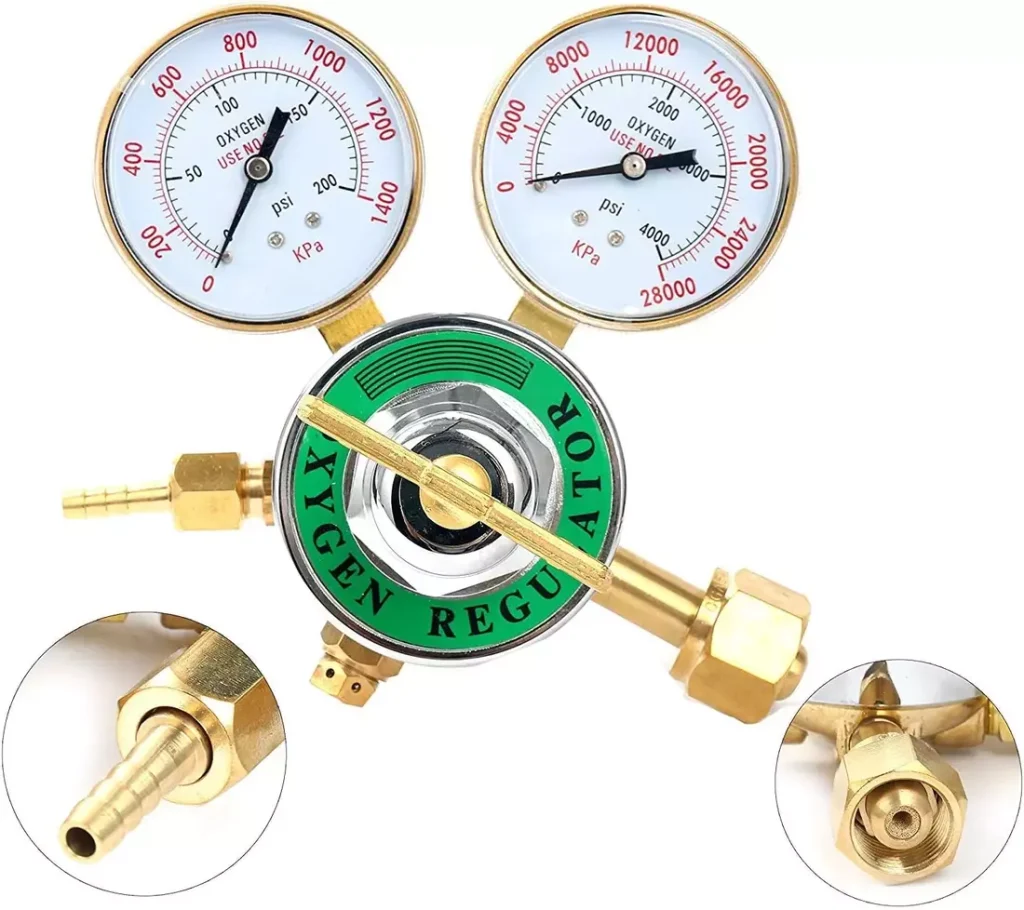 | Oxygen Regulator Large Tank Gauge Cutting Torch Regulator Outlet 0-200PSI Inlet 0-4000PSI CGA 540 | Oxygen | — | 0-200 PSI | CGA-540 | Double Gauge (2-5/8") | Check Price |
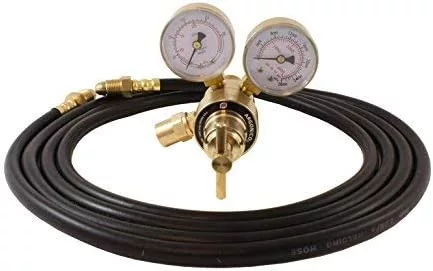 | Industrial Argon Regulator/Flowmeter Gauges for MIG and TIG Welders | Argon, Argon/CO₂, Helium | Argon 0-30 CFH CO₂ 0-20 CFH | 0-400 PSI | CGA-580 | Dual Scale Flowmeter | Check Price |
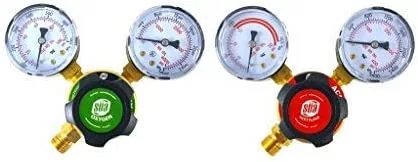 | Oxygen and Acetylene Regulators Welding Gas Gauges Pair – Rear Entry – LDP series | Oxygen + Acetylene | — | O₂ 0-100 PSI Acetylene 0-30 PSI | CGA-540 / CGA-200 | Double Gauge Pair | Check Price |
Best Welding Gas Flow Regulators
The primary usage of a gas welding regulator is to ensure the proper flow of the gas consumed by the welding machine. Their job is to mix the combination of gasses properly so each one is emitted in the correct proportion. The idea is keeping the inlet pressure and the outlet pressure as constant as possible.
Gar regulators come in different sizes, shapes, and forms. They differ in terms of performance, maximum inlet pressure, size constraints, purity requirements, types of gas being used, and sometimes personal preferences. So whether you are doing MIG welding or TIG welding, you will need to make certain adjustments.
Let’s see which are the best types of gas regulators that you can find today.
1. QB01 Argon and CO₂ Flowmeter Regulator – Best Overall Gas Regulator
Best Overall Gas Regulator
QB01 Argon and CO₂ Flowmeter Regulator
The QB01 is YesWelder’s take on the argon/CO2 flowmeter, and it gets the fundamentals right without the inflated price tag that usually comes with a decent regulator. It reads 0 to 60 CFH on the flow tube and 0 to 4000 PSI on the pressure gauge, so you always know what’s left in the tank and what’s coming out. I’ve run it on both MIG and TIG jobs and the flow stayed steady from the first weld to the last.
| Gas Type: | Argon, 75/25 & 80/20 Argon/CO₂ | Flow Rate: | 0-60 CFH |
| Pressure Gauge: | 0-4000 PSI | Inlet: | CGA-580 |
| Gauge Type: | Flow tube + pressure gauge | Material: | Copper body, brass filter |
| Outlet: | 9/16-18, 5/8-18, 1/4″ barb | Process: | MIG, TIG |
| Warranty: | YesWelder warranty | Price: | See YesWelder |
The high-density molecular brass filter sits right at the pressure reducer inlet, which is where it should be. It catches the junk that would otherwise reach your flow tube and mess up the readings. After a couple of months of steady use, my flow readings haven’t drifted at all, which is more than I can say for a couple of cheaper meters I’ve owned.
It screws onto CGA-580 cylinders, so it covers 100% argon, 75/25 argon/CO2, and 80/20 argon/CO2. The outlets give you a 9/16-18 female, a 5/8-18 male, and a 1/4-inch hose barb, so it bolts onto most MIG and TIG rigs without hunting for adapters. I swapped it between my TIG bottle and my MIG bottle in about two minutes.
The 1.5-inch pressure gauge is easier to read than the little dime-size dials on some budget units. When you’re checking tank pressure from across the bench, that extra size matters. It’s a small thing, but it’s part of why I reach for this regulator first now.
The body is solid copper, not stamped steel with a coat of paint. That shows up in how it feels in your hand and how it shrugs off knocks in a busy shop. The flow tube is protected well enough that I don’t worry about cracking it when I set the bottle down.
YesWelder sells this direct, and code WELDPROS knocks 10% off at checkout. For a regulator this solid, that makes it the best value on this list. Amazon doesn’t carry this exact unit, so go through YesWelder’s site to get the deal.
Pros
- Accurate 0-60 CFH flow with a 0-4000 PSI pressure gauge
- Brass molecular filter keeps the flow tube clean longer
- Fits CGA-580 cylinders for pure argon and argon/CO2 mixes
- Three outlets: 9/16-18, 5/8-18, and a 1/4-inch hose barb
- Big 1.5-inch gauge is easy to read from a distance
- Solid copper body handles shop abuse
- Works for MIG and TIG with no adapter swapping
- 10% off with the WELDPROS code at YesWelder
Cons
- Only sold through YesWelder, not on Amazon
- Glass flow tube needs careful handling
- No dedicated CO2 cylinder fitting without an adapter
2. BETOOLL Argon/CO2 Mig Tig Flow Meter Gas – Best Budget Flow Meter
Best Budget Flow Meter
BETOOLL Argon/CO2 Mig Tig Flow Meter Gas
BETOOLL’s flow meter is the one I point people to when they want a working regulator without spending real money. It reads 0 to 4000 PSI on the pressure side and lets you dial flow from 10 to 60 CFH. It’s not fancy, but it’s consistent, and that’s what matters when you’re trying to hold a bead together.
| Gas Type: | Argon, Nitrogen, Argon/CO₂ | Flow Rate: | 10-60 CFH |
| Pressure Gauge: | 0-4000 PSI | Inlet: | CGA-580 |
| Gauge Type: | Diaphragm flow gauge | Material: | Brass body |
| Outlet: | 9/16-18 nut, 5/8-18 fitting | Process: | MIG, TIG |
| Warranty: | See Amazon | Price: | See Amazon |
The big difference from the flow-gauge style units is the diaphragm. Because it doesn’t rely on a spring-loaded gauge for flow, it stays accurate longer and doesn’t drift the way cheap ball-float meters do after a few months. I’ve had one of these on a home MIG setup for over a year and it still reads true.
It uses a CGA-580 fitting, so it works with argon, nitrogen, and argon/CO2 mixes. It won’t fit a pure CO2 cylinder, so if you run straight CO2 for flux or MIG you’ll need something else. For anyone on a standard 75/25 or pure argon bottle, though, it plugs right in.
The outlet side has a female 9/16-18 nut and a male 5/8-18 fitting. That covers Hobart, Lincoln, and Miller machines that use a 5/8-18 male, which is most of what’s in people’s garages. No adapter needed for the common setups.
The body is lighter than the brass heavyweights, which is fine for a bench or cart. It’s not going to survive being thrown in a truck bed every day, but for a stationary home or light shop setup it’s plenty. Keep it in a drawer when it’s not in use and it’ll last.
At the price, there’s not much to complain about. You’re getting an accurate argon/CO2 meter that reads 0 to 4000 PSI and holds flow from 10 to 60 CFH. If you’re on a budget or just getting into welding, this is the one to start with.
Pros
- Diaphragm design holds flow accuracy longer than gauge-style meters
- 0-4000 PSI pressure gauge is easy to read
- 10-60 CFH covers the whole useful range
- Fits argon, nitrogen, and argon/CO2 mix cylinders
- Standard 9/16-18 and 5/8-18 outlets fit most machines
- Light and easy to mount on a cart or bench
- Reliable enough for a home shop or light production
- Hard to beat at this price
Cons
- Does not fit pure CO2 cylinders
- Lighter build than the brass heavyweights
- Not suited to being knocked around in a truck
3. Uniweld RHP400 Nitrogen Regulator with 0-400 PSI Delivery Pressure, CGA580 – Best Nitrogen Regulator
Best Nitrogen Regulator
Uniweld RHP400 Nitrogen Regulator with 0-400 PSI Delivery Pressure, CGA580
The Uniweld RHP400 is a nitrogen regulator built for people who need precise delivery pressure, not just a gas shutoff. It delivers 0 to 400 PSI through a brass piston diaphragm, and the double gauge shows both tank contents and delivery pressure at a glance. If you’re purging lines or pressure-testing pipe, this is the kind of regulator you want on the bottle.
| Gas Type: | Nitrogen (CO₂ with F36 adapter) | Delivery Pressure: | 0-400 PSI |
| Contents Gauge: | 0-4000 PSI | Delivery Gauge: | 0-600 PSI |
| Inlet: | CGA-580 | Outlet: | 1/4″ male flare |
| Material: | Brass piston diaphragm | Gauge Type: | Double gauge with rubber boots |
| Warranty: | See Amazon | Price: | See Amazon |
The brass piston diaphragm is what separates this from a cheap nitrogen valve. It smooths out delivery so pressure stays where you set it instead of creeping as the tank drains. I’ve used it for brazing and line purging and the needle barely moves once you set it.
Both gauges are easy to read. The contents gauge runs 0 to 4000 PSI and the delivery gauge runs 0 to 600 PSI, each protected by a rubber boot. That boot matters more than it sounds because the gauges are the first thing to get cracked in a truck or shop.
The inlet is CGA-580 and the outlet is a 1/4-inch male flare. That’s the standard for nitrogen service work. It can also run CO2 if you add an F36 adapter, which makes it useful beyond just nitrogen jobs.
The large brass tee handle is a detail I appreciate. You get smooth pressure adjustment without cranking hard, and the stainless steel internals resist galling over time. Cheap regulators start to bind after a while; this one doesn’t.
This is a service regulator, not a welding flowmeter, so don’t expect CFH readings. If you need steady delivery pressure for purging, brazing, or testing, it earns its price. It’s built to be rebuilt, which is more than most budget nitrogen regs can say.
Pros
- Brass piston diaphragm holds pressure steady as the tank drains
- 0-400 PSI delivery covers purging and pressure testing
- Double gauge shows contents and delivery at the same time
- Rubber gauge boots protect the dials in a shop
- Large brass tee handle adjusts smoothly
- Stainless internals resist galling over time
- 1/4-inch male flare outlet is the nitrogen standard
- Rebuildable design for long service life
Cons
- No CFH flow reading, pressure only
- CO2 use needs an F36 adapter
- Overkill if you only weld with argon/CO2
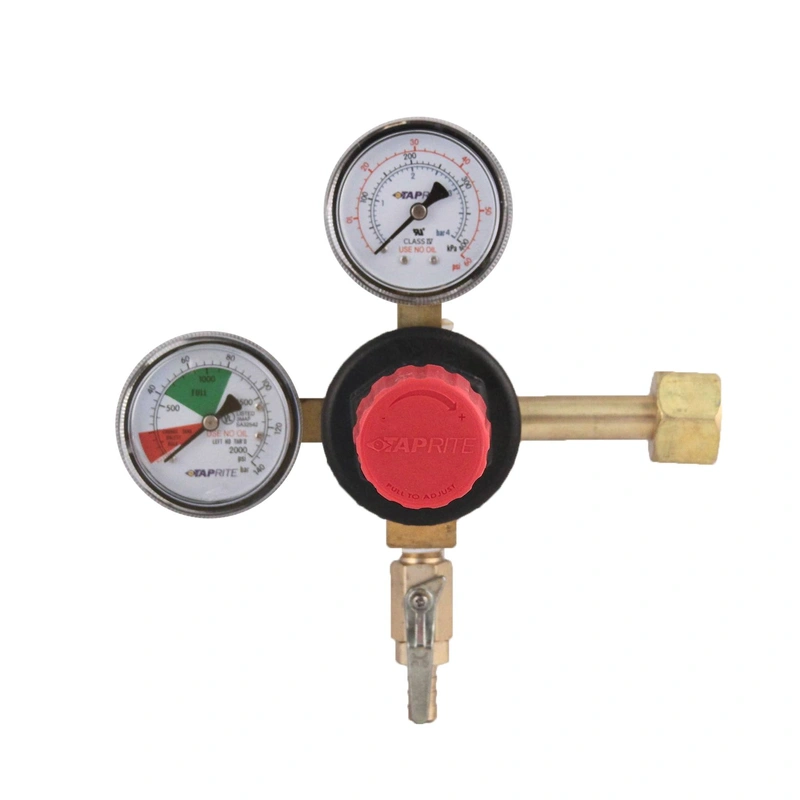
4. T742HP Primary Double Gauge CO2 Regulator, Brass – Best CO₂ Regulator
Best CO₂ Regulator
T742HP Primary Double Gauge CO2 Regulator, Brass
The T742HP is a CO2 regulator for CGA-320 tanks, and it’s the one to get if you run straight CO2 for MIG or for a keg system. It has two gauges, one for cylinder pressure and one for output, and the whole thing is brass where it counts. The front knob makes output adjustment something you can do by feel.
| Gas Type: | CO₂ | Inlet: | CGA-320 |
| Gauge Type: | Double gauge | Relief Valve: | Opens past 15 PSI |
| Seal: | Quad-Ring, leak-resistant | Tubing: | 5/16″ I.D. |
| Material: | Brass | Process: | MIG CO₂, beverage dispensing |
| Warranty: | See Amazon | Price: | See Amazon |
The dual gauges do two different jobs. One shows what’s left in the cylinder, the other shows your output pressure. That setup removes the guesswork when you’re trying to hold a consistent flow or a steady pour pressure.
The high-pressure ports use female threads on purpose, so you can’t accidentally run a low-pressure line off the wrong side. That’s a small safety detail, but it’s the kind of thing that prevents a blown hose in a busy shop.
There’s a built-in relief valve that opens past 15 PSI, plus a permanent Quad-Ring seal to stop slow leaks. A leaky CO2 regulator will empty a tank overnight, so the seal design actually matters for your bottom line.
It’s set up for 5/16-inch I.D. tubing, which is standard for beverage and light industrial lines. The whole unit is pressure-tested before it ships, so you’re not the first person to find a leak.
For MIG on CO2 or any CGA-320 application, this is a straightforward, dependable choice. It’s not flashy, but it doesn’t need to be. It just holds pressure and stays sealed.
Pros
- Dual gauges show cylinder and output pressure
- CGA-320 inlet fits standard CO2 tanks
- Built-in relief valve opens past 15 PSI
- Quad-Ring seal stops slow overnight leaks
- Front knob adjusts output by feel
- Female high-pressure ports prevent wrong-side hookup
- Pressure-tested before shipping
- Solid brass construction
Cons
- CO2 only, no argon compatibility
- Output pressure tops out fairly low
- No CFH flowmeter for TIG-style metering
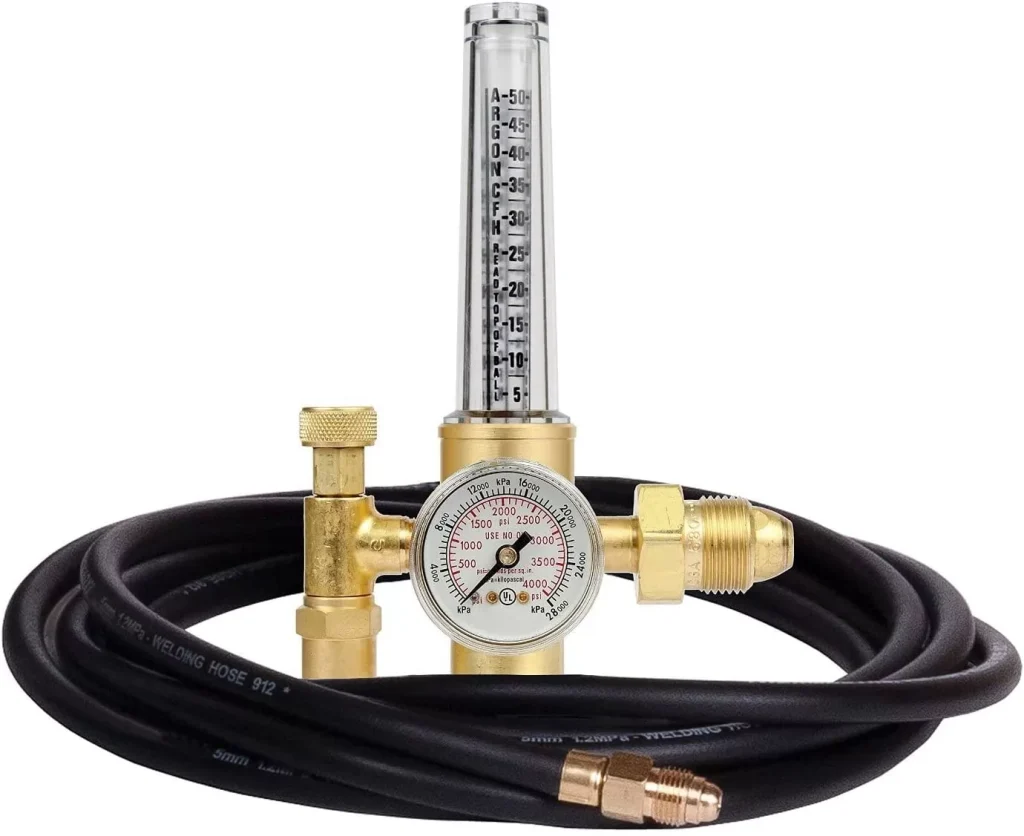
5. Argon Regulator TIG Welder MIG Welding CO2 Flowmeter 10 to 60 CFH – Best Value Argon Regulator
Best Value Argon Regulator
Argon Regulator TIG Welder MIG Welding CO2 Flowmeter 10 to 60 CFH
This argon flowmeter is the pick when you want accurate gas metering without paying a premium for a brand name. It reads 10 to 60 CFH on the flow tube and 0 to 4000 PSI on the gauge, and it fits CGA-580 tanks for argon, CO2 mixes, and helium. It’s the kind of unit that works well for both seasoned welders and beginners.
| Gas Type: | Argon, CO₂ mix, Helium | Flow Rate: | 10-60 CFH |
| Pressure Gauge: | 0-4000 PSI | Inlet: | CGA-580 |
| Gauge Type: | Flow tube + pressure gauge | Gauge Diameter: | 1.5″ |
| Material: | Brass body | Process: | MIG, TIG |
| Warranty: | See Amazon | Price: | See Amazon |
The square flow tube reads 0 to 60 CFH, and the 1.5-inch gauge shows tank pressure up to 4000 PSI. The combination gives you everything you need to set flow and know when a refill is coming. I’ve used it on TIG aluminum where gas flow has to be right or the weld puddle turns to sponge.
It screws onto CGA-580 cylinders, which covers argon, argon/CO2 blends, and helium. That flexibility means one regulator handles MIG and TIG without buying a second unit for a different gas. The CGA-580 fitting threads on clean every time.
The flow readings are accurate enough that I don’t second-guess them. Once I set 20 CFH for TIG, it stays there through the job. That consistency is what you’re actually paying for, and it delivers.
The build is simple but solid. It’s not the heaviest unit here, but the gauge is clear and the knob turns smoothly without play. For a bench or cart setup it’s more than enough.
For the money, this is the argon regulator I’d recommend to someone who welds occasionally but wants real accuracy. It does the same job as units costing twice as much, and it does it without fuss.
Pros
- Accurate 10-60 CFH metering for MIG and TIG
- 0-4000 PSI gauge shows tank level at a glance
- CGA-580 inlet fits argon, CO2 mix, and helium
- Square flow tube is easy to read mid-weld
- 1.5-inch pressure gauge is clear from a distance
- Holds flow steady once set
- Good choice for beginners and experienced welders alike
- Priced well below brand-name equivalents
Cons
- Lighter build than industrial-grade units
- No rubber gauge protection
- Flow tube is glass and can crack if dropped
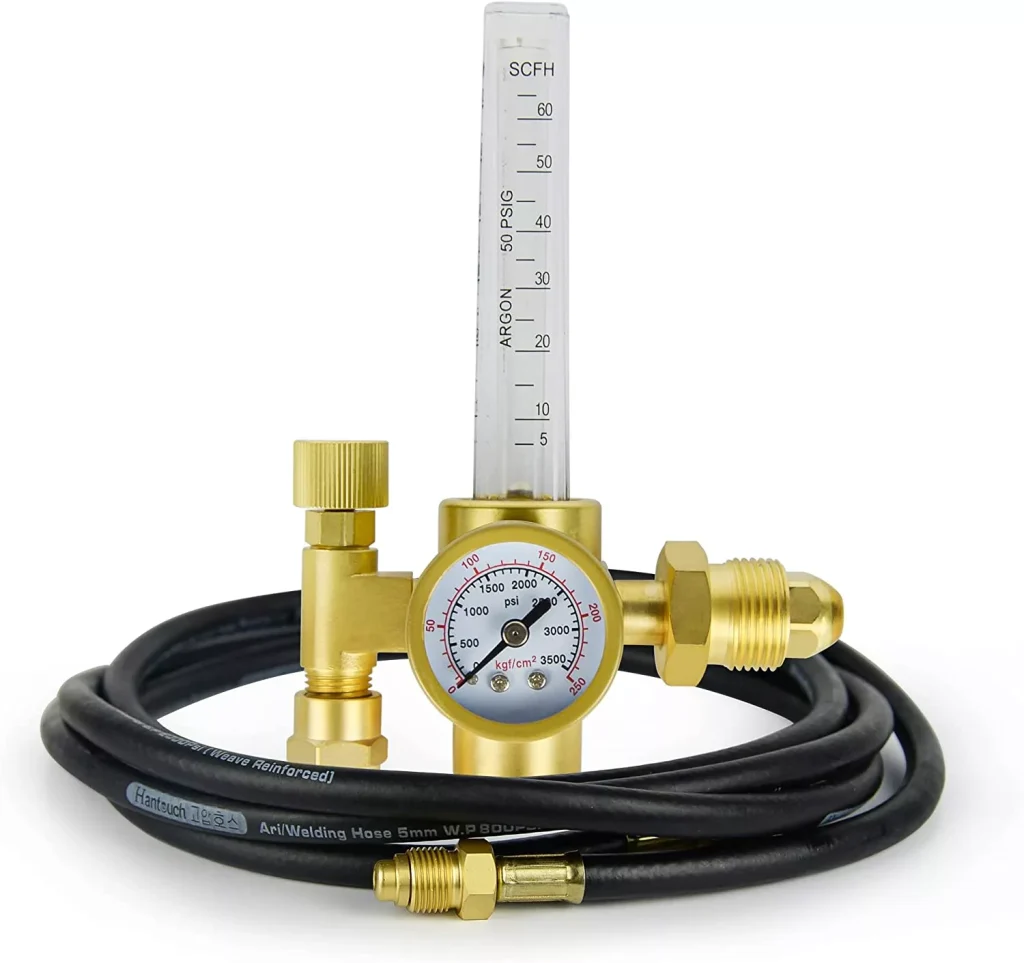
6. CO2 Argon Regulator Gas Flowmeter for Mig Tig Welding with 10FT Gas Hose – Best Hose-Included Regulator
Best Hose-Included Regulator
CO2 Argon Regulator Gas Flowmeter for Mig Tig Welding with 10FT Gas Hose
This flowmeter ships with a 10-foot gas hose, which saves you a separate trip to the store for a whip line. It reads 0 to 4000 PSI on the gauge and uses a CGA-580 inlet for standard argon and CO2 tanks. The hose alone is worth part of the asking price.
| Gas Type: | Argon, CO₂ | Pressure Gauge: | 0-4000 PSI |
| Inlet: | CGA-580 | Outlet: | 5/8 UNF-18 RH female |
| Hose: | 10 ft included | Gauge Type: | Flowmeter + pressure gauge |
| Material: | Brass body | Process: | MIG, TIG |
| Warranty: | See Amazon | Price: | See Amazon |
The included 10-foot hose is the headline feature. Most regulators make you buy the hose separately, and by the time you add that up the savings disappear. Here it’s in the box, ready to connect to a MIG or TIG machine.
The CGA-580 inlet covers argon, oxygen, and nitrogen tanks, and the outlet uses a female 5/8 UNF-18 RH fitting for the welding hose. That’s a standard connection, so it drops right onto common machines without an adapter hunt.
The pressure gauge reads 0 to 4000 PSI, which tells you tank level, and the flowmeter meters gas for MIG and TIG. The combination is the same one you’d expect from a standalone regulator and flowmeter, just bundled together.
It’s aimed at MIG and TIG work in shops, and it handles light commercial and electronics use too. The build is sturdy and the readings are easy to read even in low light.
If you’re setting up a machine for the first time or replacing an old regulator, getting the hose included removes a whole step. That convenience is the reason to pick this one.
Pros
- 10-foot gas hose included in the box
- CGA-580 inlet fits argon, oxygen, and nitrogen tanks
- Standard 5/8 UNF-18 RH outlet for most machines
- 0-4000 PSI gauge reads tank level clearly
- Flowmeter handles MIG and TIG metering
- No adapter hunting for common setups
- Sturdy build holds up in a shop
- Saves a separate hose purchase
Cons
- Plastic gauge face is easier to scratch
- No dedicated CO2 cylinder fitting
- Hose length is fixed, no shorter option
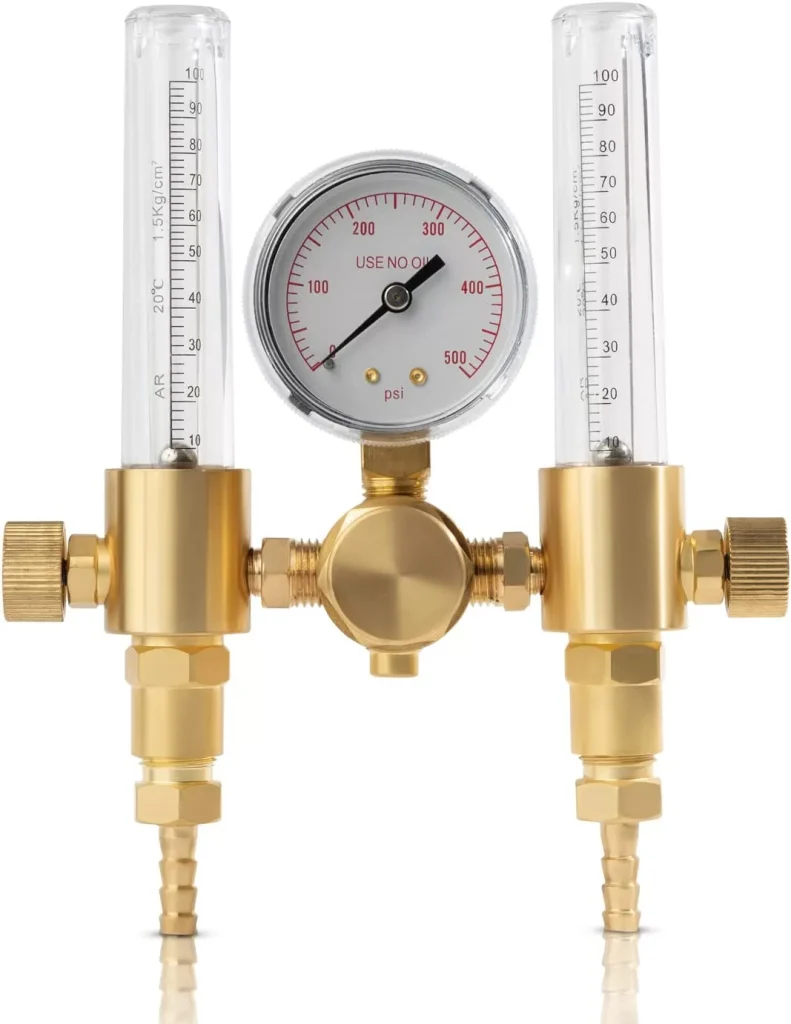
7. Dual Argon Flow Meter High Flow 0-100CFH 1/4″ Input 0-500PSI – Best High-Flow Dual Regulator
Best High-Flow Dual Regulator
Dual Argon Flow Meter High Flow 0-100CFH 1/4″ Input 0-500PSI
The SPARC dual output flowmeter is the one to grab when one regulator has to feed two machines at once. It reads 0 to 100 CFH, uses a 1/4-inch input, and handles argon, helium, nitrogen, and argon/CO2 blends. If you run MIG and TIG side by side, this removes a lot of clutter.
| Gas Type: | Argon, Helium, N₂, Argon/CO₂ | Flow Rate: | 0-100 CFH |
| Pressure: | 0-500 PSI | Input: | 1/4″ |
| Inlet: | CGA-580 | Gauge Type: | Dual output flowmeter |
| Material: | No-diaphragm design | Process: | MIG, TIG, steel & aluminum |
| Warranty: | See Amazon | Price: | See Amazon |
The dual output is the whole point. You get two controlled flows off a single CGA-580 bottle, so one tank feeds both a MIG and a TIG station without swapping regulators. For a home shop with two machines, that’s genuinely useful.
The 0 to 100 CFH range is wider than the typical 0 to 60 units, so it covers high-flow jobs that smaller meters choke on. It also works for steel and aluminum, so it’s not limited to one process.
Because it uses no diaphragm, there’s one less part to wear out. The flow-gauge style regulators can drift as the diaphragm ages; this design sidesteps that problem. The pressure gauge reads accurately even after heavy use.
The outlet options include a female 9/16-18 nut, a male 5/8-18 fitting, and a standard 1/4-inch barb. That covers almost any hose or machine connection you’re likely to have, and the barb handles the less common setups.
For a dual-station or high-flow setup, this is the smart choice. It costs more than a single meter, but it does the work of two and keeps the tank count down.
Pros
- Two outputs feed two machines from one bottle
- 0-100 CFH range covers high-flow work
- Works with argon, helium, nitrogen, and argon/CO2
- No-diaphragm design resists flow drift
- Handles steel and aluminum MIG and TIG
- 9/16-18, 5/8-18, and 1/4-inch barb outlets
- One tank replaces two for a dual-station shop
- Wide input accepts standard CGA-580 bottles
Cons
- Costs more than a single-output meter
- Not needed if you run one machine
- High flow range is overkill for basic TIG
8. VICTOR Heavy Duty Oxygen Regulator Model: 350-125-540 – Best Heavy-Duty Oxygen Regulator
Best Heavy-Duty Oxygen Regulator
VICTOR Heavy Duty Oxygen Regulator Model: 350-125-540
Victor builds the oxygen regulator you reach for when the job is heavy and the workload is real. The 350-125-540 delivers 5 to 125 PSI through a CGA-540 connection, and it’s solid brass with no painted sheet metal or plastic where it matters. This is a genuine Victor, not a knockoff.
| Gas Type: | Oxygen | Delivery Pressure: | 5-125 PSI |
| Inlet: | CGA-540 | Outlet: | 9/16-18 RH male |
| Gauge Type: | Single gauge | Material: | Heavy brass |
| Compatible: | Oxygen cylinders (CGA-540) | Process: | Cutting, heating |
| Warranty: | See Amazon | Price: | See Amazon |
The heavy brass construction is immediately obvious when you pick it up. There’s no flex, no plastic, and no thin metal anywhere in the pressure path. That’s why people trust Victor on cutting rigs that run all day.
The CGA-540 connection fits all American oxygen cylinders, and the delivery pressure runs 5 to 125 PSI for precise cutting and heating. For acetylene and propane, use the separate CGA-510 fuel-gas regulator (MC and B cylinders take a CGA-200 connection instead).
The 9/16-18 right-hand male outlet is the standard for oxygen, and the matching acetylene side uses a 9/16-18 left-hand female so there’s no way to cross-thread the two. That left-right distinction is a safety feature that’s been around forever for a reason.
For a production shop or a truck that sees daily cutting, this is the regulator that holds up. The internals are built to be rebuilt, so when a seat wears out you replace a part, not the whole unit.
This is overkill for a hobbyist who cuts once a month. But if oxygen is part of how you make a living, the heavy-duty Victor is worth every dollar over a budget import.
Pros
- Heavy brass construction with no plastic in the pressure path
- Genuine Victor build quality
- CGA-540 inlet fits all American oxygen cylinders
- 5-125 PSI delivery covers cutting and heating
- Standard 9/16-18 RH male outlet
- Left-hand acetylene side prevents cross-threading
- Rebuildable internals for long service life
- Built for all-day production work
Cons
- Overkill for occasional hobby use
- Premium price over budget imports
- Single gauge only, no dual readout
9. Argon CO2 Regulators Gauges Gas Welding Regulator cutting Regulator CGA580 – Best Dual-Gauge Argon Regulator
Best Dual-Gauge Argon Regulator
Argon CO2 Regulators Gauges Gas Welding Regulator cutting Regulator CGA580
This argon/CO2 regulator is the dual-gauge pick for MIG and TIG work, with both gauges reading up to 4500 PSI. It’s brass, it’s accurate, and it has an internal pressure relief design that makes it safe to leave on the bottle. For a shop that welds daily, it’s a dependable workhorse.
| Gas Type: | Argon, CO₂ | Gauge Range: | 0-4500 PSI |
| Inlet: | CGA-580 | Outlet: | 5/8″ female, 9/16″ male |
| Gauge Type: | Double gauge | Safety: | Internal pressure relief |
| Material: | Brass | Process: | MIG, TIG, lab use |
| Warranty: | See Amazon | Price: | See Amazon |
The dual gauges read up to 4500 PSI, which covers full high-pressure tanks and gives you an early read on when a refill is coming. Both are large and clear, so you don’t have to squint to check the tank level.
The internal pressure relief is the safety detail that matters. If pressure spikes, the relief vents instead of letting the diaphragm fail. That’s the difference between a regulator you trust and one you keep an eye on.
The CGA-580 fitting accepts standard argon and CO2 mix cylinders, and the outlets use a 5/8-inch female and a 9/16-inch male. The plastic knobs turn easily for flow adjustment, which is fine since they’re not in the pressure path.
The brass body is solid and the unit is built for commercial, industrial, and lab use. It’s accurate enough for TIG work where a half-CFH drift shows up in the weld pool.
This is a straightforward, safe, accurate regulator at a fair price. If you want dual gauges and don’t need a flow tube, this is the one to buy.
Pros
- Dual gauges read up to 4500 PSI
- Internal pressure relief adds a safety margin
- Brass body built for commercial and lab use
- CGA-580 inlet fits standard argon and CO2 mix tanks
- Clear large gauges are easy to read
- Accurate enough for critical TIG work
- 5/8-inch female and 9/16-inch male outlets
- Easy to install and set up
Cons
- No flow tube for CFH metering
- Plastic knobs are not in the pressure path but feel light
- No rubber gauge boots
10. Oxygen Regulator Large Tank Gauge Cutting Torch Regulator Outlet 0-200PSI Inlet 0-4000PSI CGA 540 – Best Large-Tank Oxygen Regulator
Best Large-Tank Oxygen Regulator
Oxygen Regulator Large Tank Gauge Cutting Torch Regulator Outlet 0-200PSI Inlet 0-4000PSI CGA 540
This oxygen regulator is set up for large cutting-torch tanks, with 0 to 200 PSI outlet and 0 to 4000 PSI inlet ratings. It’s built from sturdy copper and the 2-5/8-inch gauges are big enough to read from a step away. For a cutting rig on a large cylinder, it’s a reliable fit.
| Gas Type: | Oxygen | Outlet Pressure: | 0-200 PSI |
| Inlet Pressure: | 0-4000 PSI | Inlet: | CGA-540 female |
| Outlet: | 9/16″ | Gauge Size: | 2-5/8″ |
| Material: | Copper | Process: | Cutting torch |
| Warranty: | See Amazon | Price: | See Amazon |
The 0 to 200 PSI outlet range gives you fine control for cutting and heating, while the inlet reads up to 4000 PSI for large tanks. That combination means you can run a big cylinder for a long time and still adjust the flame precisely.
The two 2-5/8-inch gauges are genuinely easy to read. On a cutting torch, you’re often checking pressure while wearing gloves and a shield, and the larger dials make that quick. The valve displays gas pressure accurately for precise work.
The CGA-540 female inlet threads onto a standard oxygen cylinder, and the 9/16-inch outlet is the standard for cutting hoses. It’s a drop-in fit for most cutting torch setups without chasing adapters.
The copper construction holds up better than the painted-steel budget regulators, especially around heat and in a truck. The built-in flow meter lets you adjust gas flow without swapping parts.
For a large-tank cutting setup, this is the regulator that makes sense. It reads clearly, adjusts finely, and the copper body outlasts the cheap imports.
Pros
- 0-200 PSI outlet with fine control for cutting
- 0-4000 PSI inlet handles large tanks
- 2-5/8-inch gauges are easy to read at a distance
- CGA-540 female inlet fits standard cylinders
- Sturdy copper body outlasts painted steel
- Built-in flow meter for gas adjustment
- Standard 9/16-inch cutting hose outlet
- Reliable for daily cutting work
Cons
- Oxygen only, no argon or acetylene use
- Larger gauges mean a bigger footprint
- No rubber protection on the dials
11. Industrial Argon Regulator/Flowmeter Gauges for MIG and TIG Welders – Best Industrial Flowmeter
Best Industrial Flowmeter
Industrial Argon Regulator/Flowmeter Gauges for MIG and TIG Welders
This industrial flowmeter is built for shops that weld all day, with a CGA-580 inlet and a dual-scale outlet gauge for argon and CO2. It steps high cylinder pressure down to a controlled flow for TIG and MIG, and it ships with a 5-foot hose. If your welders run constantly, this is the kind of unit that keeps up.
| Gas Type: | Argon, Argon/CO₂, Helium | Flow Rate: | Argon 0-30 CFH, CO₂ 0-20 CFH |
| Inlet Gauge: | 0-400 PSI | Inlet: | CGA-580 |
| Outlet: | 5/8″ female, 9/16″ male, barb | Hose: | 5 ft included |
| Gauge Type: | Dual-scale flowmeter | Process: | MIG, TIG industrial |
| Warranty: | See Amazon | Price: | See Amazon |
The CGA-580 inlet handles argon, argon/CO2 mixes, and helium, which covers the full range of shielding gas work. The dual-scale outlet gauge reads argon from 0 to 30 CFH and CO2 from 0 to 20 CFH, so one meter covers both processes without swapping parts.
The inlet gauge reads 0 to 400 PSI, and the flowmeter steps that down to a controlled welding flow. For TIG, where a half-CFH drift shows up in the weld, that accuracy matters. It holds a steady flow through long runs.
The three outlet options are a 5/8-inch female, a 9/16-inch male, and a hose barb. The included 5-foot hose has 5/8-18 male fittings on both ends, so it connects to common machines without extra hardware.
This is an industrial unit in build and in intent. It’s meant to live on a cylinder in a production shop, not sit in a drawer between weekend projects. The flowmeter design avoids the drift that gauge-style regulators develop.
For a busy MIG and TIG shop, this flowmeter is the right call. It’s accurate, it handles both gases, and the hose is already in the box.
Pros
- Dual-scale gauge reads argon and CO2 on one unit
- CGA-580 inlet covers argon, argon/CO2, and helium
- Accurate flow control for critical TIG work
- 5-foot hose with 5/8-18 fittings included
- Three outlet options cover any machine
- Holds steady flow through long production runs
- Built for daily industrial use
- Flowmeter design resists drift
Cons
- More than a home shop needs
- No rubber gauge protection
- CO2 range tops out at 20 CFH
12. Oxygen and Acetylene Regulators Welding Gas Gauges Pair – Rear Entry – LDP series – Best Oxy-Acetylene Set
Best Oxy-Acetylene Set
Oxygen and Acetylene Regulators Welding Gas Gauges Pair – Rear Entry – LDP series
This is a matched pair of oxygen and acetylene regulators for a portable oxy-fuel rig, with a rear-entry design that keeps the gauges out of the way. The oxygen side runs 0 to 100 PSI and the acetylene side 0 to 30 PSI, and it fits standard tanks for cutting and brazing work.
| Gas Type: | Oxygen + Acetylene | Oxygen Delivery: | 0-100 PSI |
| Acetylene Delivery: | 0-30 PSI | Oxygen Inlet: | CGA-540 rear |
| Acetylene Inlet: | CGA-200 | Outlet: | 9/16-18 RH & LH |
| Gauge Type: | Double gauge pair | Process: | Cutting, brazing |
| Warranty: | See Amazon | Price: | See Amazon |
The rear-entry design is the smart part. The gauges point away from the hoses, so they don’t snag on the cart or the workpiece. On a portable rig that gets moved around, that layout genuinely helps.
The oxygen regulator uses a CGA-540 rear connector for full-size oxygen tanks, and the acetylene side uses a CGA-200 connector for MC tanks. The left and right-hand 9/16-18 outlet fittings keep the two gases from ever being cross-connected.
The delivery gauges read 0 to 100 PSI for oxygen and 0 to 30 PSI for acetylene, which is the correct range for cutting and brazing. Set the acetylene low and the oxygen where the torch wants it, and the pair holds steady.
This is a small, portable setup, not a heavy production rig. It’s ideal for a service truck or a home shop where you need oxy-fuel capability without a full cart setup.
For a matched oxy-acetylene pair that fits standard tanks and won’t cross-thread, this is a solid choice. The rear entry alone is worth it on a mobile rig.
Pros
- Matched oxygen and acetylene pair in one set
- Rear-entry design keeps gauges out of the way
- CGA-540 oxygen and CGA-200 acetylene inlets
- Left and right-hand fittings prevent cross-connection
- Correct pressure ranges for cutting and brazing
- Compact and portable for a service truck
- Fits standard full-size and MC tanks
- Holds steady pressure once set
Cons
- Not a heavy production rig
- Acetylene tops out at 30 PSI
- Small footprint means smaller gauges
Buying Guide of the Best Welding Gas Flow Regulator
The best pieces of advice when determining which gas regulator to get is to find one that will regulate the gas pressure for the gas intended for your welding machine. But there are a whole lot of things that you have to take into account. So let’s consider them together.
What Gas is the Regulator Designed for?
Probably one of the most important things to consider is using gas regulators made out of correct materials. Using the one that is compatible with the gas you are intending to use or the one you are using the most is important here.
Using the wrong one may have hazardous effects on the entire process.
So fir instance, if you use an acetylene regulator to regulate propane gas, the propane itself will damage the inside of the regulator or cause it to disintegrate.
It will lead to leakage and also result in a very dangerous situation.(1)
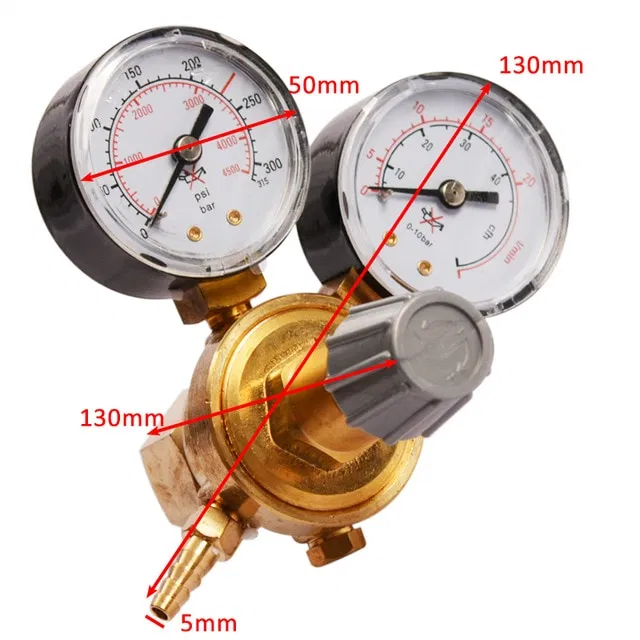
Bar Outlet on CO2/Argon regulator
A bar outlet is also very important. it is best that you get gas regulators with a low bar input as it allows you to make far easier adjustments that way.
Most gas regulators have a 0 to 10 bar outlet. But if you have to set it to 0.2 it makes things far more difficult.
Thus 0-4 welding gas regulators are a far better option in this case as it is far easier to adjust the level of delivery pressure needed.(2)

Gauges On A Gas Flow Regulator (CFH/PSI)
Being able to clearly read the measures on the gauges is something that people disregard, but is very important to have.
Being able to tell the exact readings of the gas you are using is going to help in finishing the job properly.
You also have to know the difference in gauges with different gases, as Argon uses CFH (cubic feet per hour) while oxygen is measure din PSI (pounds per square inch)

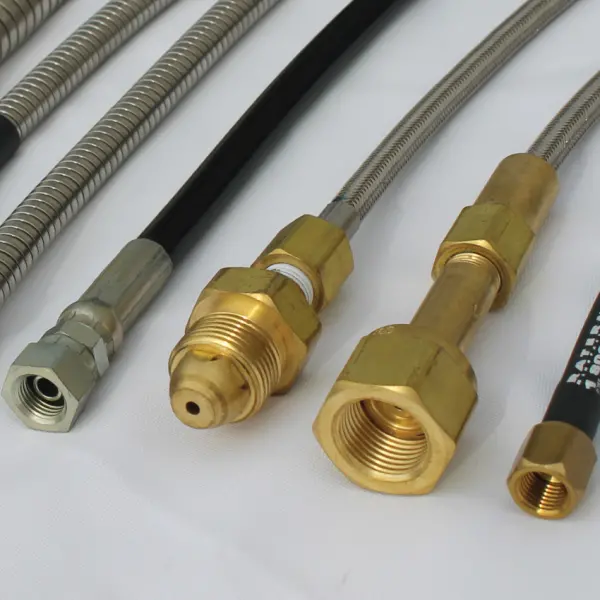
Male and Female Connectors
There are two types of connectors, male and female ones, and gas regulators usually have everything labeled for users to known which one to use.
This is necessary as you do need to properly connect the gas bottle when working in order to have favorable flow rates.
But if you don’t have the required connectors you can still use an adapter for the bottle connection.
Frequently Asked Questions [F.A.Q]
Are argon and CO2 regulators the same?
The majority of CO2 regulators are the same as Argon ones. But the main difference is the cylinder fitting. CO2 cylinders have a female CGA-320 valve, so CO2 regulators use a male fitting. Argon and other shielding gas cylinders have a male CGA-580 valve, so those regulators use a female fitting.
How long do gas regulators last?
Welding gas regulators should be replaced every 10 years. The best type of indicator is visual signs of deterioration. However, each regulator has an expiration date stamped on it which you should follow.
What is SCFH in welding?
The abbreviation SCFH stands for standard cubic feet per hour. This is a type of measurement needed to understand how much shielding gas you are applying.
Conclusion
Although it is often disregarded, gas regulators are an important part of your welding machine setup. Beginner welders may not know this when they start but more experienced ones will tell them that this is a very important part of the entire process. In order to be able to weld properly, the gas service needs to be properly adjusted based on the various parts that we talked about above. Always consider carefully your regulators and follow the instructions so you can attain quality work.






