
This Bosch GWS25-230JR review covers the company’s 9-inch large angle grinder built for heavy fabrication work. I have spent enough hours behind large grinders to know the difference between one that survives an eight-hour shift and one that fights you the whole way, and the 230JR sits firmly in the first camp.
15 amps, 6,500 RPM, and a 9-inch wheel put it in a class most 4.5-inch and 7-inch tools simply cannot touch.
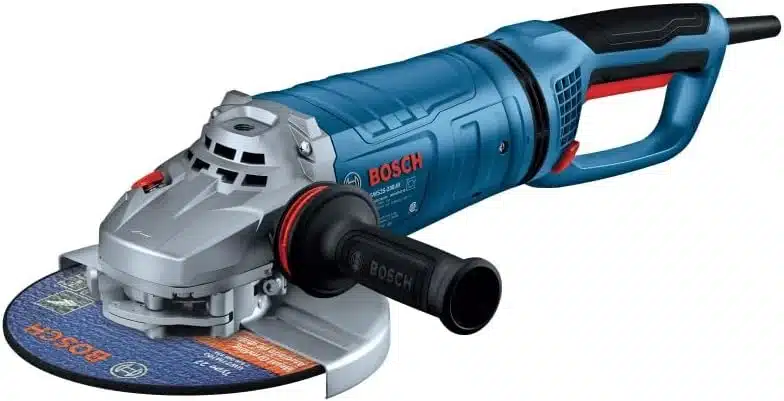
If you prep structural steel for a living, this is the kind of machine that ends up doing most of the material removal on the floor. It is one of our picks for the best large corded angle grinders, and this review explains why.
For a wider look at where it fits among other tool classes, see our guide to the types of grinding tools.
Bosch GWS25-230JR Package Content & Technical Specifications
The box arrives ready to work, with both guards and the mounting hardware included:
15 Amp 9-Inch Large Angle Grinder With Lock-On Trigger
- 9 in. large angle grinder (GWS25-230JR)
- Type A (41/1A) cutting wheel guard
- Type B (27) grinding wheel guard
- Vibration control side handle
- Backing flange
- Lock nut
- Lock nut wrench
Technical Specifications
| Model: | GWS25-230JR (SKU 06018F8310) |
| Wheel Diameter: | 9 in. (230 mm) |
| Motor: | 15 amp |
| Voltage: | 120 V AC |
| No-Load Speed: | 6,500 rpm |
| Spindle Thread: | 5/8 in.-11 UNC |
| Switch Type: | Rear trigger with lock-on |
| Variable Speed: | No |
| Soft Start: | Yes |
| Restart Protection: | Yes |
| Overload Protection: | Yes |
| Anti-Vibration Side Handle: | Yes |
| Rotatable Main Handle: | Yes |
| Weight: | 10.9 lb |
| Length: | 20.3 in. |
| Width x Height: | 5.3 in. x 4.3 in. |
| Warranty: | 1-year limited |
Pros
- 9-inch wheel covers about 70 percent more area per pass than a 7-inch
- 15-amp motor geared to 6,500 no load rpm holds torque under load
- Soft start and restart protection matched to 9-inch rotating mass
- Rotatable main handle for horizontal and vertical positions
- Anti-vibration side handle and rear-inlet cooling for long shifts
Cons
- 10.9 lb, strictly a two-handed tool
- No variable speed control
- 6,500 rpm limits accessory compatibility; ratings must match tool speed
- Wire wheels capped at 7 in., wire cups at 5 in.; no Type 11 or Type 1 wheels
- 1-year limited warranty only
How the Bosch GWS25-230JR Handles Heavy Fabrication Work
Even though ARC200 can perform lift TIG welding, you don’t get a TIG torch to do it. This seems to be the case with all budget-friendly welders that don’t include torches or spool guns, so it shouldn’t surprise you. In addition, the TIG weld function is rather basic, so it really isn’t necessary unless you wish to practice some TIG.
After a brief overview of the package content and technical specifications, let’s get to the central part of our review. Those numbers are only half the story. A grinder this size lives or dies by how it behaves across a full shift of load, so here is how the GWS25-230JR performs where it actually matters.
Power and Speed on a 9-Inch Wheel
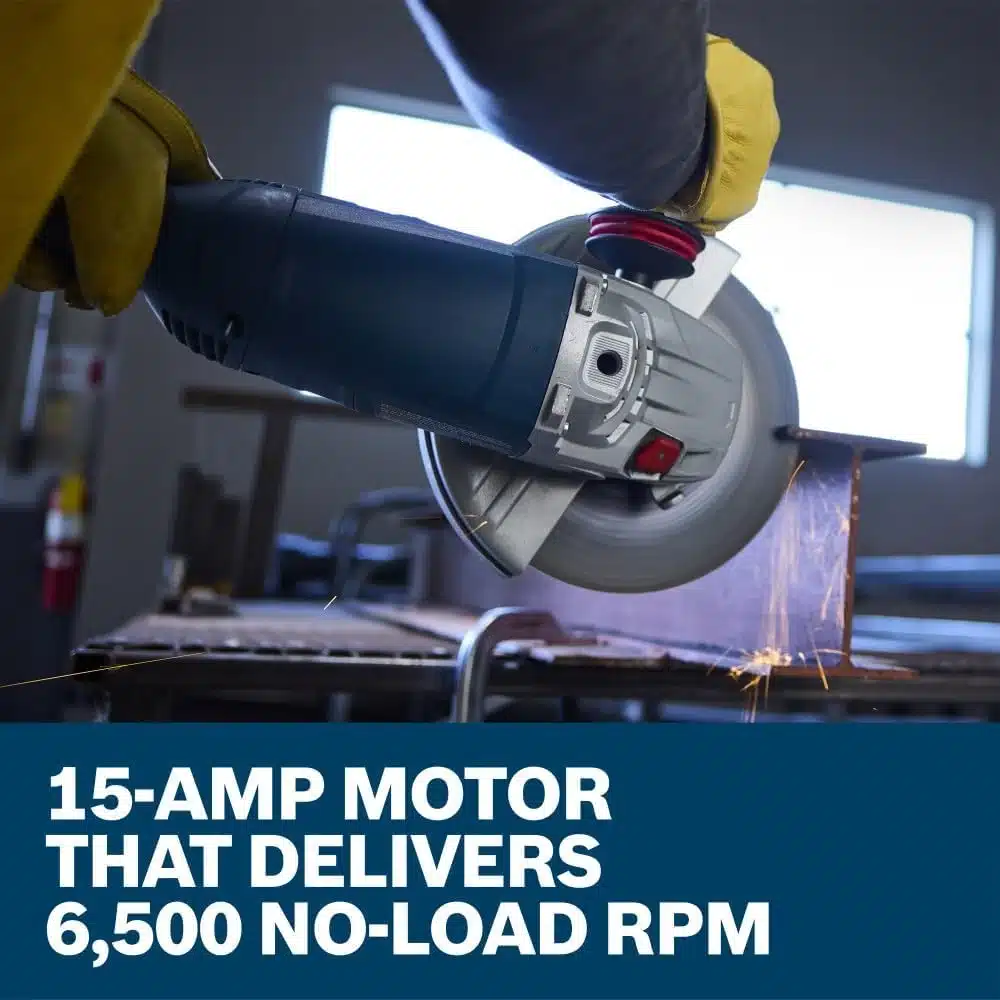
The 15-amp motor turns a 9-inch wheel at 6,500 no load rpm, and that pairing is deliberate. Large wheels carry more mass at the edge, so Bosch geared the tool down instead of chasing the 8,500 RPM of the 7-inch GWS25-180JR sibling.
What you get in return is torque that holds up under load, which is what actually matters when you are hogging off weld caps or surfacing plate. There is no variable speed control, so it is tuned for full-power heavy work.
Bosch bills that as outstanding power for high performance material removal, and the numbers back the claim.
The size step pays off in coverage. A 7-inch wheel sweeps roughly 38 square inches per pass.
A 9-inch wheel covers about 64. That is close to 70 percent more steel per sweep, and over a full shift of deck plate or I-beam prep the hours add up. When I am removing material by the pound rather than the ounce, I reach for the 9-inch first and do not think twice about it, especially for tough grinding and cutting applications like structural steel plates, thick steel, and masonry.
Soft Start, Restart Protection, and the Lock-On Trigger
Spinning up a 9-inch wheel is not trivial. The rotating mass carries enough energy that a hard start can wrench the tool in your grip, so the soft start ramps the motor up instead of slamming it.
Bosch got this right. The feature matters more at this wheel size than on any smaller grinder.
Restart protection is the other half of the safety story. If power drops while the lock on trigger switch is engaged, the grinder will not fire back up on its own when the juice returns. You have to switch it off and restart it deliberately.
Anyone who has had a breaker trip mid-cut will understand why that exists.
The lock-on trigger switch reduces user fatigue during extended use on long surface grinding runs, and overload protection is standard as well. Basic grinding safety precautions still apply, including proper Personal Protective Equipment (PPE), with guards on and positioned between you and the work, but the electronics also improve user control
Ergonomics for Long Shifts
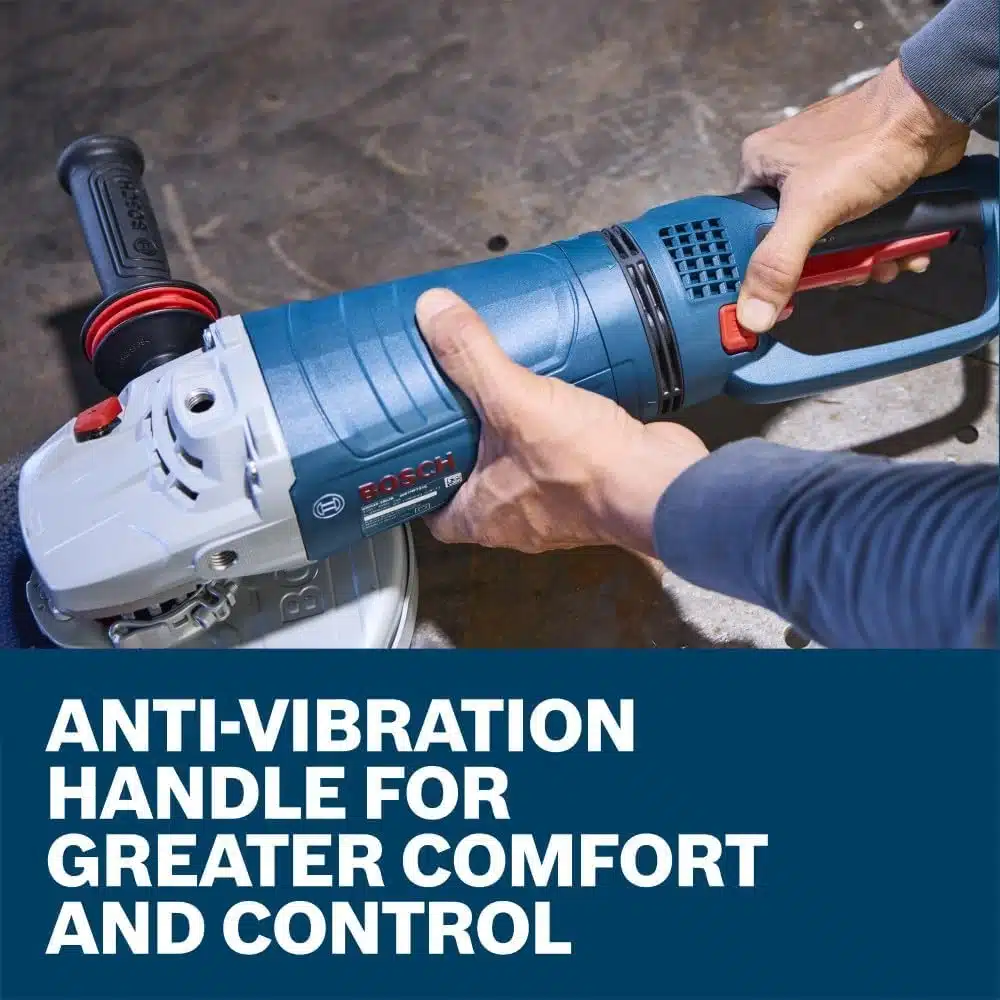
At 10.9 lb and 20.3 inches long, this is a two-handed tool with no exceptions, though I read that weight as durable construction built for hard use. The rotatable main handle is the reason long shifts stay workable, and it gives you improved comfort and enhanced user control without a fight. Rotate it to the top for horizontal surface grinding and your grip pushes down naturally. Swing it 90 degrees for vertical edge beveling. The vibration control side handle soaks up enough of the chatter that an hour of surfacing leaves your forearms usable at the end.
Cooling is the detail most people miss. Air enters through the rear inlets and moves past the armature before reaching the gear housing, so heat from long continuous runs does not pool around the windings. On a grinder that lives at wide open throttle, that routing is a motor-life decision, not a marketing line.
Frequently Asked Questions [F.A.Q]
Can the Bosch GWS25-230JR use 7-inch wheels?
Yes. The 9-inch rating is the maximum, and the manual permits grinding, cutting, sanding, and flap discs up to 9 inches. Any accessory you mount must be rated for at least the tool’s speed, and note that wire wheels top out at 7 inches while wire cups stop at 5 inches. The box ships with a backing flange and lock nut for wheel mounting, a Type A cutting wheel guard and a Type B grinding wheel guard, and the anti-vibration side handle.
What is the difference between the GWS25-230JR and the GWS25-180JR?
Wheel size and speed. The Bosch GWS25-230JR 9 in. angle grinder takes 9-inch wheels at 6,500 RPM while the 180JR takes 7-inch wheels at 8,500 RPM. Both share the same 15-amp, 120-volt platform, the rear trigger with lock-on, soft start, restart protection, and the rotatable handle. Pick the 230JR for material removal, the 180JR when you need the higher rim speed on smaller wheels. It holds a 4.8 out of 5 star rating on Amazon.
What happens after a power interruption?
The restart protection keeps the tool from restarting on its own, even if the trigger was locked on when power dropped. You turn the switch off, then restart the grinder intentionally. That cycle is deliberate and it prevents the sudden spin-up that catches operators off guard.
Is it a good choice for cutting large steel stock?
Not as a primary cutter. Bosch states plainly in the manual that this is not a dedicated cut-off machine and warns against cutting large stock and sheets with it, and its size also makes it a poor fit for precision finishing work even if it can handle occasional cuts with the proper guard. It cuts when needed with the cutting wheel guard fitted, but sustained production cutting belongs to a dedicated machine. That is different from the grinding wheel guard, or wheel guard, used for grinding tasks.
Conclusion
The GWS25-230JR large angle grinder is a one-purpose machine that does its job without drama. The 15-amp motor delivers 6,500 no load rpm and holds that speed under load, the safety electronics match the wheel mass, and the handle geometry keeps 10.9 pounds manageable across a full shift. Structural steel, shipbuilding, heavy equipment repair, pipeline work, those are its lanes. If your grinding is occasional or mostly light gauge, a smaller and lighter tool will serve you better and cost less. For fabricators who already own smaller grinders and need raw material removal at scale, it earns its spot in our roundup of the best large corded angle grinders, and full specifications live on boschtools.com.





