
The 3M Speedglas G5-01 with Adflo PAPR is the welding helmet I point heavy-duty welders toward when they ask what to buy once the budget stops being the problem.
It is 3M’s heavy-duty welding respirator system: a flip-up helmet, the G5-01TW auto-darkening welding filter, and the belt-mounted Adflo blower that pushes filtered air across your face while you weld. In our best PAPR welding helmet guide it sits second only to the Optrel, and the gap between them is thinner than the ranking suggests.
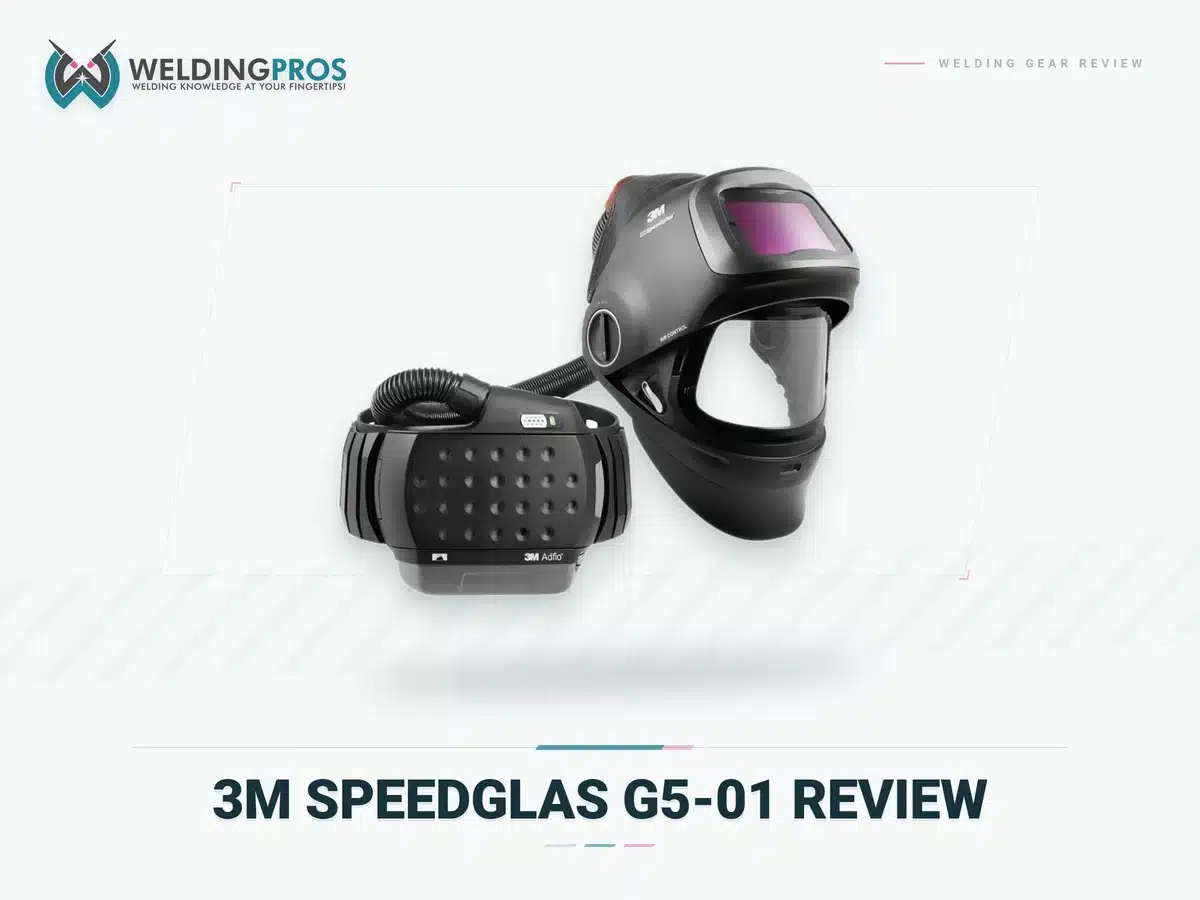
I like this system for the same reason a lot of industrial shops do. The G5-01 was designed with input from welders running high amperage who grind constantly, and it shows in the details: a flip-up front that exposes a clear grinding visor, a filter stack you can extend for vapor protection, and alarms that warn you before the airflow dies instead of after.
It is expensive, and there is no polite way around that. But if you weld for a living around hexavalent chrome, zinc fumes, or an employer who enforces respiratory compliance, this is one of the two or three systems worth spending the money on.
This review covers what the kit contains, how the helmet and blower perform in daily shop work, and who should spend this much on respiratory protection.
3M Speedglas G5-01 Package Content & Technical Specifications
The Amazon kit (model 46-1101-30i) arrives as a ready-to-weld package. 3M sells two models of the welding filter, this TW version and the VC (Variable Color Technology), and the blower side ships as one unit. Everything you need to start is in the box, including:
Heavy-Duty Flip-Up PAPR System With Stackable TH3 Filtration

- G5-01 heavy-duty flip-up welding helmet
- G5-01TW auto-darkening welding filter (Natural Color Technology)
- Adflo High-Altitude PAPR blower unit with breathing tube
- HE particulate filter with pre-filter and spark arrestor
- Turbo lithium-ion battery pack with charger
- Adjustable waist belt (29.5-45.25 in)
- G5 series storage and carry bag
Technical Specifications
| Respiratory Standard: | EN 12941 TH3, NPF 500, NIOSH approved |
| Airflow: | Greater than 170 L/min (6 CFM) |
| Filter: | HE particulate + stackable OV/AG cartridge and odor pad |
| Light State: | Shade 2.5 or 3 (Natural Color Technology) |
| Dark State: | Shade 5, 8-13 (TW); 8-14 on the VC filter |
| Viewing Area: | 2.8 x 4.25 in (71 x 108 mm) |
| Arc Sensors: | 4, arc detection down to 1 amp |
| Battery: | Turbo lithium-ion, 7-9 h runtime |
| Charging Time: | approx. 4.5 h (80% in 3 h) |
| Alarms: | Low airflow (under 170 L/min) and low battery |
| Noise Level: | Under 80 dBA at the ear |
| Weight: | 3.6 lb (1.65 kg) PAPR assembly with belt |
Pros
- Heavy-duty shell built for grinding and high-amperage work
- Flip-up visor means you never forget to switch modes
- Stackable filter system for vapors and odors
- TH3/NIOSH certified respiratory protection
- Natural Color Technology in the light state
- Adjustable airflow direction inside the helmet
- Tack welding comfort mode at shade 5
- Bluetooth statistics through the 3M Connected Equipment app
Cons
- Loud alarm tone
- No protection for the breathing hose and rear connector
- Expensive, and stacking cartridges adds cost
- No side windows
How the G5-01 Helmet Performs
Even though ARC200 can perform lift TIG welding, you don’t get a TIG torch to do it. This seems to be the case with all budget-friendly welders that don’t include torches or spool guns, so it shouldn’t surprise you. In addition, the TIG weld function is rather basic, so it really isn’t necessary unless you wish to practice some TIG.
After a brief overview of the package content and technical specifications, let’s get to the central part of our review. Looking at specifications can be enough for some seasoned welders to tell if they are on the right track or if the machine suitable for them. However, you shouldn’t take words on paper for granted, so we will find out if things are the same in practice. Shortly said, yes, this is a good welder, but let’s look at each aspect.
Optics and arc detection
The G5-01TW welding filter covers dark shades 5 for cutting and 8 through 13 for welding, and holds an intermediate shade 5 during tack welding so your eyes take less punishment when you are stitching short tacks all day.
3M calls that intermediate shade its TAP function. The light state is shade 2.5 or 3 with 3M’s Natural Color Technology, which lets more of the color spectrum through than a standard green lens, and the large viewing area keeps the whole weld zone in frame.
If you want the full picture of how the filter darkens, our article on how auto-darkening welding helmets work covers it from arc strike to dark state.

If your eyes are sensitive, the VC filter is worth knowing about. It adds shade 14 at the top end and lets you pick a warm, standard, or cool color tone in the dark state to get the best viewing contrast for the task. Arc detection comes from four sensors with five sensitivity levels, and the filter switches in 0.1 milliseconds.
It detects arcs down to 1 amp, which covers low-amp TIG work that leaves cheaper helmets blinking. The one optical complaint worth repeating: the clear grinding visor can skew light transmission under certain shop lights. It is a minor thing, but we ran into it during testing for our PAPR guide.
Grinding, flipping, and daily abuse

The flip-up design is the reason this helmet exists. You lift the ADF section and work through a clear, wide-view visor, which is how the G5-01 handles grinding, torch work, and setup inspection.
I prefer this over a dark-state grind mode because you cannot forget to switch back, and the flip-up layout is more comfortable when you are moving between tasks all day.
When the front is down, you are protected from sparks and heat. When it is up, you can see what you are grinding. 3M rates the headgear for most types of arc welding, cutting, and grinding. The accessory catalog runs deep, from rigid or fabric neck protection to a task light that runs off the Adflo battery, and its welding helmet spare parts make long-term upkeep straightforward.
Hinges, pivot rings, visor plates, face seals, and the outer and inner cover lenses are all user-replaceable wear items you swap on a regular basis, so a shop can keep one helmet alive for years instead of replacing it every time a spark chews something up. The adjustable head suspension and head harness help distribute weight evenly over long welding sessions.
The Adflo PAPR: airflow, battery, and the app
The Adflo blower sits on your belt and pushes more than 170 liters per minute through the HE particulate filter, into the helmet, and across your face.
That constant positive airflow is the whole point of a PAPR. Welding fume, grinding dust, and hexavalent chromium stay outside the headgear instead of inside your lungs, and the airflow keeps the lens from fogging.
If you have ever ended a shift with a metallic taste in your mouth, you already know the problem this solves; our page on welding fumes symptoms lists what long-term exposure does beyond the taste.

Inside the helmet, the adjustable airflow duct system lets you steer the air toward your face or the visor, and balance the top outlet against the two side outlets. The filter stack is the Adflo’s party trick: the HE filter handles particulates on its own, and when the job calls for it you stack an organic vapor/acid gas cartridge underneath, or a nuisance odor pad, and the same belt unit handles both.
Two alarms protect you: airflow below 170 l/min for 15 to 30 seconds fires an audible alarm and turns the power LED red, and a second alarm sounds when the battery has roughly 15 to 30 minutes left. Stacking the cartridge does cost you runtime, and the battery spec deserves attention, which the specifications table above covers.
The kit ships the High-Altitude assembly with the Turbo battery, rated 7 to 9 hours depending on flow and filter load, while the standard Adflo configuration runs 10 to 12 hours. Bluetooth connectivity to the 3m.com Connected Equipment app rounds out the respirator: program up to ten memory modes with your lens settings, log maintenance, and read hours on, hours in dark state, and on/off cycles. For a shop running a fleet of these across multiple work sites, that maintenance log alone justifies the Bluetooth.
Frequently Asked Questions [F.A.Q]
Is the 3M Speedglas G5-01 worth the money?
For professional welders doing heavy-duty welding, yes. The build quality, TH3/NIOSH safety rating, and modular filter system make a real difference versus cheaper alternatives, and the helmet is rebuildable rather than disposable. For hobby use, the price is hard to justify when a good auto-darkening helmet plus a fume extractor costs a fraction as much.
How long does the Adflo battery last?
Battery life is approximately 7 to 9 hours per charge on particulate filtration with this kit’s Turbo battery. The standard (non-Turbo) Adflo assembly is rated 10 to 12 hours, and an OV/AG cartridge cuts that to about 5.5, so check the assembly number and filter setup before you compare numbers, since battery life also varies with filter load.
Can you grind with the G5-01?
Yes. The front flips up to expose a clear grinding visor, and 3M lists grinding as a designed application alongside most types of arc welding and cutting. The clear visor replaces the dark-state grind mode other helmets use, so you cannot forget to switch back.
Does the G5-01 work without the PAPR?
The helmet needs the Adflo (or a Versaflo supplied-air regulator, which 3M sells separately) to deliver air, but the auto-darkening welding filter works on its own, so the helmet still protects your eyes and face with the blower off. What you lose is the respiratory protection, which is most of the reason to buy this system.
Conclusion
The G5-01 with Adflo is a system you buy once and rebuild for years. The optics are excellent with Natural Color Technology for better clarity and weld control, the flip-up grinding visor changes how you move between tasks, and the stackable filter system handles particulates, vapors, and odors on one belt unit with alarms that warn you before protection drops, shaped by extensive input from welders working at high amperages. The costs are real too: a loud alarm, a breathing hose and connector that need care because nothing shields them, and a price that only makes sense for people who weld professionally. If that is you, this is one of the best systems on the market, and it earned its place near the top of our best PAPR welding helmet guide.






