
When the work moves out of the shop and into the field, extension cords stop being an option. You need a machine that makes its own power.
The Lincoln Electric Eagle 10,000 Plus does exactly that. It pairs a 225-amp DC stick welder with a 9,000-watt continuous generator, all run by a 23 HP Kohler gasoline engine.
I have logged enough hours around engine drives to know most of them ask you to compromise somewhere. The Eagle 10,000 Plus asks for two things instead: a truck to mount it on and a willingness to feed it gasoline. In exchange, you get a machine that welds all day and powers the rest of the job site at the same time.
In this Lincoln Eagle 10,000 Plus review, I will walk through its welding output, generator power, and build quality, plus the one marketing claim you should not take at face value.
Lincoln Eagle 10,000 Plus Review: Package Content & Technical Specifications
The Eagle 10,000 Plus is a fully enclosed, truck-mountable engine-driven welder built for contractors, maintenance crews, and farm work. Lincoln ships it ready to weld, with the following in the box:
Engine-Driven DC Stick Welder with 9,000W Generator Power
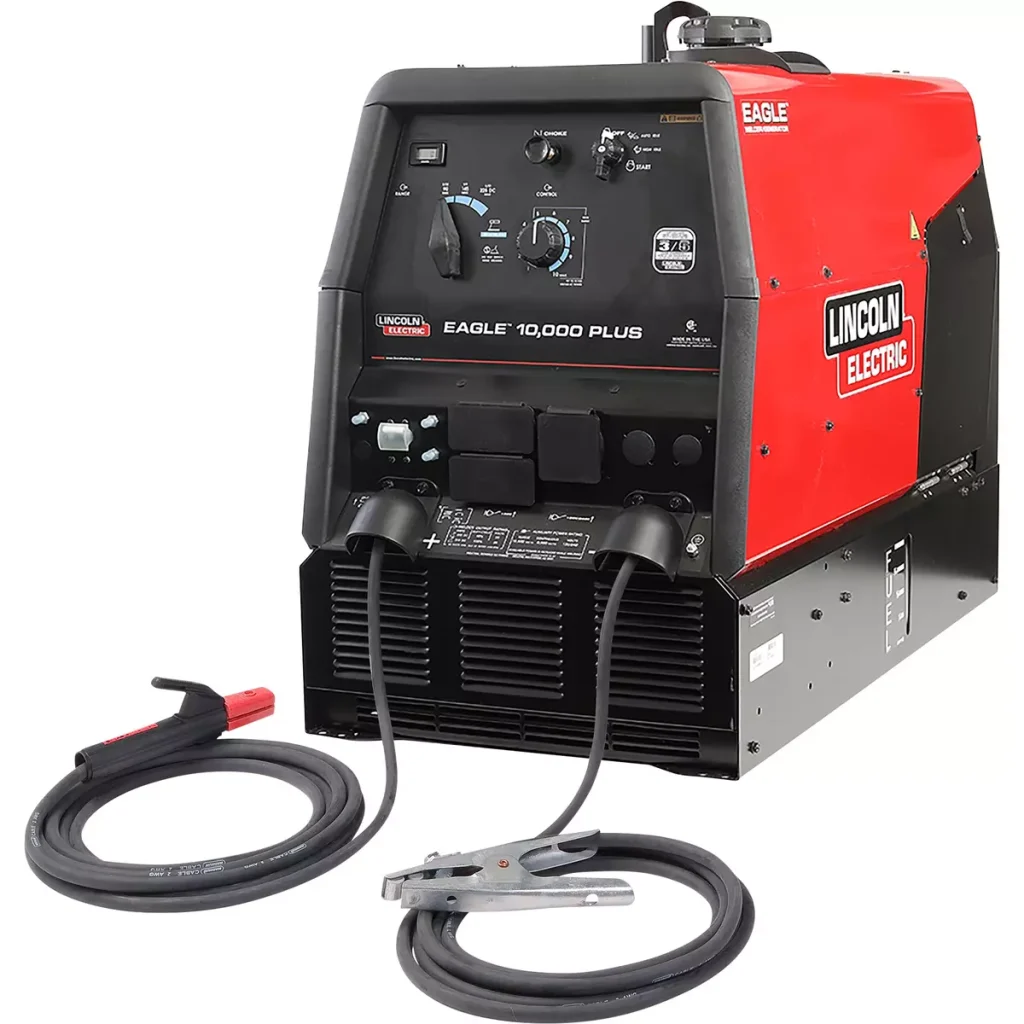
- Lincoln Electric Eagle 10,000 Plus welder generator
- 20 ft (6.0 m) #2 electrode cable
- Electrode holder
- 15 ft (4.5 m) #2 work cable
- Work clamp
- Lincoln operator’s manual (IM10028)
- Kohler engine owner’s manual
Technical Specifications
| Welding Process: | DC Stick (SMAW); MIG, flux-cored, and basic TIG with optional equipment |
| Output Range: | 50-225A DC, constant current |
| Rated Output: | 225A/25V at 40%; 210A/25V at 100% duty cycle |
| Generator Output: | 9,000W continuous; 10,500W surge |
| Receptacles: | 2x 120V duplex (5-20R); 1x 120/240V (14-50R) |
| Engine: | Kohler Command CH730, 23 HP at 3,600 RPM, 2-cylinder gasoline |
| Fuel Tank Capacity: | 12 gallons |
| Fuel Consumption: | About 1.3 gal/hr at rated output |
| Starting System: | Electric start, Group 58 battery |
| Noise Level: | 76.4 dBA at 23 ft (7 m) |
| Dimensions: | 29.9 x 21.5 x 42.3 in |
| Weight: | 514 lbs (233 kg) |
Pros
- 210-amp output at 100% duty cycle lets you weld all day without cooldown breaks
- 9,000W continuous generator power with 10,500W surge for motor starting
- Totally enclosed case protects the engine and keeps noise at 76.4 dBA
- Three service doors and an oil drain extension make maintenance painless
- 3-year welder warranty, with Kohler backing the engine separately
Cons
- The welding side is DC stick only, despite the multi-process marketing
- 514 lbs means a truck or trailer mount is mandatory
- Wire-feed MIG and AC TIG need optional equipment or a separate machine on the generator side
- Gasoline engines need more frequent servicing than diesel rivals
- Premium price compared to lighter-duty engine drives
Lincoln Eagle 10,000 Plus Review: Welding and Generator Performance
The Eagle 10,000 Plus lives or dies on three things: welding output, generator power, and durability. Here is how each one holds up in real use.
Welding Power and Duty Cycle
On the welding side, the Eagle 10,000 Plus is a 225-amp DC constant current machine. Lincoln rates it at 225A/25V at a 40% duty cycle and 210A/25V at 100%, and both ratings hold at 104°F (40°C) ambient, which matters if you weld through hot summers. In plain terms, you can run 1/8 inch 7018 rods all day without waiting for the machine to cool down, and the smooth DC output handles E6010, E6011, E6013, E7014, and E7018 electrodes without fuss. That output range covers farm repair through structural work, and if you ever need more amps in the field, Lincoln’s Ranger 330 MPX goes to 330. Most field repair work never gets there. If those ratings are new to you, our duty cycle in welding guide explains what the numbers mean in practice.
Now the honest part. Lincoln markets this machine as multi-process, and the spec sheet does list MIG, flux-cored, and basic TIG capability. In practice, the built-in welding output is DC stick. The multi-process part works one of two ways: you either add optional equipment to weld flux-cored and basic TIG in constant current mode, or you plug a separate MIG or TIG machine into the generator side and weld from that. Since MIG hates wind anyway, most field work ends up being stick or self-shielded flux wire, which the Eagle handles through optional across-the-arc wire feeders. Aluminum is not off the table either: Lincoln’s Square Wave TIG 200 plugs into the generator side and gives you full AC TIG. Just know you are buying a DC stick welder with a big generator attached, not an all-in-one multi-process unit.
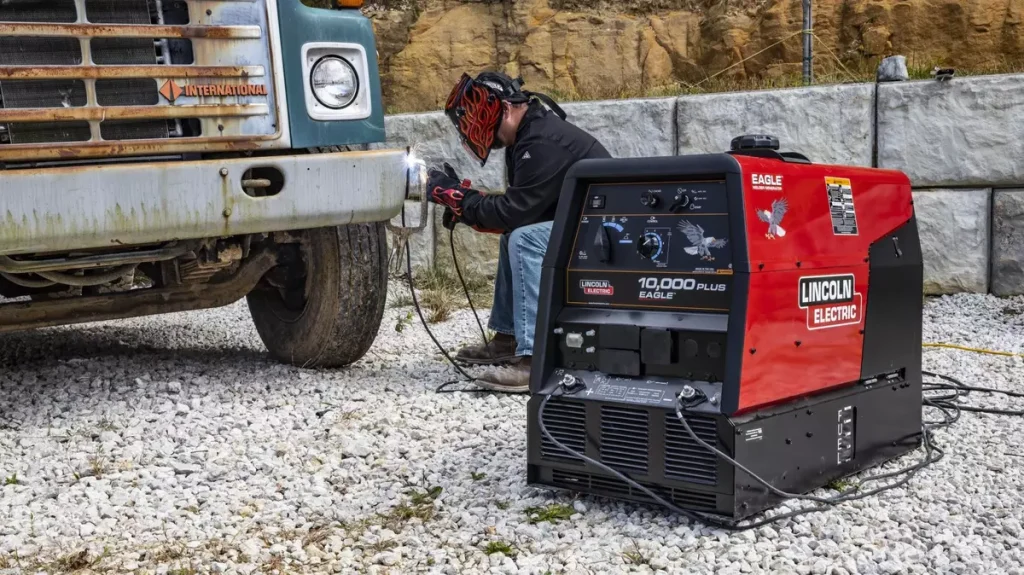
Generator Power and Engine
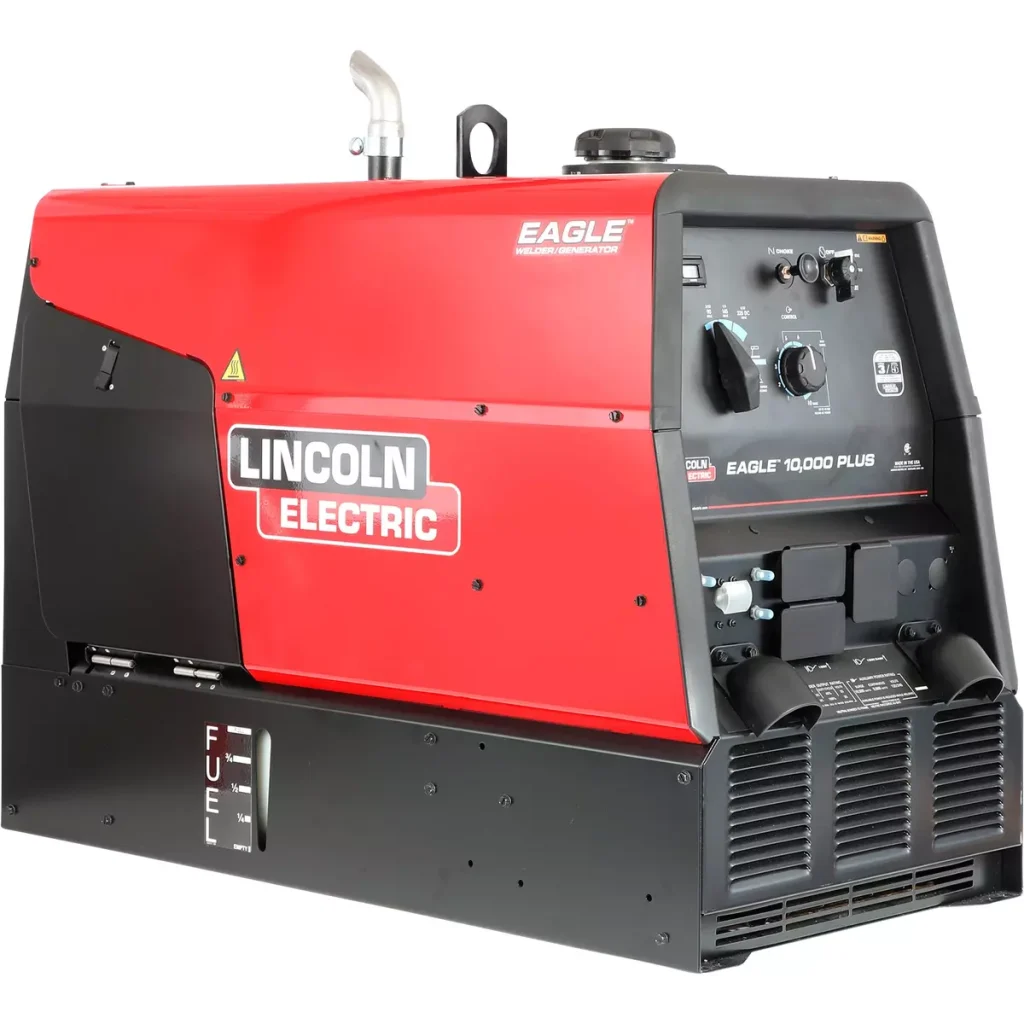
The generator side is where this machine earns its keep. You get 9,000 watts of continuous 120/240V single-phase power and 10,500 watts of surge for motor starting. The panel carries two 120V duplex receptacles good for 40 amps combined, plus one 120/240V full-KVA receptacle that delivers up to 38 amps, so running a grinder, work lights, and an inverter welder at the same time is realistic, not theoretical. A plasma cutter works too, as long as you bring a separate air supply. One thing to plan around: auxiliary power drops while you are welding, so budget your watts when both sides are working at once.
Power comes from a two-cylinder Kohler Command CH730 gasoline engine making 23 HP at 3,600 RPM. The 12-gallon tank burns about 1.3 gallons per hour at rated output, which works out to roughly nine hours of continuous welding per fill-up. Visual fuel gauges on both sides of the base make checking the level easy. Oil changes are due every 100 hours, the oil filter every 200, and the crankcase holds 2.0 quarts. The built-in hour meter takes the guesswork out of scheduling, and Lincoln included an oil drain extension tube, which sounds minor until you have changed oil on a machine bolted to a truck bed.
Build Quality and Everyday Use
The whole machine sits in a totally enclosed case with three service access doors, which keeps the engine protected from jobsite grit and brings noise down to 76.4 dBA at 23 feet. That is quieter than most open-frame engine drives I have worked next to. The powder-coated red and black finish is UV resistant, so the color holds up outdoors, and front and rear mounting holes in the base make truck or trailer installation straightforward. Kohler’s low-oil shutdown adds a safety net for the days you forget the 100-hour oil change.
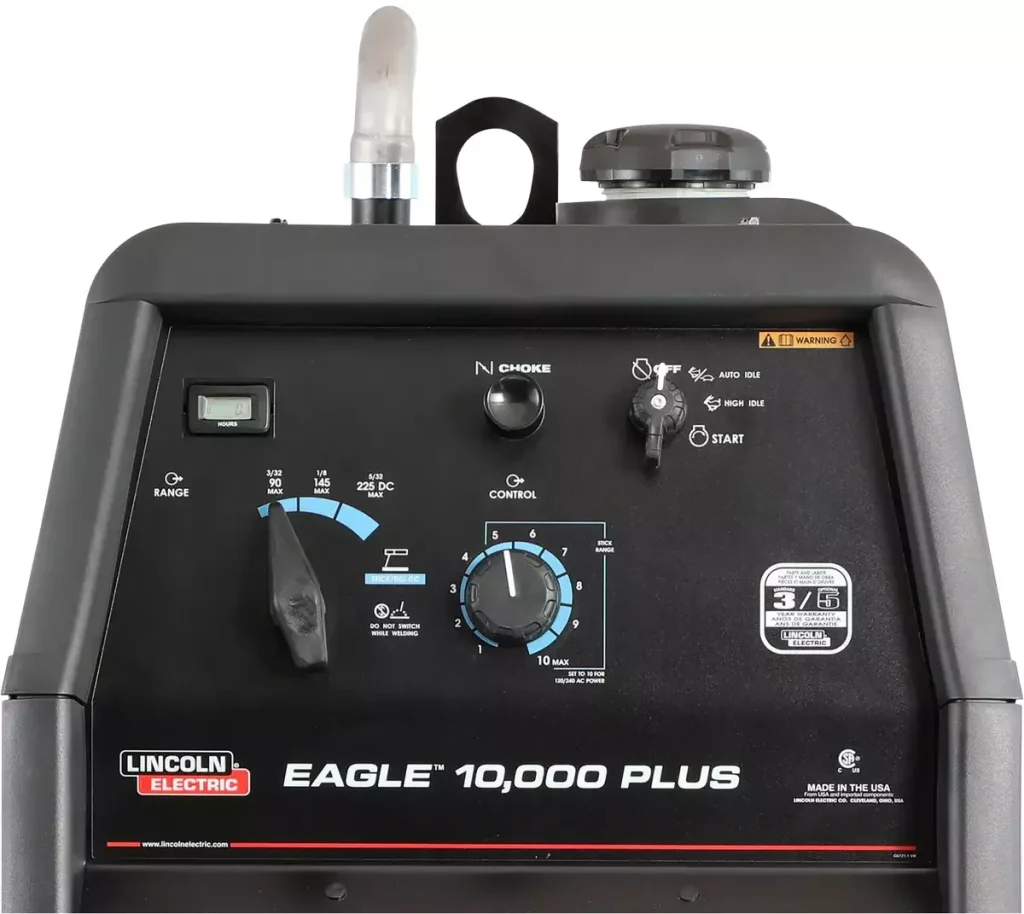
Daily operation is simple. Electric start fires off a Group 58 battery, the switch has three positions for START, OFF, and IDLER, and idle mode saves fuel and engine wear between welds. The control panel carries the range and amperage selectors plus the hour meter, all laid out logically. The choke runs on a stainless steel cable, and the fine output control lets you dial the arc in between the three range settings. Just remember this is a 514-pound machine. Plan the mount, plan the lifting, and do not buy it imagining you will carry it around a shop.
Frequently Asked Questions [F.A.Q]
Is the Lincoln Eagle 10,000 Plus really a multi-process welder?
Only partly. The built-in output is DC stick welding. MIG, flux-cored, and basic TIG are possible with optional equipment in constant current mode, or by plugging a separate welder into the 9,000-watt generator. There is no built-in wire feeder, and the welding output itself is DC only; for AC TIG on aluminum you plug a machine like Lincoln’s Square Wave TIG 200 into the generator.
How long will it run on a full tank?
The 12-gallon tank burns roughly 1.3 gallons per hour at the rated 210-amp output, so expect about nine hours of continuous welding per fill-up. Between welds the automatic idler drops the engine to about 2,200 RPM, and lighter loads stretch that runtime further.
Can it power a plasma cutter?
Yes. The 9,000-watt continuous output runs most engine-drive-compatible plasma cutters, with 10,500 watts of surge available for startup. For a larger cutter, use the 120/240V 14-50R receptacle instead of the 120V duplex outlets. Plasma cutting needs a separate air supply, which the Eagle does not provide.
How loud is the Eagle 10,000 Plus?
Lincoln rates it at 76.4 dBA at 23 feet (7 m) and 100.7 dB sound power at rated output. The totally enclosed case keeps it quieter than most open-frame engine drives, though it is still a gasoline engine and not something you want idling next to a conversation.
Conclusion
The Lincoln Electric Eagle 10,000 Plus is the machine I point farmers, ranchers, and maintenance crews toward when they need one unit that welds hard and powers everything else. You get a 225-amp DC stick welder that runs at 100% duty cycle at 210 amps, 9,000 watts of continuous generator power, and a Kohler engine that is easy to service and reasonable to feed. It is not a built-in multi-process welder, it is heavy, and it is not cheap. None of that changes the fact that it tops our best welder generator list, or that a properly maintained one will outlast the truck it is bolted to. If you want to see how it stacks up against other machines in this class, start with our engine-driven welders overview.






