
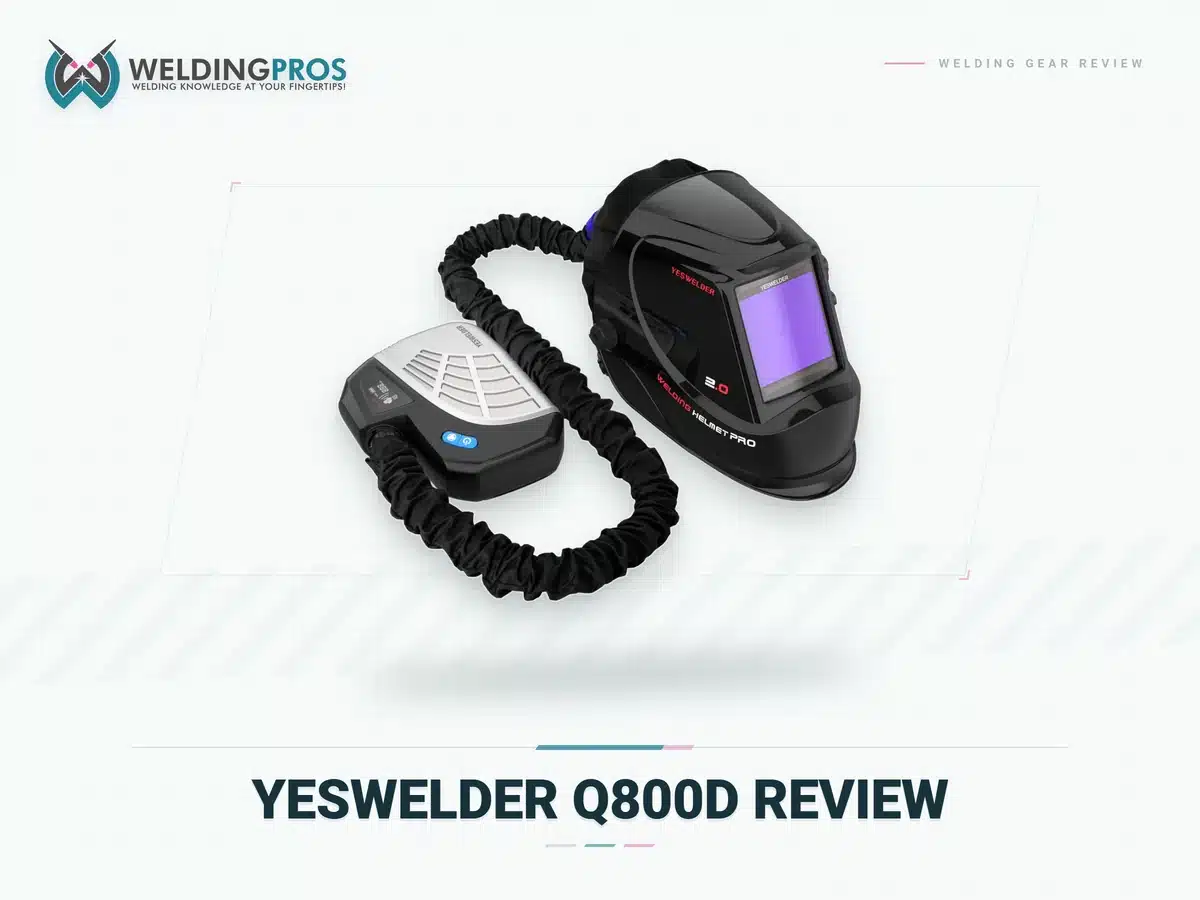
This YesWelder Q800D review answers a simple question: does filtered, fan-fed air really have to cost four figures? YesWelder took their panoramic Q800D hood, added a belt-mounted blower with a TH3P filter, and sold the package for a fraction of what 3M, Miller, and Optrel charge. That made it the budget entry point into powered air respiratory protection, and the reason it earned a spot in our best PAPR welding helmet guide.
There is a catch, and you should hear it before anything else. YesWelder has discontinued the Q800D PAPR and removed it from their store. The Amazon listing still exists but shows as currently unavailable, with no restock date.
So this YesWelder Q800D review comes with no buying links. If the system still interests you, the second-hand market is where you will find one, and this review tells you what to check before you pay for a used unit.
The package shipped as a complete system, and the hood half of it was always the strong part. Here is what the kit contains, what the specs say, and where the weak points hide.
YesWelder Q800D PAPR System Package Content & Technical Specifications
The kit arrived as a ready-to-weld package rather than an add-on for an existing helmet, including:
Budget PAPR System With Panoramic True-Color Hood

- YesWelder Q800D PAPR System panoramic auto-darkening helmet with true-color lens
- PAPR blower unit with electronic airflow control
- Breathing hose with helmet connection
- Shoulder straps and waist belt
- TH3P PARA filter
- Brush
Technical Specifications
| Part Number: | LYG-Q800D-HXJ |
| System Type: | PAPR: belt blower + panoramic ADF hood |
| Airflow: | 170–220 l/min, electronically controlled |
| Filter: | TH3P PARA (same-grade TH3P filters fit) |
| Optical Class: | 1/1/1/1 (EN379), true color view |
| Viewing Area: | 3.93 × 3.23 in (100 × 83 mm) + side windows |
| Side Windows: | Fixed shade DIN 5 |
| Light State: | DIN 4 |
| Dark State: | DIN 5–9 / 9–13, external adjustment |
| Arc Sensors: | 4 |
| Switching Time: | < 1/30,000 s |
| UV/IR Protection: | DIN 16 |
| Helmet Weight: | 1.6 lb (620 g) |
| Blower Battery: | Rechargeable, low-flow and low-battery alarms |
| ADF Power: | Solar cell + replaceable CR2450 backup |
| Sensitivity: | Adjustable low/high, auto on/off |
| Applications: | TIG, MIG, MMA, plasma, grinding |
Pros
- PAPR protection at a fraction of the big-brand price
- Extra-large panoramic view with side windows
- 4 arc sensors with true color view
- 1/1/1/1 optical clarity
- Rechargeable blower with audible and visual alarms
- Standard-grade TH3P filters fit, no proprietary cartridge
- Light 620 g hood
Cons
- Discontinued, second-hand market only
- Not built for heavy industrial daily use
- Headgear is the known weak point
- Replacement parts can be hard to track down
- Blower runtime was never officially published
What the Q800D PAPR System Actually Gives You
Even though ARC200 can perform lift TIG welding, you don’t get a TIG torch to do it. This seems to be the case with all budget-friendly welders that don’t include torches or spool guns, so it shouldn’t surprise you. In addition, the TIG weld function is rather basic, so it really isn’t necessary unless you wish to practice some TIG.
After a brief overview of the package content and technical specifications, let’s get to the central part of our review. Looking at specifications can be enough for some seasoned welders to tell if they are on the right track or if the machine suitable for them. However, you shouldn’t take words on paper for granted, so we will find out if things are the same in practice. Shortly said, yes, this is a good welder, but let’s look at each aspect.
Clean air without the four-figure price tag
The whole point of a PAPR system is breathing filtered air while you weld, and on paper the Q800D delivered the same airflow range as helmets costing two and three times more. The blower pushes 170 to 220 liters per minute through a TH3P PARA filter, which is the same filter class the big brands use in this category. Toxic welding fume stays outside the hood, and cool filtered air flows across your face for the whole shift.
Two design choices stand out. First, the alarms: the unit warns you with both sound and a visual indicator when airflow drops or the battery runs low, so you are not guessing whether your protection is still working. Second, the filter bay accepts any same-grade TH3P filter. That matters for a discontinued product. You are not locked into a cartridge nobody sells anymore, so the running cost of a used system stays reasonable.

The hood is the strongest part of the package

The Q800D hood is a panoramic design with a 3.93 × 3.23 inch main window and fixed shade 5 side windows, which improves visibility and gives you peripheral vision that standard welding helmets simply do not have.
Four arc sensors watch for strikes from any angle, which means no missed flashes when you weld in tight corners or someone strikes an arc next to you.
Optically the lens is a 1/1/1/1 class cartridge with true color view, the top optical rating a helmet can carry, and its true-color lens stack avoids the usual green tint to help you read weld puddle detail better (our optical clarity comparison explains what those four numbers mean).
The dark state adjusts from DIN 5–9 and 9–13 through an external knob, the light state sits at DIN 4, and the cartridge switches in under 1/30,000 of a second, with adjustable sensitivity.
A grind mode also lets you move through prep and cleanup without stopping to change gear. UV and IR protection holds at DIN 16 in the light state, so your eyes stay protected even before the lens darkens. The cartridge runs on solar power with a replaceable CR2450 backup battery, and the sensors power the helmet on and off automatically (here is how that auto-darkening process works in practice).
Comfortable for long days, with one weak spot
The hood itself weighs 620 grams, light for a panoramic helmet and kind to your neck over a full day. The blower and battery ride on the belt and shoulder straps instead of your head, which is the right place for them, and that layout carries you through multi-hour sessions.
Owner feedback points to solid performance for light to medium welding tasks, and at its price the Q800D was a high-value option for hobbyists and home shops.
Two honest warnings. The pivot-style headgear is the known weak point on this hood. Owners report it loosening over repeated adjustments, so budget for a replacement headgear or an upgrade if you buy used.

And the feedback record is mixed: the Amazon listing averaged 3.7 out of 5 stars from 22 ratings, including one owner whose air pack failed within the first hour and was replaced under warranty within a week. Support existed, but the unit needed it. Inspect any second-hand blower before you pay.
Frequently Asked Questions [F.A.Q]
Is the YesWelder Q800D PAPR still available new?
No. YesWelder discontinued the system and removed it from their official store, and the Amazon listing has no stock and no announced restock. New units are effectively gone. Your realistic options are the second-hand market, eBay, Facebook Marketplace, and local listings, or one of the current alternatives in our PAPR helmet roundup.
What filter does the YesWelder Q800D PAPR use?
It ships with a TH3P PARA filter, and the blower accepts any same-grade TH3P filter. That is the practical detail for used buyers: standard TH3P filters from other brands fit, so filter supply is not a dead end even though the system itself is discontinued.
Is the Q800D good for TIG welding?
The hood is rated for TIG, MIG, MMA, and plasma work. For TIG specifically, the 9–13 dark shade range covers the amperages, four sensors catch low-amperage starts better than two-sensor helmets, and sensitivity is adjustable between low and high. The limitation is the DIN 4 light state. It is darker than the shade 2.5–3 lenses aimed at precision low-amp TIG work, so if you weld very thin material at low current all day, the Q800D gives you a less bright arc view between welds than a dedicated TIG hood.
How long does the blower battery last?
YesWelder never published an official runtime figure for the blower pack, and the listing did not include one. What is documented is the warning system: audible and visual alarms fire when the battery runs low or airflow drops. The practical habit is to charge the pack before every welding session and treat the alarm as your cue to stop, not a suggestion.
Conclusion
The Q800D PAPR system did something the welding market needed: it put TH3P-filtered air, a 1/1/1/1 panoramic hood, and 220 l/min of airflow within reach of hobbyist budgets. The hood was always the strong half of the package. The blower was adequate but had a mixed reliability record, and the headgear needed replacing sooner than it should.
Now that the system is discontinued, the verdict comes down to price and condition. A used Q800D at a low price, with a healthy blower, is still a rational buy for a home or small shop that wants PAPR protection without four-figure cost, especially since generic TH3P filters keep it running. What it was never meant for is heavy industrial daily use, and a used unit does not change that. If no good second-hand unit turns up, compare the current models in our best PAPR welding helmet guide before settling for less protection.






