
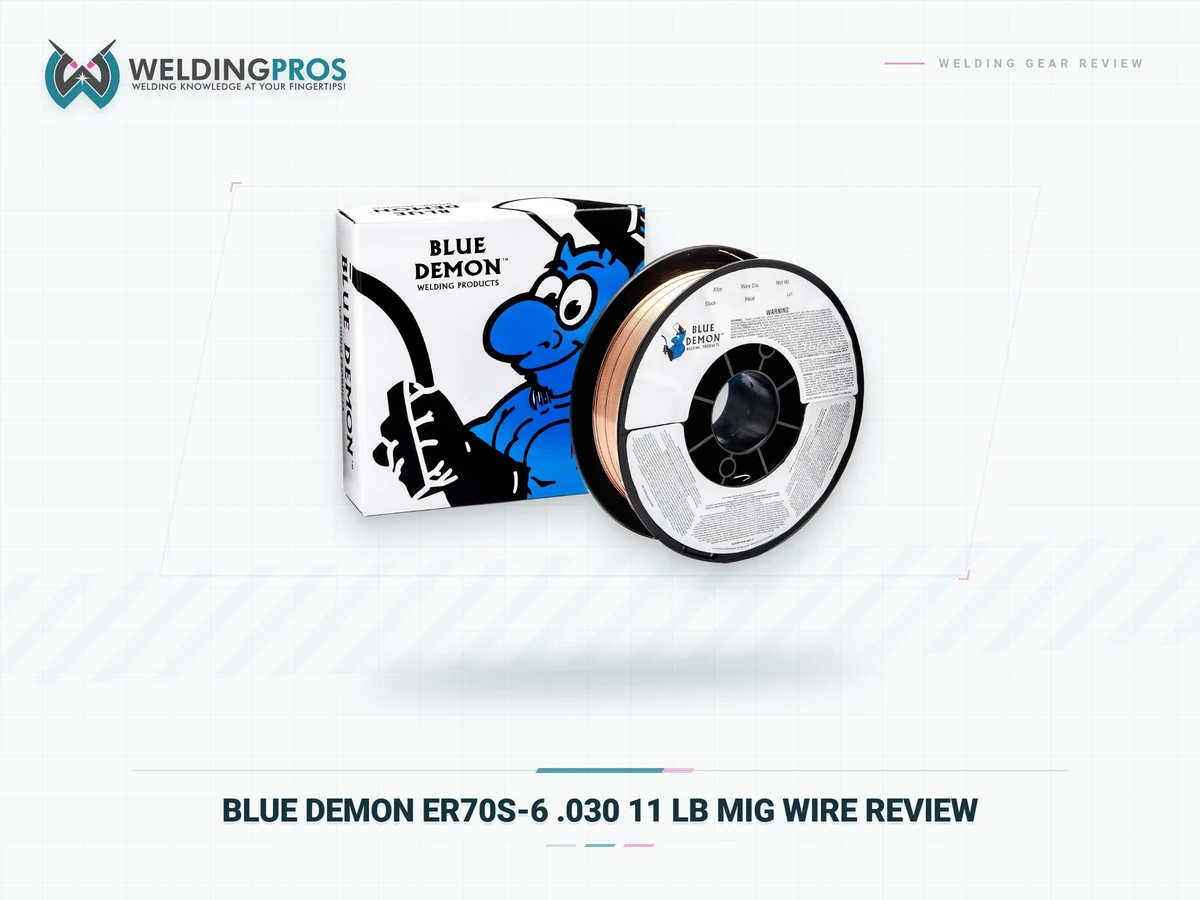
Most .030 spools stop at 10 pounds. Blue Demon sells an 11 lb one for $39.95, and that extra pound at a soft price is the pitch behind this Blue Demon ER70S-6 review. The wire holds our best .030-inch slot in the best MIG welding wire comparison, ahead of pricier spools from Lincoln and Hobart.
The question after a month of sheet metal repairs and structural work: does value wire with a bonus pound weld like value wire, or is this spool a straight bargain?
Blue Demon is a California brand distributed by Techniweld USA, and this wire is produced in China to the ER70S-6 spec.
That mix usually shows up in the price first and the weld pool second. The spec sheet still reads like any ER70S-6 should: copper-coated solid carbon steel for GMAW, 70,000 psi minimum tensile strength, and elevated silicon and manganese so the wire copes with steel that is not perfectly clean. What you give up next to Lincoln or Hobart is coating consistency, and I get into where that shows.
Blue Demon sells the ER70S-6 line from .023 up to .045 in diameter, mostly in 2 lb, 10 lb, and 11 lb spools. This review covers the .030 in., 11 lb spool, which is the size that makes sense if you burn wire most weeks; the same wire also comes in 10 lb and 1 lb rolls if you weld only occasionally.
This review pulls together what Blue Demon and its distributors publish, meaning the AWS classification data, the weld metal chemistry, and the strength numbers, next to what verified buyers report after running spools of it. Where the two disagree I say so, and where a claim exists only in marketing copy I left it out.
Blue Demon ER70S-6 .030″ 11 lb MIG Welding Wire Package Content & Technical Specifications
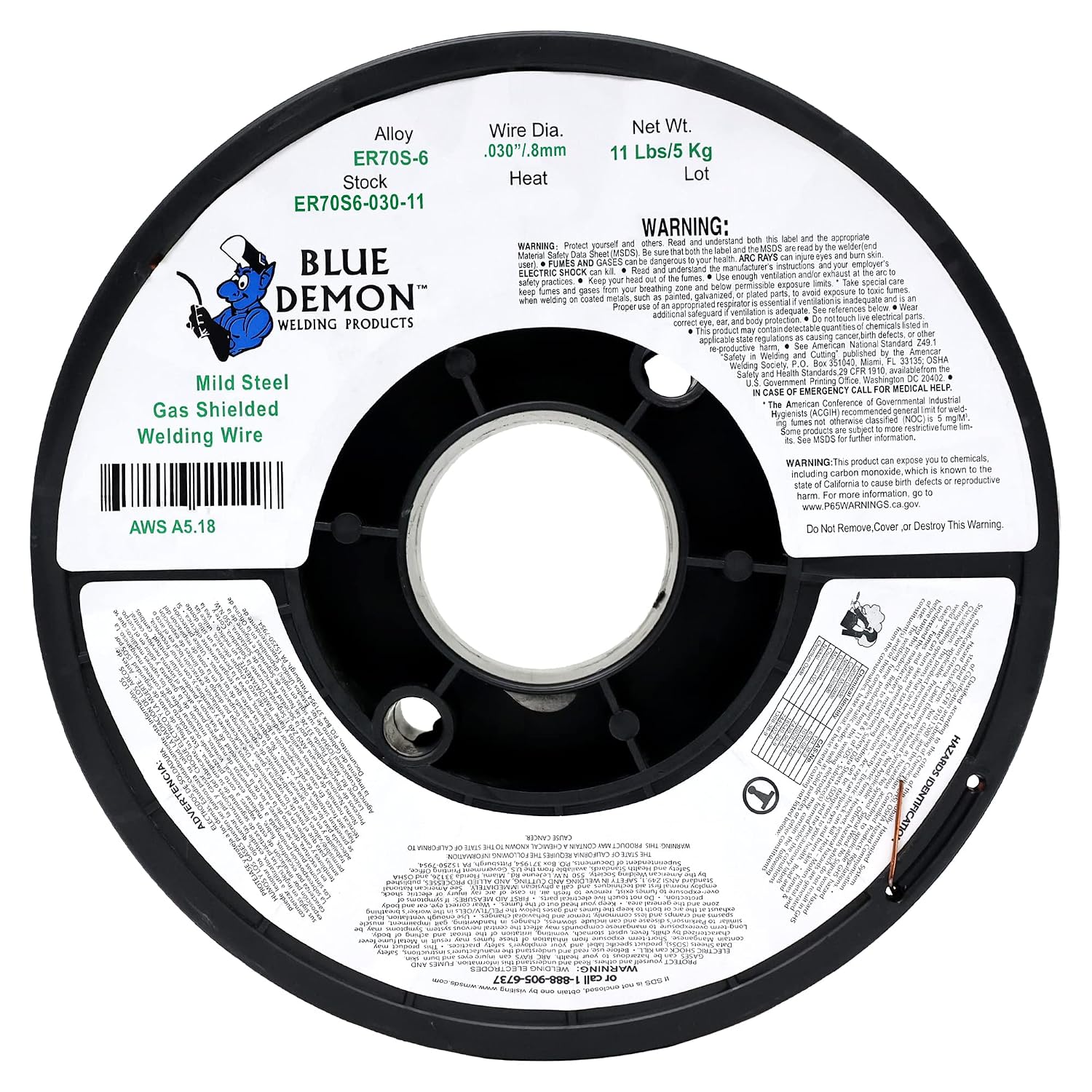
The wire arrives as a single 11 lb spool inside a printed carton. The carton carries the full classification set, AWS A5.18 ER70S-6 among it, so you can confirm exactly what you bought before opening anything. The governing specification is available from pubs.aws.org if you want the chemistry limits. Solid wire is a one-item purchase, with no bottle and no regulator to buy. Here is what the 11 lb package gives you:
The Extra-Pound .030 Spool At A Working Price
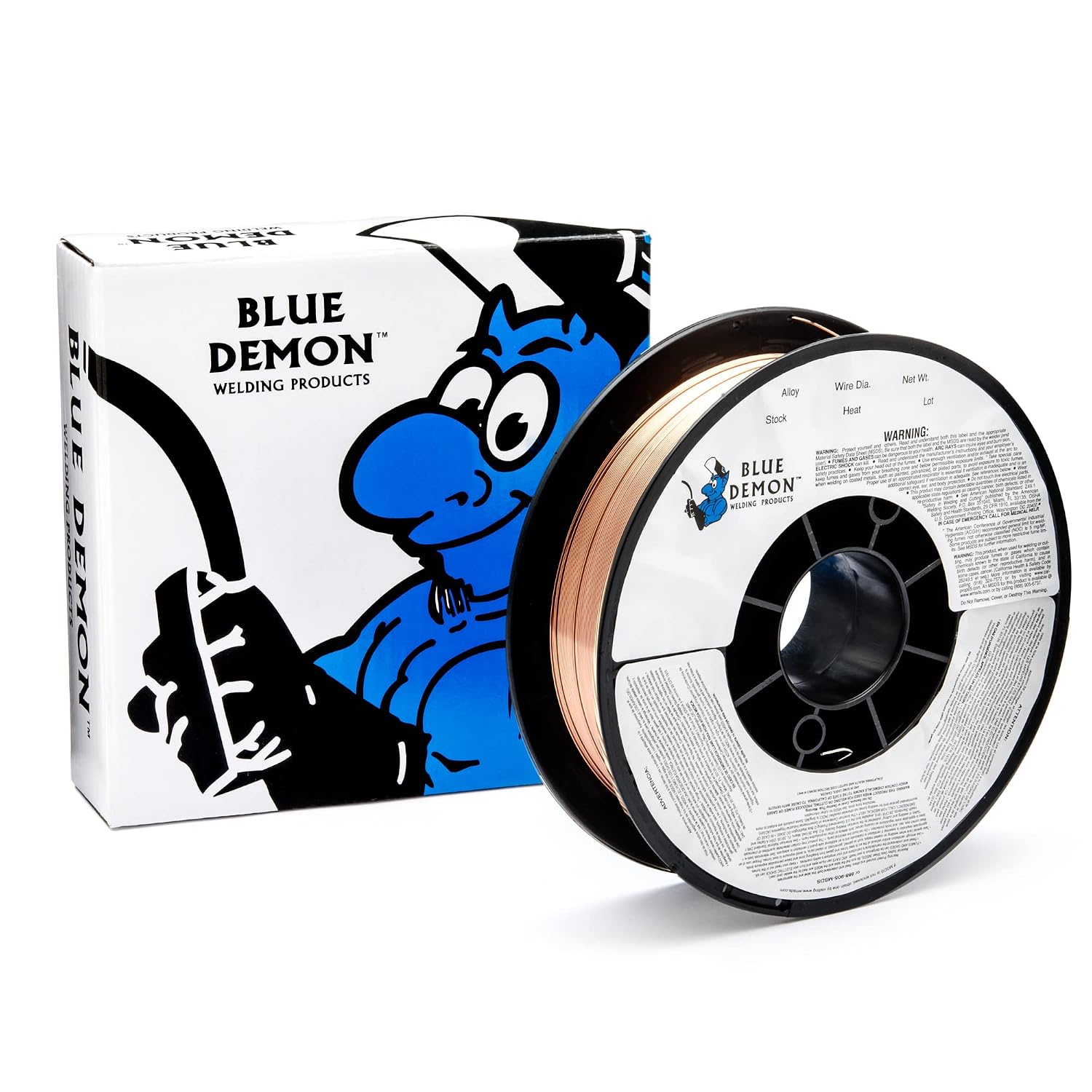
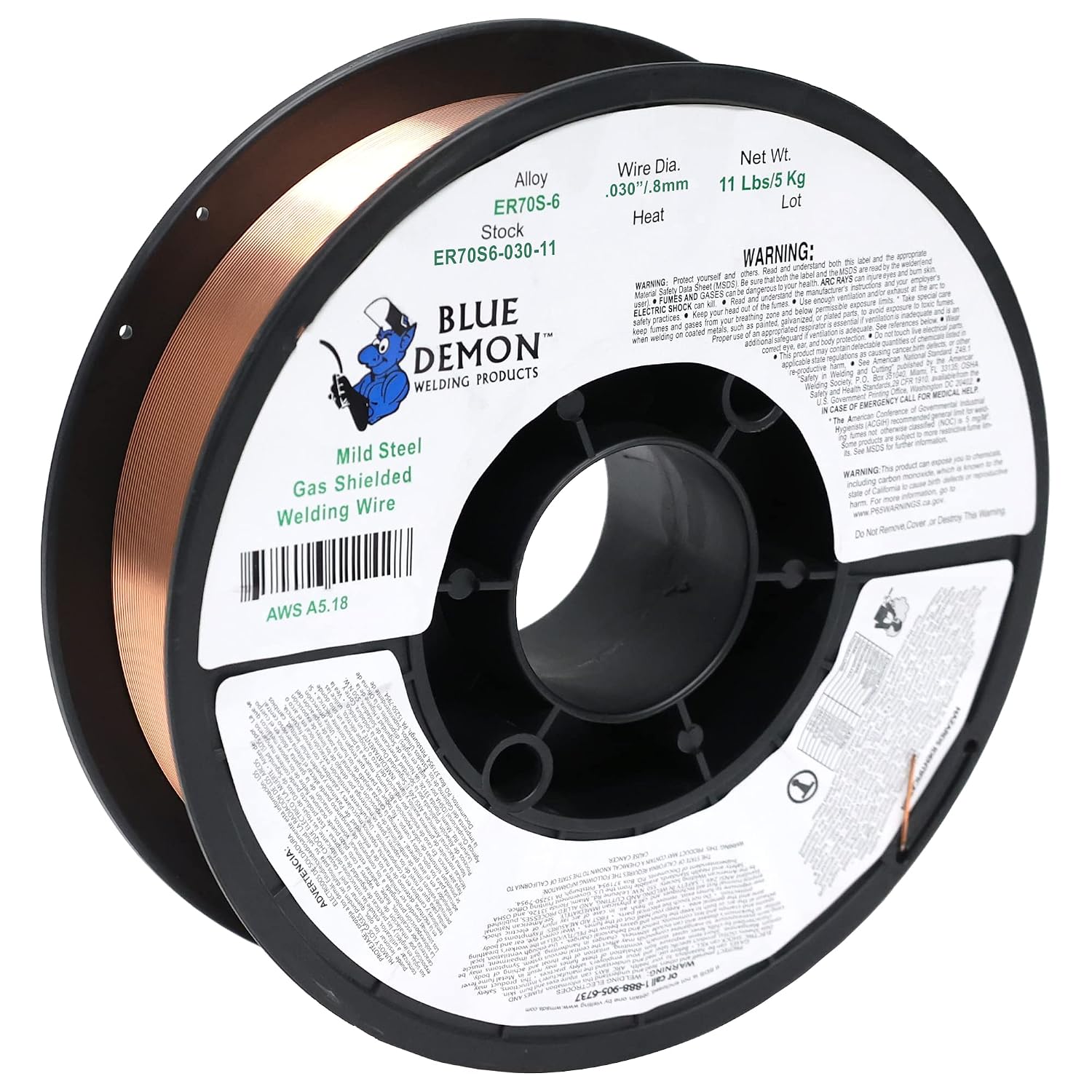
- One 11 lb spool of Blue Demon ER70S-6 .030 in. solid carbon steel MIG wire
- Protective retail carton with the AWS A5.18 ER70S-6 classification printed on it
- Wire wound on a standard 8 in. spool that fits 140 A class and larger machines
- Shielding gas required: 75/25 argon/CO2 or 100% CO2, not included
- No contact tips or drive rolls included; match them to .030 in.
- The same wire is also sold as 10 lb and 2 lb spools in diameters from .023 to .045
- Storage note: keep the spool dry and sealed until use, because the copper coating corrodes
Technical Specifications
| Wire classification: | AWS A5.18 ER70S-6 (solid, copper-coated) |
| Process: | GMAW / MIG, spray or short-circuit transfer |
| Diameter reviewed: | .030 in. (0.8 mm); line runs .023 to .045 |
| Spool size reviewed: | 11 lb (10 lb and 1 lb spools also sold) |
| Tensile strength: | 70,000 psi minimum, as welded |
| Yield strength: | 58,000 psi minimum |
| Elongation: | 22% |
| Shielding gas: | 75/25 Ar/CO2 recommended; 100% CO2 usable |
| Polarity: | DC electrode positive (DCEP) |
| Welding positions: | All: F, V, OH, H |
| Base metal: | Mild and carbon steel |
| Passes: | Single and multi-pass |
Pros
- 11 lb spool at a 10 lb price, about $3.63 per pound
- X-ray quality chemistry with elevated silicon and manganese
- Flat, well-wetted bead with low spatter on a 75/25 mix
- Extra deoxidizers handle mill scale and light rust
- All-position, single and multi-pass capable
Cons
- Solid wire, so shielding gas is mandatory
- Copper coating thinner and less even than Hobart or Lincoln L-56
- Some owners report feed stutters on long, hot runs
- Check spool capacity before fitting it to compact machines
- No batch number or date code printed on the spool
Blue Demon ER70S-6 .030″ 11 lb Performance
I ran the spool on three mild steel jobs: 18-gauge sheet patches, a 3/16 in. bracket build with three passes, and auto body panels off a parts car. Machine settings sat in the normal .030 range, around 16 to 18 volts on thin stock with wire speed near 200 IPM, up to 19.5 volts on the bracket work.
A month in, the honest summary is that the wire outperforms its price tier. The bead quality sits close enough to brand-name ER70S-6 that I had to look for reasons to pay more, and the complaints that do exist online cluster around feeding and porosity, which I tested specifically because of them.
Bead Quality, Spatter, and Porosity
On a 75/25 argon/CO2 mix the bead lays down flat with good wetting at the toes, and post-weld cleanup stayed light.
The elevated silicon keeps the puddle fluid, which is where the marketing line about minimal grinding actually holds up. Straight CO2 adds spatter and a slightly rougher bead, same as with every solid wire, in exchange for a bit more penetration on the thicker sections.
The x-ray quality claim is harder to test in a garage, but the visible evidence cooperates.
Across my multi-pass bracket, pass-to-pass fusion was clean with no undercut, and I found no porosity in the beads I sectioned.
The record is not one-sided, though. A share of owner reports mention porosity showing up, and every one of those reports traces back to gas coverage problems, a leaking liner fitting, or a drafty work area. This wire welds clean when the gas system is sound, and it punishes a neglected one faster than premium brands do. On steel castings and forging salvage work, where the parent metal is dirty by definition, the extra deoxidizers earn their keep.
Feeding, Coating, and Machine Setup
Setup is standard solid-wire work: DCEP polarity, a U-groove drive roll sized for .030, and a liner in decent shape. On a full-size machine the spool spins smoothly and the wire feeds without drama through long sessions. The one caveat I confirmed against owner feedback: on long, hot production-style runs, occasional feed stutters appear.
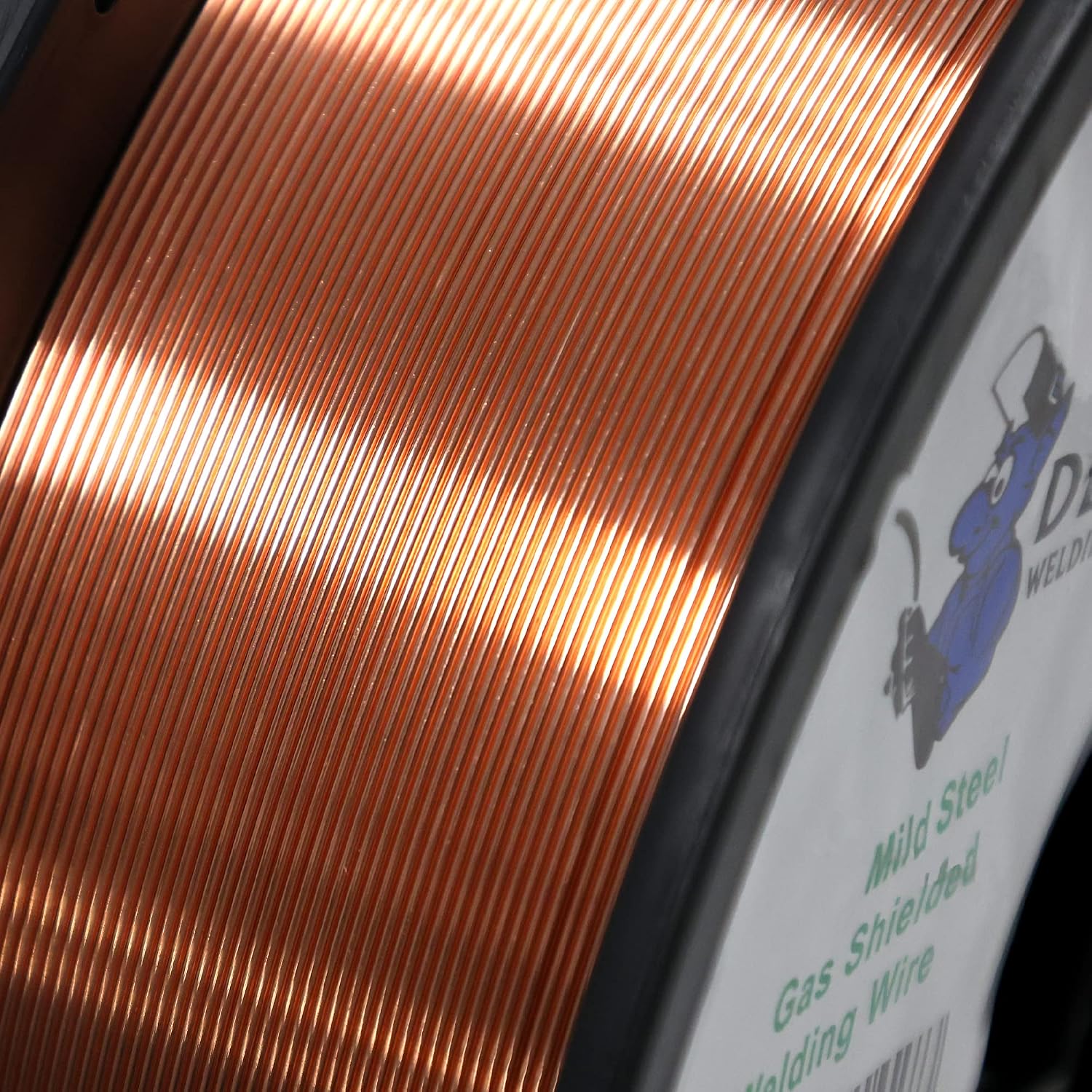
The copper coating is where the savings live. It is thinner than what Hobart or Lincoln put on their premium spools, which matters in two places, drag through the contact tip and corrosion in storage. Keep the spool sealed until you need it and store it in a dry spot. The spool measures about 8 in. across and 2.5 in. wide, so it fits any 140 A class or larger machine. Gas choice comes down to the job, and our types of welding gases guide covers the trade-offs mix by mix.
.030 on Sheet Metal and Auto Body Work
The .030 diameter is the reason to pick this spool over the .035 competition. On 18 to 24-gauge sheet it carries enough current to fuse without blowing through, and on auto body panels the finer arc control shows immediately in the bead width. Burnthrough drops noticeably compared to .035 at the same seam.
The bonus is out-of-position work: on vertical-up seams the smaller puddle is easier to steer, which anyone who has fought gravity with .035 will appreciate. It still handles 3/16 in. plate if you push voltage and wire speed up, so a hobbyist with one spool and mixed work is covered. Technique matters more than wire brand at this thickness, and the fundamentals in our how to MIG weld guide apply directly to thin-stock work with this wire.
Know the limit that comes with the GS suffix: single pass. The classification covers one pass per joint, which suits repair, fabrication, and sheet work, but not heavy multi-pass structural welds. For multi-pass jobs you want an E71T-11 wire instead. Treat the GS as the trade you make for a forgiving arc and slag that lifts clean.
Frequently Asked Questions [F.A.Q]
Does Blue Demon ER70S-6 wire work without shielding gas?
No. This is solid wire, so it needs external shielding: 75/25 argon/CO2 for the smoothest bead or 100% CO2 when you want more penetration and accept extra spatter. If you need gasless operation, that is a flux-cored product like E71T-GS, a completely different wire.
Will the 11 lb spool fit my MIG welder?
The spool measures about 8 in. across with a 2.5 in. width, which matches the spool capacity of every 140 A class and larger machine on the market. Compact hobby units built around 4 in. mini spools will not take it without an adapter. Check your spindle size before ordering.
Is this wire good for auto body and thin sheet metal?
Yes, that is its strongest suit. The .030 diameter runs cooler on 18 to 24-gauge stock than .035 does, which means fewer burnthroughs on patch panels and floor repairs. Keep voltage in the 16 to 18 V range and wire speed around 200 IPM as a starting point.
How does it compare to Lincoln L-56 or Hobart ER70S-6?
The welds are closer than the prices suggest. L-56 and Hobart carry thicker copper coatings, feed marginally better on long runs, and Lincoln prints batch data on the spool for shops that track lots. Blue Demon matches the weld quality for most shop and hobby work, gives you the extra pound, and costs less per pound. For production feed reliability I would still buy Hobart; for everything else the money stays in your pocket.
Conclusion
The Blue Demon ER70S-6 .030″ 11 lb spool is the value pick of the .030 class. Weld quality sits a half-step below Hobart and Lincoln premium wire, feed reliability mostly matches it, and the x-ray chemistry held up on multi-pass structural work. Treat it right, with dry storage, sound gas coverage, and a clean liner, and it lays down beads that give up nothing that matters. Anyone welding auto body panels or thin structural sections gets the most from this diameter, and the extra pound softens the per-pound math to about $3.63. To see how it stacks against the other seven wires we tested, read our best MIG welding wire guide.






