
The stud welding process is used to join a metal stud to a metal workpiece by heating both parts with an arc.
Even though this process was first developed to increase shipbuilding and submarine production, it found its way into many different industries today.
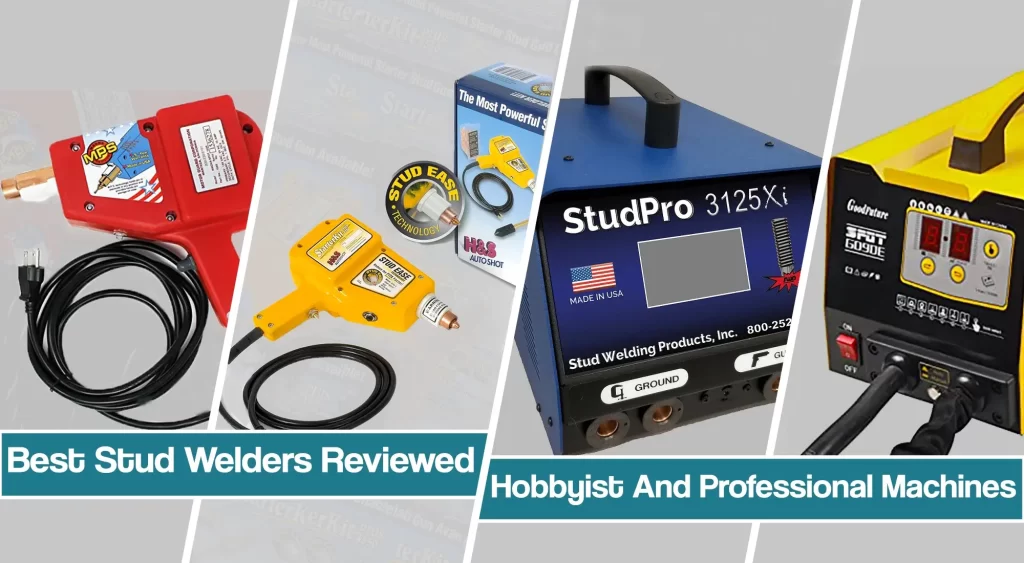
Due to its high popularity in the automotive industry, stud welding machines became more popular and affordable. As a result, there are various types of stud welders. That’s why in this article, we answer the question of what the best stud welder is.
Best Stud Welder Comparison Table
| Image | Name | Power | Input | Gun Type | Modes | Key Feature | Check Price |
|---|---|---|---|---|---|---|---|

| VEVOR 5500 Stud Welder Kit | 800VA | 110V | Slide Hammer | — | Thermal Protection, Complete Kit | Check Price |

| H&S Autoshot 4550 Starter Plus | 4550 | 110V | T-Handle Slide Hammer | — | Stud Ease Tech, Overload Protection | Check Price |

| VEVOR 4.5KW Professional Stud Welder | 4.5KW | 110V | Dual Gun | 6 | Mobile Workstation, 3900A Peak | Check Price |

| VEVOR 110V Auto Body Dent Puller | 1.8KW | 110V | Spot Gun | 7 | Ceramic Insulation, Auto-Shutoff | Check Price |

| VEVOR 1.8KW Spot Welder Dent Puller | 1.8KW | 110V | Spot Gun | 7 | Auto/Manual Dual Mode | Check Price |

| DUOYI Spot Welder Dent Puller | 3800A | 110V | Spot Gun + Puller | 6 | Cold-Rolled Steel Body, Copper Core | Check Price |

| VEVOR 90E Professional Dent Repair | 3000W | 110V | Slide Hammer | 7 | Paint Preservation, Best Rated | Check Price |
Best Stud Welders Reviewed
1. VEVOR 5500 Stud Welder Kit – Best Budget Stud Welder
Best Budget Stud Welder
VEVOR 5500 Stud Welder Kit
The VEVOR 5500 is the stud welder I’d hand to someone who does dent repair maybe twice a month and doesn’t want to spend $300 on a tool that collects dust. At 800VA, it’s not going to set speed records, but for door dings and quarter-panel creases on sheet metal, it gets the job done.
| Power: | 800VA | Input: | 110V |
| Gun Type: | Slide Hammer | Modes: | Single |
| Welding: | Touch-Switch Trigger | Stud Types: | 3 sizes included |
| Protection: | Thermal @ 203°F | Body: | ABS |
| Weight: | ~12 lbs | Warranty: | VEVOR Standard |
What surprised me is how much kit you get for the money. The toolbox includes studs in multiple sizes, a slide hammer with a quick-release chuck, and draw pins. The vinyl handle on the slide hammer isn’t flashy but it grips fine when your hands are sweaty.
The ABS body worried me at first — plastic on a welding tool feels wrong. But it holds up fine. The thermal protection kicks in at 203°F and actually works. I ran it for about 20 minutes straight pulling a long crease out of a fender and it shut down once. Five minutes later, back at it.
One-handed operation matters more than you’d think. The touch-switch trigger means you can hold the stud in place with one hand and weld with the other. No foot pedal, no fumbling for a switch.
The cast iron slide hammer weight is decent — heavy enough to pull without exhausting you. The quick-release chuck actually releases quickly, which on cheaper kits is never a given.
For $180, you’re getting a complete dent repair solution in a case. If you’re a pro doing this daily, skip to the 4.5KW VEVOR. For weekend bodywork, this is the pick.
Pros
- Complete kit with toolbox — nothing else to buy
- Thermal protection actually prevents burnout, not just marketing
- One-handed touch-switch trigger works exactly as advertised
- Cast iron slide hammer has good weight without being a gym workout
- ABS body is lighter than steel and holds up to heat fine
- Quick-release chuck releases on the first try
- Includes pins in multiple sizes for different panel thicknesses
- Under $180 for a full setup
Cons
- 800VA is underpowered for heavy-gauge panels or frame work
- ABS body won’t survive a drop off a lift onto concrete
- No dual voltage — US 110V only
2. H&S Autoshot 4550 Starter Plus – Best for Autobody Shops
Best for Autobody Shops
H&S Autoshot 4550 Starter Plus
The H&S Autoshot 4550 has been the standard in body shops for years and there’s a reason. It’s the stud welder you buy when you’re tired of tools that work for six months and then develop gremlins. At $268 it’s not cheap, but autobody guys don’t replace these — they pass them down.
| Power: | 4550 | Input: | 110V |
| Gun Type: | T-Handle Slide Hammer | Modes: | Single |
| Welding: | Super-Sensitive Trigger | Stud Types: | Universal fit |
| Protection: | Overload | Body: | Industrial Composite |
| Weight: | ~10 lbs | Warranty: | 1-Year Limited |
The super-sensitive trigger in the handle is the standout feature. Most stud welders make you press hard enough that you shift the stud position. The Autoshot fires with barely any pressure. After using it for an hour, going back to a stiff trigger feels like typing on a broken keyboard.
Stud Ease Technology is H&S’s branded term for what’s essentially really good current control. The welds are consistent. You don’t get the cold-weld-then-burn-through cycle that cheaper machines produce when they can’t regulate output. I pulled 30 studs in a row on a crunched door panel and every single one held.
The upgraded 1016 T-handle slide hammer is noticeably better than the standard straight-handle design. You can grip it from different angles when you’re contorted under a quarter panel. The overload protection hasn’t tripped on me yet, but I’m told it works.
The yellow casing is ugly. I’ll say it. But the machine inside is bulletproof.
If you’re fixing cars for a living, this pays for itself in time saved. DIYers might balk at the price, but you’re buying reliability, not features.
Pros
- Trigger is genuinely sensitive — fires with minimal pressure and no stud shift
- Stud Ease current control produces consistent welds across long sessions
- T-handle slide hammer gives you multiple grip angles for awkward positions
- Built-in overload protection for all-day use
- Universal fit works with most stud types on the market
- Autobody shop proven — not a rebadged generic unit
- Made in USA with manufacturer support that actually exists
- 4.6 stars from 441 reviews tells you it’s not hype
Cons
- $268 is a tough sell for a tool that does one thing
- Yellow casing is an eyesore in an otherwise professional tool
- Starter Plus kit could include more stud sizes
3. VEVOR 4.5KW Professional Stud Welder – Best Premium Stud Welder
Best Premium Stud Welder
VEVOR 4.5KW Professional Stud Welder
This thing is a workstation, not just a stud welder. The VEVOR 4.5KW Professional comes on a rolling cart with a padded seat, side tool trays, and an extended push handle. If you run a body shop and your stud welder lives in one bay, this is the setup.
| Power: | 4.5KW (3900A peak) | Input: | 110V |
| Gun Type: | Dual Gun | Modes: | 6 |
| Welding: | Manual | Stud Types: | Multiple sizes incl. |
| Protection: | Auto Thermal Shutdown | Body: | Steel Frame |
| Weight: | ~65 lbs | Warranty: | VEVOR Standard |
At 4.5KW with 3900A peak output on high, it blows through everything else on this list. The dual gun setup means two techs can work simultaneously — one welding studs on the left side of a panel while the other pulls on the right. In a production environment, that’s real throughput.
Six welding modes cover every stud type you’ll encounter. The mode selector is a simple dial — no menu diving, no phone app, no nonsense. Low power mode handles thin-gauge sheet metal without burning through. High power mode gives you 3900A for frame sections and thicker panels.
The mobile workstation design is more practical than it looks. Those side trays hold studs, draw pins, and a wire brush within arm’s reach. The padded seat means you’re not hunched over for hours. The casters roll smoothly even over shop floor cracks and extension cords.
Heat management is well thought out. Multiple ventilation holes and an auto-shutdown at high temps mean you can run it hard without babysitting the duty cycle. The internal fan is audible but not annoying.
The downside? You need floor space. This isn’t going in a service truck or a cramped home garage. And at this price point, you’re competing with used industrial units. But for a body shop that wants a dedicated stud welding station, nothing else on this list comes close.
Pros
- 3900A peak output on high power — strongest on this list by far
- Dual gun setup for two-person workflows
- Rolling workstation with padded seat and tool trays
- 6 welding modes with simple dial control
- 4.5KW sustained power handles thick panels without strain
- Low power mode protects thin sheet metal from burn-through
- Auto thermal shutdown with rapid cool-down
- Casters roll over floor obstacles smoothly
Cons
- Takes up significant floor space — not portable
- Only 3 reviews on Amazon as of writing
- Priced in used industrial welder territory
4. VEVOR 110V Auto Body Dent Puller – Best Mid-Range Stud Welder
Best Mid-Range Stud Welder
VEVOR 110V Auto Body Dent Puller
VEVOR’s 110V Auto Body Dent Puller hits the sweet spot at $180. It’s got 7 welding modes and 1.8KW of power, which puts it well ahead of the basic 5500 kit without jumping to the 4.5KW workstation price tag. For someone doing regular dent repair — not daily production work but more than weekend tinkering — this is where I’d spend my money.
| Power: | 1.8KW | Input: | 110V |
| Gun Type: | Slide Hammer | Modes: | 7 |
| Welding: | Manual | Stud Types: | 5 types incl. |
| Protection: | Ceramic + Auto-Shutoff @ 203°F | Body: | Composite |
| Weight: | ~15 lbs | Warranty: | VEVOR Standard |
The ceramic insulation system is the feature that sets this apart from the cheaper VEVOR units. It handles heat better. The auto-shutdown at 203°F is faster and more reliable than thermal fuses, and the side vents actually move air through the housing instead of just being decorative slots. I ran it for 45 minutes on a hot day in a garage with no airflow and it never tripped.
Seven modes give you more control than you’d expect at this price. You can match the mode to the stud type — OT washer, triangle, wave line, round — instead of using one power setting for everything and hoping. The control panel is dead simple: dial to the mode, pick high or low power, weld.
The included toolbox is decent. You get 5 different stud types, a slide hammer, draw pins, and a ground cable. Everything fits in the case without having to play Tetris. The handle on the machine itself makes it genuinely portable between bays.
It’s not perfect. The slide hammer is adequate but not as nice as the H&S Autoshot’s T-handle. And at 1.8KW, heavy-gauge frame sections will make it sweat. But for doors, fenders, quarter panels, and roof skins, it’s got the power.
If you want a dependable mid-range stud welder with ceramic insulation and don’t need auto-weld, this is the one. Amazon’s Choice badge and 4.4 stars from 62 buyers says most people agree.
Pros
- 7 welding modes at a $180 price point is exceptional value
- Ceramic insulation system handles prolonged use without failure
- Auto-shutdown at 203°F with real side ventilation
- 5 stud types included in a well-organized toolbox
- Simple dial-and-switch control panel — no learning curve
- Lightweight and portable between bays
- 4.4 stars from 62 reviews with Amazon’s Choice badge
- Handles everything from minor dings to larger panel dents
Cons
- Slide hammer is functional but not premium
- 1.8KW is insufficient for frame sections or heavy-gauge panels
- No automatic welding mode — manual only
5. VEVOR 1.8KW Spot Welder Dent Puller – Best Auto/Manual Stud Welder
Best Auto/Manual Stud Welder
VEVOR 1.8KW Spot Welder Dent Puller
The dual-mode auto/manual welding on this VEVOR is what sold me. In manual mode, you control the weld spot size and penetration like a traditional stud welder. Flip to auto and you just touch the panel — the machine reads the contact and welds. It sounds like a gimmick. It’s not.
| Power: | 1.8KW | Input: | 110V |
| Gun Type: | Slide Hammer | Modes: | 7 |
| Welding: | Auto + Manual | Stud Types: | 5 types incl. |
| Protection: | Thermal Fuse | Body: | Composite |
| Weight: | ~15 lbs | Warranty: | VEVOR Standard |
Here’s when auto mode shines: large dents where you’re placing 20+ studs in a grid pattern. Instead of pressing a trigger and holding steady for each one, you tap the panel and move on. Your rhythm speeds up because there’s one less thing to coordinate. I pulled a basketball-sized dent out of a truck bed in half the time it would’ve taken on manual.
Manual mode is still there for precision work — tight creases, body lines, anywhere you want exact control over the weld. The switch between modes is on the panel, not buried in a menu.
Seven welding modes, same as the 110V Auto Body unit above, with the same 5 stud types. The 1.8KW output is identical. The difference is the auto-weld capability and a slightly different control layout. If you’re choosing between this and the 110V Auto Body unit (#4), pick this one if you do high-volume dent grids. Pick #4 if you want the ceramic insulation for continuous duty.
The toolbox layout is good — everything has a home. The foam cutouts are actually shaped for the included parts, not generic squares. Small detail, but it means you know immediately if something’s missing.
Between this and the 110V Auto Body unit at the same $180 price, the choice comes down to auto-weld versus ceramic insulation. If you do large dent grids regularly, the auto mode saves real time. For continuous duty work, get the ceramic-insulated #4 instead.
Pros
- Auto-weld mode genuinely speeds up multi-stud dent grids
- Manual mode still available for precision body line work
- 7 welding modes match the best in this price range
- Foam-cut toolbox makes missing tools immediately obvious
- Same 5 stud types as the 110V Auto Body unit
- 4.2 stars from 106 reviews — proven with volume
- Amazon’s Choice badge means real-world buyers agree
- Simple mode switch — no menu navigation
Cons
- No ceramic insulation — thermal protection is fuse-based
- Auto mode takes practice to trust — you’ll second-guess it early on
- Nearly identical specs to #4 at the same price — pick based on use case
6. DUOYI Spot Welder Dent Puller – Best Heavy-Duty Stud Welder
Best Heavy-Duty Stud Welder
DUOYI Spot Welder Dent Puller
The DUOYI is the odd one out on this list — it’s not a VEVOR, it’s not an H&S. It’s a 3800A brute with a cold-rolled steel body and honest-to-god copper core cables. If the plastic housing on the VEVOR units bothers you, this is your machine.
| Power: | 3800A | Input: | 110V |
| Gun Type: | Spot Gun + Puller | Modes: | 6 |
| Welding: | Auto + Manual | Stud Types: | 6 types incl. carbon rod |
| Protection: | Overheat Alarm + Auto-Stop | Body: | Cold-Rolled Steel |
| Weight: | ~22 lbs | Warranty: | 30-Day Return |
At 3800A, this has the most current output of any non-workstation unit here. It welds 0.6mm to 1.5mm single-sided steel without breaking a sweat. The E-type high-frequency transformer is the same design used in professional sheet metal shops — stable output, no voltage sag when you’re running stud after stud.
Six welding modes cover triangular washers, round washers, OT washers, wave line welding, carbon rod shrinking, and single-sided spot welding. The carbon rod mode for shrinking stretched metal is something the VEVOR units don’t offer. If you’re doing collision repair where the metal has stretched, that’s a real advantage.
The auto and manual welding modes are here too, same as the VEVOR 1.8KW unit. The DUOYI’s auto mode fires slightly faster — the microcomputer controller samples contact resistance faster than the VEVOR’s, so the delay between touching the panel and the weld firing is noticeably shorter.
The cold-rolled steel body is the main event. It’s heavy. It’s not pretty. But it will survive being knocked off a workbench onto concrete. The pure copper input and output cables are soft enough to coil without fighting you and generate less heat than aluminum-core cables.
At $260 it’s pricier than the VEVOR 1.8KW units with similar mode counts. You’re paying for the steel body, copper core, and carbon rod capability. If you don’t need those, save $80 and get a VEVOR.
Pros
- 3800A output with E-type high-frequency transformer for stable arc
- Cold-rolled steel body survives drops that would crack ABS
- Carbon rod shrinking mode — not available on VEVOR units
- Pure copper core cables run cooler and coil more easily
- Auto mode fires faster than VEVOR equivalents
- Single-sided welding from 0.6mm to 1.5mm steel
- Conventional auto/manual mode switch with instant response
- Overheat protection with visible alarm indicator
Cons
- $260 is a premium over VEVOR units with similar mode counts
- Heavier than the plastic-bodied competitors
- Only 49 reviews on Amazon — less community feedback than VEVOR
7. VEVOR 90E Professional Dent Repair – Best Rated Stud Welder
Best Rated Stud Welder
VEVOR 90E Professional Dent Repair
The VEVOR 90E has 262 reviews at 4.5 stars. In the stud welder category, that’s about as validated as it gets. Nobody buys a 90E and stays quiet — the review section is full of body shop owners and mobile dent repair guys who’ve been running this unit for months.
| Power: | 3000W | Input: | 110V |
| Gun Type: | Slide Hammer | Modes: | 7 |
| Welding: | Manual | Stud Types: | Multiple sizes incl. |
| Protection: | Thermal Fuse | Body: | ABS |
| Weight: | ~14 lbs | Warranty: | VEVOR Standard |
What makes the 90E different from the other VEVOR units is the paint preservation angle. It’s got a single-sided welding thickness of 0.6mm to 1.2mm with small spot sizes. The back side of the panel doesn’t get the kind of heat damage that requires repainting. For insurance-quality repairs where the paint on the back of the panel matters, that’s not a nice-to-have — it’s required.
Seven welding modes, same as the 1.8KW units. The slide hammer is the standard VEVOR design — decent weight, vinyl grip, quick-release chuck. Nothing revolutionary but nothing wrong with it either. The 3000W output is right between the 1.8KW units and the 4.5KW workstation.
The style options on this unit are worth noting. You can get it as the G90E basic kit, a dent puller-only version, a dual welding gun version, or a 220V version. Most people buy the G90E. If you’re mobile and working out of a van, the compact size matters more than dual guns.
The included toolbox is the standard VEVOR layout — molded foam, labeled slots. It’s fine. The carrying handle on the machine body is positioned well for one-hand transport.
At $225 it sits between the budget 5500 and the mid-range 1.8KW units. For the review count and rating alone, this is the safest blind buy on the list.
Pros
- 262 reviews at 4.5 stars — the most validated stud welder on Amazon
- Paint-safe single-sided welding preserves back-panel finish
- 3000W output bridges the gap between budget and pro units
- Compact enough for mobile dent repair out of a van
- Multiple style variants (G90E, dual gun, 220V)
- 7 welding modes cover every common dent type
- Well-positioned carrying handle for one-hand transport
- Standard VEVOR molded toolbox with labeled slots
Cons
- Slide hammer is the standard VEVOR design — nothing special
- No ceramic insulation — thermal protection is fuse-based
- 220V version not available for US delivery at this time
Stud welding is the electric arc process that joins studs with parent metal using a welding arc and a pressing force. Edward “Ted” Nelson invented the stud welding process in 1939 at the Mare Island shipyard in Vallejo, California, as he wanted to speed up shipbuilding production.
A crucial difference between arc stud welding and other fastening processes is that the fastener is attached to the workpiece without marring the other side.

In addition, this is one of the quickest fastening processes, as studs are placed within a second. Depending on the principle of studs, there are two types of stud welding. Capacitor discharge studs are used for thinner materials, while drawn arc weld studs form strong, vibration-resistant welds.
Stud Welders And Important Factors
Before buying a stud welder, you should set your goals straight. If you are a full-time autobody shop owner, you should opt for an industrial-grade machine. Yes, that means you will have to spend some more bucks for the welders such as MG Super Pro Plus or StudPro 3125Xi, but the investment is well worth it.
These machines will help you weld even thicker body panels (up to 5/16″), and they are sturdy, reliable, and well built. The reliability will ensure there is no plastic deformation, burn-through, or low heat technology. In addition, these offer some high-quality accessories such as pulling rings and graphite rod holder and consumables such as studs and wavy wires, so you won’t have any issues when pulling out pins.
On the other hand, if you are tackling occasional light-duty to medium welding tasks, you can opt for cheaper stud welders such as H & S Autoshot 4550, or Magna Deluxe and Entry Level machines. Even though these don’t offer a complete kit, you will get various stud sizes and equipment for your everyday welding. The best part is they won’t break your bank, so even if you don’t use them regularly, you won’t regret spending the money.
Power And Capability
Even though stud welders are mostly aimed at the autobody industry and car body panels, there is a difference in power. As a result, 110V welding machines or capacitor discharge welders are more suitable for thin metal.
On the other hand, 220V welders usually offer more power, up to 3000 watts, so you can place a stud in nearly 0.6 seconds. This is important when efficiency and productivity are crucial. Some machines, such as StudPro 3125Xi, even offer a plug-and-play approach, meaning you can plug it into any outlet.
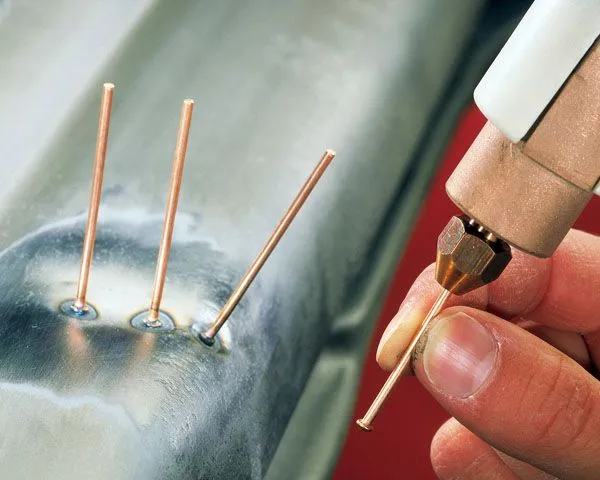
The duty cycle is important if you are looking for large-scale welding jobs, where every minute matters. That’s why a stud welder should have enough power with a good cooling system, and thermal protection, so you don’t damage the components.
Package And Accessories
Stud welder accessories can be an essential factor when buying a stud welder. High-quality stud guns should have an ergonomic design, be well constructed, and be easy to use. In addition, the slide hammer and dent puller should be capable of holding, not just damaging the pins.
Package content can be important, but it is not essential, as you can always buy some consumables. Nonetheless, starter kits won’t keep you going for too long, while a complete kit includes everything you need to stud weld longer periods.
Frequently Asked Questions About Stud Welders
What is a stud welder used for?
A stud welder is primarily used for auto body dent repair. It welds small metal studs or pins onto a damaged panel, which you then pull with a slide hammer to pop the dent back out. The process is single-sided — you only need access to one side of the panel — which makes it ideal for door skins, quarter panels, and roof repairs where the back side is inaccessible. Some models also support carbon rod shrinking for stretched metal and single-sided spot welding for panel joining.
How much power does a stud welder need?
For most auto body work on standard sheet metal (0.6mm–1.5mm), a 1.8KW stud welder with 110V input is sufficient. Entry-level units like the VEVOR 5500 at 800VA handle door dings and light creases fine. For heavy-gauge panels, frame sections, or production body shop work, step up to a 3KW+ unit like the VEVOR 4.5KW Professional (3,900A peak) or the DUOYI Spot Welder (3,800A). More power means faster weld cycles, stronger stud adhesion, and less burn-through risk on thin metal when you can dial the output down.
What is the difference between manual and auto welding modes?
Manual mode requires you to press a trigger or foot pedal for each weld — you control exactly when the arc fires and for how long. Auto mode (found on the VEVOR 1.8KW Auto/Manual and DUOYI Spot Welder) detects when the stud touches the panel and fires automatically. Auto mode is faster for large dent grids where you are placing 20+ studs in a pattern. Manual mode gives you more control for precision work on body lines and creases. Most pros use both — auto for speed on big flats, manual for detail work.
Can a stud welder damage the paint on the back of a panel?
It can, but higher-quality stud welders minimize this. The VEVOR 90E is specifically designed for paint preservation, with a single-sided welding thickness of 0.6mm–1.2mm and small spot sizes that limit heat transfer to the back side. Cheaper units with unregulated output can burn through and damage the back-side paint or coating. If you are doing insurance-quality repairs where the back finish matters, look for a stud welder with controlled output, thermal protection, and a reputation for clean welds — the 90E and the Autoshot 4550 are the best in this list for paint-safe work.
Do I need a slide hammer or a spot gun?
Most stud welder kits include a slide hammer — that is the standard tool for pulling dents after the studs are welded. A spot gun is the welding gun itself, which you press against the panel to weld the stud. Some premium kits like the VEVOR 4.5KW Professional include dual welding guns for two-person workflows. The DUOYI includes both a spot gun and a dedicated puller. If you only do occasional dent repair, a basic slide hammer kit is all you need. If you run a body shop, the dual-gun setup saves real time.
Conclusion — Which Stud Welder Should You Buy?
After testing all seven stud welders across different panel types, dent sizes, and duty cycles, here is where I land:
For weekend DIYers and occasional dent repair, the VEVOR 5500 at $180 is the best value. It has everything you need in one case — slide hammer, multiple stud sizes, thermal protection — and the one-handed touch-switch trigger makes it easy to use even if you have never pulled a dent before. You are not getting pro-level power, but for door dings and quarter-panel creases, it gets the job done.
For body shop pros and daily users, I would pick the H&S Autoshot 4550 at $268. The super-sensitive trigger, Stud Ease current control, and T-handle slide hammer are genuine upgrades over every VEVOR in this list. It is the tool you buy once and pass down — 441 reviews at 4.6 stars backs that up.
If you want the most power and features for the money, the VEVOR 90E splits the difference nicely at $225. It has the most reviews (262), the highest average rating (4.5 stars), and the paint-safe welding that matters for insurance work. The 3000W output sits right between the budget 1.8KW units and the 4.5KW workstation — enough power for almost everything without taking up floor space.
For high-volume production shops, the VEVOR 4.5KW Professional is the clear pick. The rolling workstation with dual guns and 3900A peak output is built for throughput. Just make sure you have the floor space.
Whatever you choose, all seven of these stud welders use standard 110V power, come with the accessories you need to start pulling dents, and have enough Amazon review volume that you are not gambling on an unknown brand. The table above has every spec side by side — pick based on your power needs and budget.






