
The Eastwood MP250i Elite is the machine I point restorers to when they want one welder instead of three. It MIGs, sticks, and TIGs from a single chassis, puts out 250 amps on 240V power, and still runs on a 120V outlet when that’s what the shop gives you. Eastwood built it around car work: full frames, patch panels, roll cages, heavy fabrication.
I’ve put real hours on this machine doing chassis repair and sheet metal, and this review reflects that. You get what ships in the box, how it welds day to day, and the compromises to know about before spending this much. If you’re weighing the whole lineup first, our best Eastwood welders guide covers the rest.
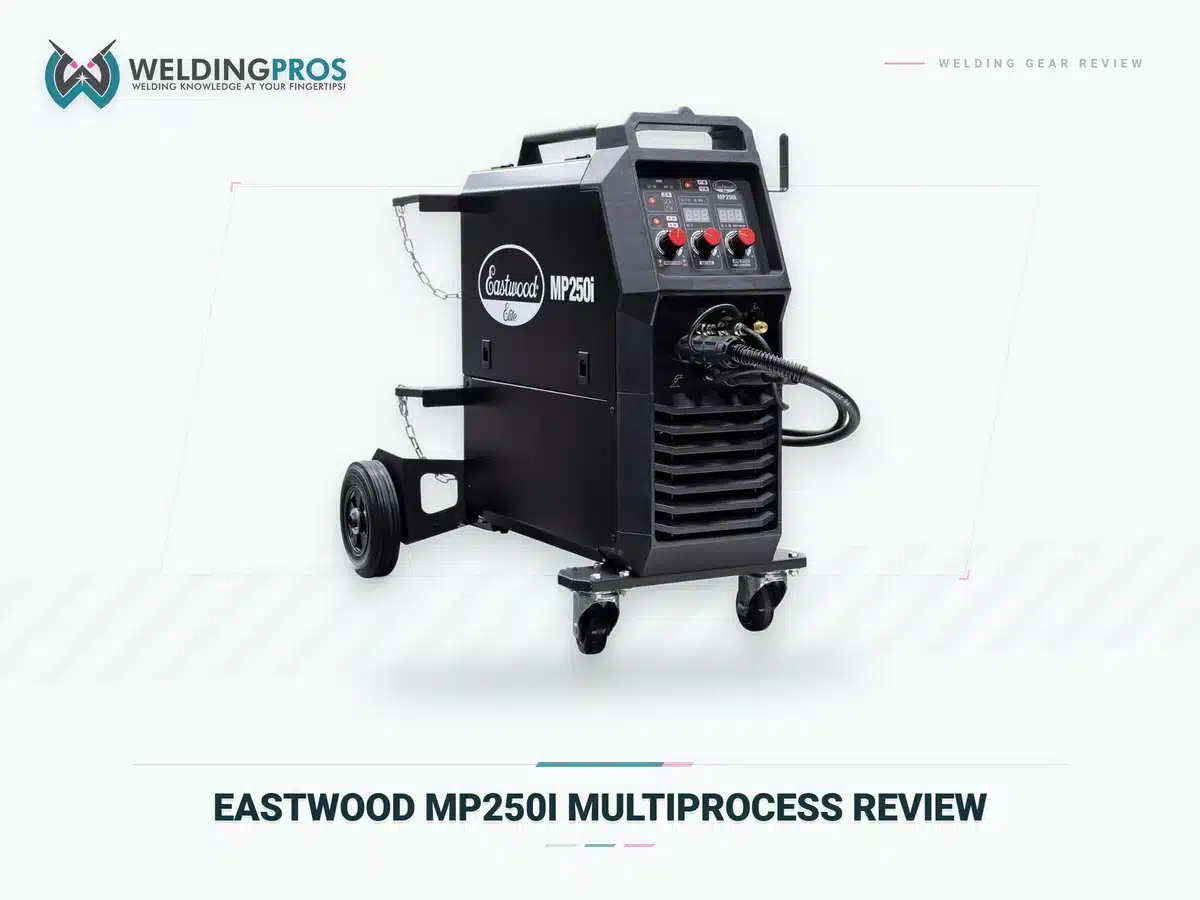
The short version: output and duty cycle are the real story here. 250 amps at a 60% duty cycle on 240V is serious work capacity for a machine that also plugs into a wall outlet, and the included TIG torch with foot pedal is the kind of accessory that usually costs extra.
In this Eastwood MP250i review, we’ll dig into the package content, the specs that matter, and where this welder earns its keep, along with the parts of the ownership experience that annoyed me.
Eastwood MP250i Multi Process Welder Review: Package Content & Technical Specifications
Eastwood ships the MP250i as a working package rather than a bare power supply, and the list matches their operator instructions: a MIG gun, a TIG gun, the pedal, the 300A electrode holder for stick welding, and the dual gas setup, all completely plumbed and ready to run.
High-Output Multi-Process Welder With Dual Voltage and HF TIG Start
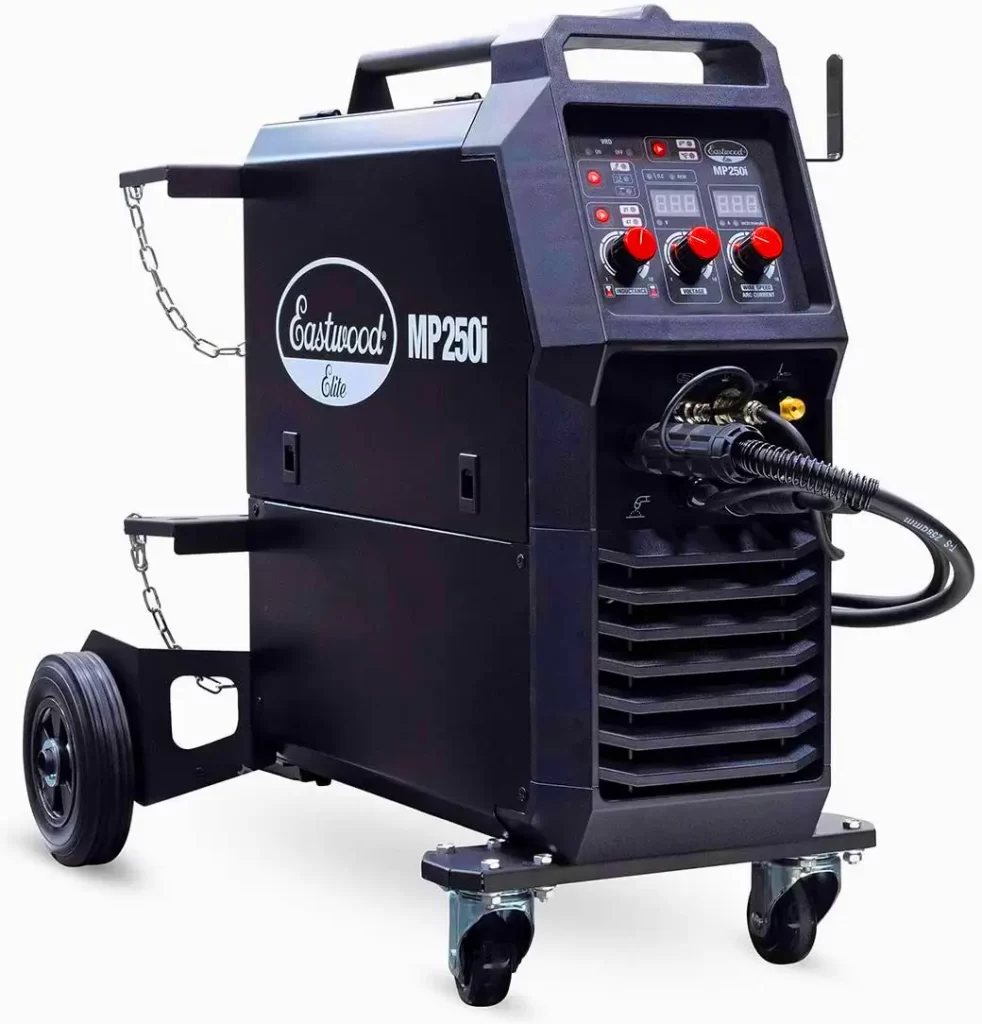
- Eastwood MP250i Elite welder on rolling cart
- ERGO24 MIG torch (14.8 ft)
- WP17 flex-head TIG torch (12 ft)
- Foot pedal for TIG welding (15.9 ft)
- 300A electrode holder and ground cable (14.8 ft)
- 120V adapter cord (24 in)
- Gas hose, two regulators (Ar/CO2), TIG consumables, MIG tips
Technical Specifications
| Welding Process: | MIG (GMAW) / Flux-Core / DC TIG (HF start) / Stick |
| Input Voltage: | 120V / 240V dual voltage, 1-phase |
| Output Range: | MIG 50-250A / TIG 15-250A / Stick 25-250A @ 240V |
| Rated Duty Cycle: | 60% @ 250A (240V) / 60% @ 140A (120V) |
| No-Load Voltage: | 56V |
| Wire Feed Speed: | 78-629 IPM |
| Wire Sizes: | .030-.045 in (8/12 in spools, 44 lb max) |
| Efficiency: | 80%, fan cooled |
| Plug Type: | NEMA 6-50P |
| Machine Weight: | 159.83 lb (72.3 kg) |
| Machine Size: | 30 x 29 x 15 in |
| Warranty: | 3-year limited / 90-day return |
Pros
- True 250-amp output on MIG, TIG, and stick
- 60% duty cycle at full output on 240V
- Dual voltage with 120V adapter cord in the box
- HF TIG start and foot pedal included
- Independent MIG and TIG gas systems, two regulators
Cons
- 159.83 lb; it rolls, but it is not portable
- Spool gun for aluminum MIG sold separately
- DC-only TIG, no aluminum TIG
- 120V input caps output at 140 amps
- Needs a 240V, 50-amp circuit for full output
Eastwood MP250i Multi Process Welder Review: Power and Performance
Spec sheets tell you what a machine can do, not what it is like to live with. I ran the MP250i the way a restoration shop would: sheet-metal panels in the morning, bracket and frame work in the afternoon, a roll cage job toward the end of the week. In real shop terms, the Eastwood Elite MP250i offers excellent value against more expensive comparable units, and the current model is a multi process machine through and through. Three things stood out over those weeks, and they map to the sections below: power delivery, process switching, and the sheer mass of the machine. Some users also report long-term reliability and support concerns with certain components, worth knowing before you buy.
One note before the details: output figures in this section are 240V numbers. The 120V adapter works fine, but the machine is a different animal on household power, and I flag it where it matters.
Input Power and Dual Voltage
The MP250i arrives wired for 240V and includes a 24-inch adapter cord for 120V outlets. On 240V you get the full 250 amps across all three processes. Plug into 120V and the ceiling drops to 140 amps, which still covers most auto-body thicknesses, just slower.
The number that surprised me is the duty cycle: 60% in both modes. Six minutes of arc-on time out of every ten at full 250-amp output beats most machines in this class, and it holds the same 60% duty cycle at 140 amps on 120V, which is how you get long welds on household power. No-load voltage sits at 56V. Note the plug: NEMA 6-50P. If your shop doesn’t have that receptacle, factor an electrician visit into the budget.
MIG, TIG, and Stick Welding Capability
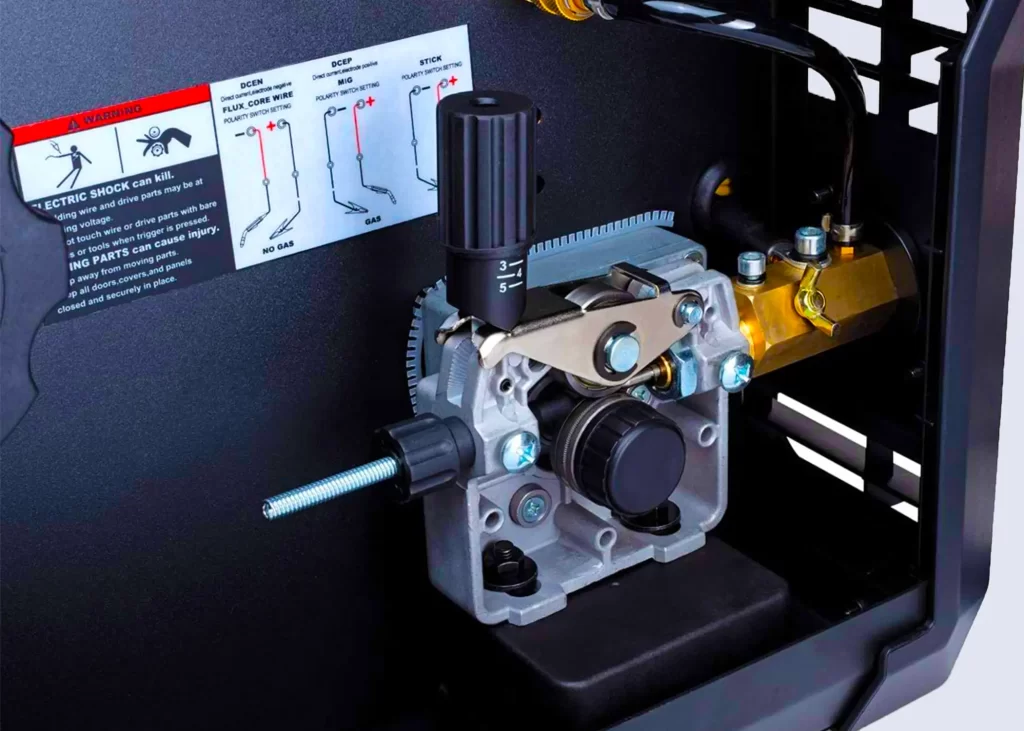
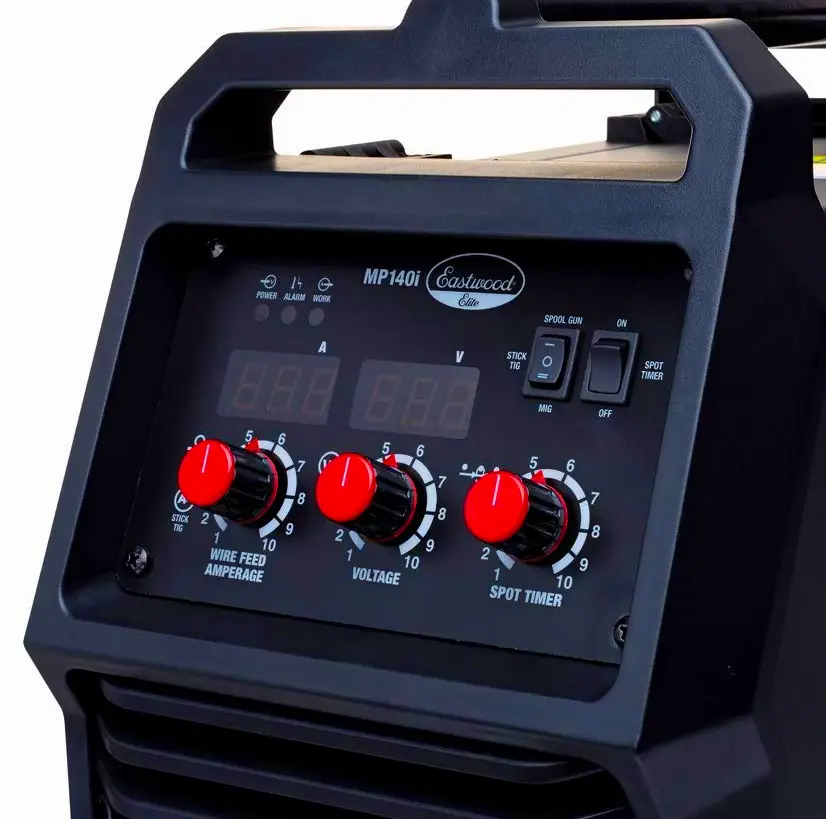
MIG and stick both burn into 1/2-inch steel on 240V, stainless included. Wire feed speed runs 78 to 629 inches per minute and the drive takes .030 to .045 wire, so the same multi process welder will weld thin sheet metal without blowthrough, chase body panels, and still hang with structural work. The TIG side is DC TIG only, for mild steel and stainless steel, and the included TIG torch supports that setup; it is not a standard DC TIG welder in the sense of a dedicated TIG machine, but it covers chrome moly tubing and general fabrication honestly.
There is no AC TIG here, so TIG welding aluminum is off the table on this machine. What you get instead is a high-frequency start, no scratch-starting and no tungsten contamination, plus a foot pedal for amperage control. In TIG mode the arc runs stable enough for general fabrication, though thin material still rewards a careful hand. Trigger behavior is switchable between 2T and 4T modes, and we’ve written up the difference between 2T and 4T separately; 4T helps on long welds because it holds the trigger for you.
Aluminum is still on the menu by MIG. Feeding aluminum wire through a standard drive setup is less practical, so for MIG welding aluminum you bolt on Eastwood’s optional spool gun and 1/4-inch aluminum is comfortably in range. The spool gun costs extra, so price it in if welding aluminum is regular work for you. The machine also runs flux core wire, and flux core welding is a budget-friendly way to lay beads on dirtier steel than other units in this class would forgive.
Build, Wire Feeder, and Handling
At 159.83 pounds, this is not a machine you toss in a truck bed, and loaded with bottles and wire it carries even more. It rolls well enough on the built-in wheels of the integrated cart, which stores two gas bottles with chains and side hooks that make cable storage easy.
The lead lengths are generous, which helps maneuverability around a project. The wire feeder accepts 8 or 12-inch wire spools up to 44 pounds, so long projects don’t turn into spool-swap sessions.
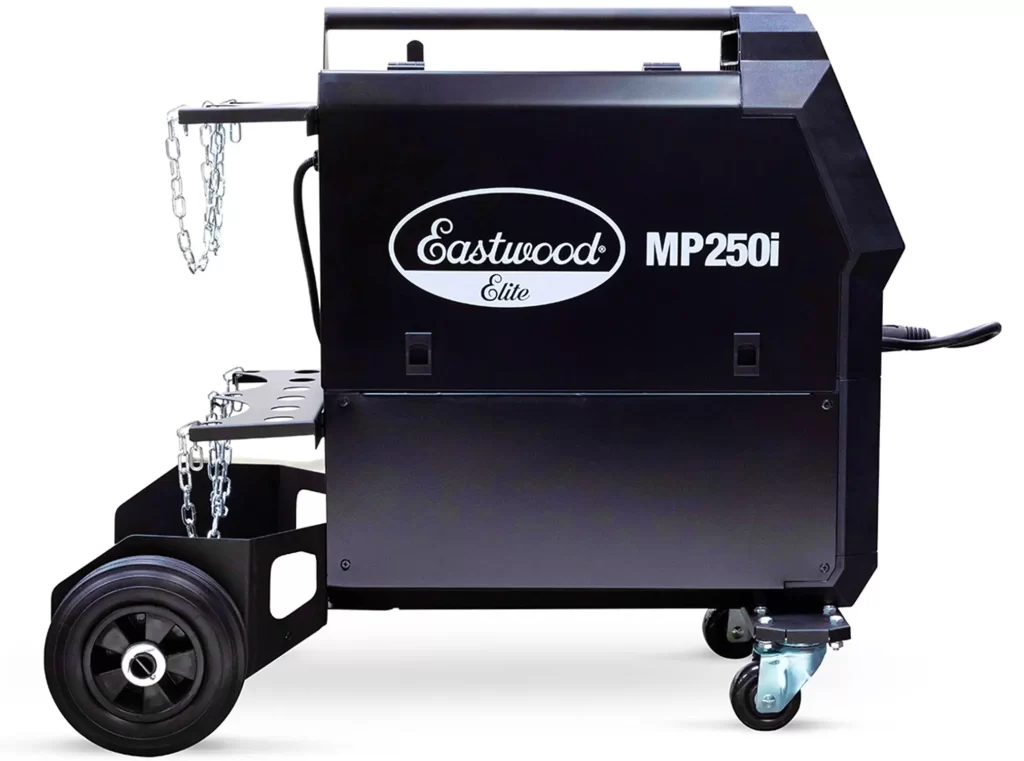
Two fully independent gas systems, one for MIG and one for TIG, mean you can instantly switch between MIG and TIG processes without changing hoses or swapping bottles mid-job. The standard gas regulators included are serviceable, and upgrading them later is a common move for finer TIG gas control. The generous leads mean the work clamp stays connected across a full chassis.
Fan cooling and timed post-flow, one second on MIG and five on TIG, keep the cup clean on cooldown. Build quality feels like the price suggests: metal drive components, no rattles, hinges that line up. Users generally praise the wire feed system for smooth feeding, and setup is straightforward enough that you can be welding within an hour of unboxing.
Frequently Asked Questions [F.A.Q]
What is the duty cycle of the Eastwood MP250i?
60% at 250 amps on 240V, and the same 60% at 140 amps on 120V. In practice: six minutes of welding out of every ten at those outputs.
Can the Eastwood MP250i weld aluminum?
Yes, by MIG, up to 1/4 inch with the optional spool gun. There is no AC TIG output, so aluminum TIG isn’t happening on this machine.
What is the difference between the MP250i and the MP200i?
Output and TIG type. The MP200i is the 200-amp AC/DC machine, and its AC balance lets it TIG-weld aluminum. The MP250i gives that up but pushes 250 amps and welds noticeably thicker steel. Eastwood backs the MP250i with a three-year warranty, and the Eastwood Elite MP250i package includes both torches, the pedal, and the dual gas setup.
Does the MP250i come with a foot pedal?
Yes. A 15.9-foot foot pedal for TIG amperage control ships in the box, along with both torches, the 120V adapter cord, and two standard gas regulators.
Conclusion
The MP250i isn’t trying to be light or cheap, and it isn’t apologizing for either. You get 250 honest amps, a 60% duty cycle at full output, dual voltage, and a real HF-start TIG setup with the pedal included. Shops whose work spans sheet metal to 1/2-inch plate can replace three dedicated machines with this one. If aluminum TIG or portability is the priority, the rest of Eastwood’s lineup serves those jobs better. For restoration and fabrication work, this is the machine to beat.






