
Eastwood has served the welding and auto-restoration community since 1978, and the company built its name by packing hobbyist-friendly features into fairly priced machines. The TIG 200 AC/DC became one of its most popular welders for a simple reason: it is a true AC/DC TIG and Stick machine with dual voltage input, a high-frequency arc start, and a 3-year warranty backed by lifetime tech support.
In this Eastwood TIG 200 AC/DC review, we go through the package content, build quality, TIG welding capability, and overall value, so by the end you should know whether this machine fits your workshop.
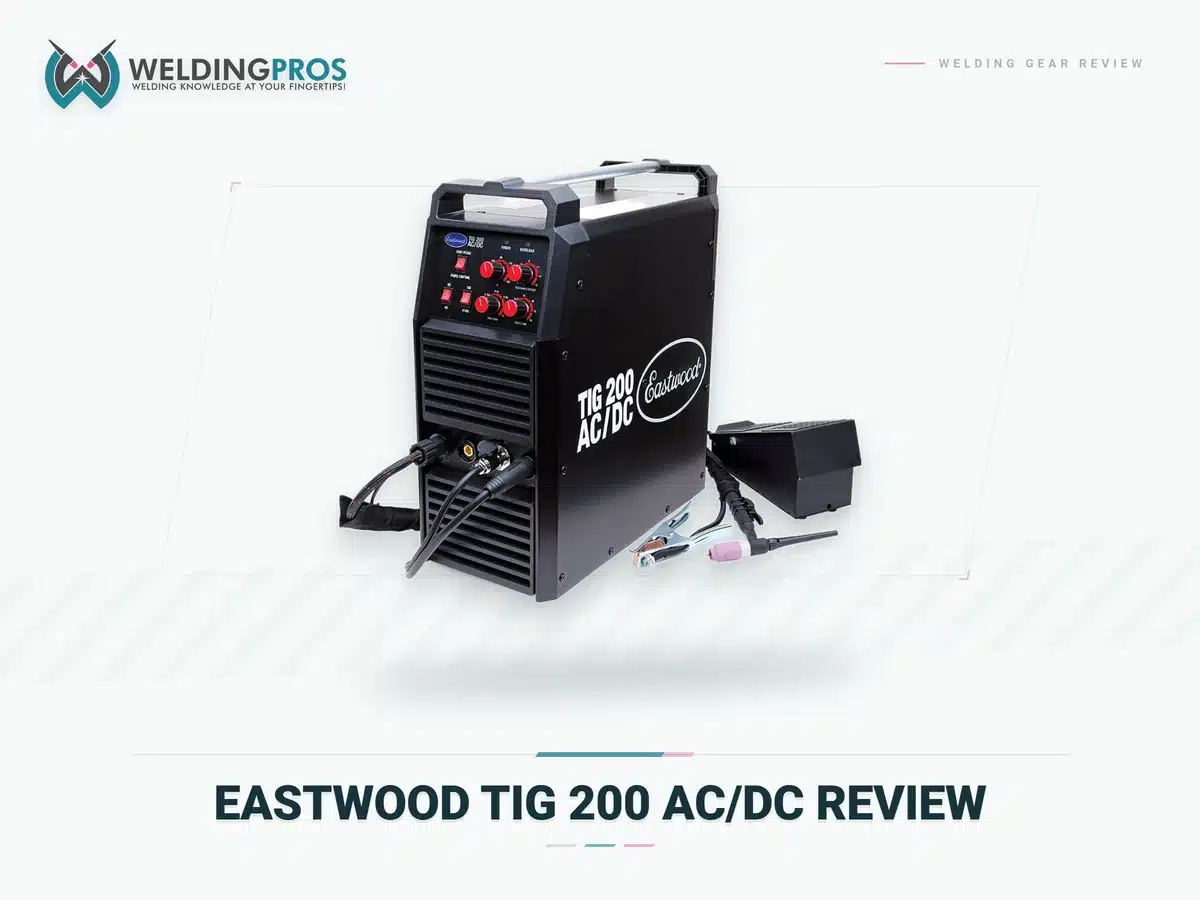
The TIG 200 AC/DC targets DIY welders, auto restorers, and light fabrication shops that want to weld steel, stainless steel, and aluminum without paying Miller or Lincoln prices. Eastwood has since launched the newer TIG 220 AC/DC, but the 200 remains available at several retailers, often at a discount, which is exactly why it still deserves a close look.
We spent time with the machine, dug through the official specifications, and read what long-term owners report. Below is everything you need to decide whether the Eastwood TIG 200 AC/DC is the right welder for your garage.
Eastwood TIG 200 AC/DC Package Content & Technical Specifications
Let us start with the package content and the technical specifications of this Eastwood TIG welder. Experienced welders can read a lot from these two lists alone, but paper numbers and shopfloor performance do not always match, so we test both in the sections that follow.
AC/DC TIG Welder With Dual Voltage Input and High-Frequency Start
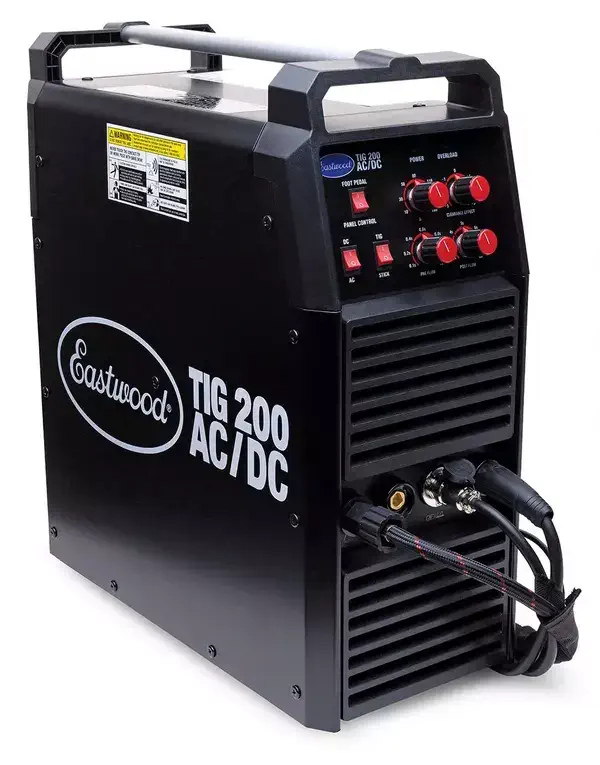
- Eastwood TIG 200 AC/DC welder with NEMA 6-50P plug
- Argon regulator/flowmeter with 4.6 ft shielding gas hose
- Ground cable with clamp (9.5 ft)
- WP-17 flex-head TIG torch (12 ft cable)
- Rocker-style foot pedal for amperage control (16 ft cable)
- 120V to 240V adapter plug and instruction manual
- Gas lens kit, collets, and two 3/32 in. tungstens (red + green)
Technical Specifications
| Welding Process: | TIG (AC/DC) / Stick |
| Weldable Materials: | Mild Steel, Stainless Steel, Aluminum |
| Input Voltage: | 120/240V dual voltage (NEMA 6-50P plug) |
| Output TIG: | 240V: 10-190 A / 120V: 10-145 A |
| Output Stick: | 240V: 10-185 A / 120V: 10-140 A |
| Duty Cycle: | TIG 60% @ 190 A (240V) / 60% @ 100 A (120V) |
| Arc Start: | High frequency |
| Pre/Post Gas Flow: | 0.1-1.0 s / 2-8 s |
| Max Welding Capacity: | Up to 1/4 in. thick material |
| Torch / Pedal: | WP-17 flex-head (12 ft) / rocker pedal (16 ft) |
| Dimensions: | 17.8 x 8.4 x 20.2 in. |
| Weight / Warranty: | 38 lbs / 3-year limited + lifetime tech support |
Pros
- True AC/DC output welds steel, stainless steel, and aluminum
- Dual voltage 120/240V input with included adapter plug
- 60% duty cycle at 190 amps on 240V input
- Complete kit: WP-17 flex-head torch, foot pedal, argon regulator
- 3-year warranty with lifetime tech support
Cons
- No electrode holder in the box for Stick welding
- AC balance and AC frequency are preset, not adjustable
- 38 lb body is heavier than the newest compact inverters
- No pulse function on this model
- Discontinued in favor of the TIG 220 AC/DC; stock is clearing
Eastwood TIG 200 AC/DC Features, Welding Power, and Value
Looking at the package content, it is clear you get strong value for the money. The WP-17 flex-head torch reaches tight spots a fixed torch cannot, and the rocker-style foot pedal is large enough to operate with your whole foot, which matters during longer aluminum welds. Eastwood also includes a starter set of consumables: collets, a #8 gas lens, gas nozzles, and two 3/32 in. tungsten electrodes, one red thoriated for steel and one green pure for aluminum.
The one gap is Stick welding: there is no electrode holder in the box, so you need to buy Eastwood item 20517 separately if you want to burn rods with it. With that covered, let us move from the box to the machine itself and see how the Eastwood TIG 200 AC/DC performs.
Even with that extra purchase, running the machine as a Stick welder is cheap to set up. The 20517 electrode holder costs a fraction of a dedicated SMAW machine, the ground clamp in the box works for both processes, and 10-185 amps on 240V covers 1/8 in. and 5/32 in. rods comfortably. It is a capable backup process rather than the main event, and treating it that way keeps expectations honest.
The accessory lineup has two details that do not show up on the spec sheet but matter daily. The WP-17 torch accepts industry-standard cups, collets, and collet bodies, so replacement consumables cost a few dollars at any welding supply counter instead of requiring brand-specific parts. Owners report the dual-gauge argon regulator holds its setting without leaking, though some find the markings small; the included #8 gas lens improves shielding coverage on tight joints compared with a plain nozzle.
Dual Voltage Input and AC/DC Output
The Eastwood TIG 200 AC/DC is an inverter-based, dual voltage machine that runs on either 120V or 240V input.
The 120V option plugs into a standard household outlet for light work around the house or garage, while 240V gives the machine its full output; on 240V you will want a 30 amp circuit. That dual-voltage flexibility is convenient when you move between work areas. The included 120V to 240V adapter plug makes the switch painless.
The official numbers show how the two inputs differ. On 240V the machine draws 23.8 amps at rated TIG load, so a NEMA 6-50R outlet on its own circuit is the right pairing; on 120V it draws 20.0 amps, which is right at the limit of a standard household outlet, so keep the circuit free of other loads while welding.
Stick mode draws more still, up to 36.2 amps on 240V, which is worth knowing before you plan heavy rod work on a shared line.
The AC/DC switch is what makes this welder so versatile. DC mode covers everyday steel and stainless steel welding, while AC mode breaks up the oxide layer on aluminum as you weld. The square-wave inverter spends more of each cycle in the cleaning phase, which produces noticeably neater and more controllable aluminum beads than a basic sine-wave machine.
In practice, the input choice comes down to the work in front of you. On 120V the machine handles thin sheet, exhaust tubing, and lighter repair work, whether you are on a garage circuit or full 240V shop power. Connecting 240V raises the ceiling to 1/4 in. single-pass material and restores the full duty cycle, and since the welder carries a cord for each input, switching is just a matter of plugging in the right one.
Welding Power and Duty Cycle
In TIG mode the machine outputs 10 to 190 amps on 240V, or 10 to 145 amps on 120V; Stick mode tops out slightly lower at 185 amps on 240V. That is enough power for material up to 1/4 in. thick in a single pass, which covers exhaust work, roll-cage tubing, and most repair jobs on a car or trailer.
The rated duty cycle is 60% at 190 amps on 240V, a generous figure for this price class; many transformer-based 200 amp machines are limited to 20%.
The high-frequency start strikes the arc without touching the tungsten to the workpiece, so the electrode stays clean and beginners avoid the frustration of scratch starting.
The full duty cycle ladder tells the real story. On 240V the TIG 200 AC/DC sustains 190 amps at 60% duty, 143 amps at 100% duty, and Stick mode holds 60% at 185 amps. Drop to 120V input and the machine still manages 60% at 100 TIG amps or 100% at 77 amps.
For a home shop, that means the thermal light rarely comes on during normal fabrication work, and when it does, the thermal protection circuit shuts the welder down safely before any component damage occurs.
Material capability follows the output numbers closely. In DC TIG you have full control over steel and stainless steel from thin sheet up to 1/4 in., and the foot pedal lets you taper current into the puddle for clean starts and finishes. In AC mode the cleaning action handles aluminum in the common hobbyist thickness range, and the green pure tungsten in the box is the right electrode to reach for first.
Build, Controls, and Value
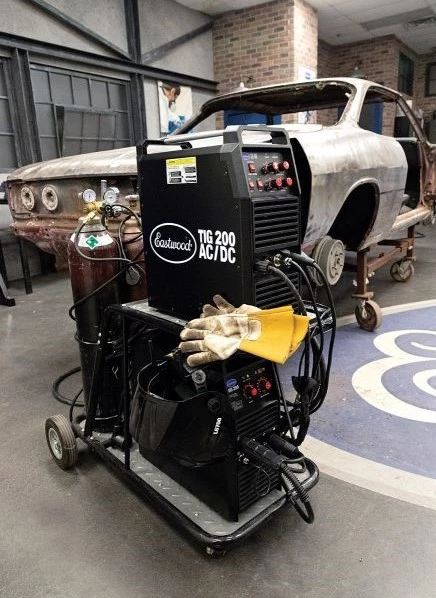
The first impression is of a sturdy, well-constructed machine, and at 38 lbs it is still manageable to carry, though a welding cart helps if you move it between jobs.
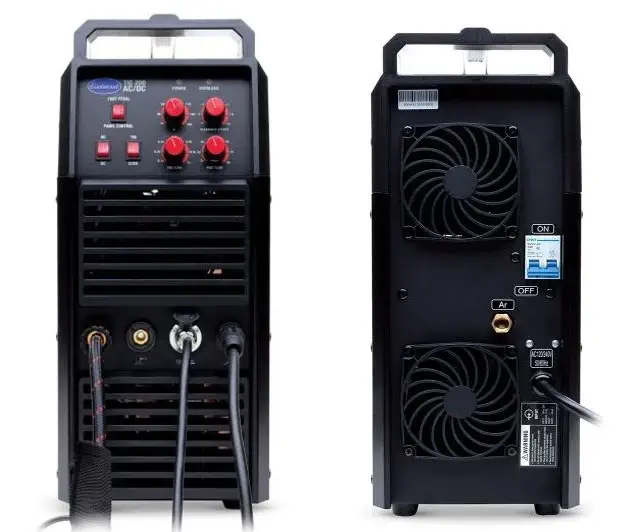
The front panel stays simple: amperage and cleaning-effect knobs, pre-flow and post-flow adjustment for accurate aluminum welding, and three plain switches for process (TIG or Stick), current (AC or DC), and control (foot pedal or torch trigger).
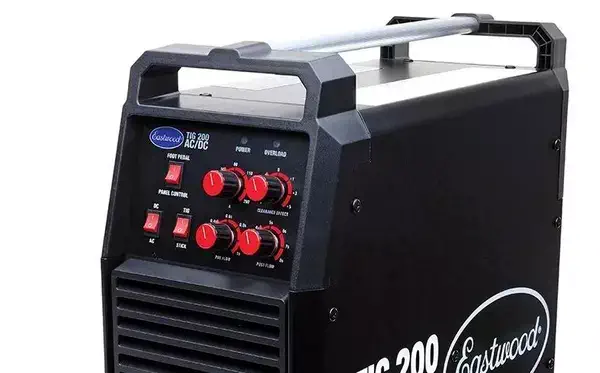
Eastwood’s own product team confirms the TIG 200 AC/DC (item 33920) does not offer user-adjustable AC balance or AC frequency; those parameters are preset at the factory. Experienced aluminum welders who like to bias the cleaning action will miss that control, and it is the clearest line between this machine and the newer TIG 220 AC/DC, which adds pulse and adjustable frequency, with a simplified pulse control that trims heat input on thin materials. For everyone else, the presets are well chosen for the common 1/8 in. and thinner aluminum work this machine is bought for.
The control layout is the other reason beginners settle in quickly. Every setting sits on the front panel as a labeled knob or switch rather than inside a menu, and the included manual walks through each control with photos. Between the high-frequency start and the responsive foot pedal, most people can lay consistent beads without fighting the equipment. Owner reviews often praise clean TIG welds on steel, stainless, and aluminum, along with smooth arc starts.
Money-wise, the TIG 200 sits in the middle of the pack. It costs less than a Miller or Lincoln 200 amp unit, more than bare-bones budget inverters, but very few machines at this price include a flex-head torch, a full-size foot pedal, and a true AC output, which is why many buyers call it the best value for the money in this class. The 3-year warranty with lifetime tech support rounds out the value, and thermal overload protection shuts the machine down before components can overheat.
Shopping context helps too. Eastwood replaced this model with the TIG 220 AC/DC in early 2026, which lists at 849.99 dollars and often sells around 699.97 dollars on promotion. Remaining TIG 200 AC/DC stock sells through retailers such as Amazon and Tractor Supply, though Eastwood’s own store now lists only the TIG 220, warranty claims and the lifetime tech support line for the 200 still run through Eastwood directly. Street prices move as inventory clears, so compare the two directly before buying: the newer machine adds pulse and adjustable frequency at a higher list price, while the older one keeps the same core processes and a complete accessory kit.
Frequently Asked Questions [F.A.Q]
Is the Eastwood TIG 200 AC/DC good for beginners?
Yes. The high-frequency start lights the arc without touching the tungsten to the workpiece, which is the friendliest way to learn TIG welding. The control panel is simple, with amperage, cleaning effect, pre-flow, and post-flow knobs plus three clearly labeled switches. What you give up are advanced settings such as pulse and adjustable AC balance or frequency. The foot pedal also smooths the learning curve, because you can start at low amperage and feed power in as the puddle forms instead of committing to one fixed number.
Can the Eastwood TIG 200 AC/DC weld aluminum?
Yes. Switch the machine to AC mode and the square-wave inverter handles aluminum well, up to 1/4 in. thick on 240V input, with enough pedal control to manage heat and avoid warping delicate work. The high-frequency start also lights the arc cleanly without scratch contact. The box includes both a red thoriated tungsten for steel and a green pure tungsten for aluminum, so you can start on aluminum the same day you unbox it. The adjustable post-flow keeps the weld shielded for up to eight seconds after the arc stops, helping control gas flow to protect the weld and avoid wasting argon while producing brighter, cleaner finishes on thin materials.
Does the Eastwood TIG 200 AC/DC come with everything needed to start welding?
Almost. The package includes nearly everything you need to start: the WP-17 flex-head torch, the rocker foot pedal, an argon regulator with hose, the ground cable, consumables, and a 120V adapter plug. You still need a shielding gas bottle, and if you want to Stick weld you must buy an electrode holder (Eastwood item 20517) separately. A bottle of pure argon is the standard pairing for both steel and aluminum TIG work on this machine, and the included regulator screws onto a standard bottle valve so you can set the gas flow for the job.
Is the Eastwood TIG 200 AC/DC still worth buying?
It depends on the price you find. Eastwood replaced the TIG 200 AC/DC with the newer TIG 220 AC/DC in early 2026, so stock now sits with retailers such as Amazon and Tractor Supply, and the 38 lb chassis is fairly portable for a true AC/DC unit even if a cart is still convenient. If you find it discounted, the combination of true AC/DC output, dual voltage, and the complete accessory kit still makes it one of the better value TIG packages for a home shop, and many buyers and reviewers call it one of the better bang-for-the-buck options at clearance pricing. It also sits in the same conversation as budget competitors like PrimeWeld and AHP AlphaTIG. If you want pulse, adjustable AC balance, or a lighter chassis, the TIG 220 AC/DC is the direct upgrade path; if you want proven capability at the lowest price, the TIG 200 remains a sensible buy.
Conclusion
The Eastwood TIG 200 AC/DC is a capable, no-nonsense TIG welder that suits everyday shop work on steel, stainless steel, and aluminum. The high-frequency start, the 60% duty cycle at 190 amps, and a complete accessory package deliver more value than the price suggests, and the 3-year warranty with lifetime tech support protects the purchase. The trade-offs are real but manageable: no electrode holder for Stick welding, no adjustable AC balance or pulse, and a 38 lb body that is heavier than the newest compact inverters. If those limits fit your work, this remains one of the best-value AC/DC TIG packages a hobbyist can buy, especially while discounted stock lasts. Set against its replacement, the TIG 220 AC/DC adds pulse, adjustable AC frequency, and a lighter body at a higher list price; none of that changes what the TIG 200 can weld, only how much fine control you have over it.






