
If you are looking for an ESAB Sentinel A50 review in plain terms, the short answer is that the A50 is still one of the better premium auto-darkening welding helmets you can buy: it stands out for excellent optics, a curved panoramic lens, color touch-screen controls, comfortable five-point HALO headgear, and broad usefulness across welding, cutting, and grinding. Together those traits change the daily welding experience more than any spec suggests. A welding helmet is the one piece of safety gear you wear for every single bead, so the gap between a cheap hood and a good one shows up fast. Clarity decides whether you can follow the puddle at 40 amps. Weight decides how your neck feels at hour seven. Controls decide how often you stop to adjust when welding instead of getting on with it. A bad helmet taxes every one of those moments, and a good one disappears while you work.
That is why the Sentinel A50 keeps coming up for people deciding whether a premium hood is worth it. The helmet also decides how much you enjoy the work, which is the part nobody puts in a spec sheet. The ESAB Sentinel A50 has been sold for several years now, and it is still in dealer catalogs because it did things most hoods still skip. A curved panoramic lens instead of a flat slit. A color touch screen instead of knobs. A five-point HALO headgear that spreads the weight around your head instead of hanging it off your forehead. When it appeared, that combination was unusual at any price, and it is still not common under 300 dollars.
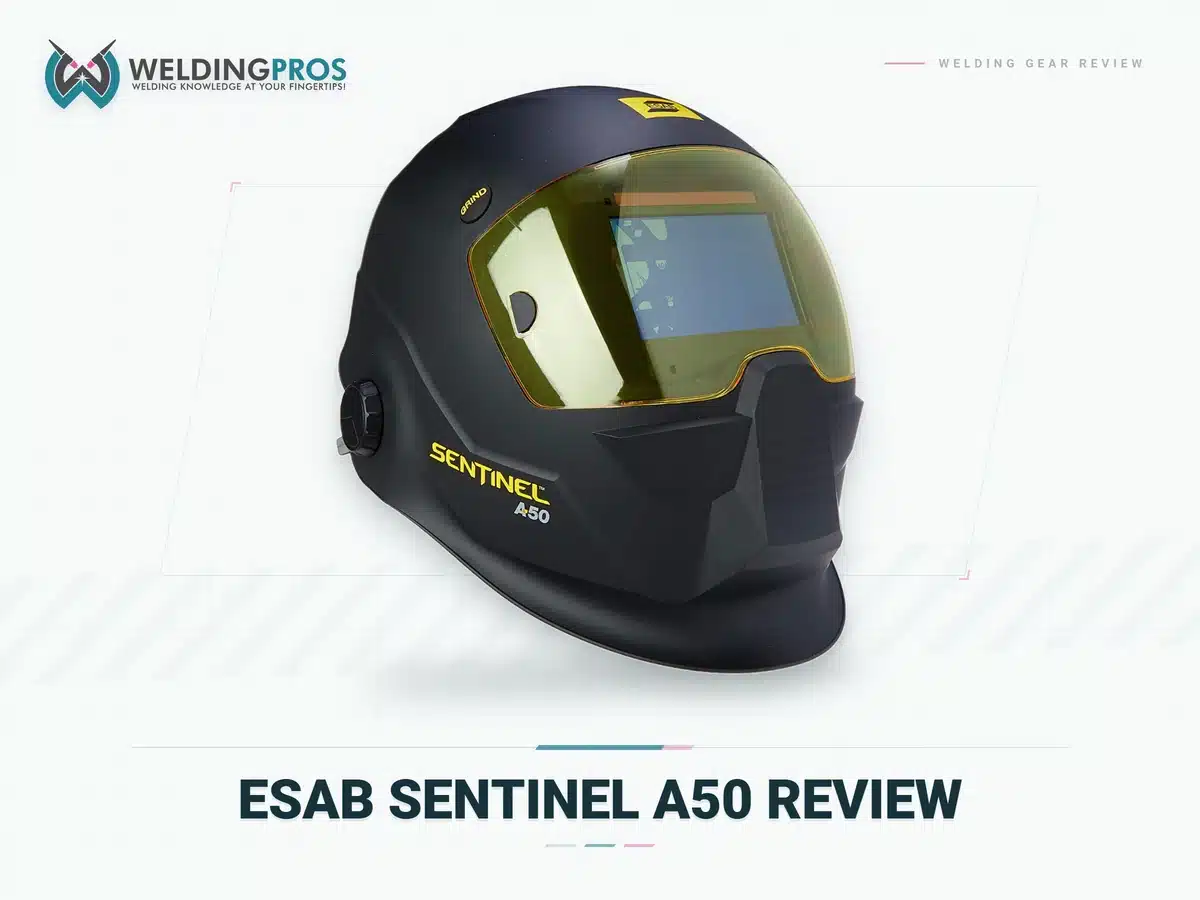
ESAB has built welding equipment in Gothenburg, Sweden, for over a century, and the Sentinel line is the company’s premium helmet family. The A50 now shares shelf space with the newer A60, and while dealers have started steering buyers toward the newer model, nobody has orphaned this welding helmet: replacement cover lenses, inside lenses, batteries, and the full headgear assembly are all still cataloged parts, and the helmet itself remains available on Amazon, where it holds 4.7 out of 5 stars across 84 ratings.
This ESAB Sentinel A50 welding helmet sits near the top of our best welding helmet list, with an optical class 1/1/1/2 rating, four arc sensors, and a shade range that covers cutting and grinding as well as welding. In this review I will go through the A50’s optical quality and viewing area, the touch-screen controls and memory functions, the comfort and build of the shell and headgear, the full specification sheet from ESAB’s own instructions for use, maintenance and replacement parts, and how the helmet behaves in daily shop use, including the details a spec table never shows.
ESAB Sentinel A50 Package Content & Technical Specifications
The A50 comes fitted and ready to weld, with the batteries already installed and a clear cover lens mounted on the cartridge. ESAB also includes an amber outer lens and a spare inside cover lens in the box, which is more accessory coverage than most hoods ship with. In the box you get:
Premium Auto-Darkening Helmet With Color Touch Screen

- ESAB Sentinel A50 welding helmet (nylon shell with ADF cartridge)
- HALO™ five-point headgear assembly with sweatbands
- 2 × CR2450 lithium batteries (installed)
- Clear front cover lens (fitted)
- Amber front cover lens
- Inside cover lens (100 x 64 mm)
- Instruction manual
Technical Specifications
| Optical Class: | 1/1/1/2 |
| Viewing Area: | 100 x 60 mm (3.94″ x 2.36″), curved |
| Arc Sensors: | Four (4) |
| Light / Grind State: | DIN 4 |
| Cutting Mode: | Shade 5–9 |
| Welding Mode: | Shade 9–13 |
| Switching Time: | 1/25,000 s (light to dark) |
| Delay Time: | 0.1–1.0 s, touch control |
| Power Supply: | Solar cell + 2 × CR2450 lithium batteries (replaceable) |
| Low-Amperage TIG Rating: | ≥ 2 amps AC/DC |
| Helmet Weight: | 1.4 lb (640 g) |
| Warranty: | 3 years |
Pros
- Optical class 1/1/1/2 with a large curved 100 x 60 mm lens
- Color touch screen with 8 memory settings
- External grind button switches to shade 4 without removing the helmet
- TIG rated down to 2 amps on both AC and DC
- Three-year manufacturer warranty
Cons
- Premium price close to professional helmet territory
- Replacement cover lenses are Sentinel-specific
- Hard hat adapter is sold separately
- No delay adjustment in grind mode
- Newer Sentinel A60 is replacing it in dealer catalogs
ESAB Sentinel A50 Performance and Features
I have used the Sentinel A50 alongside cheaper hoods long enough to know where the money goes. The optics and the headgear are better than what you get under 200 dollars, and the difference is not subtle: the puddle is sharper, the colors look real instead of green, and there is no red line across your forehead at the end of a shift. The touch controls are also faster to set than any knob arrangement once the menus become muscle memory.
None of that makes it perfect. The design is aging, ESAB has pushed its newer Sentinel A60 into most dealer catalogs, and a few choices feel dated next to fresh competition. At about 330 dollars on Amazon, it now costs more than several newer helmets with similar feature lists.
This review is written for people who weld often enough that a helmet is work equipment rather than a one-time purchase. If that is you, the details below are worth ten minutes of your time. If you weld a handful of times a year, skip to the conclusion, where I say plainly whether the premium is worth it.
Optical Quality and Viewing Area
The cartridge carries a 1/1/1/2 optical classification, and the numbers are worth decoding because they explain most of the price. The first three digits grade optical clarity, light diffusion, and luminous transmittance variation on a scale where 1 is best, and the A50 scores 1 in all three. The fourth digit, angle dependence, is a 2. In practice the weld pool stays sharp from a normal working position, and ESAB’s true color experience shows the bead the way it actually looks, so you stop flipping the hood up between tacks. Light transmission through the cartridge stays even across the lens, which is exactly what that third digit grades, and on long sessions my eyes tire less than behind the older green-tinted hoods I came from.
The lens is curved, 100 x 60 mm (3.94 x 2.36 inches), and the curve wraps toward the sides of your vision for extra peripheral visibility. On long joints the extra peripheral view matters: you see where the bead is heading without turning your head, and you catch the start of the next tack in the same glance. Inside corners and tight fabrications are where the geometry earns its keep, because you keep a clear view of the arc at angles that push a flat lens out of position.
Switching from light to dark takes 1/25,000 of a second, fast enough for low-amperage TIG work, and the cartridge holds up to shade DIN 13 protection against UV and IR at all times, even in the light state. Your eyes stay covered whether the sensors have fired or not. Few helmets at any price switch faster, and the constant-protection rating is worth confirming on any hood you buy.
The compromise is the class 2 angle dependence. Look at the arc from far off-center and the view loses some clarity, and welders who watch the puddle from a steep side angle will notice it. Around the rest of the range, the helmet covers every process without accessory filters: cutting sits at shade 5 to 9, welding at 9 to 13, and both the light shade and the grind state sit at DIN 4.
Plenty of budget hoods quote the same 1/1/1/2 classification, so the numbers alone do not tell you how a lens feels to work behind. Lens geometry, sensor placement, and color rendering separate a 90-dollar cartridge from this one, and none of them show up in a spec table. What I can say from running both: the A50’s view is wider and cleaner, with a slightly bluish tint instead of the old green, and I stop losing the puddle on out-of-position welds. Amazon buyers rate the clarity highly too, TIG welders included, including people running stainless and other specialty metals.

Touch Screen Controls and Memory

Instead of knobs, the A50 uses a color touch screen on the cartridge. Shade, sensitivity, and delay are set by tapping through menus, and the taps take a bit of getting used to in welding gloves compared with a standard screen and physical buttons on other helmets, especially during the first week. The panel wakes automatically when the arc strikes. There is no fumbling for a setting in small detents, but there is also no physical stop you can feel through the gloves.
Sensitivity runs the usual low-to-high range, and delay runs 0.1 to 1.0 seconds. Sensitivity adjustment also helps prevent false triggers from ambient light. Delay is the setting most welders ignore until they run high-amperage beads: too short and the cartridge snaps back to light while the puddle is still glowing, which is the flash you feel at the end of a long tack. Set it long for thick stock, short for sheet metal and other thin metal work. ESAB’s own shade guide in the manual suggests shade 10 for comfortable MIG work between 60 and 160 amps, which is mid-range in the A50’s band and a sensible starting point for the memory slots.
Eight memory slots store complete setting combinations, so you can jump between a 40-amp TIG setup for high precision welds and thin metal and a 200-amp MIG setup without redoing anything. Those saved setups let you quickly switch between common process presets. On a knob helmet that means three adjustments you either memorize or write on the wall. Here it is two taps. For anyone switching processes during a day, this is the feature that pays for the screen.
The control welders mention most is the external grind button. It flips the cartridge to shade 4 grind mode without taking the welding helmet off, which removes the classic walk to the bench to switch modes between welds. That outside button makes mode changes easier than on other helmets that bury the control inside the hood. One limitation: grind mode has no delay adjustment. Power comes from a solar cell assisted by two replaceable CR2450 lithium batteries, and the screen shows a four-level battery indicator so a dying cell never surprises you mid-job.
The cartridge also manages its own power. It turns on when it sees an arc and drops to standby after five seconds of idle, so there is no switch to forget and no drained battery after a week on the shelf. Battery replacement is pretty easy and needs no tools: open the cartridge back, swap both CR2450 cells, and the indicator returns to full. The cells are stocked anywhere coin batteries are sold, so a spare set for the glovebox costs a few dollars.
Comfort, Headgear and Build
The shell is high-impact nylon in a low-profile shape, and the whole hood weighs 1.4 lb (640 g), lightweight for this class. It is also a hood you forget you are wearing, and the angular shell has held up to shop life without a crack. The low profile is functional rather than cosmetic: flip the helmet up and it sits close to your head, so it clears overhead pipes and framework that would knock a taller helmet askew and gives maximum head clearance in the raised position.
The HALO head gear uses five contact points and a ratchet that adjusts across a wide range of head sizes, so the weight distribution spreads around your head and the pressure load sits noticeably lower than on a three-point gear. The pivot sits at the crown, which keeps the hood balanced when it is flipped up, and the sweatbands are replaceable and inexpensive, which matters more than it sounds on a helmet you will wear for years. ESAB sells the complete headgear assembly as a standalone part, so worn head gear is a repair, not a replacement helmet. Through a full shift it stays comfortable, and long-term owners absolutely love the fit; several reviews call it super comfortable for all-day wear, and the front and rear sweatbands do their job on hot days.
On paper the helmet meets ANSI Z87.1 along with DINplus, CE, EN 175, EN 379, EN 166, CSA Z94.3, and AS/NZS 1338.1, which covers North American and European job sites with one hood. The cartridge is rated for operation from -5 to 55 °C (23 to 131 °F) and storage down to -20 °C, comfortably wider than any shop climate you will weld in. Owners report years of daily use without the shell or cartridge giving up, which says something about durability: this hood is built to be repaired, not replaced, and the power arrangement has been reliable for me across two battery changes.
Daily maintenance is where the design shows its age in a good way. The sentinel a50 welding helmet carries its front lens front-loaded, so it swaps in about ten seconds without removing the helmet, and the box includes a clear lens fitted plus an amber spare. The curved front lens follows the body closely for a broad view, but its specialized shape means replacement lenses cost more than flat generic ones, and the surface picks up scratches if you are careless with it. Amber filters the yellow light that oxyfuel work throws off, which is why it has been the traditional gas-welding lens for decades. The three-year warranty matches what Miller and Lincoln attach to their premium hoods.
Clean it with a soft, lint-free cloth or a lightly moistened cloth, and avoid harsh chemicals that can damage the lens. ESAB says to store the helmet in a cool, dry, dark place, and the manual adds one step most owners skip: remove the batteries before long-term storage.
The manual’s application list is longer than most helmets bother printing: stick, TIG on DC and AC including pulsed, MIG and flux-cored including pulsed, plasma cutting, plasma welding, heavy duty welding processes like air carbon arc gouging, oxyfuel welding, oxygen cutting, and grinding. If a process produces arc light, this hood is rated to watch it, and the AC rating covers aluminum TIG work too.

Frequently Asked Questions [F.A.Q]
Is the ESAB Sentinel A50 good for TIG welding?
Yes. The helmet is rated for TIG at 2 amps and above on both AC and DC, and the 1/25,000 second switching time keeps low-amperage arcs from flashing through before the sensors react, which is what makes high precision welds on thin stock practical. ESAB’s own shade guide suggests shade 12 for comfortable TIG work between 50 and 150 amps, which sits mid-range in the A50’s 9 to 13 welding band. If you split your week between TIG and MIG, the eight memory slots hold both setups ready.
What batteries does the Sentinel A50 use?
The cartridge runs on a solar cell plus two CR2450 lithium coin batteries. The batteries are replaceable, the touch screen shows a four-level charge indicator, and the manual treats replacement as a user job with no special tools. CR2450 cells are stocked at any hardware or electronics counter, so a spare set costs a few dollars.
Is there a hard hat adapter available for this hood?
Yes. ESAB sells a dedicated hard hat adapter as a separate accessory, which mounts the Sentinel A50 on an ESAB hard hat for sites that require head protection beyond the hood itself. It does not ship in the box, so budget for it separately if your workplace demands it. Dealers such as Cyberweld list the adapter as a standard catalog part.
Can a cheater lens be fitted?
Yes. The helmet accepts a diopter cheater lens behind the inside cover lens, the usual fix for welders who need reading correction at working distance. The inside cover lens itself (100 x 64 mm) is a standard cataloged Sentinel part, so the whole stack, visor included, stays serviceable for as long as you own the hood.
Conclusion
The ESAB Sentinel A50 earns its place near the top of our best welding helmet list. The optics still match anything in its class: 1/1/1/2 with top marks in the first three digits, a curved 100 x 60 mm lens, and constant DIN 13 UV/IR protection even in the light state. The touch panel remembers eight setups, the external grind button removes a daily annoyance, and the HALO headgear stays comfortable through a full shift, which is the exact test most cheap hoods fail.
The helmet is no longer the new ESAB flagship, and the A60 is slowly taking its shelf space, but nothing here aged badly. Parts and lenses stay easy to find, the three-year warranty matches the big brands, and the 4.7-star track record on Amazon reflects a design that got the important calls right. If you weld for a living, this is a great helmet and the price is easy to justify. If you weld occasionally, a cheaper hood covers your needs, and the A50’s premium buys comfort you only notice late in a long workday.






