
If you are learning to weld, or you only fix things around the house a few times a month, you probably do not need an advanced synergic machine. You need something that runs on the outlets you already have and survives being hauled around a garage.
You also need something you can still find parts for ten years from now, which is where old-school transformer designs win against budget inverters. A 120V machine also saves you from rewiring the garage before your first weld.
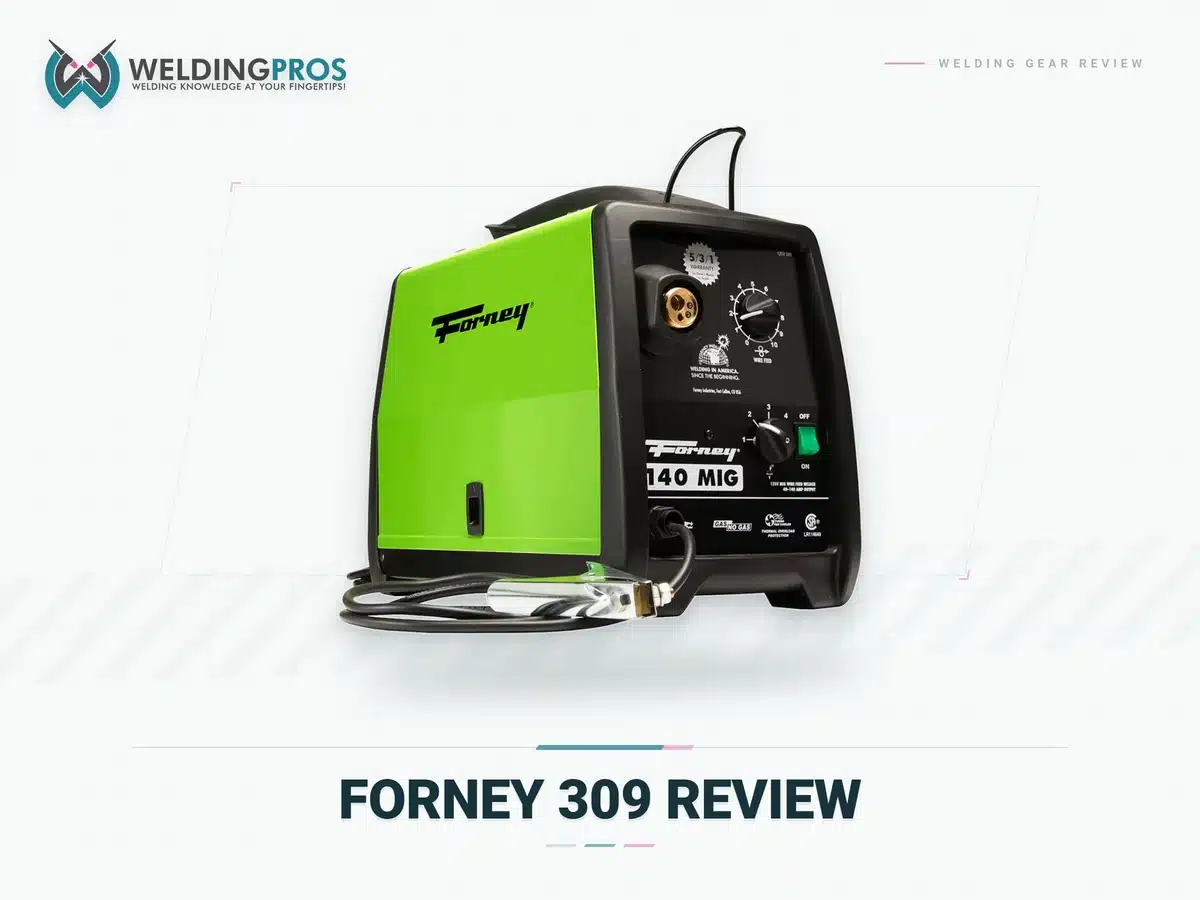
That is where the Forney 309 fits. It is a 140-amp transformer MIG welder that plugs into a regular 120V outlet, welds with solid wire and gas or self-shielded flux-cored wire, and carries one of the longest warranties in its class.
Forney has sold this basic design for years with only small updates, which tells you two things: owners keep buying it, and parts, drive rolls, and consumables stay easy to find.
The Forney 309 is a simple, heavy, honest machine: no digital display and no synergic settings, just tapped voltage and a wire feed knob. In exchange, you get a higher duty cycle than most 140-amp competitors, a Tweco-style Euro-connect gun, and a build that has barely changed in years because it works. This review is written for the buyer who wants a first welder that will outlive the project list, not a feature list.
In this Forney 309 review, we go through the package content, the real welding capability, the controls, the day-to-day handling, and the trade-offs you accept at this price, so you can decide whether this older design is the right pick for your garage.
Forney 309 Package Content (Including Gas Hose) & Technical Specifications
Forney ships the 309 as a bare-bones kit: you get the essentials to start welding right away, but none of the spare tips, drive rolls, or sample wire that come with machines like the Lincoln EasyMIG 140. Here is exactly what is in the box, and what you will still need to buy before your first weld. Plan on wire (.024 to .035 inch, solid or flux-cored), a gas cylinder with a 75/25 argon-CO2 mix if you want to run solid wire, and a small pack of contact tips. If you start with flux-cored wire, the machine welds straight out of the box with no gas at all, which is the cheapest way into wire welding. One packing note: the top handle ships unattached, and putting it on takes a screwdriver and about two minutes.
Entry-Level 120V MIG Welder With a High Duty Cycle

- Forney 309 140-amp MIG welder machine
- MIG gun with 10 ft lead (Euro-connect, Tweco #1 style consumables)
- Ground cable and clamp (10 ft)
- Gas hose
- Gas regulator with flowmeter
- Torch wrap
- Quick start guide and owner’s manual
Technical Specifications
| Welding Process: | MIG (GMAW) / Flux-Core (FCAW) |
| Input Voltage: | 120V, 1-Phase, 60 Hz |
| Output Power: | DC, 30A–140A |
| Rated Duty Cycle: | 20% @ 115A · 35% @ 90A · 60% @ 60A · 100% @ 55A |
| Wire Diameter: | .024″–.035″ (0.6–0.9 mm) |
| Wire Spool Capacity: | 4″ (1–2 lb) and 8″ (10–11 lb) spools |
| Steel Thickness: | 24 gauge – 1/4″ (mild and stainless) |
| Aluminum Welding: | Not supported (no spool gun option) |
| MIG Gun: | 10 ft Euro-connect, Tweco #1 style consumables |
| Machine Weight: | 62 lbs (28.1 kg) |
| Machine Size: | 19″ L × 9.5″ W × 16.5″ H |
| Warranty: | 5/3/1 years (90-day MIG gun) |
Pros
- 35% duty cycle at 90A beats most 140-amp rivals (20-30%)
- 5/3/1 warranty, with 5 years on transformer and rectifiers
- Euro-connect MIG gun with Tweco #1 style consumables available everywhere
- Runs both 4-inch and 8-inch wire spools
- 10 ft leads on both the MIG gun and the ground clamp
Cons
- 62 lbs transformer build is heavy and begs for a cart
- No spool gun option, so no aluminum welding, and it’s more limited than multiprocess units that also handle TIG or stick welding
- No digital display; tapped voltage only
- Can trip a 20-amp breaker at maximum output
- No spare tips, drive rolls, or sample wire in the box; rival multiprocess packages include more extras
Forney 309 Welding Performance, Controls, and Build
The Forney 309 outputs between 30 and 140 amps of DC power, which puts it at the top of the 120V entry-level class. That range makes it suitable for light fabrication, repair, and hobby work rather than heavier multiprocess jobs, and it covers 24 gauge sheet metal up to 1/4 inch mild steel in a single pass; in this output class the machine is aimed at steel and stainless work. The official rating ladder runs 115 amps at 20% duty, 90 amps at 35%, 60 amps at 60%, and 55 amps at 100%, so at the bottom of the ladder this machine holds an arc all day without a thermal shutdown. At 90 amps, 35% means roughly three and a half minutes of arc time per ten-minute cycle, enough to lay a long bead or finish a bracket before a short break.
The standout number is the duty cycle. The 309 is rated at 90 amps at 18.5 volts and 35% duty, and it still holds 60% at 60 amps and 100% at 55 amps. That is transformer physics doing the work: a copper-and-iron machine absorbs heat better than a compact inverter board. Most 140-amp competitors, including the Lincoln EasyMIG 140 and the Hobart Handler 140, are rated at 20–30% in the same range, so you simply get more arc time before the thermal protection stops you. Some lighter inverter rivals are more affordable upfront, but the 309 trades that for endurance. Even near its ceiling, the 309 holds 115 amps at 20% duty, which covers thick stock in short bursts without constant cooldown breaks. Its strong duty cycle and simple transformer design make it a reliable choice for buyers who prioritize arc time over extra features.
Welding Power and Duty Cycle
If you are still comparing machines, our updated list of the best MIG welders puts the 309 against its closest rivals, including lighter inverter units that cost less but give up duty cycle and service life. The Eastwood Elite MP140i plays in the same 140-amp class and adds stick and lift TIG, if a multiprocess machine fits your work better.
Forney’s own Easy Weld 140 MP is a different machine entirely: an inverter multiprocess unit that covers more welding processes, including stick welding and lift TIG, one person can carry it, and it targets buyers who want versatility over transformer duty cycle. If your power is 240V, the Forney 318 covers the same philosophy with more amps.
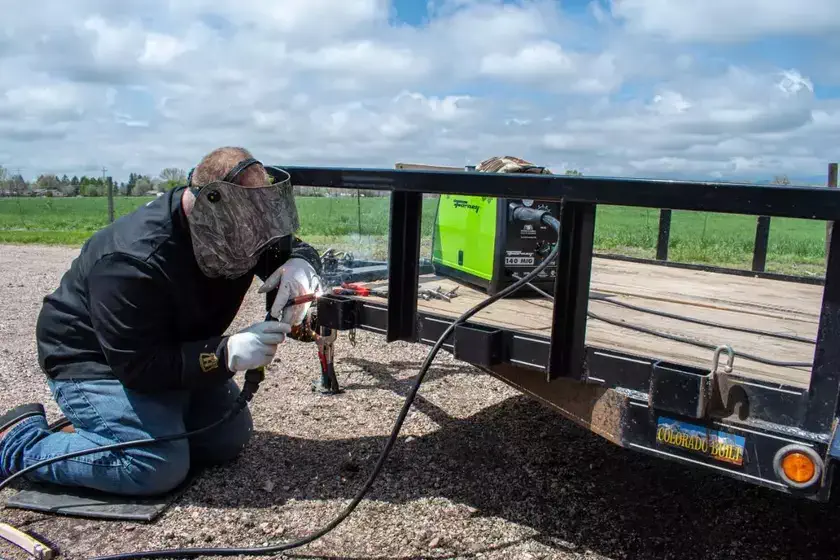
Because it is transformer-based, the 309 pulls a heavy load at full output: it runs on household 120V current, but at maximum amps it can trip a 20-amp breaker, and a small portable generator will struggle to feed it. If you regularly weld away from mains power, size the generator generously or pick an inverter machine rated for generator use.
For regular shop work on thicker material, and for buyers who do not need multiple processes and mainly want steady MIG or flux-cored performance, a dedicated 30-amp circuit is the practical fix; for heavier welding altogether, the 240V Forney 318 is the stronger sibling.
Control Panel and Wire Feed System
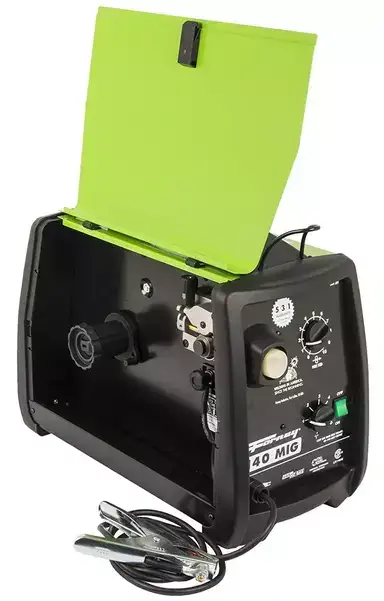
The control panel is about as simple as it gets: simple knobs and switches, with a tapped voltage switch, a wire feed speed knob, and an on/off switch.
There is no digital display, so it is easy for beginners to adjust voltage and wire feed speed by sound and bead shape, the way welders have done for decades.
Forney helps with a settings chart inside the side door that maps wire size and metal thickness to recommended taps; the tap positions help you learn the machine quickly even without a digital screen, and experienced welders usually end up a tap hotter or colder than the chart suggests.
Inside, the cast aluminum drive system with a dual-geared idler and de-spooler makes wire changes and tension adjustments quick, and the cabinet takes both 4-inch (1–2 lb) and 8-inch (10–11 lb) spools, so you can run cheap 2-pound wire on small jobs and load a 10-pound roll when a bigger project shows up.
The Euro-connect MIG gun accepts Tweco #1 style consumables, which every welding supply shop stocks and which cost a fraction of proprietary tips, and the connection comes apart in seconds when a liner needs changing.
The gun and ground lead are also easy to replace if you later want a different length or a better clamp. Both the gun and the ground cable come with 10-foot leads, so you can reach around a workbench or across a trailer without moving the machine, and the included torch wrap keeps the cables from turning into a nest between jobs.
The honest limitation: there is no spool gun option and the wire range is .024 to .035 inch, so this is a steel and stainless machine. Aluminum needs a spool gun or at least a drive set up for soft wire, and the 309 offers neither. If occasional aluminum work is on your list, pick a 140-amp machine that lists spool-gun support.
Build, Portability and Warranty
At 62 pounds and 19 x 9.5 x 16.5 inches, the 309 is a tank by entry-level standards; the typical inverter 140 weighs a third of that.
Integrated feet keep it stable on a bench, the handle helps you lift it, and the included torch wrap keeps cables organized; once you add a gas cylinder, a cart stops being optional, and any basic welding cart takes both.
That weight is the transformer, and it is also why the machine holds up: Forney has built welding equipment since 1932, owners report years of farm and shop use that prove its build quality over time, and the Amazon listing currently averages 4.6 out of 5 stars.
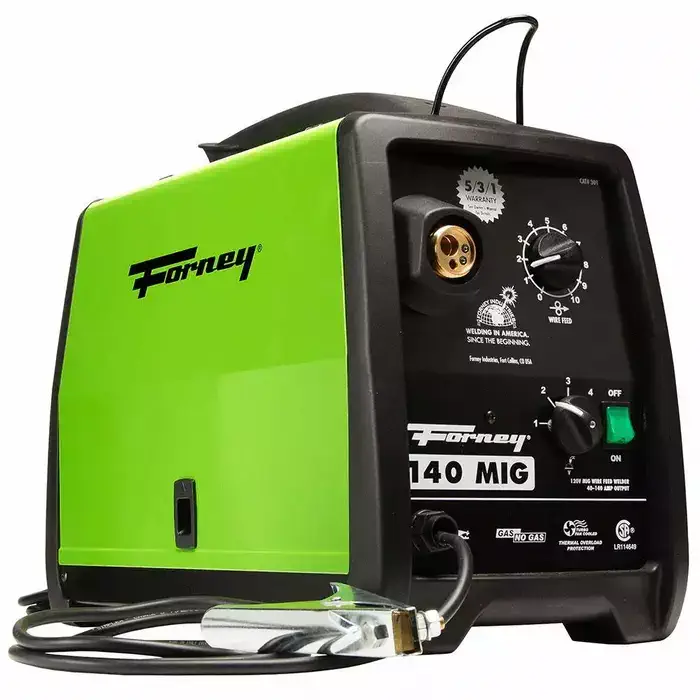
Just know the trade before you buy: this is not a machine you toss in a car trunk, and it wants a permanent spot on a bench or cart.
Forney backs the 309 with a 5/3/1 warranty (five years on the transformer and rectifiers, three years on internal components, one year on accessories, and 90 days on the MIG gun), which matches Hobart coverage and beats most budget brands, where one year is the norm.
The design is old and widely serviced, so replacement drive parts and consumables are off-the-shelf items; even out of warranty, this is a machine you can keep running, which is a big part of its appeal for garage and farm users. For a garage, farm, or small repair shop that mostly welds steel under 1/4 inch, the 309 fits buyers who want durability and serviceability more than low weight.
Frequently Asked Questions [F.A.Q]
No. The 309 has no spool gun option, its wire range stops at .035 inch, and Forney lists only mild and stainless steel as weldable materials. Feeding soft aluminum wire through a standard drive leads to birdnesting and an inconsistent arc even on machines that attempt it. For occasional aluminum work, choose a 140-amp machine with dedicated spool-gun support instead.
It is rated at 20% at 115 amps, 35% at 90 amps, 60% at 60 amps, and 100% at 55 amps. The 35% at 90 amps figure is the one to compare against other 140-amp welders, most of which sit at 20 to 30% in that range, and after a long bead a short post cooling period is normal so you do not need to worry about brief pauses between passes. In shop terms, 35% means about three and a half minutes of arc time per ten-minute cycle, which covers a long bead or a complete bracket before a short break.
Yes. The 309 handles both gas-shielded MIG (GMAW) and self-shielded flux-cored (FCAW) welding, and switching between the two is a wire and polarity change covered in the manual. For outdoor or windy conditions, .030 or .035 flux-cored wire without shielding gas is the usual setup, and it is also the cheapest way to start with this machine because no gas cylinder is needed.
It runs on a standard 120V household outlet, but at maximum output it can trip a 20-amp breaker, especially on a circuit that shares other loads. Occasional full-power welding is fine on a dedicated 20-amp circuit; for regular work on thicker material, a 30-amp circuit is the safer choice. Avoid long, thin extension cords as well: voltage drop makes the arc sputter, so if you need reach, use a heavy-gauge welder cord.
Conclusion
The Forney 309 is not trying to be a modern machine, and that is the point. You give up the digital display, the synergic settings, and any aluminum capability that newer inverter welders offer; in exchange, you get a higher duty cycle than almost anything in its class, a 5/3/1 warranty, Tweco-style consumables that every welding shop stocks, and a transformer build that has barely changed in years because it works.
Buying it is a decision about what you weld and how long you plan to keep the tool: for auto sheet metal, fence repair, and farm maintenance on steel, the 309 will still be running after cheaper inverters have been replaced. If your projects stay under 1/4 inch steel and you value durability over features, the 309 remains one of the strongest values among 140-amp MIG welders.






