
Not every MIG welder has to be light and portable. When all of your welding happens in one shop and the stock keeps getting thicker, a full-size 230V machine finishes the job faster than any hobby unit, and it does not complain when the work runs all afternoon. The IronMan 230 is that kind of machine.
The Hobart IronMan 230 was Hobart’s answer for that work: 250 amps on tap, a 60% duty cycle at 175 amps, and the twelve-tap voltage control that transformer machines were famous for.
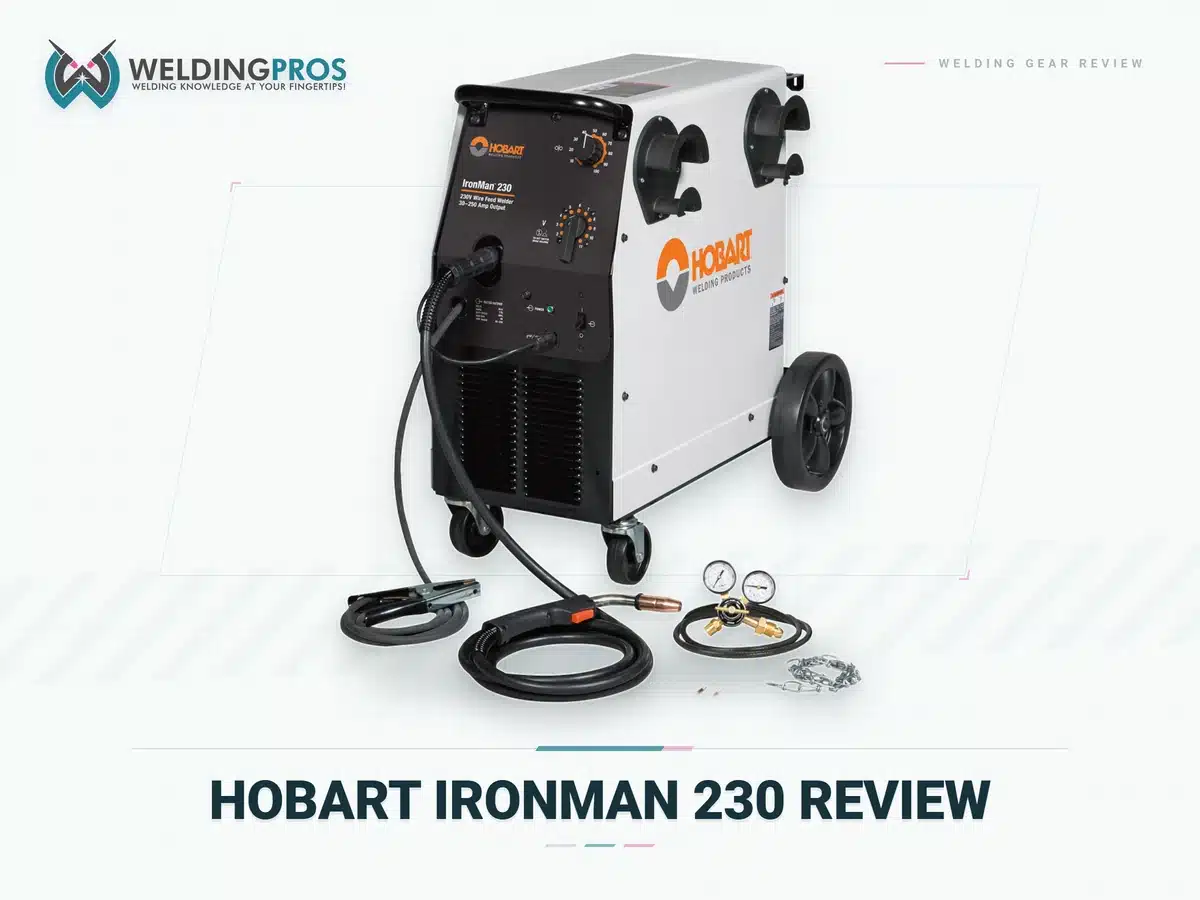
Hobart has since replaced it with the IronMan 240, but thousands of 230s are still welding in fabrication and maintenance shops, and the used market treats them as a safe buy.
In this Hobart IronMan 230 review, I go through the package contents and the official specifications, then through how the machine behaves in daily shop use. I will also cover the details the sales sheet will not tell you, like which drive rolls you actually need and what the duty cycle rating means in practice.
One thing to settle first: this is a MIG and flux-cored welder only. If you need stick or TIG output, this is not your machine. If you roll thick material into a fixed shop, keep reading.
Hobart IronMan 230 Package Content & Technical Specifications
The Hobart IronMan 230 is a Hobart MIG welder built for shops that weld every day, running on 230V single-phase power. Hobart sold it as a complete package under product number 500536, designed for MIG and flux-cored welding, and the box arrived ready to work, with the welder already mounted on its running gear and every welding essential included. A setup chart inside the machine gives material-thickness and settings guidance, which makes dialing it in faster.
Heavy-Duty 250 Amp MIG Welder for Daily Shop Work

- Hobart IronMan 230 MIG welder (product no. 500536)
- 15 ft. (4.6 m) M-25 MIG gun
- 10 ft. (3 m) work cable with clamp
- Power cord with plug
- Regulator/flow gauge with 5 ft. (1.5 m) gas hose
- Dual-groove .030/.035 in. drive roll with .030 and .035 in. contact tips
- Built-in running gear with cylinder rack and side cable hangers
Technical Specifications
| Welding Process: | MIG (GMAW) / Flux-Cored (FCAW) |
| Input Voltage: | 230V, single-phase |
| Input at Rated Load: | 32.5 A / 7.4 KVA / 6.3 KW |
| Welding Amperage Range: | 30–250 A |
| Rated Output: | 175 A at 25.5 VDC |
| Duty Cycle: | 60% at 175 A |
| Open Circuit Voltage: | 38 VDC |
| Wire Feed Speed: | 0–700 IPM (0–17.8 m/min) |
| Mild Steel Thickness: | 24 ga – 1/2 in. (13 mm) |
| Wire Sizes: | .030 / .035 in. (reversible dual-groove drive roll) |
| Machine Weight: | 185 lb. (84 kg) |
| Machine Size: | 31.5″ H × 18.875″ W × 36.5″ D |
Pros
- 250 amp output with a 60% duty cycle at 175 amps
- Welds mild steel from 24 gauge to 1/2 in. in a single pass
- Twelve voltage taps give fine control over the arc
- Spool-gun ready for aluminum with no extra control box
- Hobart 5/3/1 industrial warranty
Cons
- 230V input only, no household 115V option
- 185 lb. of shop-bound iron; stock casters want smooth floors
- Premium price next to hobby-class MIG welders
- Flux-cored welding needs optional knurled drive rolls
- Single-process machine: no stick or TIG mode
The M-25 gun that comes with it is worth a mention on its own. It is a 15 foot, 250 amp gun rated at 100% duty cycle on CO2 and 60% on mixed gas, so the torch is never the weak link when you are pushing the machine hard. The work lead is a 10 foot cable with clamp, and the regulator/flow gauge screws onto a bottle with the 5 foot gas hose already fitted. Add the dual-groove drive roll and a starter set of .030 and .035 inch contact tips, and the only thing you need to buy before the first weld is wire and gas; the machine is also spool gun ready.
Consumables are cheap and easy to stock. Contact tips come five to a package for every wire size the machine runs, flush nozzles in two orifice sizes are listed in the same parts chart, and the running gear includes a rack that carries the gas cylinder with the machine. The heavy-duty aluminum drive housing keeps wire feeding consistent through long sessions. Nothing in the package is a placeholder you replace in week one, which is more than most budget machines can say.
How the IronMan 230 Performs in Real Shop Work
On paper, the IronMan 230 reads like a workhorse: 30 to 250 amps of output gives it the range to handle everything from 24 gauge sheet to heavier fabrication, with a rated 175 amps at 25.5 VDC and enough low-end control to stay useful on thin material. Numbers only tell part of the story, so this section covers how the machine behaves when it earns its keep.
This is a transformer-class machine weighing about 185 pounds, not an inverter you toss in a truck bed, and that mass is the price of the build. Everything about it, from the twelve-tap voltage switch to the built-in running gear, is designed around staying put and welding all day. That is a limitation and a strength at once: you will not carry it up stairs, and it will not flinch at a full day of thick stock.
Hobart aimed it at maintenance and repair, auto body work, construction, farm and ranch jobs, manufacturing, and metal art. That spread tells you it was engineered as a general shop tool rather than a specialist for one trade. In practice it fits serious hobbyists and light industrial fabrication best. Like other Hobart welders built for shop duty, it has a reputation for reliability and consistent performance. It is also a value pick on the used market, since it undercuts comparable industrial models on price while keeping the output.
Power, voltage control, and arc quality
The heart of the IronMan 230 is its twelve-tap voltage control. These 12 voltage tap settings for arc control, paired with a wire feed speed control from 0 to 700 IPM, give far finer tuning than the five or six taps on smaller MIG welders.
The click voltage settings lock into place, every adjustment is readable on the panel at a glance, and you can feel the difference in the puddle.
Set the taps right for the material and the arc stays smooth with minimal spatter, and user reports consistently describe excellent arc quality with minimal spatter when the settings are right, which cuts post-weld cleanup to a quick wipe.

Output runs from 30 to 250 amps, so one machine covers 24 gauge sheet at the bottom with a 30-amp minimum output and can comfortably weld up to 1/4 inch steel, while still reaching 1/2 inch mild steel in a single pass at the top. The fundamentals do not change from any how to MIG weld guide, but the extra amperage means thick joints no longer need multiple passes or preheat.
The electrical side deserves respect. At rated load the machine draws 32.5 amps from a 230V circuit, or 37 amps on a 200V supply, which works out to 7.4 KVA, and open circuit voltage sits at 38 VDC. Plan on a dedicated 230V circuit with the correct breaker and receptacle before the machine arrives. It lacks digital displays common on newer models, but that keeps setup straightforward. It cannot be adapted down to a household 115V outlet.
If you are stepping up from a small machine, Miller’s article on MIG welding basics for mild steel is a good refresher on settings, because a 250-amp welder punishes sloppy parameters faster than a 140 ever will.
Wire drive and day-to-day handling
Wire feed comes from a dual-geared drive in an aluminum housing, and it is the reason the arc stays stable at the top of the amperage range. The standard drive roll is reversible, with a .030 inch groove on one side and .035 on the other, so a single roll covers the two wire sizes most shops burn. Hobart also sells a V-groove roll for .023 and .045 inch wire if your work calls for them, and the machine’s range runs from 24-gauge sheet metal up to 1/2-inch steel.

Two honest caveats. The V-groove rolls that ship with the machine are made for solid wire; run flux-cored wire seriously and you will want the optional knurled rolls, because soft flux-cored wire needs the extra grip. Feeding soft aluminum wire through any standard drive invites bird-nesting, which is the exact problem the optional DP 3545-20 spool gun solves; that spool gun attachment is what handles aluminum welding. It plugs straight into the machine with no control box or adapter.
Spool changes are quick. The hub takes 2, 10, 33, and 45 pound spools, the brake tension knob is toolless, and the wire aligns itself on the way in. The hinged side door opens the whole feed system in seconds, which sounds like a small thing until you have changed wire three times in a day.
Handling is a mixed bag. At 185 pounds on its built-in running gear, the wheels are what make the machine manageable on smooth concrete, and the cylinder rack and side cable hangers keep the tank, shielding gas, and leads tidy when you move it. The stock casters are not made for gravel or rough ground, so pick its parking spot with that in mind. In a fixed shop none of this matters much. On job sites it would.
The cabinet itself measures 31.5 inches high, 18.875 wide, and 36.5 deep, so it fits the footprint of a standard workbench bay, though at this weight you want it on the floor. The side door is hinged for spool and drive roll changes, and Hobart put the voltage and wire feed speed control markings where you can read them without crouching during setup. Small ergonomic points, but they add up over a full shift.
Duty cycle, cooling, and warranty

The duty cycle rating is 60% at 175 amps, which translates to six minutes of arc-on time for every ten minutes at that output. In practice that is more welding than most people can do back to back, and the margin only improves below 175 amps. The duty cycle chart in the manual shows exactly how the rating scales as amperage drops.
Thermal overload protection shuts the output down if you do manage to exceed the rating, and Fan-On-Demand runs the cooling fan only when the machine warms up, so it draws less power and pulls in less grinding dust while you are between welds, and the components see less heat over their life. The machine is certified by CSA to both Canadian and US standards and is rated to operate from -4 to 104 degrees Fahrenheit.
Frequently Asked Questions [F.A.Q]
Is the Hobart IronMan 230 good for beginners?
It can be, if you have a 230V circuit and real work lined up. The setup chart inside the side door and the simple two-knob panel keep settings easy to find, so the machine itself is not the hard part. What makes it a niche pick for a beginner is the input power and the price: light projects around the house are cheaper to weld with a smaller unit, and paying for 250 amps you never use is wasted money.
The control panel is honestly one of the friendliest parts of the machine. Two knobs, one for wire speed and one for voltage, a power light, and a power switch, with the gun receptacle on the front. There is no menu diving and no synergic modes to misconfigure, so the learning curve is about welding, not about the welder.
Can the IronMan 230 weld aluminum?
Yes, with the optional Hobart DP 3545-20 spool gun, which connects directly with no control box or adapter. The spool gun is rated at 200 amps at 60% duty cycle, carries a 20 foot cable and 4 inch spools, and with .030 to .047 inch wire it welds aluminum from 18 gauge up to 1/2 inch thick. Feeding soft aluminum wire through the standard drive invites bird-nesting, which is exactly why the spool gun exists. Our guide to MIG welding aluminum covers settings and shielding gas selection for aluminum MIG work in detail.
What is the duty cycle of the Hobart IronMan 230?
It is rated at 60% duty cycle at 175 amps and 25.5 volts, meaning six minutes of welding for every ten minutes at that output. Below 175 amps the usable arc time climbs further, and the duty cycle chart in the manual maps the whole curve. Thermal overload protection and Fan-On-Demand cooling support the rating, and the fan only spins when the machine needs cooling, which keeps the inside cleaner.
Was the Hobart IronMan 230 discontinued?
Yes. Hobart replaced it with the IronMan 240, which is the current model in the lineup and the one to buy new. While the 230 was current, Hobart sold it through its own dealer network and big retailers that carry the Hobart line, such as Northern Tool. The 230, product number 500536, remains common on the used market, parts and consumables are easy to find through the Illinois Tool Works dealer network, and its arc quality still holds up against newer machines, which is why this review stays live.
Conclusion
If your welding happens in one shop and involves thick stock, the Hobart IronMan 230 is one of the strongest single-phase MIG machines you can put in it, a reliable Hobart MIG welder for fixed-shop work. The twelve-tap voltage control, the stable dual-geared wire drive, and the 60% duty cycle at 175 amps add up to a welder that runs all day in a fabrication, farm, or maintenance shop, and that combination is what earned it a place on our best MIG welder list.
Be honest about the two costs before you buy. It needs a dedicated 230V circuit, and at 185 pounds it is not a job-site traveler. Occasional thin-sheet work does not justify this much machine.
If you are buying new, look at the current IronMan 240 instead; newer models add more interface features, but nothing was wrong with the 230’s core welding performance. Find a used 230 at a fair deal, with its package intact and its warranty history clean, and it is still a machine worth owning for years of daily welding.






