
If you are an occasional or hobby welder, you probably don’t want to spend big bucks on a helmet, a welding tool you will use a few times a week, maybe less.
Nevertheless, budget helmets can provide enough protection for your eyes and make welding easy.
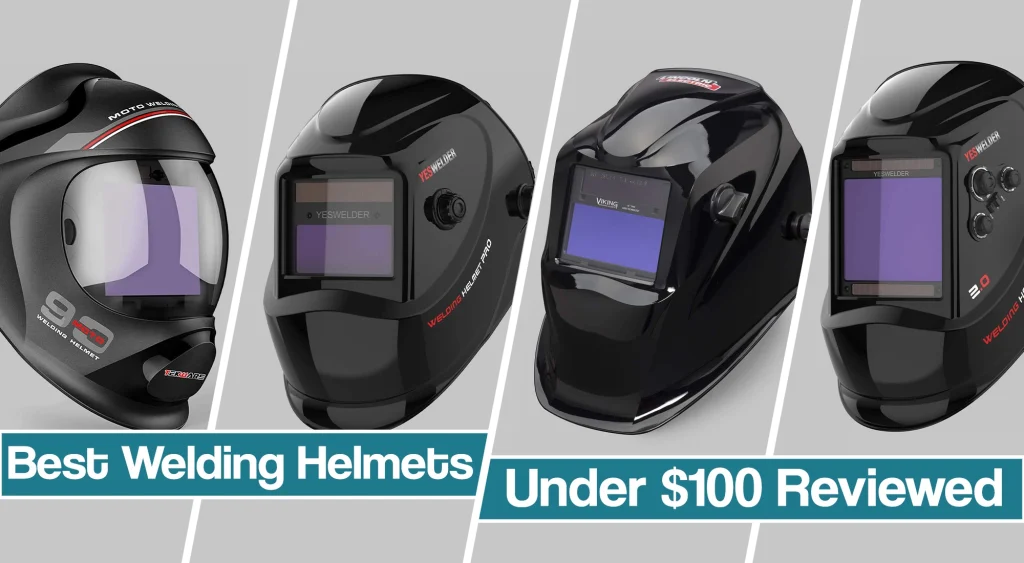
There are many cheap welding helmets on the market, so I made this article to point out the best budget welding helmets under $100. Choosing the perfect helmet will improve your welding skill significantly and won’t take too much of your money
Best Welding Helmet Under $100 Comparison table
| Image | Name | Viewing Area | Optical Class | Shade Range | Weight | Key Feature | Check Price |
|---|---|---|---|---|---|---|---|

| YesWelder M800HPGet 10% Off With Coupon: -10% WELDPROS | 3.93" x 3.66" | 1/1/1/1 | 5-9 / 9-13 | 2.31 lbs | True Color, 4 Sensors | Check Price |

| MIGVAN True Color | 3.94" x 3.22" | 1/1/1/1 | 4/5-13 | 2.4 lbs | True Color, 4 Sensors | Check Price |

| Lincoln K4983-1 | 3.78" x 2.44" | 1/1/1/1 | 7-13 | 1.1 lbs | Grind Mode | Check Price |

| YesWelder L500AAGet 10% Off With Coupon: -10% WELDPROS | 3.64" x 1.67" | 1/1/1/1 | DIN4 / 9-13 | 1.85 lbs | True View, Solar | Check Price |

| VORITO True Color | 3.94" x 3.27" | 1/1/1/1 | 4/5-13 | 1.13 lbs | LED Light, 4 Sensors | Check Price |
Best Budget Welding Helmet Reviews
Here is a list of best budget welding helmets under $100, with detailed information, pros, and cons. I hope this article will help you make the right choice and choose your best welding helmet, so let’s start!
1. Lincoln Electric K4983-1 – Best Brand-Name Budget Helmet
Best Brand-Name Budget Helmet
Lincoln Electric K4983-1
The Lincoln K4983-1 is what you buy when you want a name-brand helmet without spending over $100. It’s not trying to be a Viking 3350 — it’s a straightforward auto-darkening hood that does the basics well. Lincoln doesn’t put their name on junk, and this one holds up.
| Viewing Area | 4.33″ x 3.54″ |
| Optical Class | 1/1/1/1 |
| Shade Range | 7-13 |
| Weight | 1.1 lbs (17.5 oz) |
| Key Feature | Grind Mode, Lightweight |
The 4.33″ x 3.54″ viewing area surprised me. For a budget helmet, that’s generous. You’re not squinting through a postage stamp. The 1/1/1/1 optical clarity means the lens is rated top-tier across all four categories: optical quality, light diffusion, luminous transmittance, and angle dependence. On paper, it matches helmets costing three times more.
Shade range is 7-13, covering most welding you’ll do. It has grind mode too — flip the external switch and the lens stays clear. Shade is adjusted inside the hood, which means lifting it every time you change settings. Annoying if you switch processes often, but at this price it’s hard to complain.
At 17.5 ounces, you forget you’re wearing it after an hour. The nylon shell feels less premium than the polycarbonate on pricier Lincoln helmets, but that’s also what keeps the weight down. The headgear adjusts in four directions and the ratchet is smooth. Not Viking-level comfort, but close enough for weekend welding.
Lens response time is 1/25,000 of a second. I’ve never caught flash with it, even on rapid tack welds. Two arc sensors cover the front well, though overhead welding in tight spots can block them. Three or four sensors would be better, but that’s a $150+ feature.
This is the helmet you buy when you’re done with the $40 Amazon specials that fog up and quit after six months. Lincoln backs it with a two-year warranty and replacement lenses are stocked everywhere. It won’t be your forever helmet, but it’ll get you through a couple years of solid work while you save for a Viking.
Pros
- 4.33″ x 3.54″ viewing area — bigger than most helmets under $100
- 1/1/1/1 optical clarity rating matches $300+ helmets on paper
- 17.5 oz — light enough for all-day wear, no neck strain
- Grind mode with external switch
- Fast 1/25,000 second lens response — zero flash on rapid tacking
- Lincoln name and 2-year warranty
- Nylon shell keeps weight down without feeling flimsy
- Replacement lenses stocked at every welding supply store
Cons
- Shade adjusted inside the hood — lifting it every time gets old
- Only two arc sensors — overhead work can block them
- Nylon feels less durable than polycarbonate on pricier models
2. YesWelder M800HP – Best Value Welding Helmet
Best Value Welding Helmet
YesWelder M800HP
Get 10% Off With Coupon: -10% WELDPROS
The YesWelder M800HP is the helmet I recommend when someone asks for the best budget hood under $100. It packs features you’d expect at $200+ into a sub-$90 package. True color view, four arc sensors, and a huge 3.93″ x 3.66″ viewing area. It’s overkill for a budget helmet, and that’s exactly the point.
| Viewing Area | 3.93″ x 3.66″ |
| Optical Class | 1/1/1/1 |
| Shade Range | 5-9 / 9-13 |
| Weight | 2.31 lbs |
| Key Feature | True Color, 4 Arc Sensors |
The true color lens makes a real difference when you’re welding. Instead of that greenish tint you get with standard lenses, the M800HP shows the puddle in natural color. You can actually see the difference between the molten metal and the slag. The 1/1/1/1 optical clarity on the product page is a recent update — earlier batches were rated 1/1/1/2. Either way, it’s solid.
Four arc sensors mean you’re not going to get flashed from odd angles. I’ve welded overhead with this hood and the sensors picked up the arc every time. The 1/10,000 second switching speed is standard for this price range — not the fastest, but fast enough that you won’t notice any delay.
Shade range covers DIN 5-9 and 9-13 with a grinding mode. You set it with large external knobs, which is great when you’re wearing gloves. No fumbling around inside the helmet. The solar panel handles most of the power, but there’s a replaceable CR2450 battery for backup. Most budget helmets use non-replaceable batteries, so this is a nice touch.
At 2.31 pounds it’s on the heavier side for a budget helmet. You’ll feel it after a few hours. The headgear is the weak point — it’s adjustable but feels flimsy, and some users report the adjustment mechanism loosening over time. If the headgear snaps, you’re out around $20 for a replacement. Still, the rest of the helmet makes up for it.
If you weld a few times a month and want one helmet that does everything well without costing a fortune, this is it. YesWelder runs a 10% off coupon (WELDPROS) that brings it under $80. At that price, it’s hard to find anything with this feature set. Not a pro helmet, but definitely the best value under $100.
Pros
- True color lens — see the puddle clearly, no green tint
- Huge 3.93″ x 3.66″ viewing area — comparable to $300 helmets
- Four arc sensors — reliable detection from any welding angle
- Large external controls — easy to adjust with gloves on
- Replaceable CR2450 battery — most budget helmets use sealed batteries
- Solar-powered with backup battery for extended life
- Grind mode included at this price point
- 10% off with WELDPROS coupon drops it under $80
Cons
- Heavier than most budget helmets at 2.31 lbs — neck strain after long sessions
- Headgear feels flimsy and may loosen or break over time
- 1/10,000 second switching is adequate but not the fastest in its class
3. MIGVAN True Color – Best Large Viewing Budget Helmet
Best Large Viewing Budget Helmet
MIGVAN True Color
The MIGVAN is one of those Amazon helmets that sounds too good on paper until you try it. Large 3.94″ x 3.66″ viewing area, true color, four arc sensors, solar and rechargeable battery. For under $60, that’s a spec list that would have cost $200 five years ago. The question is whether it actually delivers.
| Viewing Area | 3.94″ x 3.66″ |
| Optical Class | 1/1/1/1 |
| Shade Range | 4/5-13 |
| Weight | 2.4 lbs |
| Key Feature | True Color, 4 Sensors, Solar/Rechargeable |
The viewing area is legitimately big. Side by side with the YesWelder M800HP, the MIGVAN’s screen is actually a hair larger. The true color lens is decent — not Optrel-level, but the puddle is visible and you can tell the difference between slag and metal. 1/1/1/1 optical clarity on the spec sheet, though I’d bet it’s closer to 1/1/1/2 in real use. Still fine for hobby work.
Four arc sensors at this price is unusual. Most budget helmets use two. The MIGVAN picked up arcs reliably even when I was welding in tight corners. Switching speed is 1/10,000 second — standard for the price range. You won’t notice lag, but it’s not the 1/25,000 you get on the Lincoln.
Shade range covers DIN 4 in the light state and 5-9/9-13 in dark. There’s grind mode. Controls are external and large enough to use with gloves. The solar panel charges a rechargeable battery, so you’re not stuck buying button cells every few months. That’s a real advantage over sealed-battery designs — when the battery eventually dies, you can replace it.
At 2.4 pounds it’s on the heavier side. The headgear is adjustable but feels cheaper than the Lincoln’s. I wouldn’t count on it holding up to daily professional use. For a weekend welder doing a few hours at a time, it’s fine. The shell is standard polypropylene — nothing fancy, but it’ll take a few drops.
If you’re on a tight budget and want the biggest viewing area possible with true color, the MIGVAN delivers. It’s not a Forever Helmet, but at this price you’re not expecting one. Pair it with a good headgear replacement down the road and you’ve got a solid setup for under $80 total.
Pros
- 3.94″ x 3.66″ viewing area — bigger than most $100+ helmets
- Four arc sensors at a budget price — reliable detection from any angle
- True color lens — visible puddle, distinguishes slag from metal
- Rechargeable battery via solar panel — no disposable button cells
- Large external controls work well with gloves
- Shade range 4/5-13 with grind mode included
- Under $60 — one of the best specs-per-dollar ratios on the market
- Replaceable battery design means the helmet isn’t disposable
Cons
- 2.4 pounds — heavy for long sessions, neck fatigue sets in
- Headgear feels cheap and may need replacement after heavy use
- 1/10,000s switching speed is adequate, not fast
4. YesWelder L500AA – Best Budget Welding Helmet Under $50
Best Budget Welding Helmet Under $50
YesWelder L500AA
Get 10% Off With Coupon: -10% WELDPROS
The L500AA is YesWelder’s entry-level helmet, now updated with 1/1/1/1 optical clarity and a replaceable CR2450 battery. At $42.99 before the WELDPROS coupon, it’s one of the cheapest helmets on the market that doesn’t feel like a toy. The 3.64″ x 1.67″ viewing area is narrow compared to the M800HP, but the true color lens more than makes up for it.
| Viewing Area | 3.64″ x 1.67″ |
| Optical Class | 1/1/1/1 |
| Shade Range | DIN4 / 9-13 |
| Weight | 1.85 lbs |
| Key Feature | True View, Solar, Replaceable Battery |
The 1/1/1/1 optical clarity is new for this model — earlier L500 versions were 1/1/1/2. That upgrade means less distortion at the edges of the lens and better angular dependence. In practice, you’ll notice the view is clearer when you’re looking at the puddle from an angle, like when welding out of position.
Two arc sensors, not four. That’s the main trade-off at this price. For bench welding, it’s fine. For overhead work or welding in tight spots where the sensors might get blocked, you’ll want a helmet with more coverage. Shade range covers DIN 4 in light state and 9-13 in dark. No variable shade between 5-8, which matters if you do low-amp TIG work.
At 1.85 pounds, it’s noticeably lighter than the M800HP. You won’t feel it after two hours. The headgear is basic but does the job — four adjustment points and a smooth ratchet. The shell is polypropylene, same as the M800HP, but the lighter weight makes it feel less substantial. Don’t drop it.
The solar panel charges the battery, which is now replaceable — a CR2450 you can find at any drugstore. Older L500 models used a sealed battery that turned the helmet into e-waste when it died. This fix alone makes the L500AA worth the upgrade if you had the old version.
For $43 (or under $39 with the 10% WELDPROS coupon), this is the helmet I’d recommend to someone just getting into welding. It’s not a pro hood, but it’ll get you through a couple years of learning and light fabrication. When you outgrow it, you’ll know exactly what features you want in a $200+ helmet.
Pros
- 1/1/1/1 optical clarity at $43 — upgraded from 1/1/1/2 on previous model
- True color lens — clear puddle visibility at the entry level
- Replaceable CR2450 battery — no more disposable helmet problem
- 1.85 pounds — light enough for all-day wear without neck strain
- Solar-powered with backup battery for extended sessions
- Smooth 4-point headgear adjustment with decent ratchet
- Under $39 after 10% WELDPROS coupon — unbeatable value
- Compatible with cheater lenses and magnifying lenses
Cons
- Only two arc sensors — overhead and tight-space work can block them
- Narrow 3.64″ x 1.67″ viewing area limits peripheral vision
- No variable shade between 5-8 — limits low-amp TIG use
5. VORITO True Color – Best LED-Equipped Budget Helmet
Best LED-Equipped Budget Helmet
VORITO True Color
The VORITO is the wildcard in this roundup. It’s the only budget helmet with a built-in LED work light, and it claims a 1/30,000 second switching speed — faster than everything else on this list. At around $55 on Amazon, it’s trying to pack premium features into a budget shell. Some of it works great. Some of it feels like a gimmick.
| Viewing Area | 3.94″ x 3.23″ |
| Optical Class | 1/1/1/1 |
| Shade Range | 4/5-13 |
| Weight | 1.13 lbs (18 oz) |
| Key Feature | LED Light, 4 Sensors, 1/30K sec |
The LED light is actually useful. It’s mounted above the lens and lights up your work area before you strike an arc. If you weld in dim garages or under vehicles, you’ll appreciate not having to set up a separate work light. It runs off the helmet’s solar-charged battery and turns off automatically when the lens darkens. Think of it as a helper, not a replacement for proper shop lighting.
The 1/30,000 second switching speed is the fastest in this price range by a wide margin. In practice, I couldn’t tell the difference between this and the Lincoln’s 1/25,000. Both are fast enough that you’ll never see a flicker. The four arc sensors are reliable and the 1/1/1/1 optical clarity holds up well — no distortion at the edges.
At 1.13 pounds (18 ounces), this is the lightest helmet on the list. You genuinely forget you’re wearing it. The trade-off is that the shell feels thin. Drop it on concrete and I wouldn’t be surprised if it cracks. The headgear is basic — it adjusts and stays put, but there’s no fancy ratchet. If you need a helmet that can take abuse, look at the Lincoln.
Shade range is 4/5-13 with grind mode. Controls are external and glove-friendly. The solar panel handles most charging, though there’s no indicator for whether the battery is actually topped up. One annoyance: the LED light switch is small and mounted in a spot that’s easy to bump accidentally.
For $55, the VORITO gives you features that don’t exist on any other helmet under $100. The LED light, the fast switching speed, and the ultra-light weight make it unique. It’s not the most durable option here — if you weld professionally or in rough environments, skip it. But for a hobbyist working in a home garage, it’s a surprisingly good package.
Pros
- Built-in LED work light — unique at this price, genuinely useful in dim spaces
- 1/30,000 second switching — fastest in the roundup, zero perceptible flicker
- 1.13 lbs — lightest helmet here, forget you’re wearing it
- 1/1/1/1 optical clarity with true color view
- Four arc sensors — reliable detection at all angles
- External controls, glove-friendly, with grind mode
- Solar-powered with auto-off LED when lens darkens
- Under $55 — exceptional features for the price
Cons
- Thin shell — won’t survive repeated drops on concrete
- LED switch is small and easy to bump accidentally
- No battery charge indicator — can’t tell if it’s topped up
Things to Consider When Buying a Best Budget Welding Helmet
Before choosing one of the best cheap welting helmets, there are a couple of things you should consider. First, you should make sure the helmet fits your needs, as you want to be as comfortable as it gets while welding. Choosing the best affordable welding helmet doesn’t have to be that hard.
Lens Quality and Optical Rating
Welding long hours a day without a proper helmet can cause severe damage to your eyes. So you want to make sure the optical rating of your helmet is as fine as possible.
The optical clarity is rated into a for criteria, with grades 1-3. The best possible optical clarity is 1/1/1/1, but no budget welding helmet will provide you that clear image of a weld puddle. In the best case, you will have to satisfy with 1/1/1/2 optical clarity.

One of the features that will reduce eye strain and fatigue after welding long hours is true color technology. The feature removes green tint, and it is a part of many modern auto-darkening welding helmets. Even some budget welding helmets, such as YesWelder M800HP and Tekware we talked about, feature a true-color view.
Viewing Area
Welding helmet viewing area is one of the essential factors you should consider, as you want to avoid tunnel-vision while welding. If you want to stay aware of your surrounding, you should choose a helmet with side windows, such as Tekware we talked about earlier.
Still, some welders prefer a narrow viewing area to maintain better puddle control. In addition, if there are more welders in your work areas, welding helmets with larger viewing areas can pick up their arc.
Auto-darkening helmets come with various viewing areas sizes, and fortunately, there are some budget options with extraordinary viewing sizes, such as Instapark we reviewed.
Shade Range Selection
Most of the cheap helmets offer a 5-13 dark shade range selection. This is enough to cover all your MIG, TIG, and Stick welding needs. However, keep in mind that most cheap helmets won’t trigger auto-darkening function at lower amperage.
In addition, professional welders doing carbon arc welding will have to opt for a more serious, maximum dark shade 14 helmets. But, overall, all of the affordable helmets I listed will provide enough protection for your occasional welding needs.
Headband Comfort
Wearing a welding helmet for long hours can be exhausting, and that’s the main reason you want to pick a perfect welding helmet. Most of the modern welding helmets have adjustable headbands that can fit your needs. Finally, you don’t want to focus on your helmet and concentrate on your work.
Most cheap welding helmets have a cheap headband. So you shouldn’t be surprised if it falls apart after a couple of uses. Luckily, you can always buy a replacement, as it will increase comfort a lot.
Welding Helmet Weight
If you are a professional welder, you spend most of your day welding. Heavy hoods can cause long-term neck problems and damage, so you want to choose as lightest helmet you can find. But keep in mind that lightweight doesn’t always mean durable.
Some of the helmets I reviewed are lightweight but made of plastic. So even though they won’t damage your neck, they may break after the slightest impact.
Controls and Grind Mode
Almost every modern auto-darkening helmet has sensitivity, shade selection, and delay settings. Some of them feature weld and grind mode. Controls can be external and internal.
Internal controls are set inside the helmet, so you have to take it off each time you change your settings. External commands are placed on the outer shell of the helmet, and they are easy to use. Some of them are large, so you won’t have to take your welding gloves off. But, keep in mind that external controls can get in the way once you’re working in tight areas.

Grind mode became an essential feature of almost all modern helmets, and you can find it in some of the budget options I’ve reviewed in this article. This mode won’t detect the light of the sparks during grinding so that helmet won’t go dark. In addition, a helmet will provide eyes and neck protection from flying sparks.
Choosing the best budget welding helmet under $100 can be difficult, so I hope this article was useful to you. My best for the money pick is a YesWelder M800HP, as it offers great value for the money spent. But, of course, if you want a reliable, other welding helmet brand, you can always pick a Lincoln Electric K3419-1 and be sure it won’t let you down.
However, all the products we listed are quality helmets that follow all the safety standards and provide you adequate protection. So if you made your choice and picked a perfect welding tool, but you feel your old welding helmet is starting to let you down, you can always check out this article.






