
If you are new to welding or you only weld occasionally around the house, you should not go straight to the most advanced and expensive welding helmet on the market.
Luckily, there are helmets such as the YesWelder M800HP that pack decent features and the latest technologies at a fairly reasonable price
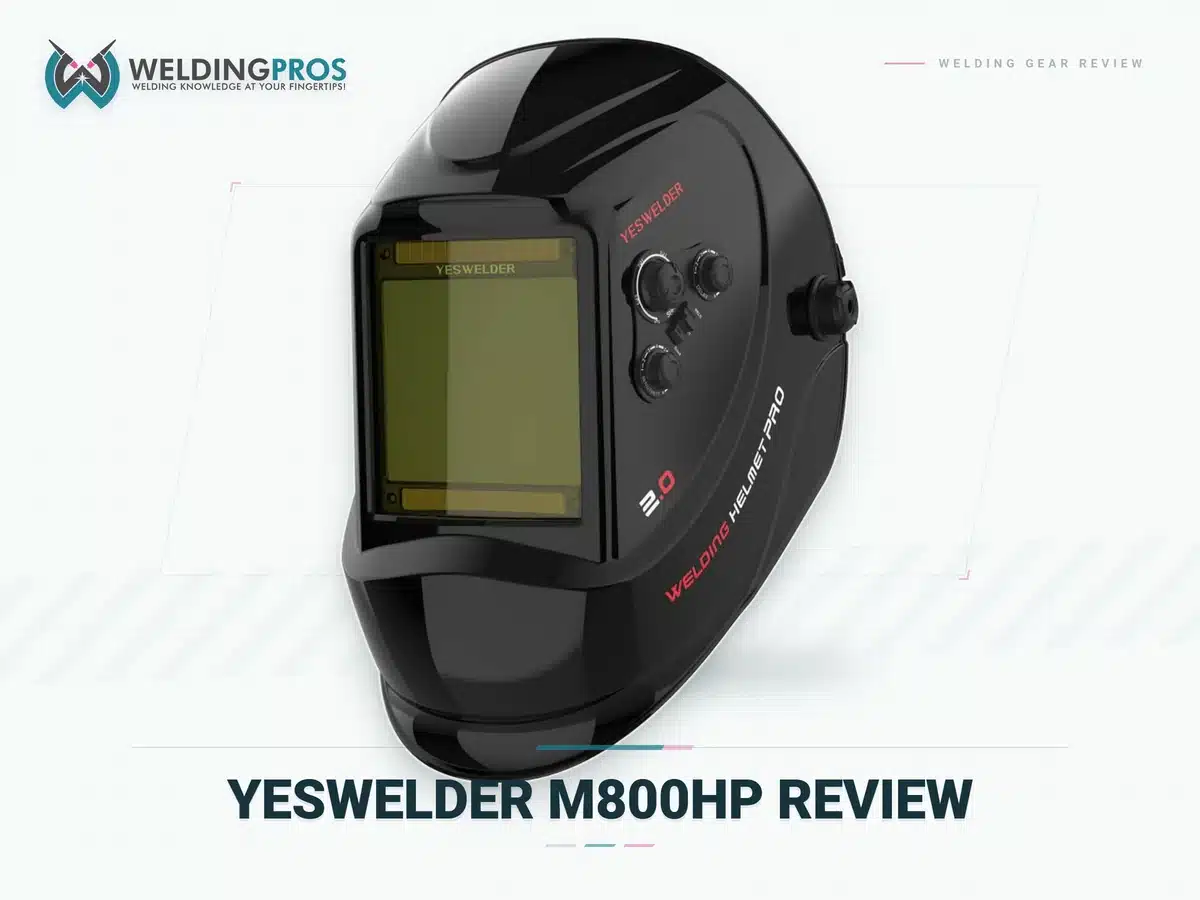
The YesWelder M800HP is a large-view, true color auto-darkening helmet that offers excellent value for the money spent. At the time of writing it sells for 82 dollars, and for that money you get a 3.93 x 3.66 inch viewing area, four arc sensors, and a true color lens with 1/1/1/1 optical clarity, which is a combination you rarely see on budget helmets.
YesWelder sells the M800HP platform, internally designated LYG M800H, in seven shell designs, from plain black to licensed graphic editions, and every one of them carries the same lens, sensors, and controls. That matters for this review: whatever the shell looks like, the welding experience is identical. We tested the classic black version, and everything below applies to all seven.
In this YesWelder M800HP review, we will discuss its value, features, and the good and the bad.
YesWelder M800HP Package Content & Technical Specifications
The YesWelder M800HP, model LYG M800H, is a true color auto-darkening welding helmet with a large viewport and fast arc detection, and the best part is that you get everything you need to start welding straight out of the box, including:
Budget-Friendly True Color Welding Helmet With Large Viewing Area

- YesWelder M800HP auto-darkening welding helmet
- 2 x Replacement lenses
- Replacement battery
- Storage bag
- Headgear (pre-installed)
- User manual
10% Discount Code: “WELDPROS”
Technical Specifications
| Product Type: | True color auto-darkening welding helmet (LYG-M800HP platform) |
| Viewing Area: | 3.93" x 3.66" (100 x 93 mm) |
| Arc Sensors: | 4 premium sensors |
| Optical Clarity: | 1/1/1/1 |
| Response Time: | <1/30,000 s (bright to dark) |
| Light State: | DIN 4 |
| Dark State: | DIN 5-9 / 9-13 (outside variable, free adjustment) |
| UV/IR Protection: | DIN 16 |
| Power Supply: | Solar cell + replaceable battery |
| Power On/Off: | Fully automatic |
| Diagnostics: | Low voltage indicator + ADF self-check |
| Shell Material: | PP (working temperature 23-131℉) |
Pros
- Excellent value for the money (82 dollars at the time of writing)
- True color view with 1/1/1/1 optical clarity, uncommon on budget helmets
- Large 3.93 x 3.66 inch viewing area with four arc sensors
- Quick setup and external controls make it good for beginners
- Two replacement lenses and a spare battery included in the box
Cons
- Headgear feels low quality compared to the lens and may wear out early
- Shade level varies slightly between the top, center, and bottom of the screen
- Red color reproduction is weak when welding
- Sensitivity and delay controls are not very precise
- Not built for professionals who weld long hours every day
For a budget helmet, the included accessories are unusually complete. Replacement cover lenses are consumables: spatter and scratches eat them, and buying them separately costs a few dollars each time. Starting with two spares plus a battery in the box means the first year of hobby use is covered without extra orders, and the storage bag protects the lens stack from garage dust and scratches between sessions.
YesWelder M800HP Performance and Features
True color view, a 3.93 x 3.66 inch viewport, four arc sensors, and optical clarity rated 1/1/1/1 are the four pillars of this helmet.
After a brief overview of the package content and technical specifications, let’s get to the central part of our review. Looking at specifications can be enough for some seasoned welders to tell if they are on the right track or if the helmet is suitable for them. However, you shouldn’t take words on paper for granted, so we will find out if things are the same in practice. Shortly said, yes, this is a good helmet, but let’s look at each aspect.
True Color Lens and Optical Clarity
The true color view is the headline feature of the M800HP. Instead of the heavy green tint you get on basic auto-darkening helmets, the lens passes colors almost naturally, so metal, puddle, and seams keep close to their real look. Optical clarity is rated 1/1/1/1, which means top marks for optical class, light diffusion, luminous transmittance, and angle dependence. At this price that rating is uncommon; many budget helmets ship 1/1/1/2 lenses, and the difference shows up as less distortion at the edges of the view. One honest limitation of this welding helmet: red reproduction is weak, so if your work depends on judging red tones, look at more expensive welding helmets.
The helmet switches from its DIN 4 light state to the dark state in under 1/30,000 of a second, fast enough that your eyes never catch the unprotected arc. Dark shade is adjustable from DIN 5 to 9 and DIN 9 to 13 through the outside variable control, so you can tune the shade for MIG, Stick, TIG, or grinding work without opening the helmet.
The four digits in 1/1/1/1 each grade a different property of the lens: optical class, light diffusion, uniformity of luminous transmittance, and angle dependence. A 1 in every column means the view stays sharp and evenly lit across the whole window, including the corners, where cheaper lenses start to warp and darken. Most helmets at this price carry a 2 in at least one of those columns.
In the light state the lens sits at DIN 4 with the true color treatment, which is bright and clear enough for setup work, grinding, and torch alignment. Because colors look close to natural in both states, your eyes do less readjusting every time the arc stops, and that shows up as less fatigue over a long afternoon of tack welds.

Viewing Area and Arc Sensors

The 3.93 x 3.66 inch viewing area is what most buyers notice first. Compared with a standard 3.62 x 1.65 inch viewport, you see roughly double the area, which helps a lot with torch placement and keeping the puddle in view when you weld out of position. YesWelder pairs the big window with four arc sensors instead of the usual two, so the helmet keeps detecting the arc even when you block a sensor with your arm or a fixture.
UV and IR protection stays at DIN 16 in both light and dark states, so your eyes are shielded whenever the helmet is on your head, lit or not. The lens itself is a stack of four premium optical lenses, and the package includes two replacement outer lenses plus a spare battery, which covers the usual wear items.
Four sensors also make the helmet friendlier for out-of-position work. When you weld overhead or along a vertical seam, your arm, the torch, or the workpiece ends up between an arc sensor and the arc. With only two sensors, that is the classic moment a cheap helmet fails to darken. With four spread across the window, at least two keep a clear line to the arc, so switching stays consistent.
A window this size also helps with instruction and post-weld inspection: you see the whole weld pool plus the surrounding seam, which beginners find far more forgiving than a narrow slit while they are still learning torch angle and travel speed. That happens to be exactly what most people bought this helmet for, and it is a good thing the window delivers on it.
The shell is polypropylene, and YesWelder rates it for working temperatures from 23 to 131 degrees Fahrenheit, with storage down to -4. That covers an unheated garage in winter and a hot shop in summer. The spare outer lenses in the box matter here too, since spatter pitting on the cover lens is the fastest way to lose the clean view this helmet is sold on.
External Controls, Battery, and Headgear
Shade, sensitivity, and delay are set from buttons on the side of the helmet, so you never need to take it off or open the shell mid-job. That matters if you weld with gloves on; the controls are large enough to operate without looking. Grind mode is included, which locks the lens at DIN 4 for cutting and grinding work.
Power comes from a solar cell supported by a replaceable battery, and the helmet turns on and off fully automatically when it senses the arc. A low voltage indicator warns you before the battery dies, and the ADF self-check function runs its own self-testing routine each time the helmet powers up, confirming the filter works. The headgear adjusts on both sides, and YesWelder ships it pre-installed in the middle position, so most users only need a small adjustment before the first weld; its ergonomic design distributes the weight evenly, and owner feedback highlights the visibility and comfortable wear during use.
One note from the manual worth repeating: adjust both headgear sides symmetrically rather than ratcheting one side only. Asymmetric adjustment is what prematurely wears the pivot points, and since the headgear is the weakest part of this helmet, it is worth doing right from day one.
Sensitivity is adjustable between low and high; testing it is simple, start low and raise it until the lens stops reacting to ambient light. Delay is variable, so you can match the lens behavior to the welding process: a short delay for tack-heavy work, a longer one for continuous beads on thicker material.
Customer feedback backs up most of this. Across about 95 reviews the helmet averages 4.8 out of 5, and the recurring themes are how light it feels on the head, how clear the screen is next to the green-tint budget helmets people upgraded from, and how comfortable the rear adjustment strap is. Most owners are happy with the purchase: plenty of them bought it to replace a basic green-tint helmet, and the reviews agree on the essentials. The most common criticism matches ours: it takes a bit of fiddling to figure out the right sensitivity and delay settings, especially if you are new to welding, and the headgear is the part most likely to break if it is mistreated.
The grind setting deserves a mention because it is useful at this price for checking your work post-weld. Flip the hood to grind and the lens locks at DIN 4, so you can walk from the bench to the angle grinder without swapping to a face shield or lifting the hood between cuts. For a hobbyist welding alone, that one switch removes a real chunk of hassle.

Frequently Asked Questions [F.A.Q]
Is the YesWelder M800HP good for beginners?
Yes. The M800HP welding helmet is one of the easiest auto-darkening models to set up. Shade, sensitivity, and delay are adjusted from three external buttons, and the helmet turns itself on and off automatically, so there is nothing to remember before your first weld. The box also ships with everything needed for the first day of welding: spare lenses, a spare battery, a storage bag, and the manual, which is great because first-time buyers usually forget the consumables. If you bought this helmet as your first auto-darkening hood, there is nothing extra to order before you start. Buyers who are new to welding consistently highlight how simple it is to use, and it fits occasional users who want an easy first hood. It is a good match for anyone who welds a few times a month, which makes it a great starting point.
Does the YesWelder M800HP have a grind mode?
Yes, the M800HP has a grind mode that locks the lens in the light state at DIN 4 for cutting and grinding work. You switch to it from the side controls without taking the helmet off. Combined with the DIN 5-13 dark shade range, this covers welding, cutting, and grinding with one helmet, a combination that usually shows up on helmets a tier or two up in price.
Is the YesWelder M800HP solar powered?
It is a hybrid. A solar cell keeps the battery topped up during use, but this welding helmet also relies on a replaceable battery as its main power reserve. The solar assistance is the reason the spare battery can sit in the box for months; day to day, the cell carries most of the load. A low voltage indicator on the lens tells you when a change is due.
What is the viewing area of the YesWelder M800HP?
The viewing area is 3.93 x 3.66 inches (100 x 93 mm), which is a large-view format, listed by YesWelder under the LYG M800H model name. For comparison, a standard budget helmet gives you about 3.62 x 1.65 inches, so the M800HP shows roughly double the screen area, with four arc sensors covering the window. That extra glass is the single biggest quality-of-life jump over a basic helmet.
Conclusion
The YesWelder M800HP is not a professional helmet, and it does not pretend to be one. What it is, is one of the strongest values on the budget end of the market: a true color 1/1/1/1 lens, a 3.93 x 3.66 inch viewport, four arc sensors, and a grind mode, all for 82 dollars at the time of writing. The buyer record supports it: 4.8 out of 5 across about 95 reviews, with the same few complaints we found in our own use, none of them deal breakers for the target user. If the plain black shell is too plain, the same LYG M800H platform comes in six graphic designs, including three limited artist collaborations, with identical optics inside. Hobbyists, beginners, and occasional welders get features here that normally cost considerably more. If you weld long hours every day or need precise, fine-step shade control, a higher-end helmet will serve you better. For everyone else, this hood is easy to recommend, and as a first welding helmet in particular there is little here you will outgrow quickly. For alternatives, see our roundup of the best welding helmets.
Subscribe: Get FREE 30 page PDF Welding Symbols Chart With Applied Examples for Each Symbol!
In the past year, we have written a number of reviews on welders and plasma cutters from YesWelder. If you are still interested in this brand and wish to read them, you can find links to the rest of them here.
- Arc 165DS Welder review.
- Firstess CT2050 Welder/Cutter Review (has built in air compressor).
- YWA 160 Lift TIG Welder Review.
- Cut 65DS Plasma Cutter Review.
- YWM 200 Multi Process Welder Review.
- YWM 211p TIG Welder Review.
- 225p TIG Welder Review.
- MP200 Multiprocess welder Review.
- 205a Stick Welder Review.
- CUT 55DS Plasma Cutter Review.
- TIG 205DS Welder Review.
- 250p AC/DC TIG Welder
- Pro 250 MIG Aluminum Welder.
- 205ds MIG Welder Review.






