
Few names in welding carry the weight Hobart does. The Handler 140 sits near the small end of their MIG lineup, and it has kept a loyal following among homeowners, farmers and part-time fabricators for well over a decade. That reputation shows up in almost every Hobart Handler 140 review you will read, ours included.
The machine is built in the United States, simple to operate, and sturdy enough for a working shop rather than a showroom. As the second smallest MIG unit in the Hobart range, it lands in a sweet spot for DIY work: enough power for real jobs, compact enough to live in a garage.
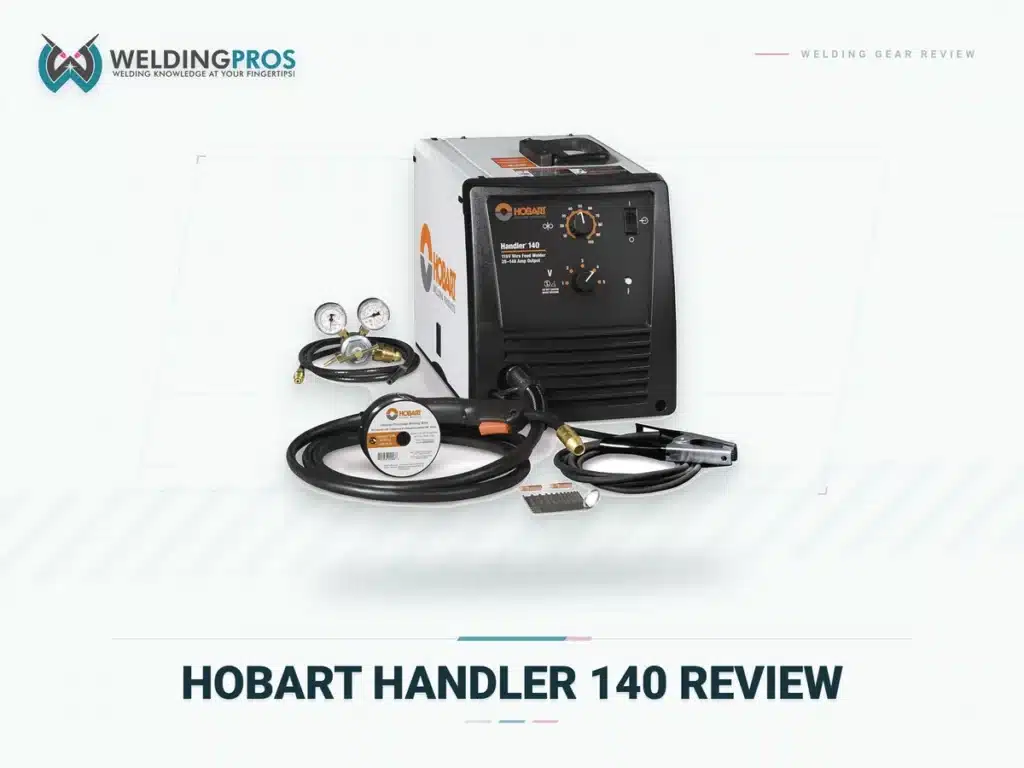
It runs on a standard 115V household outlet and weighs 57 pounds, so moving it between the garage, the barn and a friend’s shop stays a one-person job. See where it lands in our best beginner welders guide.
In this Hobart Handler 140 review we cover what arrives in the box, how the machine performs on real jobs, and where it falls short.
Hobart Handler 140 Review: Package Content & Technical Specifications
The Handler 140 arrives ready to weld flux-cored right out of the carton, and with a gas bottle and a spool of solid wire it becomes a full MIG setup. In the box you get the welder, a 10 ft MIG gun, a work cable with ground clamp, the dual-gauge gas regulator and hose, a sample spool of .030 flux-cored wire, spare contact tips and the manual.
American-Made 115V MIG and Flux-Core Welder for Home, Farm and Light Fabrication

- Hobart Handler 140 MIG welder
- 10 ft MIG gun with liner
- 10 ft work cable with ground clamp
- Dual-gauge gas regulator with hose
- 0.030 in flux-cored drive roll (installed)
- Spare 0.030 in contact tips
- User manual
Technical Specifications
| Welding Process: | MIG (GMAW) / Flux-Core (FCAW) |
| Input Voltage: | 115V AC (standard household outlet) |
| Output Range: | 25–140 A |
| Rated Duty Cycle: | 20% @ 90 A |
| Wire Feed Speed: | 40–700 IPM |
| Material Thickness: | 24 gauge – 1/4 in mild steel |
| Voltage Controls: | 5-position tap selector |
| Wire Sizes: | 0.024 – 0.035 in |
| Drive System: | Cast aluminum drive with Quick Select 3-groove roll |
| Leads: | 10 ft MIG gun / 10 ft work cable with clamp |
| Machine Weight: | 57 lbs |
| Warranty: | Hobart 5/3/1 industrial |
Pros
- Welds 24 gauge to 1/4 in. mild steel
- Runs on any standard 115V household outlet
- Industrial cast aluminum wire drive
- 5/3/1 industrial warranty from Hobart
- Uses standard consumables stocked everywhere
Cons
- 20% duty cycle at 90 A limits long welds
- Fixed voltage taps instead of infinite control
- Aluminum welding needs an optional spool gun
- MIG and flux-core only, no stick or TIG
- 57 lb transformer body is no one-bag carry
How the Handler 140 Performs in Real Work
The short answer of this Hobart Handler 140 review: yes. It is a versatile Hobart welder, easy to run as a first MIG welder, built solid, with a dependable arc and enough portability for small to moderate jobs around the home, shop, or farm. No machine is perfect, but after years on the market the Handler 140 still has far more going for it than against it, especially for beginners and hobby welders who want a reliable machine at a fair price for regular repair and fabrication work.
The work it handles includes auto body repairs, sheet metal work, home improvement projects, work on cars, trailers, machinery repairs, and general shop jobs. It is not a fragile hobby machine either. This one takes a beating, finishes the job, and is ready again the next morning, with support for both flux-cored and solid MIG welding adding to its everyday usefulness. It also lets many first-time buyers start welding without buying a lot of extra stuff up front.
Spec sheets only tell half the story. The sections below cover the core specs worth checking before buying, including power requirements, warranty, and operating cost, then the parts that actually decide whether this welder earns its shelf space: the wire drive, the arc, duty cycle, portability, and aluminum work, then the common questions and our final verdict. It runs on a 115-volt outlet and is easy to operate for home users.
Build Quality and Wire Drive
Open the side door and the first thing you meet is an industrial cast aluminum wire drive with all-metal construction, not the plastic feed housing you find on entry-level machines. The Quick Select drive system uses a three-groove drive roll for solid and flux-cored wire, and it allows tool-free roller changes when moving between .024, .030 and .035 stock. A sturdy metal frame and panels, plus the included dual-gauge gas regulator, show it comes well equipped.

The gun also stays electrically cold until you pull the trigger, thanks to a built-in contactor. That sounds like a footnote until you routinely set the torch down between tacks. If you are still building your technique, our guide on how to MIG weld pairs well with this machine.
Arc Quality and Duty Cycle
Output spans 25 to 140 amps across five voltage taps, with infinite wire feed speed on top, and it can weld steel up to 1/4 inch thick at its maximum output; open-circuit voltage is 28 VDC. On solid wire and 75/25 argon-CO2 the arc stays smooth from 24-gauge sheet up to 1/4-inch plate in a single pass, though it performs best on thin-to-medium thicknesses and may need a more careful setup to avoid spatter on very thin work. Switch to flux-cored wire and you gain the penetration for flux core welding outdoors without shielding gas, which is where farm repairs actually happen.
It will run on a 15-amp circuit with reduced output, but a dedicated 20-amp circuit is the better power setup for maximum performance, and it is best not to use an extension cord if you can avoid it.
The rated duty cycles are 20% at 90 amps, which means two minutes of arc-on for every ten minutes at that output. As output power rises, that limit drops, so extended heavy use will require cooling breaks to prevent overheating. For hobby and farm pacing that is plenty; a production table would be better served by the Handler 190 or larger. Miller’s welding knowledge hub has a clear explanation of how duty cycle ratings are measured if you want the full method. Many competing models offer higher duty cycles, which matters more for industrial use than hobby work.
Portability and Aluminum Work
At 57 pounds the Handler 140 is light for a transformer machine, and the carry handle makes it a genuine one-hand load to the driveway or a friend’s shop. It runs on any 115V circuit, so generators and household outlets stop being a planning problem, and the gun and work cables are still easy enough to manage for short moves.
Aluminum is on the menu too, but only in a narrow band of thin stock, provided you add a spool gun and feed .030 ER4043 or ER5356 wire under pure argon; it is not spool gun ready out of the box. We walk through the complete setup in our article on MIG welding aluminum.

Without the spool gun, skip aluminum on this machine, and if you need broad aluminum coverage across different thicknesses, this is not the machine for it.
Frequently Asked Questions [F.A.Q]
Is the Hobart Handler 140 good for beginners?
Yes. It plugs into a standard 115V outlet, so beginners can start welding quickly with flux core welding, and the five voltage taps allow fine setup. The control panel stays simple with only two knobs and a switch, and a weld set-up chart inside the side door helps with settings. That combination is why it holds a spot on our best beginner welders list. One practical tip: use a dedicated 20-amp circuit for the best results.
Can the Handler 140 weld aluminum?
It can, for thin aluminum stock, with two additions: a Hobart SpoolMate spool gun and .030 aluminum wire under 100% argon. Pushing soft aluminum wire through the ten-foot MIG gun liner without a spool gun ends in bird-nesting, and because the Handler 140 is not spool gun ready from the factory, that extra hardware matters; thicker aluminum takes multiple passes and stays limited next to larger machines.
What is the duty cycle on the Handler 140?
The machine is rated at 20% duty cycle at 90 amps, so two minutes of arc-on per ten-minute window at rated output. As output rises the thermal light guards against overheating, and thick material eats into that window fast because it needs multiple passes. At lower settings you can weld much longer before it needs to cool.
What wire does the Hobart Handler 140 use?
Solid ER70S-6 from .024 to .035 inch with 75/25 gas, or .030 to .035 flux-cored wire with no gas at all, and on 115V power this machine is especially well suited to thin materials. The Quick Select drive roll covers all three sizes without tools. MIG welding with gas uses the included dual-gauge regulator setup for cleaner welds, while flux-cored wire helps keep cost down because no bottle is needed. The drive system and control boards are covered for three years, while the MIG gun and relays are covered for one year.
Conclusion
The Hobart Handler 140 is a versatile, easy-to-use machine built like a workhorse and priced like a compromise that is not one. Hobart backs it with a 5/3/1 warranty: five years on the power source, three years on the drive system and control boards, and one year on the MIG gun and relays. It suits small and moderate projects and still holds its own on the occasional bigger job. If your work outgrows it, Hobart’s larger Handlers are a natural step up. If you are starting out, welding mostly at home, or you want a dependable backup unit, the Handler 140 is probably exactly what you need, especially for the value, warranty, and all-metal drive system.






