
If you’re looking for an entry-level welder, then an excellent choice is a 120V model. For 110V alternatives, check our best 110V welders roundup.
That’s because they’re built to get the job done for a reasonable price. However, how do you choose whether to get a MIG welder, a TIG welder, a stick welder, or a combination of all 3?
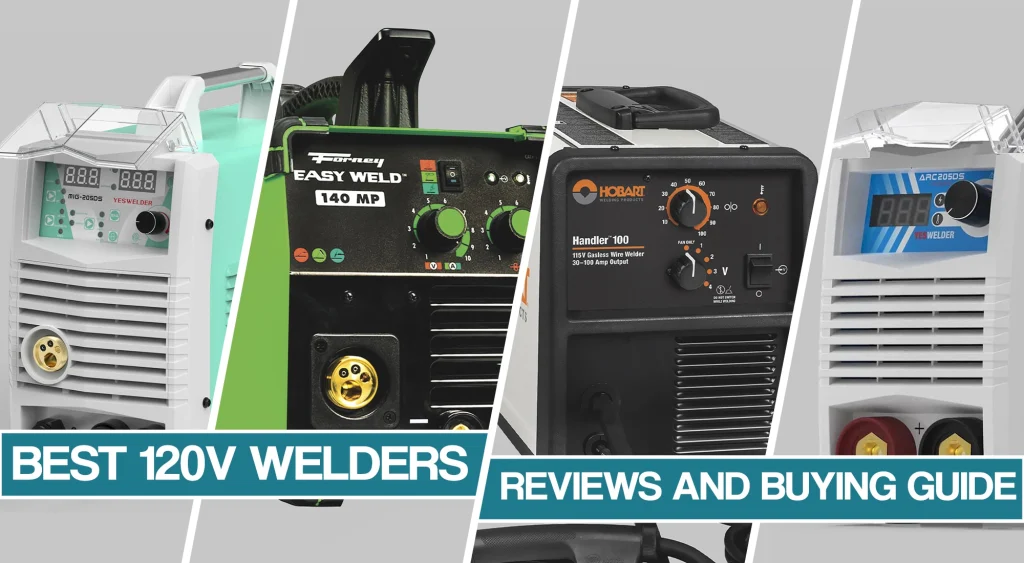
Our guide to the best 120V welders looks not only at the best welders on the market but also at the uses of each type of welder, so you can make an informed decision about which welder is best for your needs.
120V Welder Comparison Table
| Image | Name | Voltage | Current | Amperage | Duty Cycle | Process | Check Price |
|---|---|---|---|---|---|---|---|
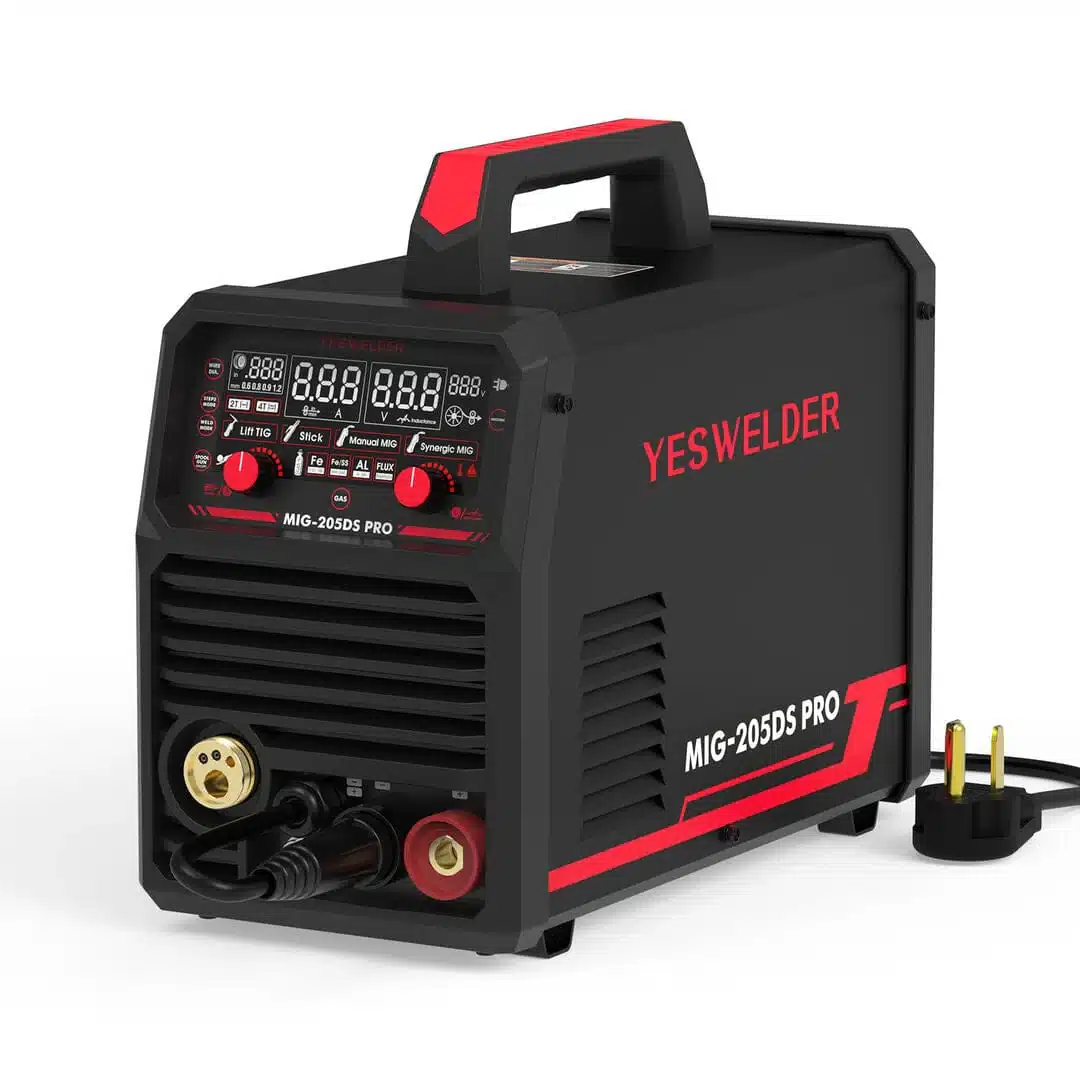 | YesWelder MIG-205DS Multi-Process WelderGet 10% Off With Coupon: -10% WELDPROS | 110/220V | DC | 40-205A | 60% @ 205A | MIG/TIG/Stick Flux Core | Check Price |

| AHP AlphaTIG 203Xi AC/DC TIG/Stick Welder with Pulse | 110/220V | AC/DC | 10-200A | 60% @ 200A | TIG/Stick | Check Price |

| Hobart 140EZ MIG Welder | 120V | DC | 30-140A | 20% @ 90A | MIG/Flux Core | Check Price |
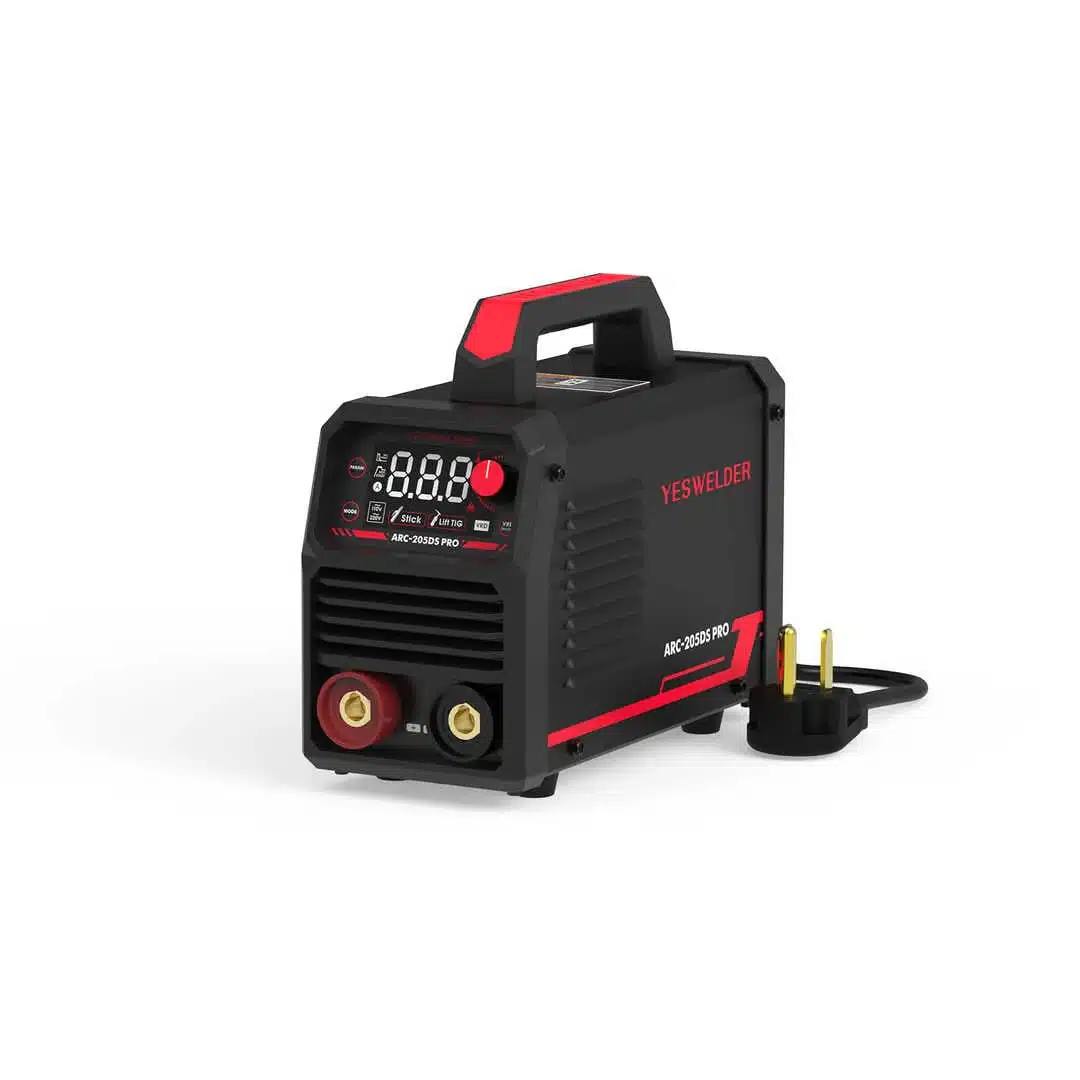 | YesWelder ARC-205DS-PRO Stick/Lift TIG WelderGet 10% Off With Coupon: -10% WELDPROS | 110/220V | DC | 20-205A | 60% @ 155A | Stick/Lift TIG | Check Price |
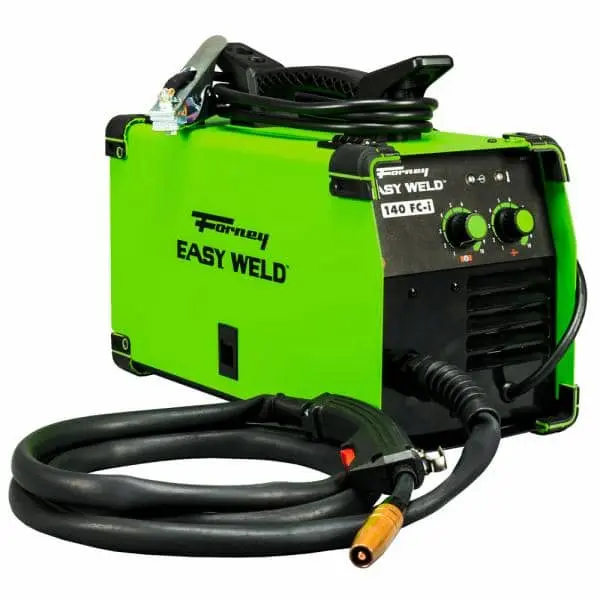 | Forney Easy Weld 140 MP Multi-Process Welder | 120V | DC | 30-140A | 30% @ 90A | MIG/TIG/Stick | Check Price |
Best 120V Welder Reviews
1. YesWelder MIG-205DS Multi-Process Welder – Best Value Multi-Process Welder
Best Value Multi-Process Welder
YesWelder MIG-205DS Multi-Process Welder
The YesWelder MIG-205DS is a 4-in-1 machine that does MIG, flux core, stick, and lift TIG on both 120V and 220V power. At its price point, you’re getting a full metal wire drive system instead of the plastic feeders that show up on budget machines. That matters because the wire feed is what determines whether your bead looks like a weld or a bird crapped on your workpiece.
| Process: | MIG / Flux Core / Stick / Lift TIG | Amperage: | 120V: 30-160A / 220V: 30-200A |
| Input Voltage: | 120V / 220V Dual Voltage | Duty Cycle: | 60% @ 160A (MIG, 120V) |
| Materials: | Steel, Stainless Steel | Weight: | 33 lbs |
| Wire Feed: | Up to 590 IPM | Wire Roll: | Up to 8-inch diameter |
| Warranty: | 1 Year | Price: | Check YesWelder |
On 120V power the MIG-205DS pulls 30-160 amps, and on 220V it stretches to 200 amps. The duty cycle holds up at 60% across all processes — MIG at 160A on 120V and 200A on 220V, TIG at 140A/180A, stick at 140A/180A. For a dual-voltage machine under $500, those numbers are hard to beat. I’ve run 7018 rods up to 5/32-inch on 120V without tripping a breaker or fighting the arc.
The lift TIG function is scratch-start only — no high-frequency start here — so don’t expect to weld aluminum or thin stainless with it. It’s there for steel TIG in a pinch, and it works, but it’s not the reason you buy this machine. You buy it for MIG and stick. The MIG side handles solid wire with gas and flux core without, and the wire feed speed tops out at 590 IPM which is fast enough for production work on thin material.
What you get in the box is reasonable: the power unit, a MIG torch, ground clamp, stick electrode holder, gas hose, and a basic starter kit. The manual is actually detailed — uncommon at this price — and walks you through setup step by step. You’ll need to buy your own gas cylinder and welding helmet, but that’s standard.
Build quality is solid for the money. The metal wire drive system is the standout — most competitors at this price use plastic. The machine weighs 33 pounds so it’s portable enough to throw in a truck but heavy enough that it doesn’t feel like a toy. YesWelder’s warranty is one year, which is shorter than the 3-5 years you get from Miller or Lincoln, but those machines also cost three times as much.
If you’re a hobbyist who wants one machine that covers MIG, flux core, stick, and occasional TIG without spending more than your first car, the MIG-205DS is the obvious pick. If you’re a pro doing 8-hour days of MIG on 3/8-inch plate, get a dedicated 220V machine. This one sits right in the sweet spot for home shops, farm repair, and light fab work.
Pros
- Full metal wire drive system instead of plastic — rare at this price
- Dual voltage (120V/220V) with solid amperage range: 30-200A
- 60% duty cycle across MIG, TIG, and stick — not derated on 120V
- Handles 6010 to 7018 electrodes up to 5/32-inch on 120V
- MIG wire feed speed hits 590 IPM — fast enough for production thin-gauge work
- 33 pounds — portable but doesn’t feel flimsy
- Detailed instruction manual — better than most budget machines
- 4-in-1 versatility at a sub-$500 price point
Cons
- TIG is lift-start only — no HF start, no aluminum TIG
- One-year warranty is short compared to Miller/Lincoln/Hobart
- TIG torch not included in the box
2. AHP AlphaTIG 203Xi AC/DC TIG/Stick Welder with Pulse – Best TIG Welder for the Money
Best TIG Welder for the Money
AHP AlphaTIG 203Xi AC/DC TIG/Stick Welder with Pulse
The AHP AlphaTIG 203Xi is a 200-amp AC/DC TIG and stick welder that packs features you’d expect on a $2,000 machine into a $670 price tag. The big LCD color display isn’t a gimmick — it shows your waveform, lets you dial in pulse settings visually, and the Rapid Set feature calculates starting amperage based on material type and thickness. For anyone who’s tired of consulting a cheat sheet every time they switch from aluminum to stainless, this alone is worth the money.
| Process: | AC/DC TIG, Stick | Amperage: | 10-200A |
| Input Voltage: | 120V / 220V Dual Voltage | Duty Cycle: | 200A @ 60% |
| Materials: | Steel, Stainless, Aluminum | Weight: | 69 lbs |
| AC Frequency: | 20-200Hz | Pulse: | AC & DC, adjustable |
| Warranty: | 3 Years | Price: | Check Amazon |
On the AC side you get full frequency and balance control — 20-200Hz frequency to tighten or widen the arc cone, and 10-90% balance to control cleaning action versus penetration. The pulse function works in both AC and DC with adjustable peak current, background current, and frequency. If you’re welding thin aluminum (anything under 1/8-inch) the pulse keeps the puddle controllable instead of blowing through. If you’re doing stainless sheet metal, the high-speed pulse tightens the bead and reduces heat input.
The HV Start system is solid-state electronic ignition — no point gap to adjust, no high-frequency interference that messes with electronics nearby. When paired with the NOVA 2.0 torch (ultra-flex cable, decent consumables out of the box), arc starts are clean and consistent. The foot pedal gives you real-time amperage control, and the 2T/4T sequencer function handles pre-flow, start amps, up-slope, welding amps, down-slope, and post-flow with or without the pedal — useful for pipe welding or positions where a pedal isn’t practical.
At 69 pounds this is not a portable machine. It lives on a cart or a bench and stays there. The duty cycle is 200A at 60% which is more than enough for the kind of work this machine is built for — automotive fabrication, motorcycle frames, aluminum boat repair, stainless kitchen equipment, art and sculpture. On 120V the output is limited (you’ll get roughly 120-130A max), so for full-power aluminum work you need a 220V outlet.
Compared to a Miller Dynasty or Lincoln Aspect, the 203Xi gives you about 80% of the features at one-third the price. The arc isn’t quite as buttery-smooth as a Dynasty, and the pulse isn’t as sophisticated, but for a home shop or small fabrication business the difference is academic. The three-year warranty from AHP is solid — longer than what you get from most import brands and on par with domestic manufacturers.
If you want to learn TIG on a machine you won’t outgrow in six months, or you need AC/DC capability for aluminum without spending Miller money, the 203Xi makes the strongest case in its price bracket. The LCD interface and Rapid Set take the guesswork out of setup, and the pulse features give you real control over heat input. At $670 it’s not cheap, but it’s also not expensive for what it does.
Pros
- LCD display with Rapid Set auto-amperage — dial in material and thickness, it calculates settings
- Full AC frequency (20-200Hz) and balance control (10-90%) for aluminum
- Pulse in both AC and DC with adjustable peak/background/frequency
- HV Start — solid-state electronic ignition, no point gap maintenance
- Foot pedal included plus 2T/4T sequencer for remote switch operation
- 200A output at 60% duty cycle — enough for most fab shop work
- Dual voltage 120V/220V operation
- Three-year warranty — competitive with domestic brands
Cons
- 69 pounds — this is a shop machine, not a portable unit
- 120V output limited to ~130A — need 220V for full-power aluminum
- Not as refined as a Miller Dynasty at triple the price (but you’d only notice if you weld 40 hours a week)
3. Hobart 140EZ MIG Welder – Easiest to Use 120V MIG Welder
Easiest to Use 120V MIG Welder
Hobart 140EZ MIG Welder
The Hobart 140EZ replaces the long-running Handler 140 with one meaningful upgrade: EZ Mode. Instead of fiddling with voltage taps and wire speed knobs until the bead looks right, you set two dials — material thickness and wire diameter — and the machine figures out the rest. Infinite voltage control means you can fine-tune the arc if you want, but for 90% of the work this machine is built for, the auto-set gets it right on the first try.
| Process: | MIG, Flux Core | Amperage: | 25-140A |
| Input Voltage: | 120V Only | Duty Cycle: | 90A @ 20% |
| Materials: | Steel, Stainless, Aluminum (spool gun) | Weight: | 57 lbs |
| Wire Feed: | 40-700 IPM | Thickness: | 24 ga. – 1/4 inch |
| Warranty: | 5/3/1 Years | Price: | Check Amazon |
Output runs 25-140 amps on standard 120V household power. On a 20-amp breaker you’ll pull full output without tripping. Material capacity tops out at 1/4-inch mild steel in a single pass, but realistically anything over 3/16-inch needs beveling or multiple passes. For auto body panels, furniture tubing, gates, and general home shop work, the 140EZ is sized correctly. It’s not a structural fabrication machine and doesn’t pretend to be.
Setup takes about 10 minutes out of the box: attach the gas hose, load the wire, plug it in, and go. The wire feeder is smooth and consistent — typical Hobart — which translates directly to less spatter and fewer burn-throughs on thin material. Out of the box you get the power cord, work clamp, regulator with gas hose, a spool of flux-cored wire, contact tips, and a material thickness gauge. You supply the MIG gas cylinder, helmet, and gloves.
At 57 pounds with a carry handle, the 140EZ is portable enough to move between the garage and the driveway. Build quality is what you’d expect from Hobart — the case is steel, the wire drive is metal, and the transformer has some heft to it. This is not a lightweight inverter machine. The trade-off is reliability: transformers don’t fail like inverter boards do, and Hobart’s 5/3/1 warranty (five years on the transformer, three on electronics, one on the gun) reflects that confidence.
The 140EZ is DC only and 120V only — no dual voltage, no stick function, no TIG capability. It’s a MIG welder, period. If you need multi-process, look at the Forney or YesWelder options. If you want the simplest path from unboxing to laying down decent beads on mild steel, the 140EZ does exactly that with minimal frustration. The EZ Mode eliminates the learning curve that scares beginners away from welding.
Flux-core performance is solid — the machine ships with a spool of Hobart’s own wire, which runs cleaner than most generic flux-core. With gas and solid wire, the arc is smooth and the bead profile is consistent. Spatter is minimal for a 120V machine. If you’re a beginner who wants to weld instead of spending weekends reading forums about settings, or a home mechanic who needs a reliable MIG welder that just works every time you plug it in, the 140EZ earns its spot at the top of the 120V MIG category.
Pros
- EZ Mode takes the guesswork out of settings — set thickness and wire size, start welding
- Infinite voltage control lets experienced users fine-tune beyond auto-set
- Metal wire drive and steel case — built like a transformer machine should be
- Smooth wire feeder produces consistent beads with minimal spatter
- 5/3/1 Hobart warranty with excellent US-based support
- Runs full 140A output on a standard 20-amp household circuit
- 10-minute setup from unboxing to welding — ideal for beginners
- Flux-core and MIG capable out of the box, gas regulator included
Cons
- 120V only — no dual voltage, limits material thickness to 1/4-inch
- 57 pounds — heavier than inverter-based competitors
- MIG only — no stick or TIG functionality
4. YesWelder ARC-205DS-PRO Stick/Lift TIG Welder – Best Budget Stick Welder
Best Budget Stick Welder
YesWelder ARC-205DS-PRO Stick/Lift TIG Welder
The ARC-205DS-PRO is YesWelder’s digital-display stick and lift TIG welder, and at 11 pounds it’s the lightest machine on this list by a wide margin. Dual voltage (120V/220V) with a simple switch on the back — no rewiring, no adapters. On 220V it pushes 205 amps at a 60% duty cycle, which is enough to run 5/32-inch 7018 rods all day without overheating. On 120V you’re capped at roughly 125 amps, which covers most home and farm stick work with rods up to 1/8-inch.
| Process: | Stick, Lift TIG | Amperage: | 20-205A |
| Input Voltage: | 120V / 220V Dual Voltage | Duty Cycle: | 205A @ 60% |
| Materials: | Steel, Stainless | Weight: | 11 lbs |
| Hot Start: | Adjustable | Arc Force: | Adjustable |
| Warranty: | 1 Year | Price: | Check YesWelder |
The digital display is the real upgrade over the non-PRO version. You see your actual amperage setting in real time instead of squinting at a dial with painted-on numbers that wear off after six months. The arc force and hot start settings are adjustable — crank up the hot start for 6010 rods that need a kick to get going, or dial it back for 7018 where you want a softer start. Arc force controls how aggressively the machine pushes amperage when the arc length shortens, which is useful for vertical and overhead positions.
The lift TIG function works with a scratch start. It’s not HF start and it won’t weld aluminum, but for steel TIG on brackets, exhaust pipes, and thin-gauge fabrication, it does the job. The TIG torch isn’t included in the box, which is worth knowing upfront — budget another $50-80 for a basic air-cooled torch. The stick side is where this machine earns its keep, with smooth arc characteristics across 6010, 6011, 6013, and 7018 electrodes.
For the price — often under $200 — the ARC-205DS-PRO punches well above its weight class. The included accessories are functional: a ground clamp with decent jaw width, an electrode holder that doesn’t feel like it’ll fall apart in a week, and a basic brush/hammer for slag. No welding helmet in the box, but at this price you shouldn’t expect one. The carry strap is a nice touch for a machine you can literally sling over your shoulder.
Durability on the PRO version is better than the base model. The case is reinforced where the original had flex, and the knobs feel more secure. It’s still an import machine with a one-year warranty, so set expectations accordingly — this is a $200 welder, not a $2,000 Lincoln. But for hobbyists, farmers who need a lightweight stick welder for fence repair, and beginners learning stick on a budget, the value proposition is hard to argue with.
If you need a machine that fits in a backpack and welds on both 120V and 220V, this is it. The digital display and adjustable arc characteristics set it apart from the sea of anonymous stick welders in the sub-$300 range. Pair it with a good auto-darkening helmet and a box of 7018 rods, and you’ve got a capable setup for less than the cost of a single Miller repair bill.
Pros
- Digital amperage display — no guessing settings like on analog-dial stick welders
- 11 pounds — lighter than most welding helmets, fits in a backpack
- Dual voltage 120V/220V with simple rear switch, no rewiring
- 205 amps at 60% duty cycle on 220V — runs 5/32-inch rods continuously
- Adjustable hot start and arc force — tune for 6010 vs 7018 rods
- Lift TIG capability for basic steel TIG work without buying a separate machine
- Under $200 — cheapest digital-display dual-voltage stick welder in its class
- Reinforced case and better knob feel vs the non-PRO version
Cons
- TIG torch not included — budget another $50-80 for a basic air-cooled torch
- One-year warranty — shorter than established brands
- Lift-start TIG only — no HF start, no aluminum capability
5. Forney Easy Weld 140 MP Multi-Process Welder – Best Beginner Multi-Process Welder
Best Beginner Multi-Process Welder
Forney Easy Weld 140 MP Multi-Process Welder
The Forney Easy Weld 140 MP covers MIG, flux core, stick, and DC TIG on standard 120V power, making it the most accessible multi-process option for beginners. At 24.8 pounds it’s manageable for a home shop, and the interface keeps things simple: a process selector dial, voltage knob, and wire speed control. If you can operate a kitchen stove, you can set up this welder.
| Process: | MIG / Flux Core / Stick / DC TIG | Amperage: | 10-140A |
| Input Voltage: | 120V Only | Duty Cycle: | 30% @ 90A (MIG) |
| Materials: | Mild Steel | Weight: | 24.8 lbs |
| Wire Feed: | 79-197 IPM | Thickness: | 24 ga. – 1/4 inch |
| Warranty: | Limited Warranty | Price: | Check Amazon |
Performance on MIG and flux core is where the 140 MP shines. The wire loads easily through a hinged door on the side, and the drive system feeds smoothly without bird-nesting. Amperage ranges from 10-140 amps, and the wire feed adjusts from 79-197 IPM — not blazing fast, but enough for sheet metal, auto body work, and light fabrication up to 1/4-inch mild steel with flux core. Spatter is higher than I’d like, especially with the included flux-core wire, but switching to a better brand of wire helps.
The stick function handles 6011 and 6013 rods up to 1/8-inch without complaint. 7018 rods work but need a bit more finesse on 120V — the arc isn’t as stable as a dedicated stick machine at the low end. The DC TIG function is scratch-start only, and the TIG torch is not included. You’ll need to buy a torch, regulator, and argon cylinder separately. This puts the real cost of TIG capability closer to $450-500 after accessories, which is worth knowing before you click buy.
The build quality is Forney’s usual: not premium, but not disposable either. The case is stamped steel with a plastic front panel, the knobs have positive detents, and the ground clamp and electrode holder are basic but functional. The MIG gun is a live-tip design which means the wire is always hot — worth remembering if you’re used to a trigger-activated contactor on more expensive machines. It’s a safety consideration, not a dealbreaker.
Duty cycle is the biggest limitation: 30% at 90 amps on MIG. That translates to about 3 minutes of continuous welding followed by 7 minutes of cooling. For tack welding and short beads on thin material, it’s fine. For running long beads on 1/4-inch plate, you’ll trip the thermal overload regularly. This is a hobbyist and light repair machine, not a production tool.
For the price — typically $350-400 — the Easy Weld 140 MP gives you four processes in one box with a brand that has been around since the 1930s. The warranty and support network are established. If you’re learning to weld and want to try MIG, flux core, and stick without buying three separate machines, this is the safest bet. Just know the limits: it’s a 120V beginner machine with a low duty cycle, and the TIG function is more of a checkbox than a real feature.
Pros
- Four processes in one box — MIG, flux core, stick, and DC TIG — all on 120V
- Simple three-knob interface: process selector, voltage, wire speed
- Wire loads easily through hinged side door, smooth feed without bird-nesting
- Forney brand established 1930s — customer support and warranty you can count on
- 24.8 pounds — portable enough to move between garage projects
- Handles 6011, 6013, and 7018 rods up to 1/8-inch
- Infinite wire feed speed adjustment for fine-tuning on thin materials
- Sub-$400 entry point for multi-process capability
Cons
- 30% duty cycle at 90A — 3 minutes welding, 7 minutes cooling
- TIG torch not included — adds $50-80 plus gas cylinder cost
- Live-tip MIG gun (wire always hot) — safety consideration for beginners
120V Welder Buying Guide
Before you can buy a welding machine, you really need to establish what kind of welding process you will need for the materials you want to work with. Let’s take a look:
Gas Metal Arc Welding or MIG on 120V
With MIG welders, you feed the welding wire (electrode) through the welding gun, and it exits at the contact tip. The protective gas that flows through the welding gun protects the molten pool and the welding arc (usually Argon or carbon dioxide) from contaminants in the air like O2.
The wire is then melted and acts as an adhesive between two metal pieces. It’s a very fast way to weld.
MIG machine is best used for welding aluminum (with spool gun or aluminum wire feeder) and mild steel, sometimes stainless steel. It’s much faster than stick or TIG welding. It’s also kinder to your lungs because it doesn’t produce much smoke (when you don’t use it). You can weld light-gauge materials and thin metal sheets like on auto body or fences without too many issues on 120V, but with thicker materials, you will need to run multiple passes or get a stronger welder
Tungsten Arc Welding or TIG
In TIG welding, an electric arc and a tungsten electrode are used. This electrode won’t be consumed during the welding process, and it is shielded by helium or another inert gas. It’s harder to learn than other forms of welding because you have to use both arms to operate TIG welders.
However, TIG welding tends to produce the highest-quality welds, and if you need to weld aluminum, stainless steel, nickel alloy, chrome alloy, magnesium, or gold and want the best results, it’s your best option.

Usually, TIG welding on 120V household current is basic DC welding with scratch start (there are exceptions), but GTAW on 120V is usually used for basic stuff or for learning on a cheap machine.
Shielded metal arc or stick welding
Stick welding uses a hard flux instead of an external shielding gas supply.
SMAW consumes the electrode and the flux as it goes.
Throughout the process of metal arc welding, the heat from the welding arc melts the electrode flux and forms a gas bubble that protects the welding pool and arc from contamination.
It tends to form a large amount of “slag,” though, which must be removed once the work is done; simple stick welders are extremely cheap.

You can work on any material with manual metal arc welding from mild steel to titanium (aluminum, copper, cast iron, everything) note that: You will not do titanium on a 120v welder I was just saying.
You can work in any position and under any conditions except in rain. The downside is that it’s a slow welding process, somewhat hard to learn, and hardest to master.
Multi-process Welder
If you want the functionality of more than one welding machine, the easiest way is to purchase a machine that offers multiple capabilities.
It’s possible to get 3-in-1 machines that let you do everything in your workshop at a lower cost. But these machines are often geared more at the hobbyist end of the market, and you may opt for separate devices if you are doing heavy-duty work of a specific kind.
Welder Power And Welding Thickness
You need to be clear about the thickness of the metals you will work with before you invest in a welder machine. If you’re not certain about this, then the best rule of thumb is
Pick a welder with a high amperage output. You should also ensure it has an adjustable range, or you’ll be stuck with a welder that only does one job well.

You should also pay attention to performance at low amperage, as this will determine your ability to work with the thinnest materials. Low amperage can cause impairments during the arc strike, which can damage weld quality.
Duty Cycle
A duty cycle is 10 minutes long, and the percentage given tells you how many minutes out of 10 it will run before the welder must be left to cool down before it can be used again. So, for example, a 70% duty cycle means 7 minutes of use, 3 minutes of rest every 10 minutes. Easy, right?
Price, Quality, And Warranty
This pretty much boils down to common sense: you don’t want to spend far more than you need to on a machine if you only have occasional requirements for it. But you also shouldn’t buy a welder that costs next to nothing and then breaks the first time you use it.
Balance price and quality around your own requirements and look at your welder as an investment but not as the best way to spend every penny you own.
You should always make sure that it comes with a half-decent warranty too. A 1-year warranty for cheaper machines but the more you spend, the more warranty you should demand.
Weight And Portability
This should be fairly obvious. If you want a high level of portability from your welder then you want to make sure it’s light enough to move around. You may need to buy a welding cart if it’s too heavy. The lighter the welder, the easier it is to move around when you work.
Frequently Asked Questions (F.A.Q)
Are 120 Volt Welders Any Good?
Yes, if you are just intending to tackle some basic welding projects that don’t require high skill, high speeds, or very heavy gauge materials – then they are a super choice. You can get most welding tasks done with most types of metal at 120V without a problem.
What Size Breaker Do I Need For A 120V Welder?
If you need one for a 120 V welder then we’d recommend a minimum of 30 amps of protection. You might want to go a little lower if you’re not 100% confident in your supply. The higher the voltage of the welder, the more amps the breaker requires.
Conclusion
All of these 120v welding machines are excellent. The best 120-volt welder for most people from our list is probably the Forney Easy Weld which offers a lot of functionality for a very reasonable price.
If you want a specialist TIG welder then you ought to give the AHP AlphaTIG a spin as it’s an exception machine for its price bracket.
If, however, you’re prepared to go with a less well-known brand then the YesWelder MIG-205DS Multi-Process welder is quite probably going to give you the best value for money of all the 120V welder options here.






