
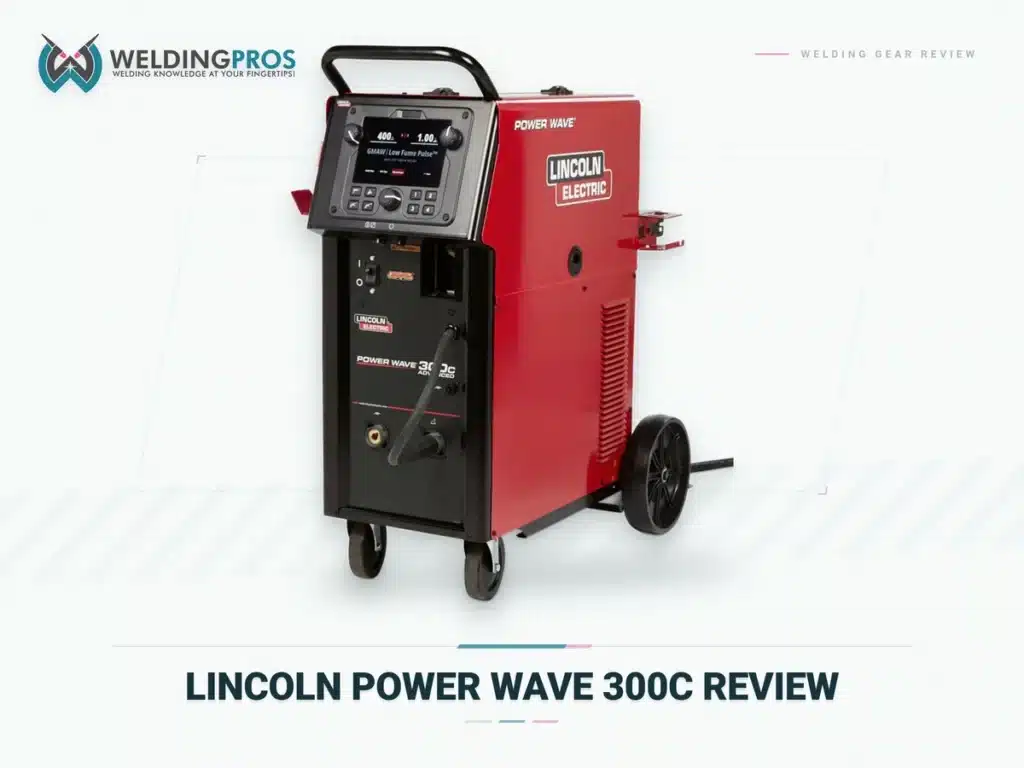
Our blog leans toward hobbyist gear, but every so often an industrial machine earns a closer look. The Lincoln Electric Power Wave 300C is that machine: an all-process welder built for technical training programs and industrial fabrication shops, sitting near the top of Lincoln’s current lineup.
In this Lincoln Power Wave 300C review we cover the Power Wave 300C Advanced model, since that is the version with AC/DC output and the advanced waveform packages. We will go through what the Power Wave platform does differently, what you get in the box, and where this welder makes sense, including the parts that sting: the price and the extras you buy separately.
If you are shopping for something more affordable, our multi-process welder picks cover machines a home shop can actually power. The 300C is a different animal, and it helps to know the difference before you fall in love with the spec sheet.
Lincoln Electric Power Wave 300C Review: Package Content & Technical Specifications
One package note before the specs: the box covers MIG welding only. The Magnum gun, Harris regulator, work lead, and drive rolls get you running steel right away, but TIG and stick work needs a torch and an electrode holder you buy separately, or the Educational One-Pak bundle that includes them.
300 Amp All-Process Industrial Welder With 100% Duty Cycle
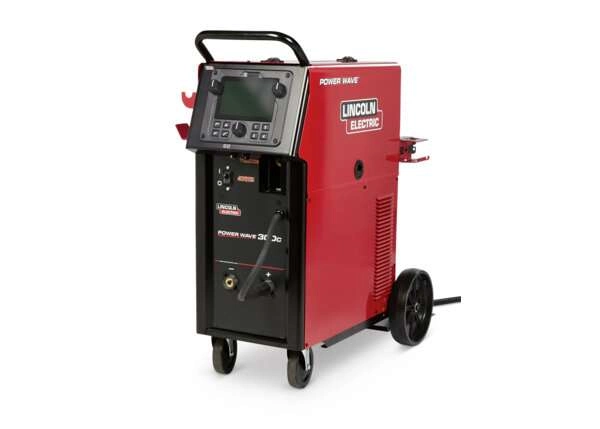
- Lincoln Power Wave 300C Advanced welder
- Magnum PRO Curve 300 MIG gun Ready-Pak
- Harris flowmeter regulator with hose kit
- 10 ft. (3 m) work lead
- 0.035/0.045 in. combination V-groove drive rolls
Technical Specifications
| Welding processes: | Stick, MIG, pulsed MIG, flux-cored, TIG, arc gouging |
| Polarity: | AC/DC (Advanced model) |
| Input voltage: | 200-600V, single phase or three phase, 50/60 Hz |
| Output range: | 5-350 A |
| Rated output: | 300 A @ 100% duty cycle (MIG, FCAW, TIG) |
| Stick output: | 280 A @ 100% duty cycle (325 A @ 40%) |
| Input power tech: | PowerConnect 200-600V auto, Tribrid power module |
| Display: | 7 in. (178 mm) IP67 high-resolution display |
| Connectivity: | Ethernet, USB, CheckPoint production monitoring |
| Auxiliary power: | Optional 115V (10A) AC duplex receptacle |
| Net weight: | 226 lbs (102.5 kg) |
| Warranty: | 5 years |
Pros
- Industry’s only true 300 A all-process welder at 100% duty cycle
- AC/DC output with HF TIG and AC aluminum modes (Advanced)
- Smart Pulse, Low Fume Pulse, and STT waveforms included
- 7 in. IP67 display, one-button process selection
- PowerConnect accepts 200-600V, single phase or three phase
Cons
- MSRP $13,417 to $17,183; sold through Lincoln dealers only
- No TIG torch or electrode holder in the box
- 226 lbs on a built-in cart; not a portable machine
- Lincoln consumables cost more than generic wire
- Auxiliary power outlet and water cooling are paid options
Lincoln Power Wave 300C Review: Build, Controls, and Performance
After the specifications, the hands-on details: how the 300C is built, how the controls work, and what the power section delivers under a full shift.
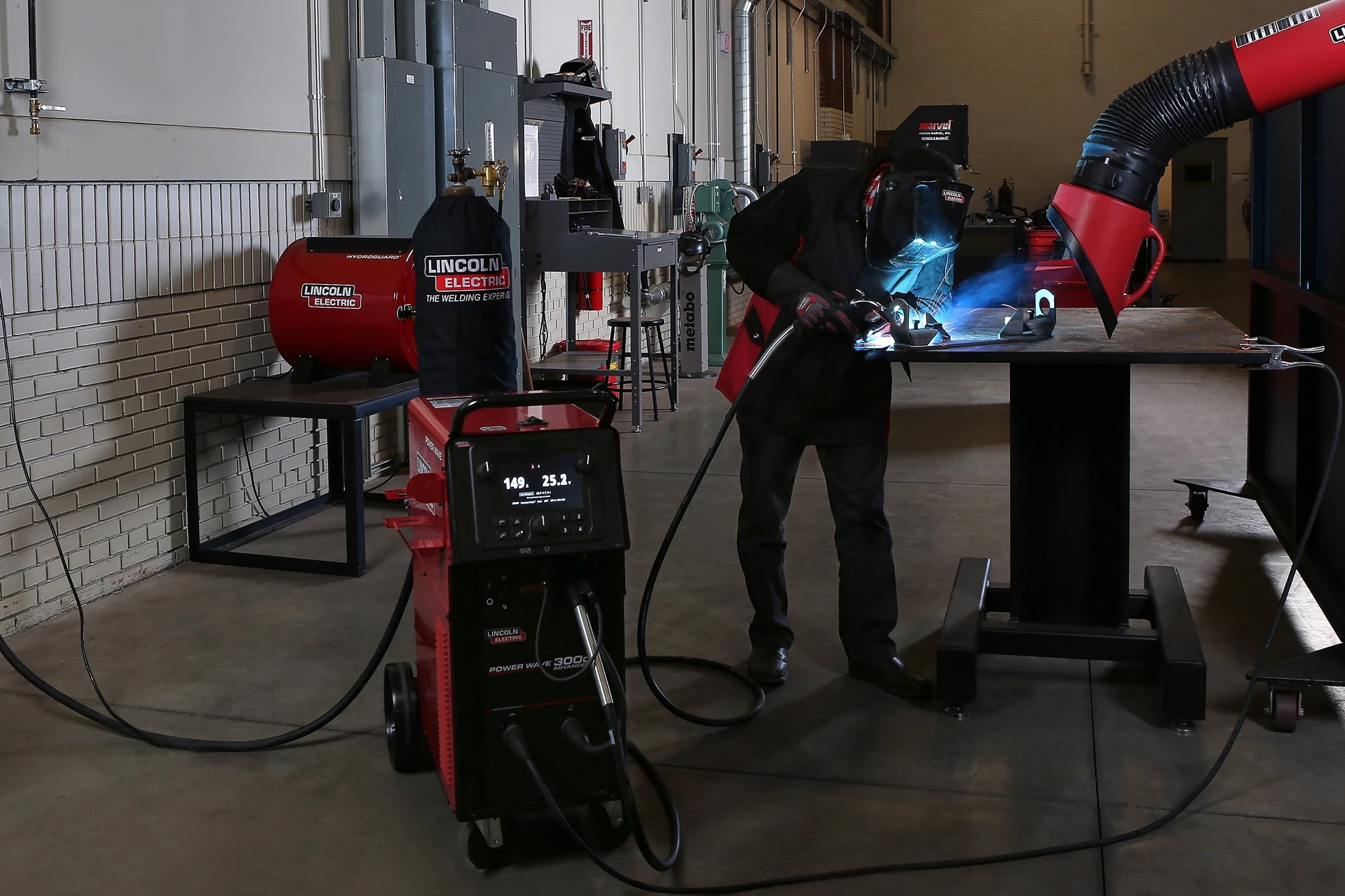
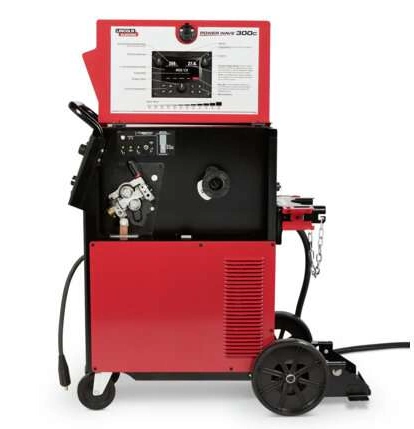
At 226 lbs on an integrated cart, the 300C is a compact machine built like the industrial unit it is. The cabinet rolls on rear wheels with a tilting bottle rack and chain, and the cable management hooks integrated up top keep leads off the floor. The Twist-Mate connection and gas solenoid are factory fitted for TIG. Nothing about it feels like consumer gear, and the on-demand fans keep the shop quiet between welds.
Build Quality and Ready-to-Run Design
Lincoln also sells a dual gas bottle upgrade kit (K4866-1) and a Cool-Arc 40 water cooler adapter (K4898-1) for shops that need them. Neither is in the box, but the frame accepts both, which tells you who this machine is for: fabricators who configure a station once and weld for years.
The control panel is the best part of this welder. The 7 in. IP67 display is readable with gloves on, and process selection is one button: stick, flux-cored, TIG, or MIG welding. Four memory presets store repeatable setups, and two knobs handle voltage and wire feed speed. ArcFX shows what the arc will look like before you strike it.
Advanced Welder Controls and Arc Modes
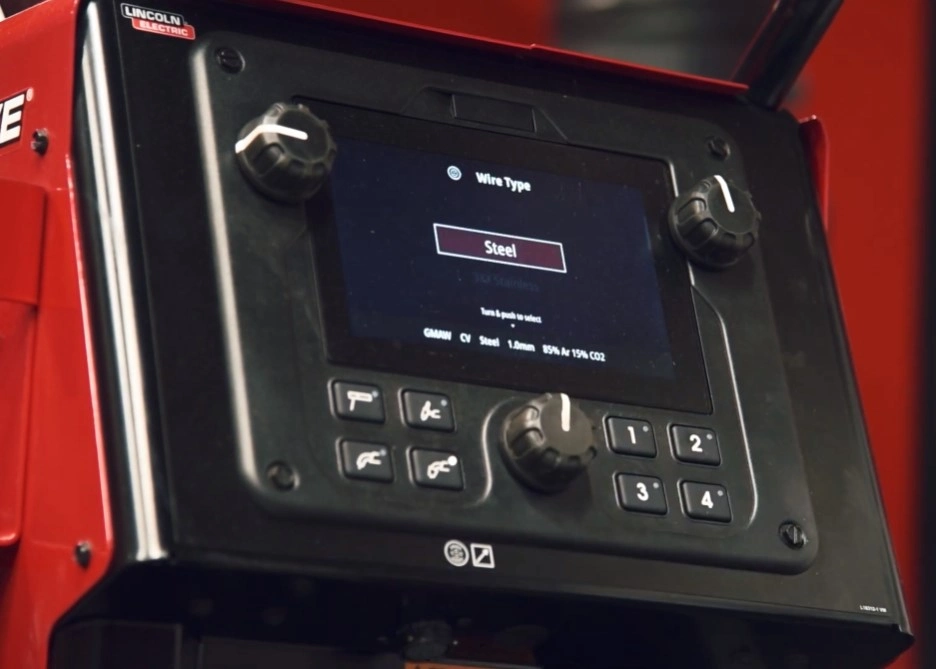
The Advanced pack is where the arc technology lives, and the Wave 300C advanced process platform delivers all the arc performance that implies. Smart Pulse tailors the pulse to your wire feed speed automatically: low WFS gets a narrow, focused arc for out-of-position work, high WFS gets a wide, soft arc for flat. STT controls heat independently of wire feed speed, which is what makes thin-sheet MIG possible without burn-through. Low Fume Pulse trades a little deposition for a lot less fume at the arc, and Pulse-on-Pulse stacks two pulses for TIG-quality beads on thin aluminum.
HF TIG with AC aluminum modes is included on the Advanced model. If you are weighing TIG machines, our how to choose a TIG welder guide explains what these controls buy you; welder settings and waveform controls this deep used to mean a separate synergetic power source. Here it is one machine that does all of it, and as part of the broader Power Wave system it adds Industry 4.0 connectivity with Lincoln Electric CheckPoint production monitoring for tracking quality assurance across every booth.
Input and Output Power
Output is 5-350 A with the rating that matters more than the peak: 300 A at 100% duty cycle on MIG, flux-cored, and TIG, which makes this a true 300 amp 100 duty cycle all process machine rather than a peak-number special.
Stick is 280 A at 100%. That welding output is the whole point of this machine. Our Power MIG 256 review covers a similarly rated light-industrial machine at 40% duty; the 300C simply never needs to cool down.
That output range covers the whole span from technical training to industrial fabrication: the same machine runs a first-year booth in the morning and production welds after lunch, which is exactly how Lincoln sells it.
Input power is 200-600V, single phase or three phase, 50/60 Hz, with AC/DC output capability on the Advanced model. PowerConnect automatically adjusts across the entire input voltage range, so welding output remains constant from a 208V tap to a 575V tap, and the Tribrid power module maintains a high power factor that keeps the machine from drawing more than it needs at full output. An optional 115V (10A) duplex receptacle with Surge Blocker runs a grinder without disturbing the arc.
Wire capacity covers industrial spools: 0.035-0.052 in. solid steel wire, 0.035-0.045 in. stainless, 0.045-0.052 in. metal-cored, and 0.035, 3/64, and 1/16 in. aluminum. Flux-cored runs 0.045, 0.052, and 1/16 in. Adapters fit 22-30 lb spools on the 2 in. spindles, and the Readi-Reel adapter (K363P) mounts 8 in. spools. For a flux-core welding shop running wire all day, that capacity is the difference between loading spools weekly or monthly.
Frequently Asked Questions [F.A.Q]
Is the Lincoln Power Wave 300C good for beginners?
Yes, with a caveat. The interface is simple enough that Lincoln Electric sells this machine into technical training programs: one-button process selection, four memory presets, and a display that tells you what the arc is doing. A novice can be productive on it fast. The caveat is the price and the power supply. This is a machine a school or a fabrication shop buys, not a first welder for a home garage.
What is the difference between the 300C Standard and Advanced models?
The output hardware is the same 350 A, 300 A @ 100% duty cycle all process machine in both: an all in one, all process design. The Standard is DC-only, while the Advanced adds AC/DC output, HF TIG with AC aluminum modes, and the Smart Pulse, Low Fume Pulse, and STT waveform packages; Lincoln’s spec sheet calls the result best in class performance, and the arc backs it up. The Educational One-Pak bundles the Advanced with the torches and accessories needed to weld every process out of the box. MSRP runs $13,417 for the Standard, $17,183 for the Advanced, and $17,749 for the One-Pak.
Is the Power Wave 300C worth the money?
For a shop or training program that will run it daily, yes. The 300C is the do everything Power Wave: you buy once, weld non-stop at 300 amps, and the five-year warranty plus the Lincoln Electric service network cover the long haul. For hobby use, no. The machine outclasses anything a home shop needs, and Lincoln consumables add running cost that a hobby budget feels.
Can the Power Wave 300C weld aluminum?
On the Advanced model, yes, three ways: AC TIG with high-frequency start, pulsed MIG, and Pulse-on-Pulse for thin stock. The TIG torch is a separate purchase. Supported aluminum wire diameters are 0.035, 3/64, and 1/16 in.
Conclusion
The Power Wave 300C is the most capable welder we have reviewed on this site. Nothing else combines all-process capability with a true 300 A @ 100% duty cycle rating, and the Advanced model’s waveform control is useful arc technology, not marketing copy. The price is the price: roughly $13,400 to $17,200 depending on the package, dealer-sold. If you run a training program or a fabrication shop, this machine will outlast its warranty and probably the building it lives in. Home users should look at our multi-process picks and spend the difference on wire.






