
Welding machines can be clunky, heavy, and hard to maneuver.
In my lifetime, I owned many welders of different shapes and sizes, and believe me when I tell you that convenience helps you complete the job right.
This goes double when working around the house and doing some home repairs. In that case, you are never going to need a professional welder that could only get in the way. Luckily, the industry has evolved so much that we have a number of 110V MIG welders that you can plug in any socket around the house and do the job in two minutes flat.
But you can’t do anything properly if you don’t have good features, quality, and enough power to complete your work. That’s why I went out of my way to consider all those parameters and devise a list of the best 110V welders to help my fellow welders in need.
(In case you want to see the list of the best MIG welders we picked out, check this page.)
Best 110V Welders Comparison Table
| Image | Name | Voltage | Current | Amperage | Duty Cycle | Process | Check Price |
|---|---|---|---|---|---|---|---|

| YesWelder YWM-160 4-in-1 MIG WelderGet 10% Off With Coupon: -10% WELDPROS | 110/220V | DC | 30-160A | 60% @ 160A | MIG/Flux Core/Lift TIG/Stick | Check Price |

| YesWelder MIG-205DS-Pro 5-in-1Get 10% Off With Coupon: -10% WELDPROS | 110/220V | DC | 20-205A | 60% @ 205A | MIG/Flux Core/Lift TIG/Stick/Plasma | Check Price |
 | Forney Easy Weld 140 MP | 120V | DC | 10-140A | 30% @ 90A | MIG/Flux Core/Stick | Check Price |
 | Lincoln 90i FC Flux Core Welder | 120V | DC | 20-90A | 20% @ 90A | Flux Core | Check Price |
 | Weldpro 200A AC/DC TIG Welder with Pulse | 110/220V | AC/DC | 10-200A | 60% @ 200A (220V) 40% @ 110V | TIG/Stick | Check Price |
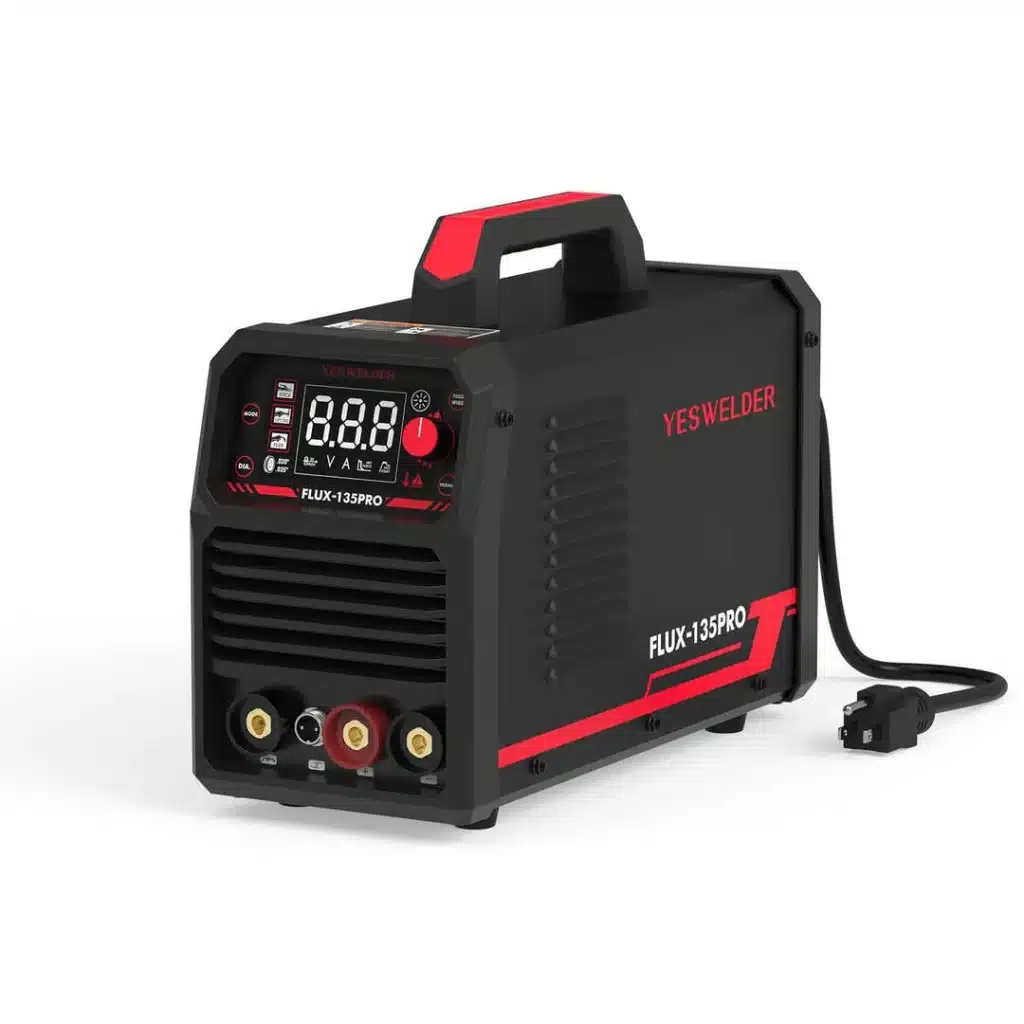 | YesWelder Flux-135-PROGet 10% Off With Coupon: -10% WELDPROS | 110V | DC | 20-135A | 30% @ 135A | Flux MIG/Lift TIG/Stick | Check Price |
Best 110v Welders Reviews
If you are not a professional welder and only need a machine to do some work around the house, a 110V MIG welder (or any other) is more than enough. With it, you can work on light- to medium-gauge metal with ease. Plus, you don’t need a generator or any separate power source, since they work on your standard 110V power input found in every home.
Unfortunately, these machines can be either a hit or miss when it comes to performance. They are not built to handle a lot of power, so don’t even expect it. Choosing the best 110V welder is not impossible; it’s just a matter of knowing where to look.
1. YesWelder YWM-160 4-in-1 MIG Welder – Best Budget Multi-Process 110V Welder
Best Budget Multi-Process 110V Welder
YesWelder YWM-160 4-in-1 MIG Welder
The YWM-160 is YesWelder’s entry-level multi-process machine and at $225 it’s hard to complain. You get MIG, flux core, lift TIG, and stick in a box that weighs under 20 pounds. I’ve used it for thin sheet metal repairs and exhaust work — it handles 1/8-inch steel without breaking a sweat. The IGBT inverter keeps the arc stable even when you’re running off a garage outlet.
| Spec | Value |
|---|---|
| Process | MIG / Flux Core / Lift TIG / Stick |
| Amperage Range | 30–160A |
| Input Voltage | 110V / 220V Dual Voltage |
| Duty Cycle | 60% @ 160A |
| Weight | 24.8 lbs |
| Warranty | 1-Year |
| Price | Check YesWelder |
The synergic MIG mode is what makes this thing beginner-friendly. Set your material thickness and the machine figures out voltage and wire speed. It’s not perfect — you’ll still need to dial things in for weird positions or dirty metal — but it gets you 80% there without touching a chart. The digital display is clear and the amperage knob has solid detents so you’re not guessing.
At 160 amps max, this isn’t a production machine. Quarter-inch mild steel is about the ceiling for single-pass MIG. You can go thicker with bevels and multiple passes, but that’s not what this welder is for. For auto body, hobby fabrication, and farm repairs, it’s plenty. The lift TIG function is basic — no HF start, no AC for aluminum — but it works for DC TIG on steel and stainless.
The 60% duty cycle at full output surprised me. Most budget machines in this range tap out at 20-30%. That means six minutes of continuous welding out of every ten before it thermal-protects. In practice you’ll stop to reposition or chip slag long before you hit that limit, but it’s nice knowing the machine won’t quit on a longer bead.
Portability is a real strength here. At about 25 pounds you can throw it in the trunk and weld at a buddy’s place without needing a hoist. The handle is molded into the case and doesn’t feel like it’ll snap off. Dual voltage means it works on 110V at home and 220V if you ever upgrade your garage. The switch between voltages is manual — flip a plug adapter, no internal rewiring needed.
For $225 you’re getting a lot of machine. The wire feed is smooth, arc starts are consistent, and it comes with a basic MIG torch and stick electrode holder. What you don’t get: a TIG torch (sold separately), a spool gun for aluminum, or a fancy case. The ground clamp is the stamped-steel kind that works fine but won’t survive being run over by a truck. If you’re learning to weld or need a grab-and-go machine for small jobs, this one earns its spot.
Pros
- Four processes in one machine at $225 — hard to beat for value
- Synergic MIG mode simplifies setup for beginners
- 60% duty cycle at 160A outperforms most budget welders
- Dual voltage with simple plug-adapter switching
- IGBT inverter delivers stable arc on 110V household power
- Under 20 pounds — genuinely portable without sacrificing output
- Digital amperage display with solid detented knob
- Handles 1/4-inch mild steel in single-pass MIG
Cons
- TIG torch sold separately — lift TIG only, no HF start or AC
- Ground clamp is lightweight stamped steel, plan on upgrading it
- 1-year warranty is shorter than the 3-5 years competitors offer
2. YesWelder MIG-205DS-Pro 5-in-1 MIG Welder – Best Dual-Voltage MIG Welder for the Money
Best Dual-Voltage MIG Welder for the Money
YesWelder MIG-205DS-Pro 5-in-1 MIG Welder
The MIG-205DS-Pro is YesWelder’s mid-range multi-process machine and the step up from the YWM-160 that makes sense if you need more power. At 205 amps on 220V, it’ll do 3/8-inch steel in a single pass and handles aluminum with a spool gun. On 110V you’re capped lower but can still handle most home-garage work. The build quality feels a notch above the budget tier — the wire drive is all metal and the case has real heft to it.
| Spec | Value |
|---|---|
| Process | MIG / Flux Core / Stick / Lift TIG / Aluminum |
| Amperage Range | 30–205A |
| Input Voltage | 110V / 220V Dual Voltage |
| Duty Cycle | 60% @ 205A |
| Weight | 33 lbs |
| Warranty | 1-Year |
| Price | Check YesWelder |
Synergy mode is the star here. You pick your process, wire size, and material thickness, and the machine sets voltage and wire speed. It’s not foolproof — gas mix and stickout still matter — but it cuts setup time in half compared to manual dial-in. For flux core on dirty metal, I bump the voltage up 1-2 volts from what Synergy suggests and it runs clean.
The dual-voltage flexibility is what puts this ahead of 110V-only machines at this price. On 220V you get the full 205 amps and can run .035 solid wire for structural work. On 110V it’s more of a sheet-metal and exhaust-pipe machine. The switch between voltages is a simple plug adapter — no rewiring, no transformer to lug around — but you do need access to a 220V outlet to unlock the top end.
The included MIG torch is decent. It’s a 10-foot Binzel-style gun with a brass neck and a standard consumable set. Wire feeds smooth through .030 and .035 solid wire, and .030 flux core runs without birdnesting if you keep the drive roll tension right. Adding the optional TIG torch gives you lift-start DC TIG for steel and stainless — no AC, no aluminum — but it works for basic TIG work.
At 33 pounds it’s not a backpack welder, but it’s manageable with one hand and the top handle is solid. The spool compartment fits 4-inch and 8-inch spools. The front panel layout is clean — all controls on one face with clear labels. The digital display shows actual voltage and amperage while welding, which is rare at this price.
YesWelder backs this with a 1-year warranty and a 30-day return window. That’s standard for the brand but shorter than the 3-5 years you’d get from Lincoln or Hobart. The included accessory kit is basic — a hand shield, a wire brush, and a starter spool of .030 flux core wire. You’ll want to buy a real auto-darkening helmet and some .030 solid wire on day one. For the money, the output and features are solid. Just know the warranty is what it is.
Pros
- 205 amps on 220V handles 3/8-inch steel in a single pass
- Synergy mode cuts setup time — pick settings and start welding
- Dual voltage with simple plug-adapter switching, no transformer needed
- All-metal wire drive handles .030 and .035 solid wire without slipping
- Digital display shows live voltage and amperage while welding
- 10-foot Binzel-style MIG torch with brass neck and standard consumables
- 30-day return window lets you test it risk-free
- Spool compartment fits both 4-inch and 8-inch spools
Cons
- 1-year warranty is short — Lincoln and Hobart offer 3-5 years
- TIG torch not included — lift TIG only, no AC or HF start
- At 33 pounds it’s double the weight of the YWM-160
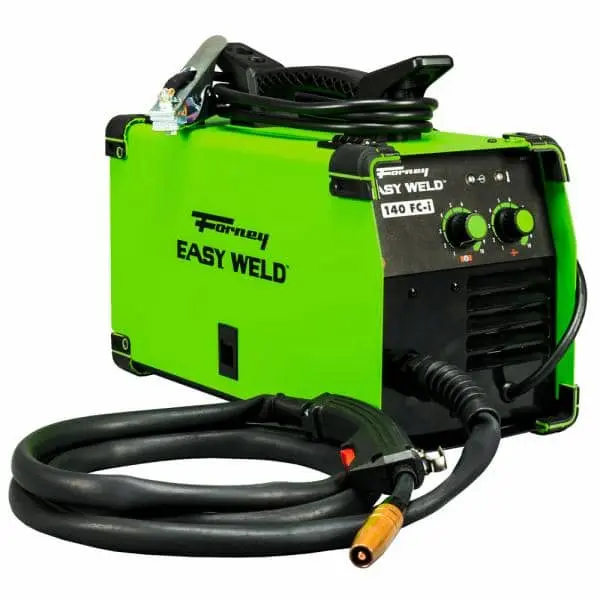
3. Forney Easy Weld 140 MP Multi-Process Welder – Best Entry-Level Multi-Process 120V Welder
Best Entry-Level Multi-Process 120V Welder
Forney Easy Weld 140 MP Multi-Process Welder
The Forney Easy Weld 140 MP is the cheapest multi-process machine on this list and it does more than you’d expect for the price. MIG, flux core, stick, and DC TIG — all from a standard 120V outlet. It’s not going to weld bridge girders, but for sheet metal, exhaust tubing, and thin-gauge repairs, it gets the job done. The thermal overload protection is a nice safety net on a budget machine — it shuts down before you cook the internals.
| Spec | Value |
|---|---|
| Process | MIG / Flux Core / Stick / DC TIG |
| Amperage Range | 30–140A |
| Input Voltage | 120V |
| Duty Cycle | 30% @ 90A |
| Weight | 25 lbs |
| Warranty | 1-Year |
| Price | Check Amazon |
Setup is straightforward. The Synergy-style settings handle voltage and wire speed based on your material thickness. It’s not as refined as the YesWelder Synergy system — you’ll still need to tweak for position and fit-up — but it keeps a beginner from cranking every knob to max and wondering why they’re blowing holes. The infinite voltage and wire speed dials give you fine control once you learn the machine.
The wire feed is where the price shows. It’s plastic-housed and finicky with .030 flux core if the liner gets kinked. Keep the torch cable straight and it feeds fine. I recommend Forney’s 42285 and 42290 MIG wire — matched to the drive rolls and cleaner than generics. Takes 4-inch and 8-inch spools so you’re not stuck with oddball sizes.
Spatter is the main complaint with this welder, and it’s earned. On flux core it throws more BBs than machines twice the price. Cleaning your workpiece helps — grind to bare metal, wipe with acetone — but you’ll still spend time with a chipping hammer. For MIG with gas, the spatter drops significantly. If you can run a bottle, do it.
At 25 pounds it’s portable enough for mobile work. The plastic case feels cheap next to the metal-bodied YesWelders, but it’s held up fine in my experience as long as you don’t drop it off a tailgate. The handle is molded into the top and the front panel controls are well-labeled. No digital display — just knobs with detents — which is fine at this price.
For the money, the Easy Weld 140 MP gives you four processes and enough power for home-garage work. The 30% duty cycle at 90 amps means breaks on longer welds, but that’s normal for a 120V machine. If you’re learning and don’t want to spend $400+, this is a solid starting point. Just budget for a better ground clamp and some quality wire.
Pros
- Four processes from a standard 120V outlet at a budget price
- Thermal overload protection shuts down before you cook the machine
- Infinite voltage and wire speed dials for fine-tuning
- Takes standard 4-inch and 8-inch spools — no oddball sizes
- Synergy-style auto-set helps beginners avoid blown holes
- Light enough at 25 lbs for mobile and garage work
- Runs much cleaner with MIG gas than flux core alone
- Simple knob-based controls — nothing computerized to fail
Cons
- Plastic wire feed housing — keep the torch cable straight or it kinks
- Spatter is heavy on flux core, budget time for cleanup
- 30% duty cycle at 90A means frequent cool-down breaks
4. Lincoln 90i FC Flux Core Welder – Best 110V Flux Core Welder for Beginners
Best 110V Flux Core Welder for Beginners
Lincoln 90i FC Flux Core Welder
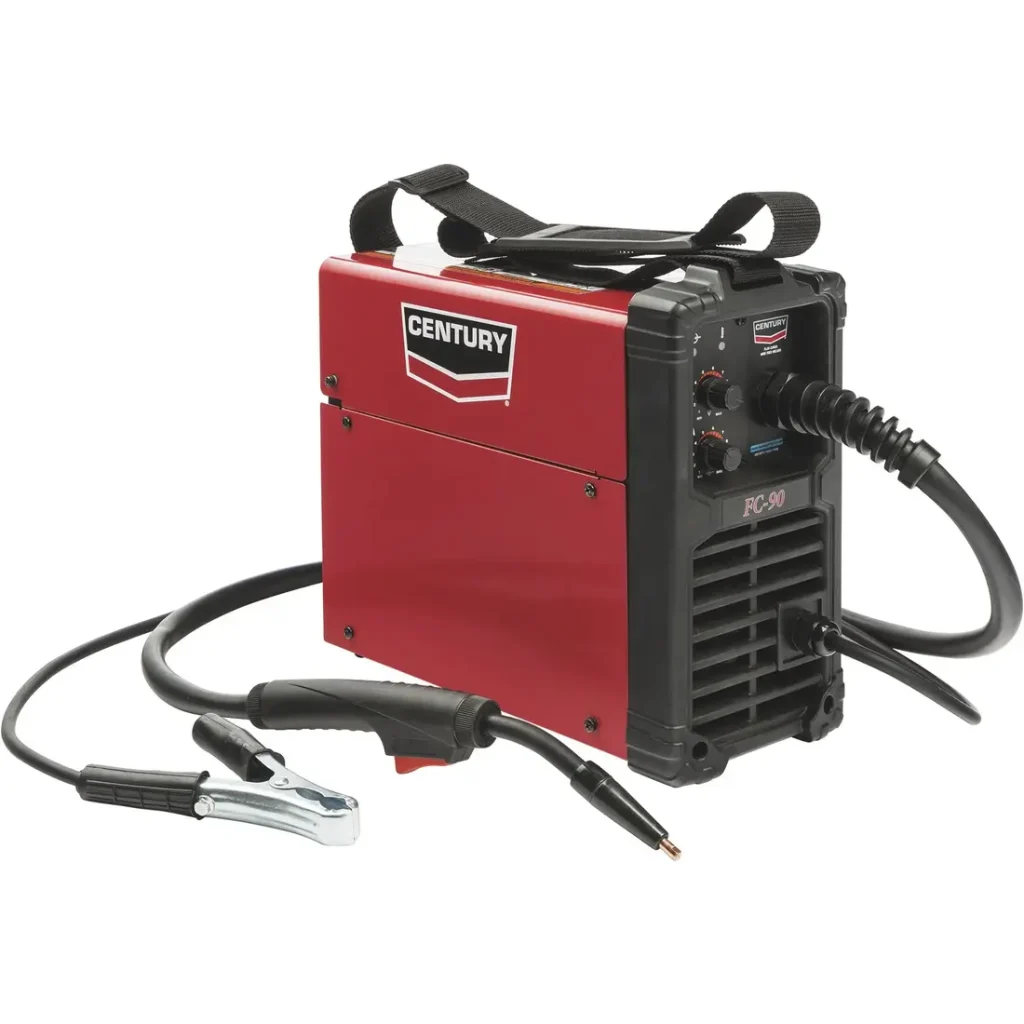
The Lincoln 90i FC is a single-process flux core machine from the Century brand — Lincoln Electric’s consumer line. It does one thing and does it well: gasless flux core welding on 110V. No gas bottle, no regulator, no complexity. If you’re welding outside where the wind blows shielding gas away, flux core is the move, and this little Lincoln handles it better than most budget multi-process machines.
| Spec | Value |
|---|---|
| Process | Flux Core Only |
| Amperage Range | 20–90A |
| Input Voltage | 110V |
| Duty Cycle | 30% @ 80A |
| Weight | 18 lbs |
| Warranty | 1-Year |
| Price | Check Amazon |
At 18 pounds it’s the lightest welder on this list. You can carry it up a ladder or throw it in the truck without thinking twice. The build quality is classic Lincoln — the case is stamped steel, the internals are tidy, and the ground clamp is actually decent. The wire feed compartment only takes 2-pound spools due to the compact size, but .030 and .035 flux core wire in 2-pound rolls is easy to find.
The amperage range is 20-90 amps, which puts the sweet spot at 18-gauge to 1/4-inch steel. You can do thinner with some skill, and thicker with beveling and multiple passes, but this machine is built for auto body, HVAC ductwork, and light repair. The arc is surprisingly stable for a transformer-based machine — Lincoln’s quality control shows in the consistent starts.
The duty cycle is 30% at 80 amps, which is fine for the target user. You’re not running production beads with this thing. Three minutes of welding, seven minutes to cool down. In practice, hobby welders stop to check fit-up, grind, and reposition often enough that duty cycle rarely becomes the bottleneck.
Setup is dead simple. Open the door, drop in a spool, feed the wire through the drive roll, close the tension arm, and go. The wire speed and voltage knobs are clearly labeled with material thickness guides printed right on the machine. No digital screens, no menus — just two knobs and a power switch. If you can run a caulk gun, you can set up this welder.
The plastic wire feed mechanism is the weak point. It works fine for light use but I wouldn’t expect it to survive years of daily welding. Lincoln sells replacement drive rolls and liners, and they’re cheap. For $250-ish, you’re getting Lincoln’s arc quality in a compact package built for weekend warriors and mobile repair. Just don’t expect MIG or TIG — this is flux core only.
Pros
- Lincoln arc quality in a compact 18-pound package
- Dead simple setup — two knobs with thickness guides printed on the machine
- Stamped steel case, not plastic — survives job-site knocks
- Runs .030 and .035 flux core wire cleanly on 110V household power
- No gas bottle needed — weld outside in the wind without issues
- Consistent arc starts thanks to Lincoln’s transformer design
- Replacement drive rolls and liners are cheap and easy to find
- Handles 18-gauge to 1/4-inch steel without breaking a sweat
Cons
- Flux core only — no MIG, TIG, or stick capability
- Plastic wire feed mechanism won’t hold up to daily production use
- 2-pound spool limit means more frequent spool changes
5. Weldpro 200A AC/DC TIG Welder with Pulse – Best 110V TIG Welder for Aluminum
Best 110V TIG Welder for Aluminum
Weldpro 200A AC/DC TIG Welder with Pulse
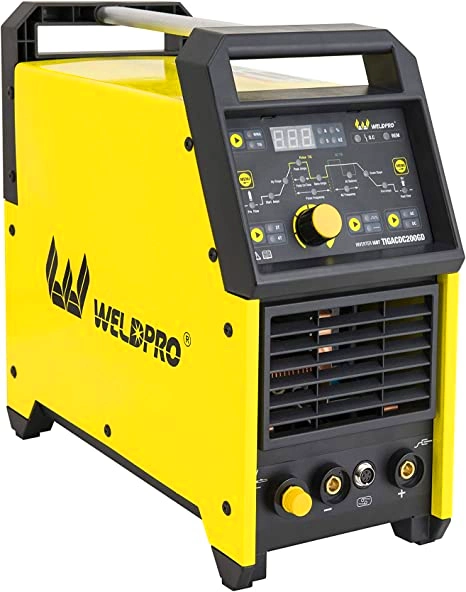
The Weldpro Digital TIG200GD is the odd one out on this list — it’s a dedicated TIG and stick machine, no MIG, and it’s the only one here that can weld aluminum. AC TIG with pulse puts it in a different category than the multi-process MIG machines above. If you’re doing aluminum fabrication, thin-gauge stainless, or anything where appearance matters, this is the tool for the job.
| Spec | Value |
|---|---|
| Process | AC/DC TIG / Stick |
| Amperage Range | 10–200A |
| Input Voltage | 110V / 220V Dual Voltage |
| Duty Cycle | 60% @ 200A (220V) |
| Weight | 45 lbs |
| Warranty | 3-Year |
| Price | Check Amazon |
The dual-voltage setup gives you 200 amps on 220V and a usable range on 110V for thinner material. On 110V you’re realistically capped around 125 amps, which handles 1/8-inch aluminum and thin stainless without issue. The high-frequency start means no scratching or sticking — you hold the torch near the workpiece and the arc jumps. Clean starts every time.
The foot pedal is better than expected at this price. Most budget TIG machines ship with a pedal that feels like a plastic toy. This one has a metal base, smooth travel, and responsive amperage control. It makes a real difference when you’re feathering the puddle on thin aluminum or tapering off at the end of a bead to avoid craters. Stick welding with the pedal isn’t as smooth — I’d stick to TIG with it.
Pulse mode is the hidden gem here. At 1-10 pulses per second, you get better control over the weld puddle and less heat input into the workpiece. On 16-gauge stainless, pulse at 2 PPS kept the heat-affected zone tight and the warping minimal. Higher pulse rates help with aluminum by breaking up the oxide layer and keeping the cleaning action consistent.
The 60% duty cycle at 200 amps on 220V is generous. On 110V, you’ll hit thermal limit sooner at max output, but for the kind of work you’d do on 110V — thin sheet, small parts, brackets — you probably won’t notice. The digital display is clear and the menu navigation is intuitive once you spend 10 minutes with the manual.
At around $700, the TIG200GD competes with machines costing twice as much. You get AC/DC, pulse, HF start, a quality foot pedal, and a 3-year warranty. The included TIG torch is a WP-17 style with a flex head and a gas lens — usable out of the box. If you’re serious about TIG and need aluminum capability on a budget, this is the one.
Pros
- AC/DC TIG with pulse — welds aluminum, stainless, and steel
- High-frequency start means clean arc initiation every time
- Quality foot pedal with metal base and smooth amperage control
- 60% duty cycle at 200 amps on 220V — built for longer sessions
- Pulse mode at 1-10 PPS tightens heat-affected zone on thin metal
- Dual voltage — 110V for thin work, 220V for full output
- 3-year warranty beats most competitors in this price range
- WP-17 flex-head TIG torch with gas lens included
Cons
- No MIG capability — TIG and stick only
- Stick welding with the foot pedal is awkward, stick to TIG
- At ~45 lbs it’s the heaviest machine on this list
6. YesWelder Flux-135-PRO 3-in-1 Gasless MIG Welder – Best Compact 110V Gasless Multi-Process Welder
Best Compact 110V Gasless Multi-Process Welder
YesWelder Flux-135-PRO 3-in-1 Gasless MIG Welder
The Flux-135-PRO is YesWelder’s tiny 3-in-1 that runs exclusively on 110V and doesn’t need a gas bottle. At 16.5 pounds, it’s the most portable machine on this list by a margin. Flux core MIG, lift TIG, and stick — three processes in a box you can carry with two fingers. For apartment-dwellers, mobile welders, and anyone without a garage, this is the machine that fits.
| Spec | Value |
|---|---|
| Process | Flux Core MIG / Lift TIG / Stick |
| Amperage Range | 30–135A |
| Input Voltage | 110V |
| Duty Cycle | 60% @ 135A |
| Weight | 16.5 lbs |
| Warranty | 1-Year |
| Price | Check YesWelder |
The 135-amp output on 110V is impressive. Most 110V-only machines top out around 90-100 amps, so getting 135 from a standard wall outlet puts this in a different league for material thickness. You can weld 3/16-inch steel in a single pass and push to 1/4-inch with beveling. The IGBT inverter keeps the arc steady even when your outlet voltage dips.
Synergy mode handles wire speed and voltage for MIG and flux core. You pick wire size and material thickness, and the machine does the math. The fine-tune adjustment goes from -5 to +5 volts, so if the Synergy setting isn’t quite right for your position or metal condition, you can bump it without switching to full manual. Experienced welders will appreciate the manual override for tricky joints.
The built-in MIG torch is a double-edged sword. It’s always there, always connected, no setup required — great for grab-and-go welding. But if the torch fails or you want to upgrade to a longer gun, you’re disassembling the machine to swap it. For the target user — hobby welders and mobile repair — it’s fine. Professional welders who swap torches regularly should look at the MIG-205DS-Pro instead.
At 16.5 pounds with a carry handle molded into the top, this thing goes anywhere. I’ve thrown it in a backpack for a job-site repair. The duty cycle is 60% at 135 amps, which is surprisingly high — you get 6 minutes of continuous welding before it cycles off. In practice you’re stopping to chip slag or reposition long before that.
For under $200, the Flux-135-PRO packs more output per dollar than anything else on this list. You get three processes, Synergy mode, a 60% duty cycle, and genuine portability. The compromises are real — built-in torch, 110V only, no gas MIG capability — but if those aren’t dealbreakers, this is the best value for a grab-and-go 110V welder.
Pros
- 135 amps from a 110V outlet — most competitors top out at 90-100A
- 15 pounds with a carry handle — genuinely backpack-portable
- Synergy mode with -5 to +5 fine-tune voltage adjustment
- 60% duty cycle at 135A outperforms machines twice the price
- Three processes in one: flux core MIG, lift TIG, and stick
- IGBT inverter holds stable arc even on weak outlet power
- No gas bottle needed — flux core welds anywhere, indoors or out
- Under $200 makes it the best amp-per-dollar on this list
Cons
- Built-in MIG torch — you’re disassembling the machine to replace it
- 110V only, no 220V option for thicker material
- No gas MIG capability — flux core only for wire welding
Buying Guide to the Best 110V Welder
Choosing the best 110V MIG welder can either be heaven or hell. But if you are in the ballpark about what you need, things get a lot easier. Here are some things to consider.
How Portable Is It?
The area where you will be working could determine the type of welder you buy. Consider If your idea is to work in a garage or at home close to a power source as opposed to having to move your welder around. If you do have to hit the road and take your machine with you, a compact, lightweight, and portable unit is needed.
Welder Price Range
You can’t expect a really cheap machine to work wonders. What you pay for a MIG welder is what you get. But you can still purchase a unit that can work even for small bucks. To select a good one you have to dig deep or look at my list above. Household 110V MIG welders usually aren’t expensive, but the trick is to choose one with features that suit you.
Welder Safety and Protection
To tell the truth, welders are doing some pretty dangerous work all things considered. So safety has to be our number one priority. Picking a welder with great safety features should always be a priority.
Luckily, a 110V MIG welder is safer than others. Due to its inherently low electrical usage, you are less likely to be electrocuted by a 110V welder than by others with higher electrical potential.

Multi-Amp Settings
A machine that uses multi-amp settings can greatly affect your electricity bill. Having a machine with a wider amperage range lets you switch seamlessly between different operations and processes while working. You don’t have to use the same amount of heat for different jobs, and it can even result in a better-looking weld.
Welding Power and Material Thickness
Choosing the correct MIG welder depends on the thickness of the material you are working on. The minimum it can cut should be 1/8 inch. The thicker it gets, the more versatile a welding machine is needed, with greater welding power.
Duty Cycle
A welder’s duty cycle measures how long it can work before needing to rest to cool down. So if a MIG welder has a 60% duty cycle, it can run without interruption for 6 minutes. If you have to work on larger projects for longer periods, pick one with a higher duty cycle.
Ease of Use
Properly controlling a welding process takes time and practice. You have to know how much heat is generated and how to control it. Luckily, this can be done much more easily with a 110V welder, which is why it is primarily recommended for beginners.
Welding Processes
MIG welders are the most popular type of welder on the market. But some can do Stick and TIG exclusively, while others, multi-process welders, offer a 3-in-1 special.
MIG/Fluxed-Cored Welding
MIG welding is the best process for home usage diy repairs. It is the easiest to learn and you don’t have to worry about “sticking.” The result is often a good-looking weld meant to last.
Flux core welding is a lot messier with a flux core machine and creates a lot of spatter. But it’s still cleaner than stick.
Stick Welding
Stick welding is one of the oldest but most common welding processes used today. It is a bit harder to learn, but it is more reliable. The best part about stick welders is that they are affordable, lightweight, and you can use them outdoors.
TIG Welding
TIG is best used for thinner metals. It requires a tungsten electrode and a shielding gas to prevent contamination of the weld. Its advantage lies in its versatility of use for different materials.
Power Options
A 110V MIG welder can be plugged into any household outlet.
You don’t require an adapter, a generator, nor a dedicated power socket like you would when using a machine with 220v power output.
Frequently Asked Questions (F.A.Q)
What is the amperage output of 110V welders?
The amperage rated output of 110V welders is around 80-90 amps.
Can you use a generator to run 110V welders?
Yes, you can but you probably don’t need to. You can plug a small welder into any household socket.
Are 110V welders any good?
110V welders are perfect for small applications, DIY projects, fixing things around the house, or working on thinner materials.
What thickness can 110V welders weld?
They can weld up to 24-gauge sheet metal and up to 1/8-inch mild steel.
Conclusion
By all accounts, a 110v machine is pretty much a low-power supply, but a lightweight machine that is very useful, particularly if you need it for quick work as something that you can set up quickly. Even if you are a seasoned welder, I would recommend having one in your arsenal, but especially if you are a beginner, this would be a good entry-level welder to test your metal and see if you really like the job.






