
Not every welding job needs a workshop full of equipment. If you repair fences, fix farm gear, or weld around the house, a light stick machine that runs on the nearest outlet does most of the work.
The YesWelder ARC-205DS PRO is that kind of machine: a dual voltage 205A stick welder with a lift TIG option, priced at $138 at the time of writing. That mix of price, output, and portability is what earns it a spot in our best stick welder guide.
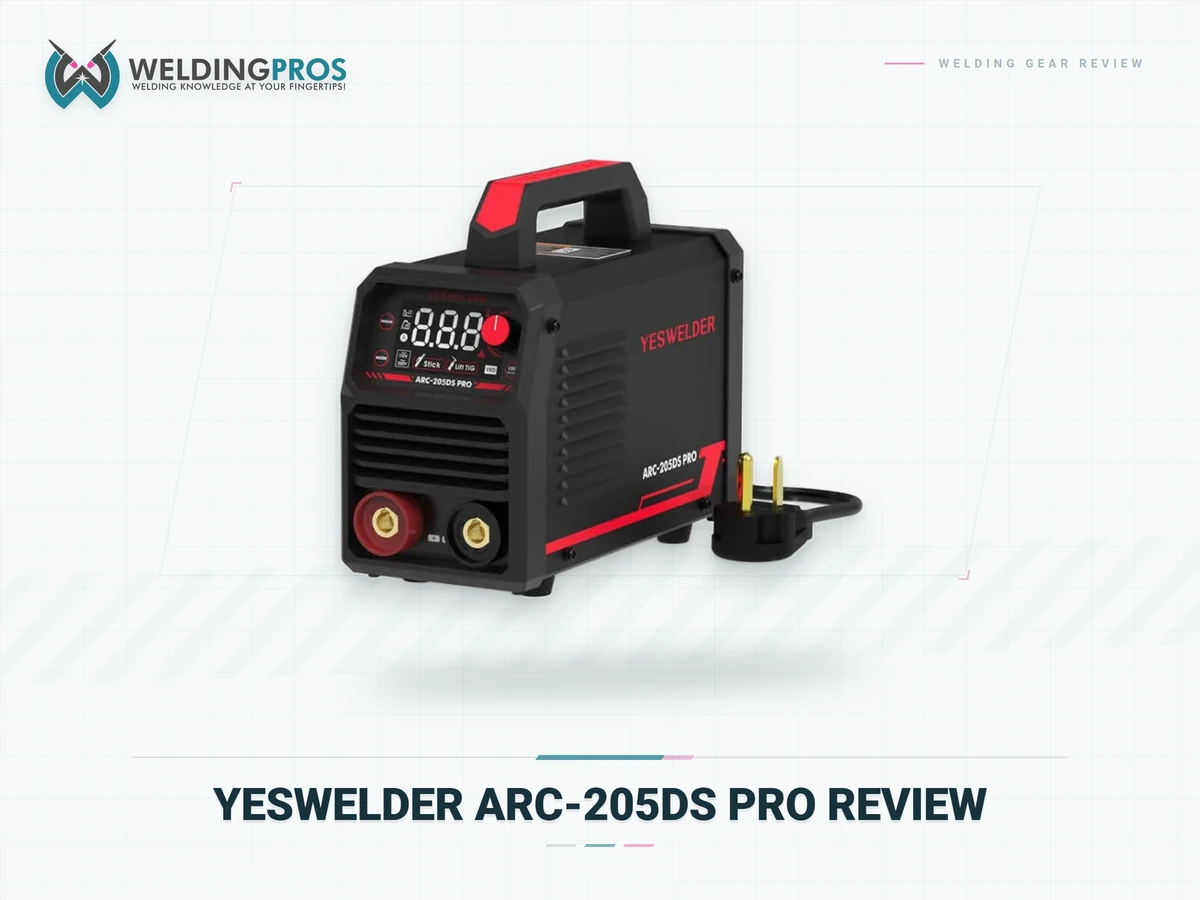
The ARC-205DS PRO is aimed at beginners and at professionals who want a cheap backup machine for the garage or the van. Setup takes minutes, the hot start function lights rods without repeated strikes, and at 8.4 lb you can carry it in one hand.
In this YesWelder ARC-205DS PRO review we go through the package, the verified specs, and how the machine behaves in daily work, including details the product page does not tell you.
YesWelder ARC-205DS PRO Package Content & Technical Specifications
The box is simple and complete for stick welding. YesWelder ships the machine with both cables, a cleaning brush, and the 110V adapter plug, which is the piece that makes dual voltage actually usable in practice: you are not shopping for anything before your first arc. Here is what comes in the box and what the official numbers look like:

Technical Specifications and Dual Voltage
| Welding Process: | Stick (SMAW) / Lift TIG |
| Input Voltage: | 110/220V ±10%, 50/60 Hz |
| Current Range: | Stick: 20-145A @ 110V, 20-205A @ 220V; TIG: 15-205A |
| Rated Output: | 205A @ 28.2V, 60% duty cycle |
| Duty Cycle Detail: | 110V: 60% @ 145A, 100% @ 112A; 220V: 60% @ 205A, 100% @ 158A |
| Open Circuit Voltage: | 65V |
| Electrode Diameter: | Up to 3/32″ (2.4mm) @ 110V; up to 1/8″ (3.2mm) @ 220V |
| Material Thickness: | Stick: up to 3/16″ @ 110V, 3/8″ @ 220V |
| Machine Weight: | 8.4 lbs (3.8 kg) |
| Machine Size: | 11.6″ × 5.3″ × 7.7″ |
| Protection Degree: | IP21S; overheat, overcurrent, undervoltage protection |
| Certification & Warranty: | CE, ETL, UL; 2-year warranty |
Pros
- 205A output at a budget price
- True dual voltage with adapter included
- Only 8.4 lb, one-hand portable
- Hot start and arc force are adjustable 0-10
- VRD reduces open-circuit voltage in stick mode
Cons
- TIG torch sold separately
- No foot pedal support
- Generator use not recommended below 10 kW
- Not rated for pipe thawing (manual limitation)
- No aluminum welding capability
YesWelder ARC-205DS PRO In Daily Use
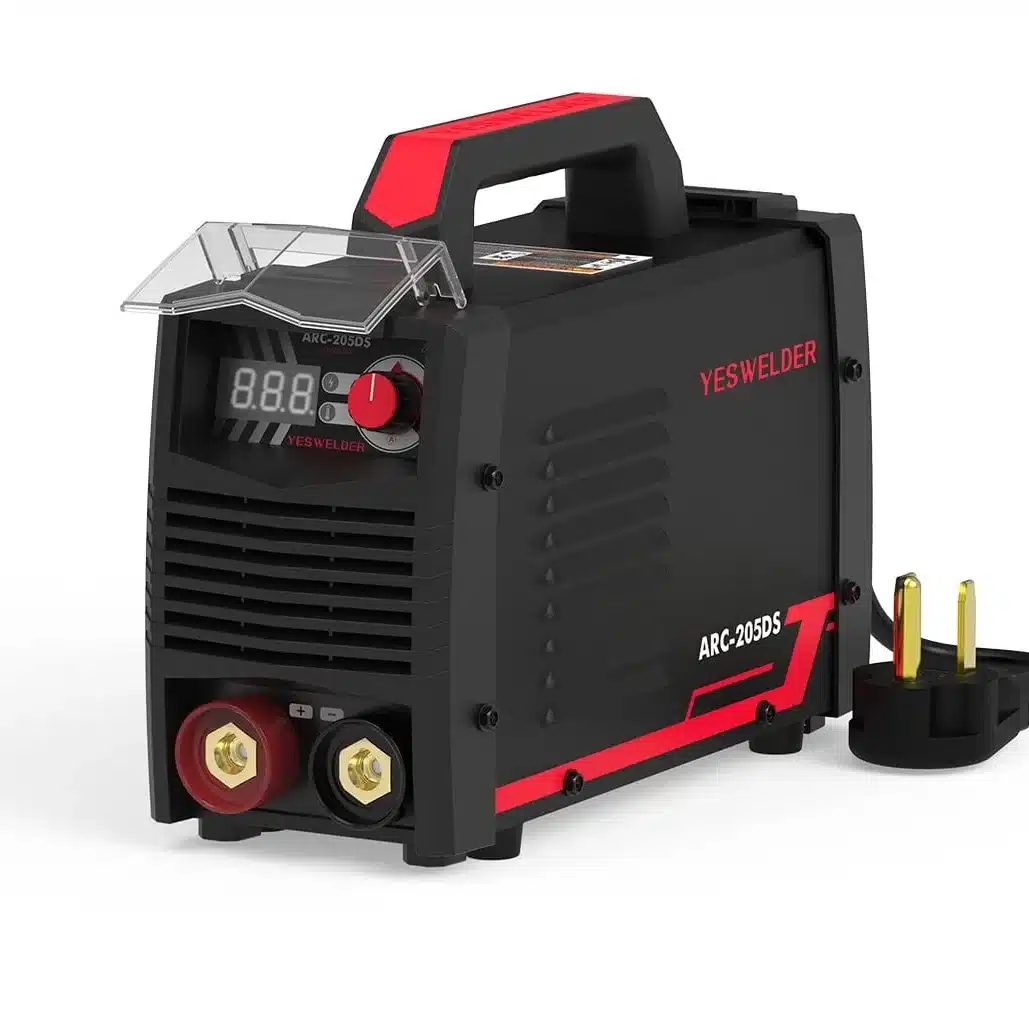
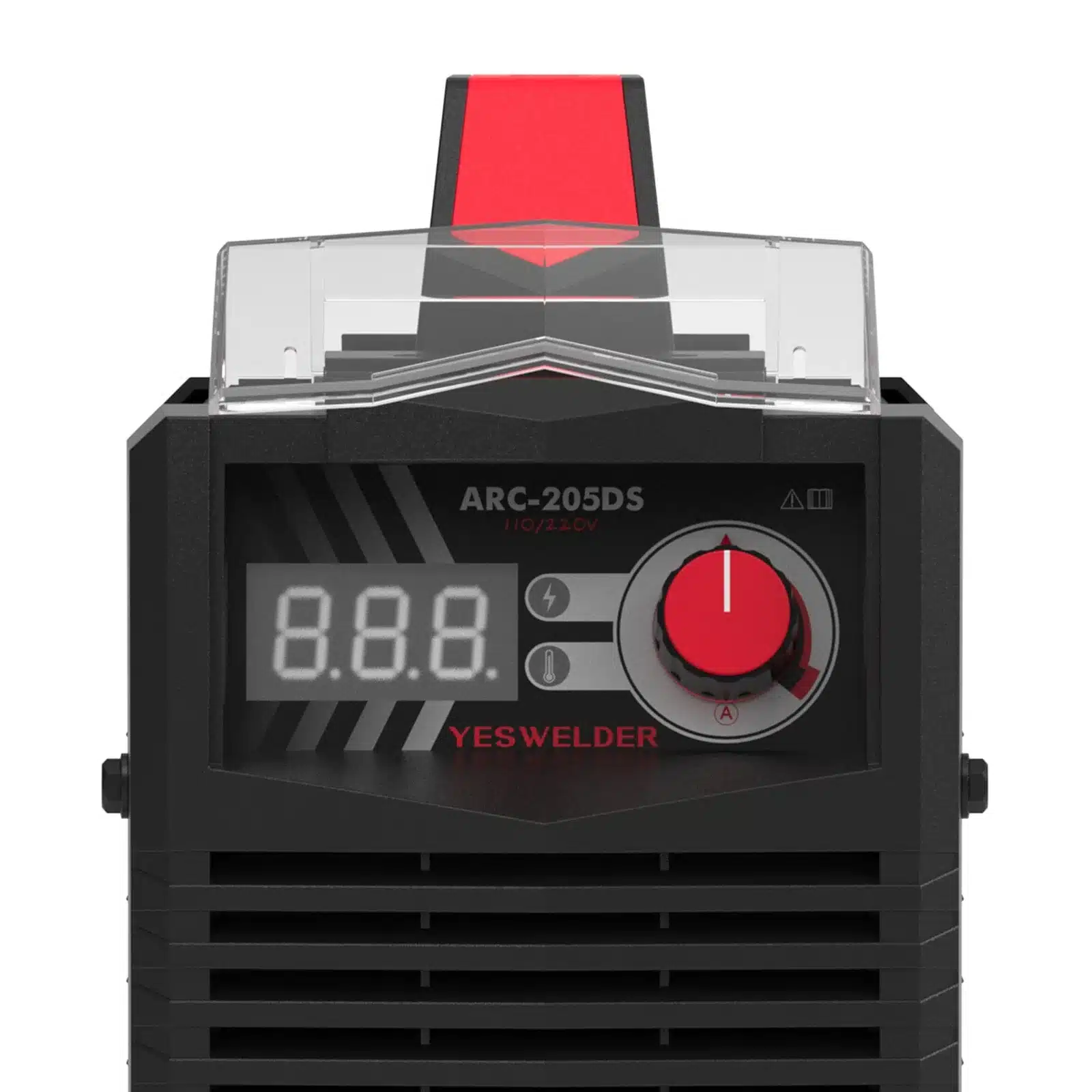
After the package and the numbers, here is how the ARC-205DS PRO behaves where it matters. The controls are simple: a mode button switches between stick and lift TIG, a parameter button steps through amperage, arc force, and hot start, the value knob sets each one, and a separate VRD button toggles the voltage reduction device in stick mode.
The digital display sits in the middle of the panel; the IGBT inverter technology behind it is what keeps the machine this compact. It shows the value you are adjusting, so there is no guessing whether the knob landed on 90A or 110A, and the same display doubles as the fault indicator when a protection circuit trips. That is the whole control layout.
There are no menus and no hidden second functions, which is what you want with gloves on and a fresh rod in the holder. If you are new to electrodes, the basics of rod selection and arc striking are covered in our stick welding guide.
At $138 for the bare welder, the ARC-205DS PRO undercuts most 200A-class stick machines by a wide margin. The core argument of the original review still holds in 2026: you will struggle to find another new 205A dual-voltage machine with this build quality at this price. Machines in this bracket usually make you choose: either you get a 140A-class compact that runs from any outlet but tops out on thick stock, or you get a 200A machine tied to a 220V socket.
The ARC-205 model series is popular among DIYers and hobbyists precisely because it refuses that choice, and it fits hobbyist and light professional applications equally well. Inverter technology keeps the power output of a shop machine in a case one person carries, and the same inverter technology is why the duty ladder does not collapse on household power. This one hands you both plugs in the same box. A new welder that lands under one hundred and forty dollars with this power output is rare at any weight; the light weight is the bonus that makes it a van machine.
The Price
YesWelder also sells bundles if you want more in the box. The welder-plus-helmet bundle costs $177 and adds the LYG-L600A auto-darkening helmet, and the combo bundle at $213.60 adds the WP-17V lift TIG torch plus a pair of heat-resistant welding gloves. Buying the torch separately costs about the same difference, so the bundle only makes sense if you plan to try lift TIG anyway. If you would rather split the payment, the store offers Klarna at four payments of $34.50, though a single charge is simpler at this price.
Running costs stay low after the purchase. Stick welding needs no shielding gas, no bottle rental, and no regulator; your only consumables are rods, and this machine burns the most widely stocked classes there are, E6011, E6013, and E7018.
Rod consumption is slow at home-shop volumes, so a single sealed box of 1/8 in. 7018 outlasts most garage projects. If you later add the TIG torch, budget for a small argon cylinder and a regulator, because lift TIG on this machine runs pure argon only.
Owner feedback backs the value argument. The YesWelder store page showed 4.8 out of 5 stars across 96 reviews at the time of writing, with 80 five-star and 15 four-star ratings, a single three-star, and no one-star or two-star reviews at all. The pattern in the written reviews is consistent: people bought it as a light second machine and ended up reaching for it first. One field welder called this little machine stout enough for field work yet light enough to carry with one hand, and a crane technician wrote that he uses it to avoid dragging leads from the main welder across a job site.
Warranty cover rounds out the value case: two years against defects in materials and workmanship, with CE, ETL, and UL certification behind the electronics. At this price, that is the difference between a disposable tool and a machine you plan around.
One more price fact worth knowing: the bundles tell you the real spread. The full helmet bundle at $248.70 includes the torch and gloves as well, and YesWelder runs anniversary and seasonal discounts on top of the list prices, so the bare welder is cheapest during those windows. The helmet bundle saves money over buying the two items separately, and the combo bundle only pays if the torch is on your list anyway. The machine itself is the same across every bundle; only the box contents change.
Rod pairing is where the power becomes useful. E6011 digs through rust, paint, and dirty joints, which is why farm and fence repair people keep it loaded. E6013 starts easy, runs smooth on mild steel sheet, and forgives a beginner’s arc length. E7018 lays the clean, strong beads you want on structural work, but it absorbs moisture from the air, so keep the tin sealed between sessions and dry the rods if they have sat out. The machine takes electrodes up to 3/32 in. on 110V and 1/8 in. on 220V, which covers the common sizes of all three classes.
The old review’s claim that it “easily welds 1/4 inch steel and even more with multi-pass welds” checks out against the official numbers: stick capacity is rated to 3/16 in. steel at 110V and 3/8 in. at 220V, and multi-pass work pushes past that when the joint is prepared properly. For context, 3/8 in. plate is close to the limit of what a household circuit can feed a welder on in the first place. On thick structural work the steel is rarely the limit; the wall socket usually gives up first.
Which plug should you run? If a 220V circuit is within reach of the work, use it: full range, full duty, no compromise. When the job sits on household power, dual-voltage operation lets the welder run from a standard 110V outlet, and the 145A ceiling still drives 1/8 in. and 5/32 in. rods on everything up to 3/16 in. stock, which covers most repair welding short of heavy structural plate. The adapter means you decide per job, not at purchase.
One thing to watch: the review unit’s plastic front-panel cover protects the controls in transport, but it is not a lock, so keep the machine away from grinding dust all the same.
The Power
On 220V the YesWelder ARC-205DS delivers its full rated output, 205A at 28.2V, with a 60% duty cycle at that rating and 100% duty at 158A. On a regular 110V outlet it caps at 145A in stick mode, still with a 60% duty cycle at that output and 100% at 112A.
That is more than the usual 90-140A budget sticks manage on household power. Read the duty rating on a ten-minute clock: 60% means six minutes of arc-on time, then four minutes of cooling.
In practice the limit rarely matters for the work this machine is bought for, because repair welding is tack, stitch, reposition. If you ever do hit the thermal limit, the indicator lights up and the output stops until the machine cools; nothing is damaged, the pause is the protection working as designed.
The fan runs whenever the machine is on and clears the case quickly once you stop welding.
The old review’s claim that it “easily welds 1/4 inch steel and even more with multi-pass welds” checks out against the official numbers: stick capacity is rated to 3/16 in. steel at 110V and 3/8 in. at 220V. It burns E6011, E6013, and E7018 rods up to 1/8 in. diameter on 220V.
Ease of Use, Build Quality, and TIG Welding
Setup is simple: plug in the machine, connect the 10 ft electrode holder cable, attach the ground clamp to the work, pick your rod, and dial the amps. Adjustable hot start and arc force (both 0-10) make arc starts easy even for beginners and keep the arc stable, which matters most for beginners still learning rod control.
It helps to understand what those two settings actually do, because the manual assumes you already know. Hot start briefly boosts the current at ignition, so the rod lights instead of electrode sticking when you scratch it across the steel.

Set it high for E7018 on cold or thick metal, lower when you are running thin stock and worried about burn-through. Arc force reacts while you weld: when the arc shortens and the rod nearly touches the puddle, the machine pushes extra current to keep the arc alive instead of letting it snuff. Beginners benefit twice, first because fewer rods stick, and second because a stable arc makes it much easier to see what the puddle is doing.
Both controls are set with the same knob through the parameter button, and the display shows the number you are on. There is no synergy-style automatic mode, and none is needed at this price.
The machine also compensates for input voltage fluctuation automatically and shuts down on overcurrent, overload, and overheating. At 8.4 lb in a 11.6 x 5.3 x 7.7 in. case with a carrying handle, it is a one-hand carry to the job, and the IP21S rating means it tolerates shop dust but not rain.
Protection behavior is worth knowing before it happens. The undervoltage guard drops the output when the supply sags, which protects the inverter and keeps the arc from turning mushy on a long extension cord. The overcurrent and overload circuits cut the output if something goes wrong inside or the load spikes. The overheat circuit is the one you will actually meet.
It is duty-cycle enforcement, and the fix is four minutes of patience while the fan runs. In every case the display doubles as the fault code reader, so you are not decoding blink patterns. The VRD button deserves a sentence of its own. VRD stands for voltage reduction device: in stick mode it drops the open-circuit voltage from roughly 65V to a safer level while you are between rods, which matters if you work in damp conditions or sweat-soaked gloves. It trades a slightly softer restrike for safety margin, and on a machine this light that is a trade many field welders accept knowingly. In lift TIG mode the VRD turns off, because the lift-start process needs the full open-circuit voltage to strike.
Lift TIG sits behind the same panel, and it is DC TIG only, so TIG welding still requires the torch and gas hardware bought separately. Switch the mode button and the machine becomes a DC TIG power source for steel and stainless, driving an optional WP-17V-35 torch on pure argon. Steel TIG work is where it does its best precision work, and among TIG welders at this price it is one of the few that includes the function at all.
There is no high-frequency start and no foot pedal, so you touch the tungsten to the metal, tilt, and lift to strike. It is the honest version of TIG at this price. No welding aluminum, no pulse schedules, no AC balance. For tacking up stainless trim or running thin sheet repairs it is a useful second process, and the 2.4 mm tungstens it takes (WT20, WC20, WL20, WL15 classes) are cheap and stocked everywhere. Filler wires ER70S-6 for steel and ER308L for stainless pair with it.
The machine also compensates for input voltage fluctuation automatically and shuts down on overcurrent, overload, and overheating. At 8.4 lb in a 11.6 x 5.3 x 7.7 in. case with a carrying handle, it is a one-hand carry to the job site, and the IP21S rating means it tolerates shop dust but not rain.
Frequently Asked Questions
Can the YesWelder ARC-205DS PRO weld aluminum?
No. The machine welds steel with stick electrodes and steel or stainless steel with lift TIG. Aluminum is not listed as a weldable material in the official specifications, and the DC-only output offers no AC balance for aluminum anyway. Aluminum needs an AC TIG machine or a MIG setup with a spool gun, not a flux core or stick process. If aluminum is regular work for you, this is the wrong machine, whatever the price.
What is the duty cycle of the ARC-205DS PRO?
The rated output is 205A at a 60% duty cycle on 220V. On 110V the machine delivers up to 145A at 60% duty, and it runs at 100% duty at 112A on 110V or 158A on 220V. The rating works on a ten-minute cycle, so 60% means six minutes of arc-on time followed by cooling. If the thermal protection trips, the indicator lights up and the output stops until the machine cools; nothing is damaged and no reset is needed. Our stick welding rod chart helps you match amperage to each rod size.
Does it come with a TIG torch?
No, the box includes the stick leads only. Lift TIG works with the optional WP-17V-35 torch, which is not included; the machine offers DC TIG via lift start only, with no high-frequency start and no AC output. It uses 100% argon, and there is no foot pedal support, so amperage is set on the panel before you strike. Adding the torch later is a five-minute swap: the torch plugs into the negative output, and TIG also requires a separate gas regulator and hose for the argon supply.
Can I run it on a generator?
YesWelder does not recommend generator use, and dirty power from a small generator is a common way to kill inverter welders. If you have no other option, the manual requires at least a 10 kW (15 HP) 120/240V generator with AVR, and the machine still compensates for input fluctuation within those limits. One owner in the store reviews reports finishing an on-site project from a generator with this machine, which matches the manual’s floor rather than contradicting it.
Conclusion
The original review called this machine a pearl among a thousand oysters, and two years later the description still fits. For $138 you get a 205A dual-voltage stick welder that weighs 8.4 lb, starts rods reliably, and carries a 2-year warranty with CE, ETL, and UL certification. The limits are honest ones: no TIG torch in the box, no foot pedal, no aluminum, no wire feeding, and caution around small generators.
Who should buy it is now easy to answer. If you weld steel at home, on a farm, or on site, and your work is basic repairs, light fabrication, mobile work, and maintenance rather than production, this machine covers the whole job list for less than the tax on a shop-grade engine drive. Beginners get hot start and arc force that hide the two classic early mistakes, and a panel that explains itself. Experienced welders get a light, portable 3.8 kg backup whose power output earns its van space ahead of any 200A little machine with a chord.
Who should look elsewhere: production shops running long beads at high amps, anyone welding aluminum, and anyone who wants foot-pedal TIG. If your typical job is thin car-body sheet, a small flux core or MIG machine serves that work better than any stick welder, and flux core wire is the cheaper route when appearance does not matter. Those needs cost real money to satisfy, and pretending a $138 stick welder covers them is how bad purchases happen.
That is the long version of what this yeswelder arc 205 review set out to check. If you want one machine that covers steel repair work at home and on site without draining your wallet, the ARC-205DS PRO is still the best stick welder for the money we know at this price.






