
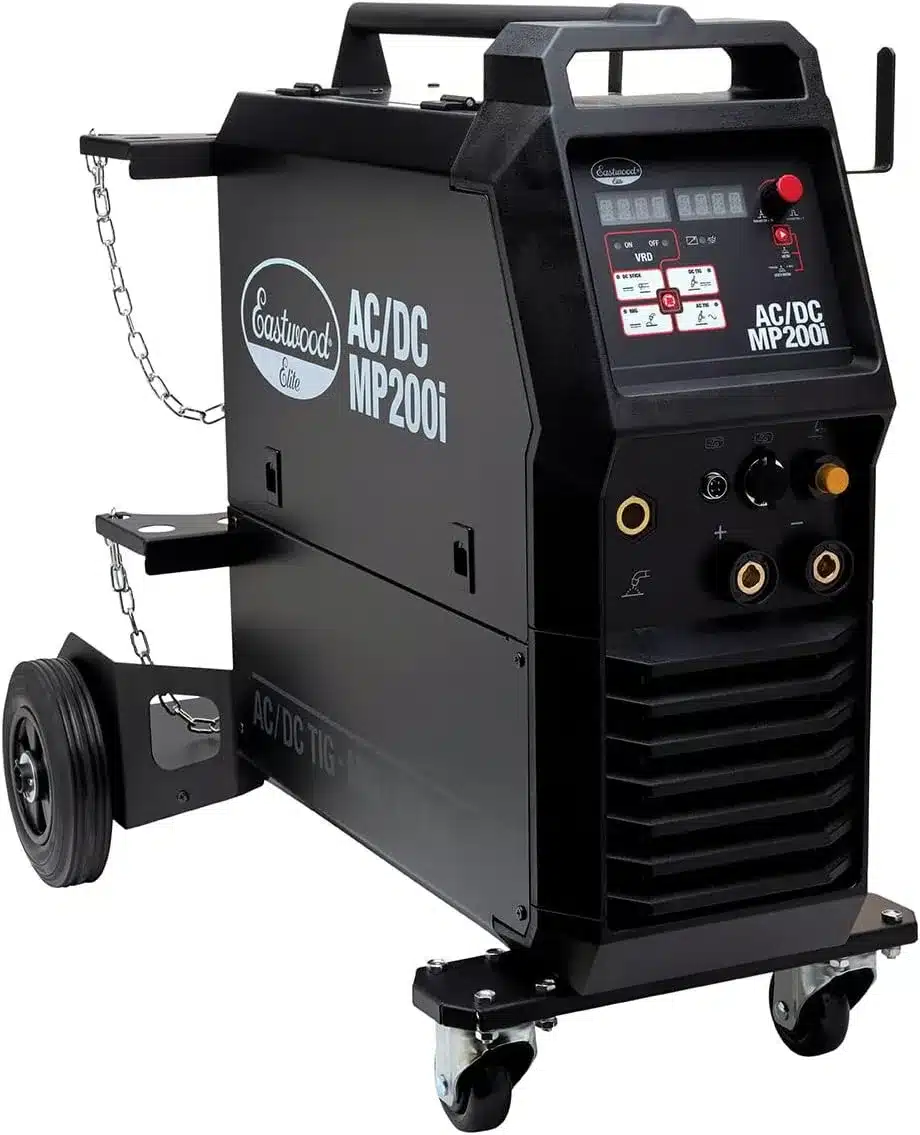
The Eastwood Elite MP200i AC/DC is the machine Eastwood built for people who kept asking why multi-process welders always treat TIG as an afterthought.
Most of them are MIG units with a scratch-start torch bolted on. This one starts with the TIG side: high-frequency start, a rocker-style foot pedal on a 16-foot cable, and a true AC output, so aluminum is on the menu instead of a workaround. It runs MIG, flux core, TIG, and stick from one chassis, and its dual voltage input swings between 120V and 240V outlets. The whole station rolls around the shop on its own cart with two gas bottles strapped in.
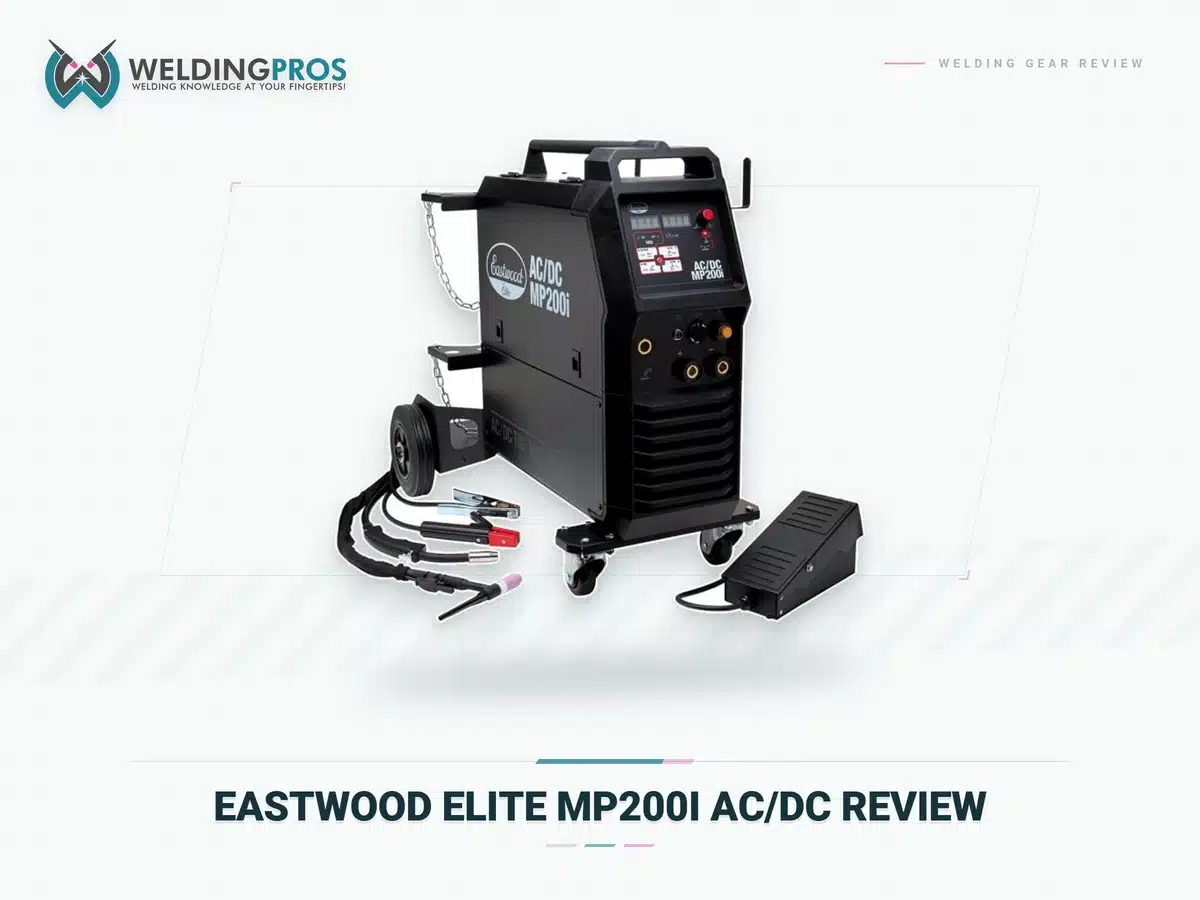
We spent time with the machine to see whether the do-it-all pitch survives contact with real work. The short version: steel, stainless, and aluminum are all weldable with the included torches, the duty cycles are strong for this class, and the package arrives with nearly everything you need. The trade-offs are weight, price, and amperage floors that will matter to thin-metal welders.
In this Eastwood Elite MP200i review, we cover the details, good and bad.
Eastwood Elite MP200i Review: AC/DC Welder Package Content & Technical Specifications
When investing in the Eastwood Elite MP200i AC/DC, your money gets you a complete welding station rather than a bare power supply, including:
True AC/DC Multi-Process Welder With High Frequency TIG Start
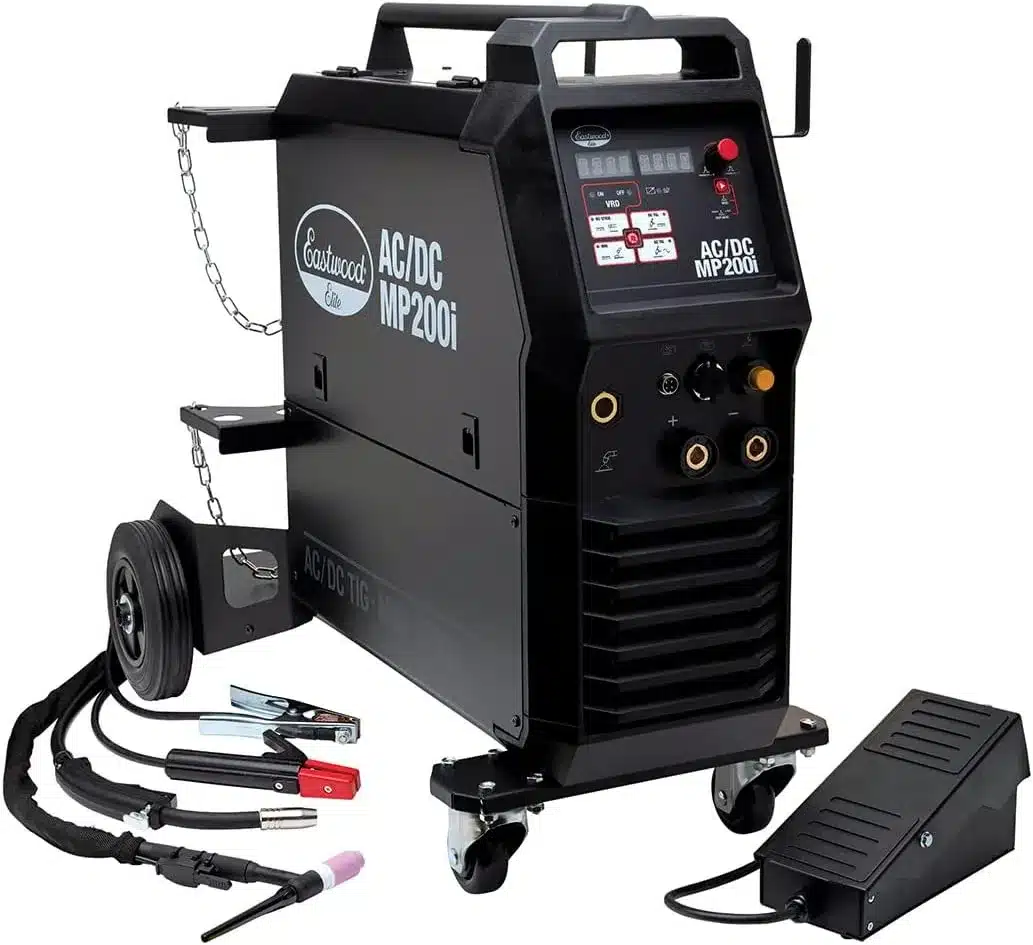
- Eastwood Elite 200 Amp AC/DC Multi-Process Welder
- WP-17F flex-head TIG torch with 12-ft. cable and gas lens kit
- Tweco-style MIG gun with 8-ft. cable and 0.030-in. tip installed
- Rocker-style TIG foot pedal with 16-ft. cable
- Electrode holder and ground clamp with 10-ft. cable
- Two CO2/Argon gas regulators, hoses, and cylinder chains
- Rolling cart hardware: wheels, casters, and cylinder brackets
Technical Specifications
| Welding processes: | Gas/flux-core MIG, AC/DC TIG, Pulse TIG, stick |
| Input voltage: | 120V or 240V, 50/60 Hz, single phase |
| Output current (240V): | MIG 40–200A, DC TIG 5–200A, AC TIG 10–200A, Stick 20–200A |
| Output current (120V): | MIG 40–120A, DC TIG 5–120A, AC TIG 10–120A, Stick 20–120A |
| Duty cycle (240V): | MIG 40% @ 200A, TIG 50% @ 200A, Stick 40% @ 200A |
| TIG arc start: | High frequency start |
| No-load voltage: | 68V |
| Wire feed speed: | 35–590 in/min; 4 or 8-in. spools up to 11 lb |
| Gas system: | Independent MIG and TIG lines, two 40–125 cu ft bottles |
| Dimensions / weight: | 35.20 × 19.88 × 30.28 in; 95.68 lb (43.4 kg) |
| Plug: | NEMA 6-50P with 24-in. 120V adapter cord |
| Warranty: | 3 years |
Pros
- True AC TIG with high-frequency start, so aluminum is possible without a dedicated machine
- Rocker-style foot pedal with a 16-ft. cable gives precise amperage control
- Independent MIG and TIG gas systems let you switch processes without swapping bottles
- Duty cycles of 40% at 200A MIG and 50% at 200A TIG outperform most 200-amp multi-process rivals
- 3-year warranty and free lifetime tech support from Eastwood
Cons
- At 95.68 lb with its cart, it is not a machine you carry to a job site unassisted
- Full 200A output needs a 240V 50A circuit; the 120V adapter limits you to 120A
- Stick floor of 20A and MIG floor of 40A are high for very thin sheet metal work
- Ships in two boxes and needs basic cart assembly before the first weld
- Optional spool gun required for MIG welding aluminum
Eastwood Elite MP200i AC/DC Multi Process Welder Review: Performance and Features
Unlike budget multi-process machines that ship TIG as an afterthought, the MP200i AC/DC arrives with the full TIG kit in the box: the WP-17F flex-head torch with gas lens, the foot pedal, tungsten, and two regulators. You also get the cart hardware, chains for the bottles, and a MIG gun with a 0.030-in. tip already installed, so the only things you buy separately are gas and wire.
A spec sheet can only tell you so much. The numbers that matter most in practice are the duty cycles, the amperage floors, and how the machine behaves when you switch processes, so that is where we spent our time with it.
Arc Quality and Aluminum TIG Capability
TIG welding is the reason this machine exists. High-frequency start lights the arc without touching tungsten to the work, and the square-wave AC output cleans oxide while you weld, which is what separates an aluminum-capable TIG from a steel-only one. On 240V you get 5 to 200 amps DC and 10 to 200 amps AC, enough range for everything from thin sheet to a heavy fillet. The foot pedal is the rocker style with a long 16-foot cable, so you can sit back from the bench and still fine-tune the heat mid-weld. In our time with the machine, arc starts were consistent and the AC balance kept aluminum beads clean without heavy tungsten erosion.
MIG and stick hold up their end. The wire feeder handles 4 and 8-inch spools up to 11 pounds, and feed speed runs 35 to 590 inches per minute, which spans body-sheet thin to structural work. Stick welding output goes from 20 to 200 amps, so the machine doubles as a serious stick welder for 7018 on 3/8 plate. Flux-core is there for outdoor work when hauling bottles is impractical.
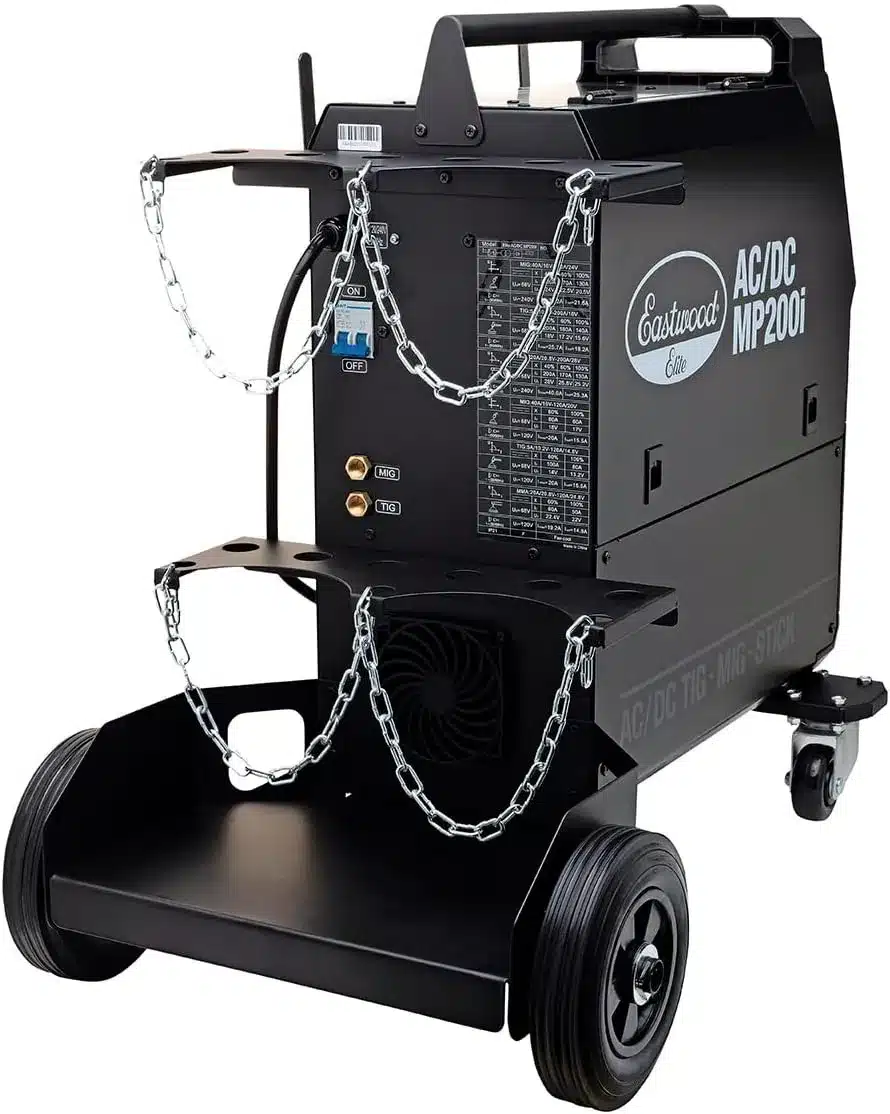
Our one complaint on the numbers: the 20-amp stick floor and 40-amp MIG floor limit how gentle you can be on thin stock, so restoration folks welding patch panels will live at the bottom of the dial.
Build Quality, Cart, and Shop Integration
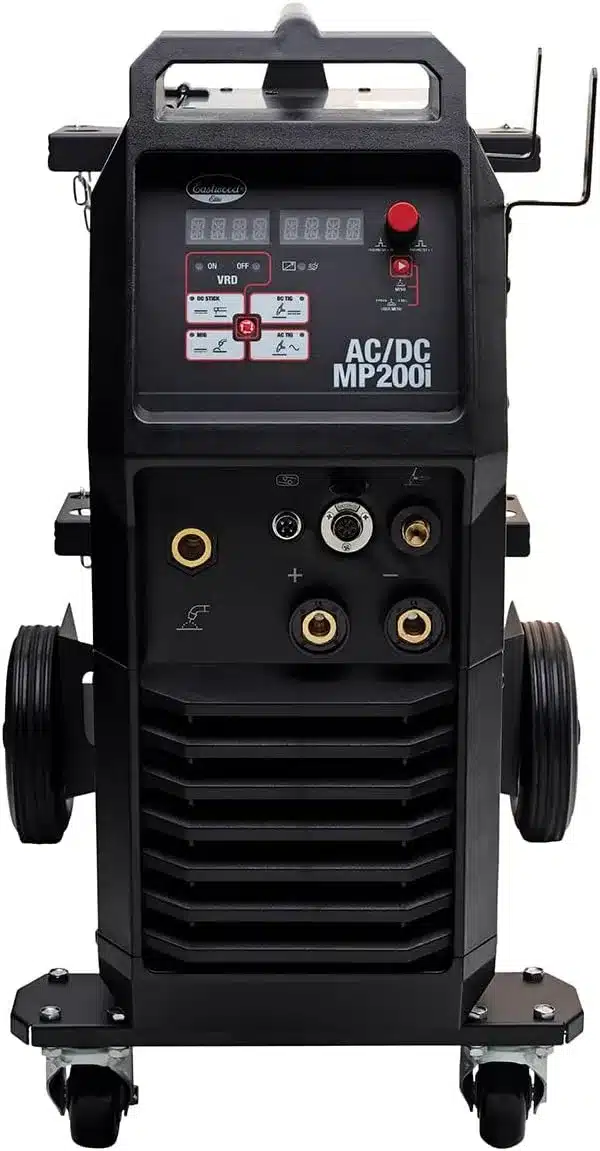
The MP200i AC/DC arrives in two boxes because the second box is the cart. Bolt on the rear wheels, front casters, and the double cylinder bracket, and the welder becomes a rolling station that holds two 40 to 125 cu ft bottles with chains, plus hooks for the torch and ground leads. Assembled weight is 95.68 lb, which sounds heavy until you realize most of that is the cart doing double duty as storage. The IGBT inverter design keeps the power section compact, and a dynamic cooling fan runs only when the machine needs it, so a quiet shop stays quiet between welds. On the TIG side, this TIG welder is especially well suited to aluminum work, and the inverter stays smooth enough to keep a stable arc on thin and mid-thickness metal. The controls are easy to read, and the amperage display helps during setup.
Everything about the layout says the machine expects to be used, not admired. MIG and TIG gas lines are separately plumbed with their own regulators, so switching from MIG steel to TIG aluminum is a torch swap plus a panel selection, not a bottle change. The separate bottles also keep consumables organized around the process you are actually running. On the wire-feed side, plan on multiple passes beyond 3/8 inch stock. The WP-17F TIG torch with its flex head reaches where a rigid cup cannot, and the included gas lens kit is the kind of accessory cheaper machines leave you to buy. The NEMA 6-50P plug is the standard 50-amp welder plug, and the included 24-inch adapter cord opens up standard 120V household outlets at reduced output.
Price, Value, and Who Should Buy It
At around $1,750 at full price, the MP200i AC/DC sits in serious territory for a home shop. The honest comparison is against buying separate machines: a 200-amp MIG, an AC/DC TIG welder with high frequency, and a cart to hold them all would cost well past this price bought individually. There is no other way to get all of it for the same money. What you give up is the ability to run two processes at once and the last word in duty cycle that a dedicated industrial unit delivers. What you get is one footprint, one gas system with separate MIG and TIG lines, one warranty, and aluminum capability that most multi-process machines simply do not have.
For a restoration or fabrication shop that mostly welds steel but hits aluminum a few times a month, this is the machine that removes the buy-a-second-welder conversation. Beginners should budget time to learn TIG fundamentals and the panel, since process selection and AC balance settings are new territory if you have only run a basic MIG machine.
Eastwood backs the machine with a 3-year warranty, 90-day returns, and lifetime tech support, and the company’s product page shows buyer feedback of 4.6 out of 5 across 26 reviews. That softens the entry price if this is your first serious Eastwood welder.
The brand also benefits from strong reviews, especially from shoppers comparing it with Miller or Everlast options for a garage or small shop setup. If your work is strictly thin sheet steel, a lighter and cheaper DC-only machine will serve you just as well for less mone
Frequently Asked Questions [F.A.Q]
Can the Eastwood MP200i AC/DC weld aluminum?
Yes. The AC TIG output with high-frequency start and the square-wave arc is designed for aluminum, and Eastwood rates TIG welding of steel, stainless, and aluminum up to 1/4-in. thick. To MIG weld aluminum you need the optional spool gun, since the standard wire path will not feed soft aluminum wire reliably.
What is the difference between MP200i and MP200i AC/DC?
They are different machines. The original Elite MP200i is DC-only for TIG, weighs 34 lb, and cannot TIG weld aluminum. The AC/DC version reviewed here weighs 95.68 lb with its cart, adds features the original never had: true AC TIG with high-frequency start, the foot pedal, and independent MIG and TIG gas systems. Eastwood sells both, so check the model name before buying.
Is the MP200i AC/DC dual voltage, and what outlet does it need?
It ships with a NEMA 6-50P plug, the standard 240V 50-amp welder outlet, and full 200-amp output requires that circuit. A 24-in. adapter cord is included for standard 120V household outlets, which caps output at 120 amps. Eastwood recommends a dedicated 20-amp 120V circuit when using the adapter.
Is the duty cycle enough for real fabrication work?
On 240V the machine is rated 40% at 200 amps for MIG and stick, and 50% at 200 amps for TIG, which means four to five minutes of arc-on per ten-minute cycle at full power. Backed down to 130 amps MIG or 140 amps TIG, the rating climbs to 100%, so typical fabrication amps run all day without the thermal light.
Conclusion
The Eastwood Elite MP200i AC/DC earns its premium by being the rare multi-process welder that does not compromise the TIG side. High-frequency start, true AC output, a real foot pedal, and a rolling cart with dual gas storage make it a complete one-machine shop for steel, stainless, and aluminum. The weight and the price are the honest costs of that capability. If your projects mix metals and you have the outlet for it, this is one of the strongest all-around packages in Eastwood’s lineup, and an easy recommendation over stacking up separate machines.





