
If you occasionally weld around the garage or farm, a good stick welder is one of the most useful welding tools you can own, and you do not need an expensive welder to do useful work.
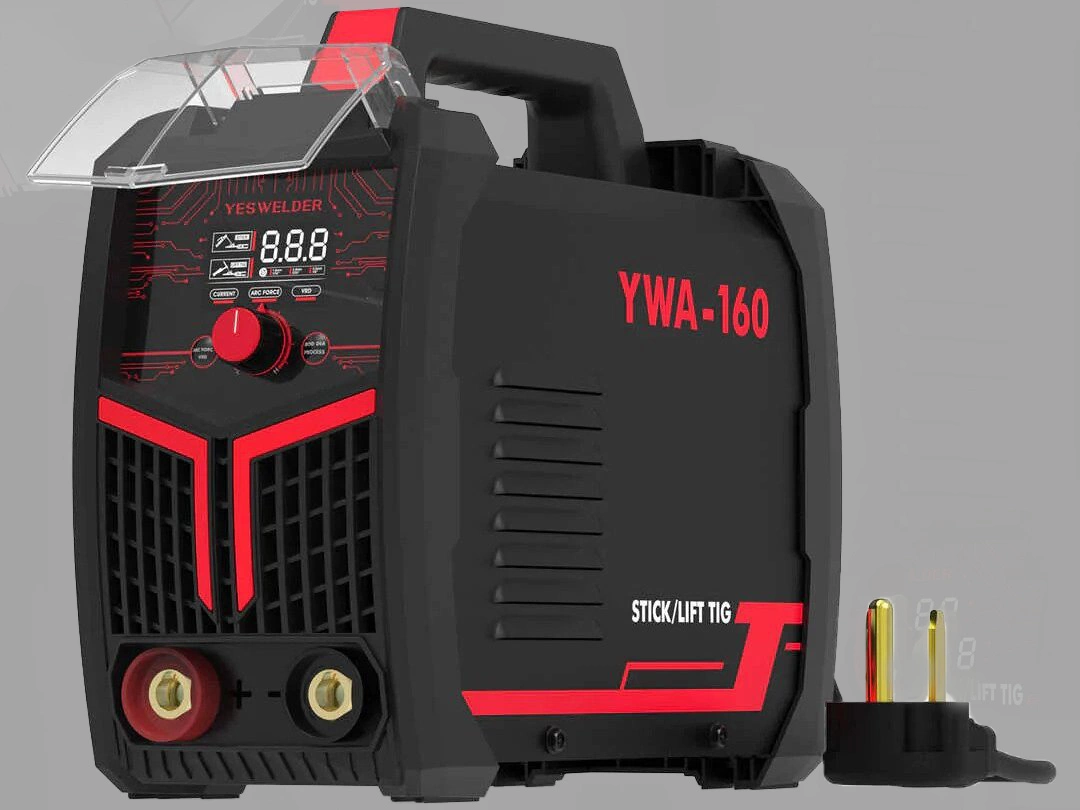
The YesWelder YWA-160 is that kind of welder. It is a 160-amp inverter stick welder with a lift TIG option, dual-voltage input, and a set of arc welding controls you rarely see at this price on a stick and TIG welder.
One thing to know up front: this is an older model that YesWelder no longer sells.
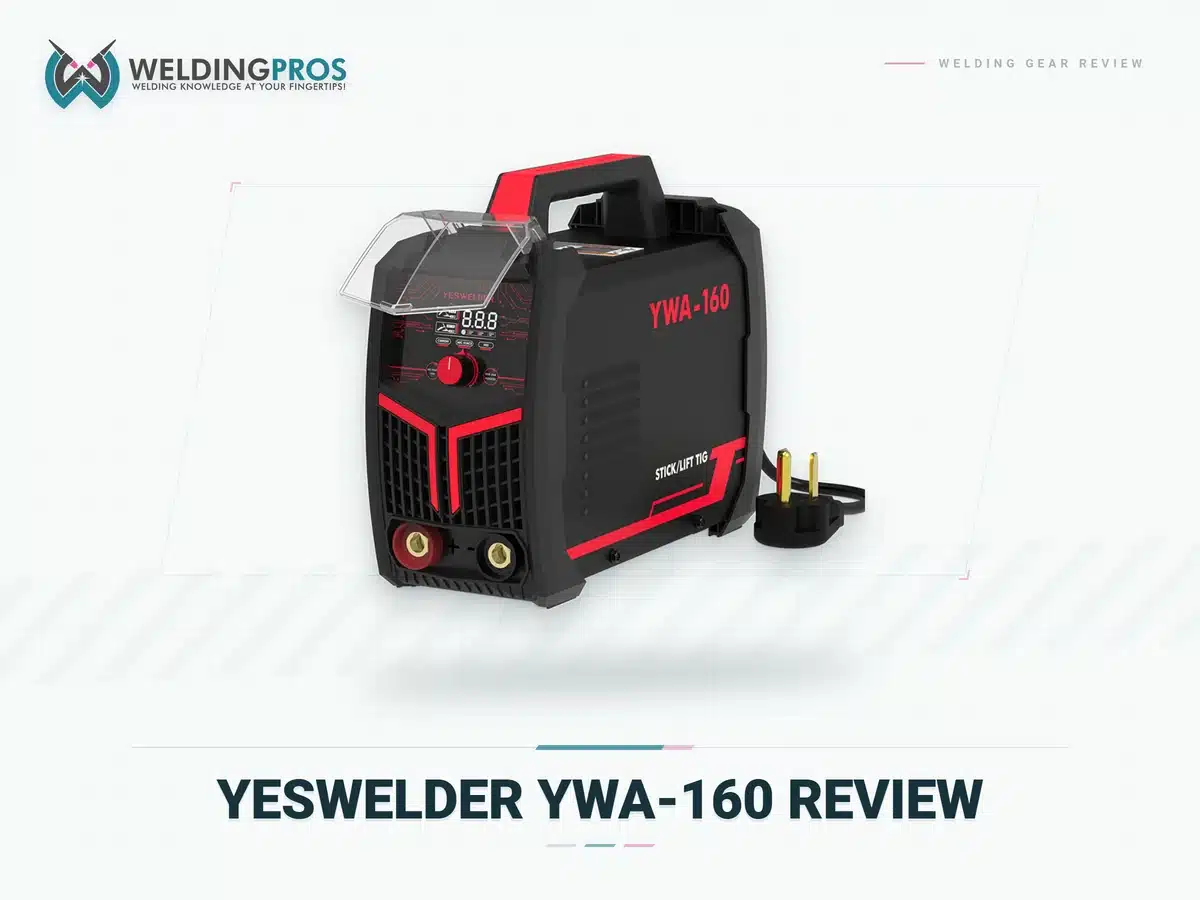
The company has since moved its stick lineup to the ARC-125A, ARC-125DS, and ARC-205A machines. Plenty of YWA-160 units are still welding in home shops today, and if you want one, the second-hand market is where you will find it.
The YWA-160 replaced the ARC-165DS in its day, and it brought a metal case, more amps, and better arc controls than the older blue box. This welding machine review covers what the welder does well, where it falls short, and what to check for if you buy a used unit. YesWelder launched it in 2022 as a step up from the ARC-165DS.
The YWA-160 also marked a design shift for the brand. Earlier machines like the ARC-165DS wore the blue-and-white YesWelder livery, while the YWA-160 introduced the black-and-red look that later carried into the Firstess MP200 and the YWM MIG series. Under the new skin sat the same value formula the brand built its name on: a metal case, a simple control panel, and enough output for real welding work.
A name note before we go further, because the two get confused constantly. The YesWelder YWM-160 is a different machine that is still in the current lineup: a 4-in-1 MIG welder with a wire feed, built to run gas MIG with shielding gas, gasless flux core, lift TIG, and stick. The YWA-160 in this review has no wire feed and no spool at all; it is a pure stick and lift TIG welder. If you landed here while shopping for the MIG welder, our best 110V welder guide covers that class of machine. This review is about the stick welder.
In this YesWelder YWA-160 review, we will discuss its package content, specifications, features, and real-world welding power, so you know exactly what this welding machine is worth on the used market.
YesWelder YWA-160 Package Content & Technical Specifications
The YesWelder YWA-160 arrived in a lean package. In the box you get the welder, a 10-foot electrode holder, a 10-foot work clamp, the 110V and 220V power adapter, and the manual. That is the full list.
The 110V and 220V power adapter deserves a mention of its own. It is the piece that unlocks 220V operation on this welder, it is specific to this machine, and it is not something you can replace at a hardware store. If you are buying a used YWA-160, check that the adapter is in the box before anything else. The manual is the other quiet plus: it covers electrode selection and the panel controls in plain language, which first-time welders appreciate.
The included welding accessories are better than the price suggests. The electrode holder on this welder grips rods positively and shows no flex in normal use, and the work clamp bites through mill scale well enough for stick welding. Ten feet of lead on both sides means you can work around a bench or along a trailer without moving the machine every few minutes.
Budget-Friendly Dual-Voltage Stick Welder With Lift TIG And Arc Controls
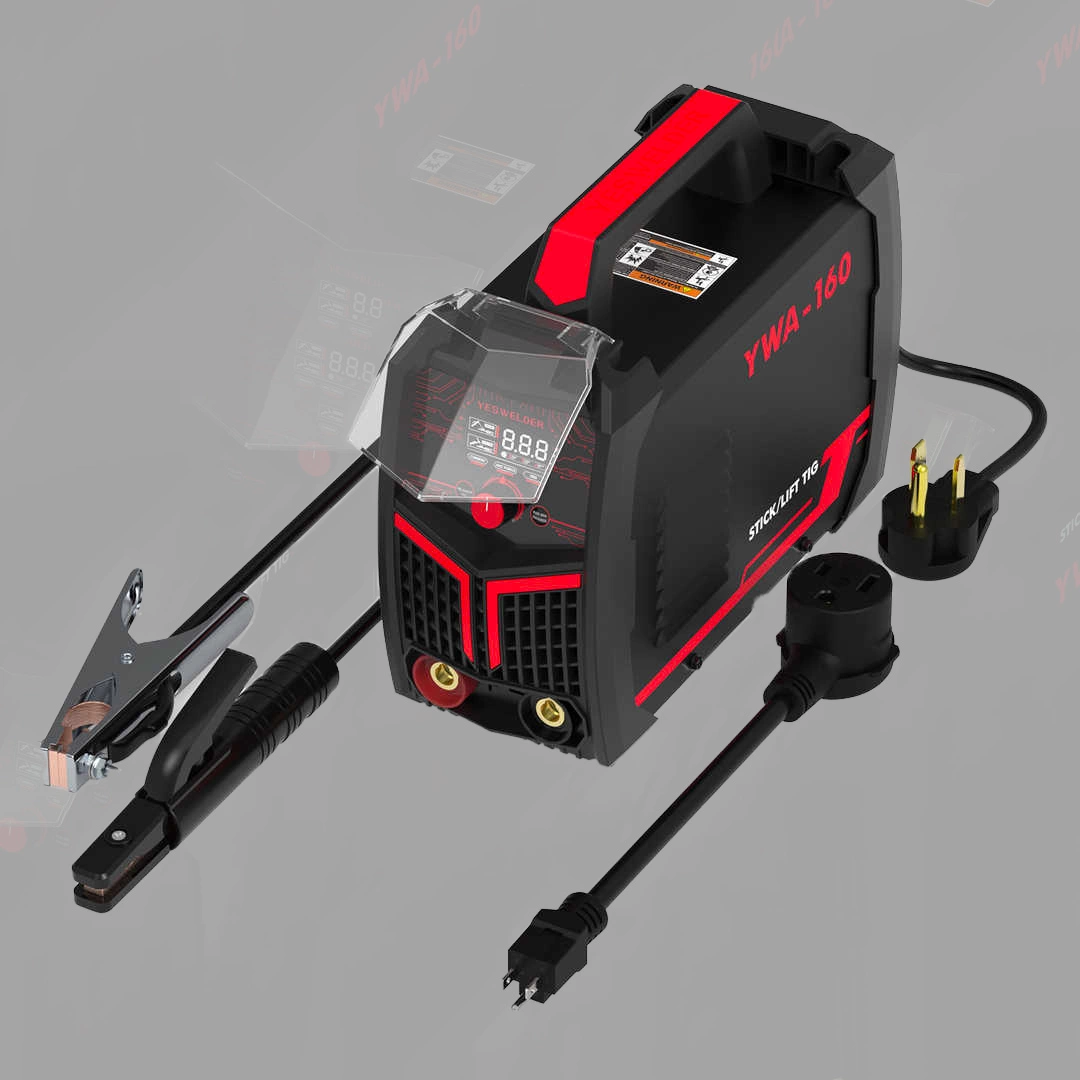
- YWA-160 Welding Machine
- 10 ft Electrode Holder
- 10 ft Work Clamp
- 110V & 220V Power Adapter
- User Manual
Technical Specifications
| Welding Process: | Stick (SMAW) / Lift TIG |
| Input Voltage: | 110V & 220V (Dual Voltage), 50/60 Hz |
| Input Current: | 30A at 110V / 23A at 220V |
| Rated Output: | 26.2V |
| Output Current: | Stick 20-160A, TIG 15-160A @ 220V; Stick 20-120A, TIG 15-120A @ 110V |
| Rated Duty Cycle: | 60% at 160A, 100% at 124A @ 220V; 60% at 120A, 100% at 93A @ 110V |
| Efficiency: | 85% |
| Power Factor: | 0.93 |
| Insulation Grade: | H |
| Operating Temperature: | -10 to +40°C (14 to 104°F) |
| Dimension: | 15.6″ × 7.7″ × 13″ |
| Net Weight: | 15 lbs. |
Pros
- 160A output with 60% duty cycle at full power, 100% at 124A
- Dual voltage 110V/220V with included adapter
- Adjustable arc force runs 6010, 6011, and 7018 electrodes
- Digital display with automatic electrode-diameter current setting
- 15 lb metal housing is portable and durable
Cons
- Discontinued; no longer sold on yeswelder.com
- No TIG torch included for the lift TIG mode
- VRD can make arc starting harder until tuned
- Only 1-year warranty when it was sold new
- Second-hand market is the only purchase route
YesWelder YWA-160 Review: Build, Power, And Features
There is no TIG torch included, which is normal for stick-first machines, so plan on buying a TIG torch separately if you want to try lift TIG welding. One more note before the details: the YWA-160 predates the current YesWelder stick lineup, so parts support for the welder runs through YesWelder support rather than a live product page.
Lift TIG welding on a stick machine is best treated as a free bonus rather than a second process. With a separately purchased torch you can lay clean beads on steel and stainless across the 15-to-160-amp TIG range, which covers exhaust work, thin repair panels, and practice welding hours. What you cannot do is weld aluminum, because that needs AC output the YWA-160 does not have.
YesWelder simplified the package compared with the ARC-165DS, which shipped with a basic mask, chipping hammer, and brush. Most owners threw those extras away, so the leaner YWA-160 box is honest rather than cheap: you get exactly what you need to start welding projects and nothing you will replace in week one.
Input Power And IGBT Inverter Technology
The YWA-160 welder runs on IGBT inverter technology and accepts dual voltage input: 110V or 220V. On a regular household 110V outlet it draws 30 amps and outputs up to 120 amps, which is enough for 1/8-inch steel and light welding work.
Connected to 220V through the included adapter, it draws 23 amps and reaches its full 160-amp output.
Welding efficiency is rated at 85 percent with a 0.93 power factor, which is solid for a compact inverter welder and helps on long extension cords.
The classic weakness of inverters this size is burning 6010 rods, but YesWelder states the YWA-160 handles 6010, 6011, and 7018 electrodes, and the adjustable stick welding arc force is what makes that possible.
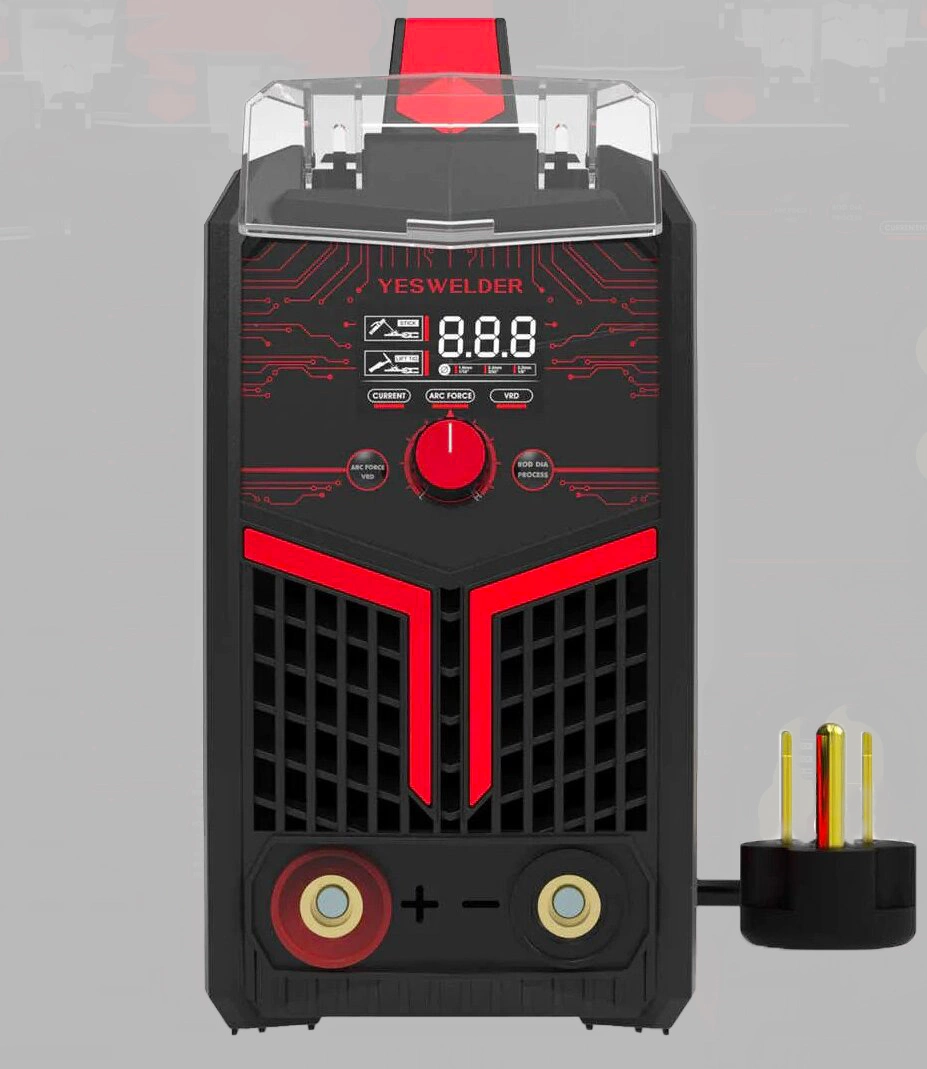
That 30-amp input figure at 110V matters in practice for hobbyists. On a standard 15 or 20-amp household circuit the machine runs happily at low and middle settings, but pushing toward its 120-amp ceiling on 110V can trip the breaker during longer welding runs. Most owners who test both inputs settle into the same routine: light jobs on household power, thick stock on a 220V circuit, where the welder draws less input current while delivering 40 more amps.
Control Panel And Arc Settings
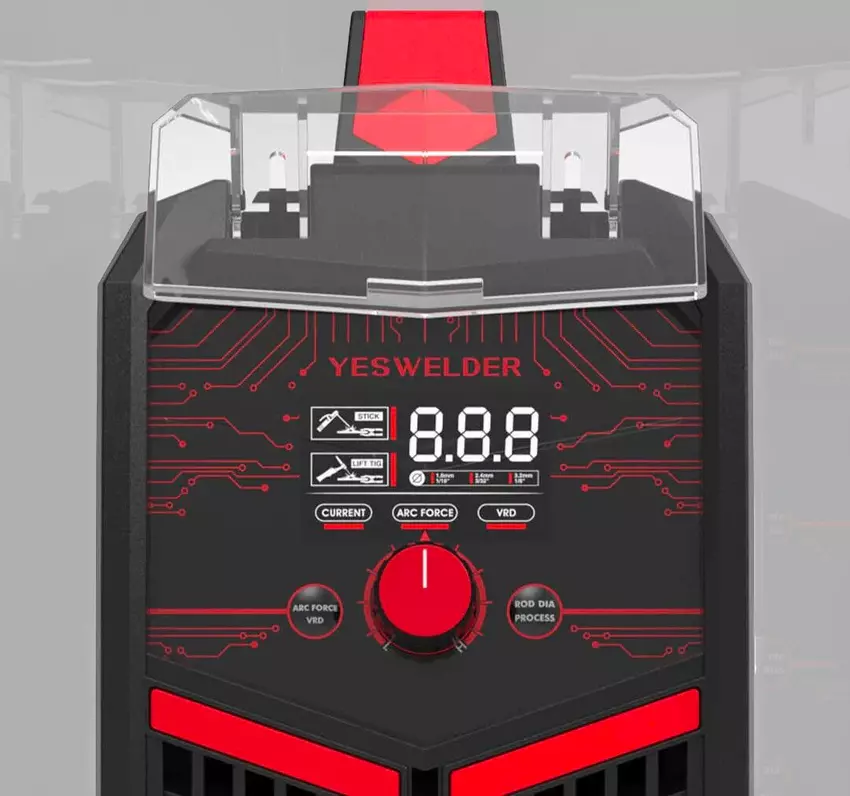
The front panel keeps things simple: a digital display that shows your set current, one knob, and two buttons. One button acts as synergic rod control for easy adjustments: pick the electrode diameter and the welding machine applies the recommended current automatically.
That is a useful crutch while you are still learning amperage settings, and manual adjustment stays available for pros and hobbyists alike.
Beyond the auto settings, you get three adjustable features: arc force, hot start, and VRD. Arc force bumps up the amperage when the voltage drops, which keeps the arc stable and smooth and prevents the electrode from sticking; owners report the setting works on a 1-to-10 scale.
Hot start adds current at ignition for reliable strikes, and the VRD lowers the open-circuit voltage for safer work in damp conditions, at a small cost to arc starting.
The three controls interact, and understanding that is most of the learning curve. Arc force set too high for the rod can make the electrode stick instead of burning cleaner, and a hot start that is too aggressive on thin material will blow through edges. Start from the smart setting for your electrode diameter, then adjust one control at a time until the arc performance sounds right. That setup sequence is the fastest way to find the sweet spot on this panel.
Stick Welding Power And Duty Cycle
This is a DC welder rated at 160 amps on 220V and 120 amps on 110V. On household power the welder handles steel up to 1/8-inch; on 220V the YWA-160 will handle 5/32-inch electrodes and steel to match. The lift TIG mode, used with a separately purchased torch, covers thin material and repair welding.
Thin stock is the other place this machine surprises. One first-time welder patched a go-kart muffler with 1/16-inch 6011 rods at around 35 amps; at 70 amps the arc blew through the thin pipe almost instantly, and dialing the current back fixed it.
That is normal stick-welding physics, but the 20-amp floor and stable low-end arc of the YWA-160 make the low range usable for thin material.
The duty cycle is the standout number: 60 percent at the full 160 amps, and a full 100 percent at 124 amps on 220V. Many name-brand stick welders only offer 20 to 30 percent at maximum output, so this welder can run all day in the middle of its amperage range. One owner’s test logged ten consecutive 3/32-inch 7018 rods on a 110V outlet at 86 amps without a hiccup.
Durability reports are the strongest part of the ownership record. A maintenance technician at an industrial food processing plant describes a unit that has been dropped, soaked, frozen, and run for long hours on 6011 and 7018 without a failure. One owner is not a survey, but the pattern repeats across the small review pool: this welder was built to survive shop life, not just to survive the warranty period.
Portable enough for job site use, it rounds out the case for a used one. At 15 pounds with a molded handle, the machine moves to the job instead of the job moving to it: fence repairs, trailer work, DIY projects, or a friend’s bench across town. The four extra pounds over the ARC-165DS bought a metal housing that shrugs off being stowed under a bench or riding in a truck bed tool box between jobs. None of that changes when the machine changes hands, which is why used examples still sell quickly.
Frequently Asked Questions [F.A.Q]
Is the YesWelder YWA-160 still made?
No. The YWA-160 is an older model that YesWelder no longer sells or lists on its site. The current stick lineup is the ARC-125A, ARC-125DS, and ARC-205A. YWA-160 units do show up on the second-hand market, and customer reviews report the machines hold up well over time. eBay and Facebook Marketplace are the usual sources for used units, and prices there sit well below the $139.99 the machine carried in its final months on the store.
Can the YWA-160 weld aluminum?
No. This is a DC stick and lift TIG welder, and aluminum requires an AC TIG welder rather than a DC machine. The lift TIG mode works on steel and stainless steel with a separately purchased torch, but there is no AC output for aluminum. Aluminum stick rods do exist, but they demand careful technique and a machine that holds steady current, and on a compact DC inverter the results are discouraging enough that we would not steer you there.
What electrodes can I run with it?
The manufacturer lists 6010, 6011, and 7018 electrodes, and the smart setting behind the electrode-diameter button applies the recommended current automatically. The adjustable arc force is what lets the inverter run 6010s, which many small welding inverters struggle with in testing. Use quality rods and fine-tune the arc force before judging the arc. As a starting point, the typical range is 70 to 100 amps for a 3/32-inch rod and 110 or more for 1/8-inch, depending on material thickness; the electrode-size button already lands in that window.
Is 15 pounds too light for a 160-amp stick welder?
Not for an inverter welder. The YWA-160 weighs 15 pounds net, which is about four pounds heavier than the ARC-165DS it replaced, and the case is metal rather than plastic, which customer reports back up. For DIY projects around the garage the weight is an advantage, since you can carry the welder to the job instead of dragging leads around.
Conclusion
The YesWelder YWA-160 was one of the better value stick welders of its generation, and used units remain a sound buy if the price is right. You get 160 amps of DC power from a compact welder, a strong duty cycle, dual-voltage input, and arc features that work. Remember that the model is discontinued: it is no longer sold on yeswelder.com, parts and support go through YesWelder directly, and your purchase route is the second-hand market. If you would rather buy new, our best 110V welder guide covers current machines in this class, and our stick welding guide covers the technique side.
At $139.99 in its final months on the store, the YWA-160 undercut most name-brand machines with similar output by half or more. Brand-name stick inverters such as the ESAB Rogue line, the Hobart Stickmate series, or the Lincoln Invertec cost two to four times as much, and that premium buys longer warranties and a service network. If there was a deal breaker when the welder was new, the one-year warranty was it. A Miller Maxstar or Lincoln Invertec stick welder in this output class weighs about the same, costs several times more, and backs it with longer coverage.
If you are shopping the second-hand market for one, check four things before paying: that the dual-voltage adapter is included, that both leads are supple rather than cracked, that the manual is included, the display shows a live output figure on strike, and that the seller lets you test-weld a few rods before money changes hands. A ten-minute test with 7018 tells you more about the welder than any listing photo can.






